Bio Shop
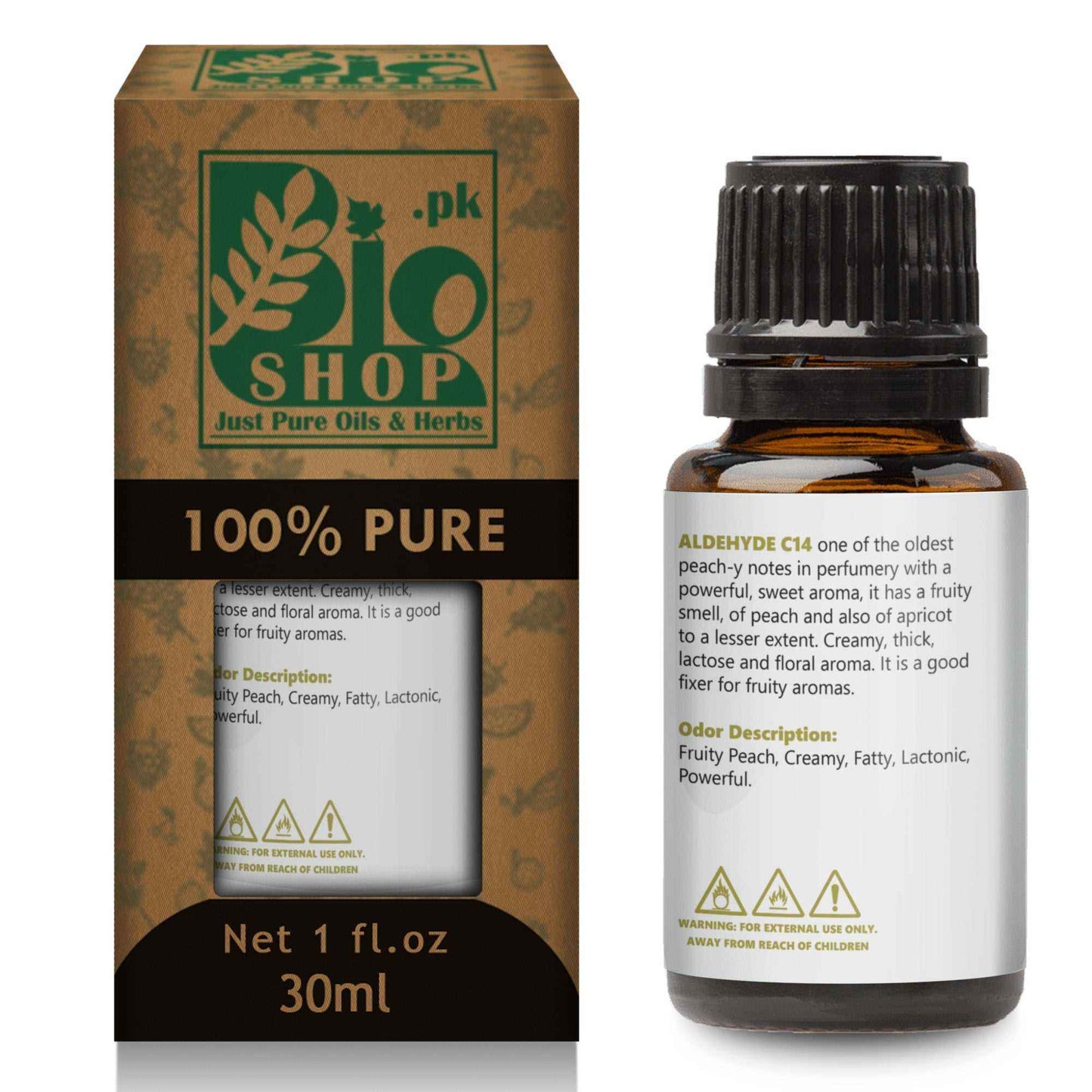
Aldehyde C14
Aldehyde C14
Olfactory Notes: The classic "Peach" note; velvety and fruity.
Couldn't load pickup availability

Explore
Information About Aldehyde C14
Key Features
✦ Gamma-Undecalactone (Aldehyde C14) — a synthetic lactone delivering an intensely creamy, ripe peach aroma with exceptional smooth character
✦ Despite its trade name, it is a lactone not a true aldehyde — offering better stability, less volatility, and easier handling than classical aldehydes
✦ Extremely potent at very low concentrations — effective at 0.05% to 1.0% across most applications
✦ Core building block for peach accords, fruity florals, chypres, and warm oriental attar blends
✦ Found in the DNA of iconic compositions including Mitsouko (Guerlain) and countless fruity oriental fragrances
✦ IFRA 51st Amendment compliant when used within published category limits — suitable for leave-on and rinse-off applications
✦ Vegan, animal-free synthetic ingredient — no natural peach extraction required
About Aldehyde C14
Aldehyde C14, formally known as gamma-Undecalactone, has been a cornerstone of perfumery since the early twentieth century. First synthesized in the early 1900s, it rapidly became the defining material for realistic peach facets in fine fragrance — long before modern fruity musks and macro-cyclic lactones arrived. Its adoption in Guerlain's Mitsouko in 1919 cemented its legendary status, and generations of master perfumers have reached for it when building warm, ripe, skin-close fruit effects in chypres, orientals, and fruity florals alike.
What makes Aldehyde C14 exceptional is a combination of intensity and naturalness that is difficult to replicate with other materials. Its odor threshold sits in the single-digit parts-per-billion range, meaning a fraction of a percent transforms an entire composition. The lactone ring structure gives it a roundness and creaminess — closer to the smell of peach skin and peach flesh simultaneously — rather than the sharp, artificial character of cheaper peach aromatic compounds. It blends seamlessly into skin-like musks, powdery bases, and rose-peach combinations, giving compositions a living, sensual warmth.
Bio Shop Pakistan supplies cosmetic-grade Aldehyde C14 (gamma-Undecalactone) suitable for DIY perfumers, attar blenders, soap and candle makers, and professional cosmetic formulators across Pakistan who demand high-purity, reliable fragrance ingredients for creative and commercial production.
Olfactory Profile
SCENT DESCRIPTION : Aldehyde C14 opens with an intensely ripe, juicy peach character — warm, fleshy, and saturated with the scent of peach skin and peach nectar simultaneously. It carries a deep lactonic creaminess underneath the fruity burst, giving it a smooth, almost buttery roundness that prevents it from reading as synthetic or sharp. At low doses it recedes into a warm, apricot-like skin note that merges seamlessly with musks and woods. At higher doses it pushes into luscious, almost gourmand territory — overripe peach on a summer afternoon.
NOTE POSITION : Mid to Base
FRAGRANCE FAMILY : Fruity · Oriental · Chypre
FACETS : Peach · Apricot · Creamy · Lactonic · Warm
TENACITY : High — 8 to 12 hours on skin, longer on textiles
SILLAGE : Medium to High — close-skin fruity warmth at moderate doses, expanding to noticeable sillage at 0.5% and above
Technical Specifications
Chemical Name : gamma-Undecalactone (γ-Undecalactone)
CAS Number : 104-67-6
Synonyms : Aldehyde C-14 Peach · Peach Aldehyde · Undecalactone · 1,4-Undecalactone · Peach Lactone · gamma-n-Heptyl-gamma-butyrolactone
Purity : 98% minimum (verify with supplier for batch CoA)
Appearance : Colorless to pale straw-yellow clear liquid
Odor Threshold : Approximately 7–10 ppb in water — extremely potent
Solubility : Soluble in alcohol (ethanol, IPM, DPG) and fixed oils · Practically insoluble in water
Specific Gravity : 0.942–0.950 g/cm³ at 20°C
Flash Point : Approximately 93–100°C (199–212°F)
Type : Synthetic lactone aroma chemical
Applications & Usage Guidelines
Fine Fragrance ★★★★★
Aldehyde C14 is one of the most important fruity base materials in fine fragrance history. It anchors peach accords, softens chypre compositions, and adds lactonic warmth to floral orientals. Use at 0.1% to 1.0% in EDP and EDT concentrations for best results.
Attar and Oriental Blending ★★★★★
In attar and oriental fragrance culture, the warm, ripe peach of gamma-Undecalactone is deeply valued. It bridges rose, oud, and musky bases with a fruity creaminess that makes compositions feel lush and opulent. Pairs exceptionally with rose absolute, sandalwood, and ambergris-type materials.
Functional Fragrance ★★★☆☆
Usable in fabric softeners, detergents, and air care products where a soft peach accord is desired. Stability in high-pH detergent bases can be a concern — lactones are susceptible to hydrolysis in strongly alkaline environments, so encapsulation or late-stage addition is recommended.
Cosmetics ★★★★☆
Suitable for body lotions, creams, and leave-on skin care where a skin-close peach warmth is desired. Highly effective at low concentrations. Observe IFRA leave-on limits and conduct patch testing for leave-on rinse-off formulations with sensitive-skin positioning.
Home Fragrance ★★★★☆
Performs well in reed diffusers and wax melts at 0.5% to 2.0%. Candle performance is moderate — high fragrance load may be needed to achieve lift, as the lactone character can be partially consumed by combustion. Blends well with vanilla and coconut materials in home fragrance.
IFRA & Usage Rate
Recommended Usage Rates by Application
EDP (Eau de Parfum) : 0.3% – 1.0%
EDT (Eau de Toilette) : 0.1% – 0.5%
Body Lotion / Cream : 0.1% – 0.5%
Shampoo / Body Wash : 0.05% – 0.3%
Candle : 0.3% – 1.0% in fragrance blend
Reed Diffuser : 0.5% – 2.0%
Soap (CP / MP) : 0.2% – 0.8%
IFRA 51st Amendment Limits (gamma-Undecalactone, CAS 104-67-6)
Category 1 (Lip products) : 0.01%
Category 2 (Deodorant / Antiperspirant) : 0.54%
Category 3 (Eye area, facial cosmetics) : 0.10%
Category 4 (Fine fragrance — EDP / EDT / Cologne) : 5.0%
Category 5A (Body lotion, body cream, hand cream) : 1.0%
Category 5B (Face cream / moisturiser) : 0.54%
Category 5C (Hand sanitiser, wipes) : 0.54%
Category 6 (Mouthwash — not applicable for fragrance use) : N/A
Category 7A (Rinse-off hair products — shampoo) : 1.5%
Category 7B (Leave-on hair products) : 0.54%
Category 8A (Intimate wash — rinse-off) : 1.5%
Category 9 (Fabric softener, laundry products) : 1.5%
Category 10 (Household surface cleaners, candles, diffusers): Not restricted
Category 11A (Fabric — stored products) : Not restricted
⚠️ Gamma-Undecalactone is a QRA (Quantitative Risk Assessment) material. Stay within category limits for leave-on skin applications.
⚠️ Lactones can undergo hydrolysis in high-pH (alkaline) bases. Test stability in soap and detergent formulations before final production.
⚠️ Always verify current IFRA limits at ifrafragrance.org — amendments are updated periodically.
Blending Guide
Method 1 — Pre-Dilution in Carrier
Gamma-Undecalactone is highly potent and benefits enormously from pre-dilution before use. Dilute to 10% in DPG or IPM and work from this dilution for precise dosing in both fine fragrance and cosmetic formulas. This prevents accidental overdosing, which can push the peach note into an artificial or overripe direction.
Method 2 — Building a Peach Accord
Combine Aldehyde C14 with Aldehyde C16 (strawberry lactone), a small amount of Linalool for floral brightness, and Ethyl Maltol for a confectionery warmth to build a full-spectrum peach accord from scratch. This accord can be floated on a rose-musk base or used as a fruity heart in an attar composition.
Method 3 — Chypre and Oriental Integration
Use at 0.1% to 0.3% as a modifier in chypre or oriental bases. Its lactonic creaminess softens oakmoss sharpness, rounds out patchouli, and bridges the gap between rose and woody-amber drydowns. This is how it functions in classic chypre perfumery — not as a hero note, but as a seamless integrator.
BEST PAIRINGS
Rose Absolute / Rose Oxide → Iconic rose-peach accord — one of perfumery's classic combinations
Benzyl Benzoate → Adds depth and balsamic smoothness to the lactone
Iso E Super → Cedar-skin facets combined with peach give a modern fruity-woody character
Galaxolide / Habanolide → Musk pairing that amplifies skin-like sillage and longevity
Ethyl Maltol → Creates warm, gourmand peach-candy effect — ideal for oriental and dessert accords
Sandalwood (Sandalore / natural) → Creamy wood foundation that elevates the peach into a luxurious milky register
Hedione → Jasmine-magnolia brightness that adds diffusion to the lactone's closeness
Coumarin → Classic fougère peach facet — natural-smelling summer warmth
AVOID : Strongly alkaline formulation environments without stability testing. Avoid combining at high percentages with other lactones (Aldehyde C18, Aldehyde C16) without careful dose management — lactone overload can create an artificial, chemical-sweet effect.
Perfumer's Note
When I first encountered Aldehyde C14, I made the mistake every beginner makes — I assumed more was more. One extra drop and the composition became a fruit bowl rather than a fragrance. What gamma-Undecalactone teaches you, if you let it, is the art of suggestion. At 0.1% you do not smell peach. You smell warmth. You smell skin. You smell something you cannot name but cannot stop reaching for. The material is not a note — it is an emotional state. Every attar built around rose and oud, every chypre with a living quality, every modern fruity floral that feels genuinely sensual rather than manufactured — Aldehyde C14 is almost always somewhere in the architecture, invisible but essential.
ADVANCED TIP : For attar and concentrated oil work, try building a 1:1:1 combination of gamma-Undecalactone, Benzyl Benzoate, and Rose Oxide at 1% total in your base oil before adding any other materials. This micro-accord creates a rose-skin-peach diffusion platform that keeps the entire composition cohesive throughout the drydown. The Benzyl Benzoate acts as a fixative for the volatile lactone while the Rose Oxide sharpens the fruit into something floral rather than edible — the difference between a fine attar and a fruit candy.
Safety & Storage
Physical State : Clear liquid at room temperature
Skin Safety : May cause sensitization in susceptible individuals at high concentrations — use within IFRA limits · Patch test recommended for leave-on products
Eye Contact : Avoid direct contact · Rinse thoroughly with water if contact occurs · Seek medical attention if irritation persists
Ingestion : Not for internal use · Keep away from children · Seek medical attention if ingested
Ventilation : Work in a well-ventilated area · Avoid prolonged inhalation of concentrated vapors
Storage : Store in a tightly sealed container away from heat and direct sunlight · Ideal temperature 15–25°C
Shelf Life : 2–3 years when stored correctly in sealed original container · Lactones may slowly hydrolyze on prolonged exposure to moisture
Container : Dark glass or aluminum — avoid PET plastic for long-term storage
Flammability : Flash point approximately 93–100°C — not highly flammable at ambient temperature · Keep away from open flame during handling
FAQ
Q: What does Aldehyde C14 smell like?
A: It smells like intensely ripe, creamy peach — warm, smooth, and slightly buttery. It is one of the most natural and convincing peach-type materials in synthetic perfumery.
Q: Is Aldehyde C14 actually an aldehyde?
A: No. Despite the trade name, Aldehyde C14 (gamma-Undecalactone) is a lactone — a cyclic ester — not a true aldehyde. It has none of the sharp, waxy character of classical aldehydes like C11 or C12. The naming is a legacy of early aroma chemical trade conventions.
Q: How much Aldehyde C14 should I use in a perfume?
A: Start at 0.1% to 0.3% in the final blend — pre-dilute to 10% in DPG first for control. It is extremely potent. The IFRA limit for fine fragrance (Category 4) is 5.0%, but compositions rarely require more than 1.0% for a strong peach presence.
Q: Can I use Aldehyde C14 in soap and candles?
A: Yes, with precautions. In cold-process soap, test for discoloration and ricing — use at 0.2% to 0.8% in fragrance blend. In candles, it performs moderately — high fragrance loads may be needed for peach throw since lactones can be partially consumed by combustion.
Q: How does Aldehyde C14 compare to natural peach extract or peach absolute?
A: True peach absolute exists but is extremely rare, expensive, and inconsistent batch to batch. Gamma-Undecalactone is the industry standard replacement and in many ways superior — it is consistent, affordable, stable, and captures the essence of ripe peach flesh more convincingly than most naturals. Many perfumers argue that the lactone IS the scent of peach at a molecular level, since it is one of the compounds naturally responsible for peach aroma in the fruit itself.
Where Can You Safely Use Aldehyde C14?
Discover how Aldehyde C14 performs across different applications—rated for safety, stability, and effectiveness.