Bio Shop
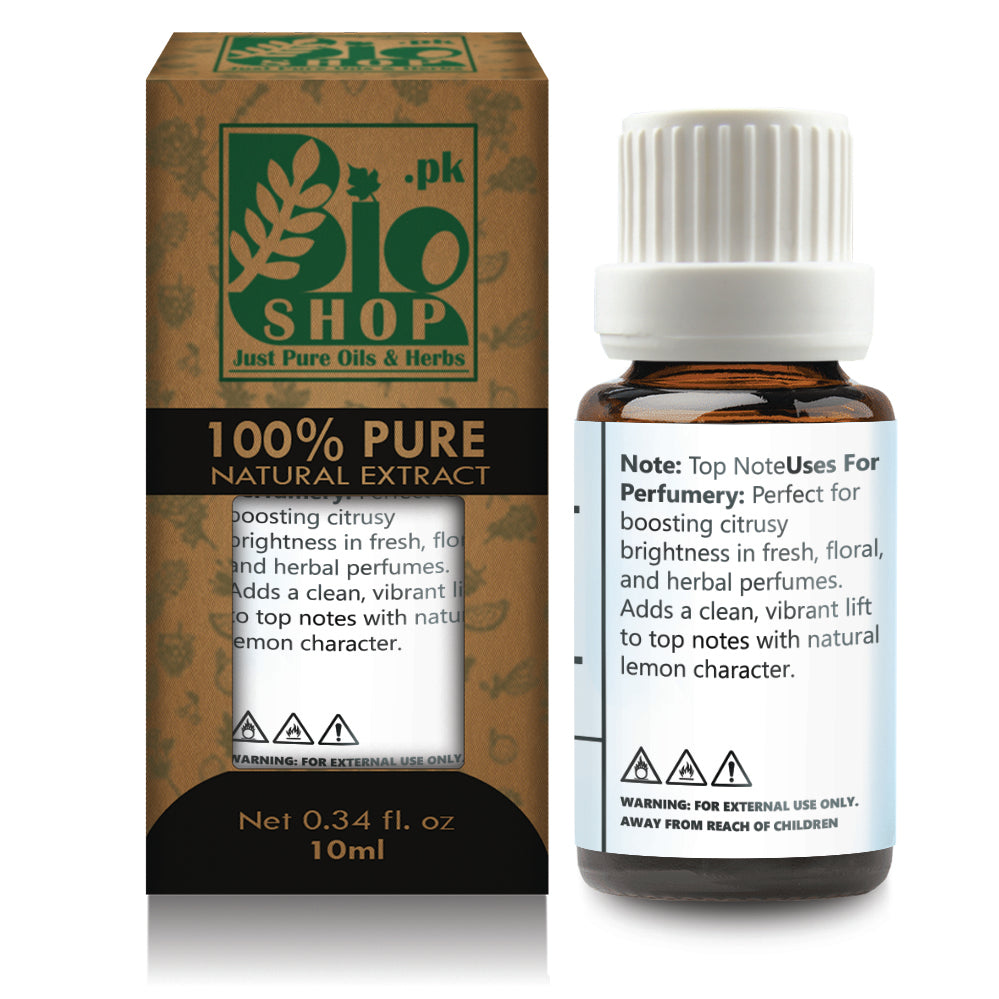
Citral (10% in DPG)
Citral (10% in DPG)
Olfactory Notes: Sharp, powerful, fresh lemon-peel scent.
Couldn't load pickup availability

Explore
Information About Citral (10% in DPG)
Key Features
✦ Intense, true-to-life lemon aroma chemical derived from or identical to the key component found in lemongrass and lemon myrtle essential oils
✦ Composed of two isomers: geranial (citral A, sharper lemon) and neral (citral B, softer, slightly floral lemon) for a rounded citrus character
✦ Acts as a versatile top note in fine fragrance, colognes, functional products, and candles
✦ Serves as a chemical precursor for ionone synthesis and vitamin A production in industrial chemistry
✦ Very high odor intensity — requires careful dosing; effective at low usage rates in most applications
✦ Found in globally recognised products including lemon colognes, dishwash detergents, shampoos, and citrus candles
✦ Vegan and cruelty-free; available in synthetic and lemongrass-derived natural forms
About Citral (10% in DPG)
Citral has been a cornerstone of the fragrance industry since the late 19th century. First isolated from lemon oil and later identified as the primary odor compound in lemongrass, it quickly became one of the most commercially significant aroma chemicals in the world. Its natural occurrence across a wide range of citrus and herbal plants made it a logical target for both extraction and synthesis, and today it is produced on an industrial scale via petrochemical routes as well as through natural distillation of lemongrass oil.
What makes citral exceptional is not just its olfactory quality but its chemical versatility. It is one of the few aroma chemicals that functions both as a finished fragrance ingredient and as a raw material for further synthesis. Perfumers rely on it to deliver an unmistakably fresh, sparkling lemon character, while chemists use it as a starting point for producing alpha and beta ionones, methyl ionones, and carotenoids. This dual role makes it indispensable in both the fragrance and pharmaceutical industries. Its potency is also noteworthy — even trace concentrations of citral are detectable by the human nose, making it highly cost-effective when used with precision.
Bio Shop Pakistan supplies cosmetic-grade Citral suitable for independent perfumers, DIY beauty product formulators, candle makers, and home fragrance crafters seeking a reliable and potent citrus aroma chemical at the bench scale.
Olfactory Profile
SCENT DESCRIPTION : Citral opens with a sharp, radiant burst of freshly squeezed lemon peel, bright and almost effervescent in character. As it develops, it softens into a slightly greener, more herbal lemon quality reminiscent of lemon verbena and lemon myrtle leaves. There is a faintly floral, almost rose-citrus nuance in the dry-down contributed by the neral isomer. Despite its simplicity, citral is strikingly vivid and true-to-nature, evoking sunlit citrus groves with remarkable clarity.
NOTE POSITION : Top to Top-Mid
FRAGRANCE FAMILY : Citrus · Green · Herbal
FACETS : Lemon · Green · Zesty · Herbal · Floral-Citrus
TENACITY : Medium — 4 to 6 hours on blotter; shorter on skin due to volatility
SILLAGE : Medium — projects well at first application, fades to a close skin scent within a few hours without fixation
Technical Specifications
Chemical Name : 3,7-Dimethyl-2,6-octadienal (mixture of geranial and neral)
CAS Number : 5392-40-5
Synonyms : Citral 96, Lemon Aldehyde, Geranial/Neral mixture, 2,6-Dimethyl-2,6-octadienal
Purity : 96% minimum (cosmetic and fragrance grade)
Appearance : Pale yellow to yellow mobile liquid
Odor Threshold : 0.01 to 0.04 ppm (extremely potent)
Solubility : Insoluble in water; soluble in alcohol, fixed oils, and most fragrance diluents
Specific Gravity : 0.886 to 0.891 at 20°C
Flash Point : Approximately 90°C (194°F)
Type : Semi-synthetic (also available as natural, derived from lemongrass oil)
Applications & Usage Guidelines
Fine Fragrance : ★★★★★
Citral is a fundamental top note building block in cologne, eau de toilette, and fresh fougère compositions. It delivers the sharpest, most realistic lemon effect available to perfumers and is used in virtually every citrus fragrance family. At controlled dosages it blends beautifully with florals, woods, and herbs without dominating the accord.
Attar & Oriental Blending : ★★★☆☆
Citral is used sparingly in attar and oriental work where a lifted, citrus facet is desired over heavier bases. It pairs well with sandalwood, ambergris bases, and rose to add brightness. Its high volatility means it contributes primarily to the opening of an attar composition rather than the dry-down.
Functional Fragrance : ★★★★★
One of the most widely used aroma chemicals in functional fragrance for household cleaners, dishwashing liquids, fabric softeners, and air fresheners. Its fresh lemon character communicates cleanliness and hygiene very effectively. Usage rates in functional products can be slightly higher than in leave-on cosmetics.
Cosmetics : ★★★☆☆
Citral can be used at low concentrations in rinse-off cosmetics like shampoos and body washes to contribute a fresh citrus note. Leave-on applications such as lotions and creams must be formulated with caution due to IFRA and dermatological sensitization limits. Always calculate inclusion rate against finished product concentration.
Home Fragrance : ★★★★★
Citral performs excellently in candles, reed diffusers, and room sprays where skin contact limits do not apply. It provides a clean, bright, and instantly recognisable lemon note that diffuses well with heat and air movement. Blends particularly well with eucalyptus, mint, and light woods in home fragrance applications.
IFRA & Usage Rate
Recommended Usage Rates in Finished Product
EDP (Eau de Parfum) : 0.5% to 1.5%
EDT (Eau de Toilette) : 0.5% to 2.0%
Body Lotion (leave-on) : 0.2% to 0.6% maximum
Shampoo / Body Wash : 0.5% to 1.6%
Bar Soap (rinse-off) : 0.5% to 1.5%
Candle : 0.5% to 2.0%
Reed Diffuser : 1.0% to 3.0%
IFRA 51st Amendment Reference Limits (in finished product)
Category 1A — Lip products : 0.02%
Category 2 — Deodorant / Antiperspirant : 0.3%
Category 3 — Face moisturizer : 0.2%
Category 4 — Hand cream : 0.6%
Category 5A — Body lotion : 0.6%
Category 7A — Rinse-off hair products : 1.6%
Category 9 — Rinse-off body products : 2.5%
Category 10A — Fabric softener : 0.5%
Category 11A — Fine fragrance (hydroalcoholic) : 2.0%
Category 12 — Candle, diffuser : No restriction specified
⚠️ Citral is a known skin sensitizer. Always calculate the final concentration in the finished product and ensure compliance with current IFRA guidelines before formulating leave-on products.
⚠️ Patch test recommended for all leave-on applications.
⚠️ IFRA limits listed are for guidance. Always verify against the current IFRA Amendment document or supplier safety data sheet before commercial production.
Blending Guide
Usage Method 1 — Direct Dilution in Alcohol
Dissolve Citral in perfumer's alcohol (IPM or ethanol 95%+) at 1% to 10% as a pre-diluted working solution before adding to your fragrance blend. This makes precise dosing far easier given its extreme potency. A 10% dilution in DPG or IPM is the most practical bench format for small-scale work.
Usage Method 2 — As a Citrus Accord Booster
Add Citral at 0.3% to 0.8% into an existing lemon or citrus accord to sharpen and extend the natural citrus effect. It works as a lifter alongside lemon essential oil, lime EO, or bergamot to counteract the natural fading of real citrus top notes over time.
Usage Method 3 — Precursor for Ionone Synthesis
Advanced formulators can use Citral as a starting material for reacting with acetone under basic conditions to produce pseudo-ionones, which are further cyclised into alpha and beta ionones. This is an advanced organic chemistry application requiring proper lab setup.
BEST PAIRINGS
Lemon Essential Oil → Amplifies and extends the natural lemon note; adds longevity
Bergamot EO → Creates a lifted, sparkling citrus-floral opening
Lemongrass EO → Reinforces the green, herbal lemon character naturally
Geranium EO → Adds a rose-citrus bridge between top and heart notes
Eucalyptus EO → Produces a clean, fresh, medicinal-citrus effect for functional fragrance
Cedarwood (Virginia) → Grounds the citrus top note with a dry, woody base
Ambroxan → Creates a modern, airy citrus-musk effect for skin scents
Iso E Super → Adds diffusion and lifts the citral note in woody-citrus accords
Hedione → Softens and extends the floral-citrus facet in fine fragrance
Coumarin → Provides a sweet, powdery bridge in fougère compositions
AVOID
✦ Avoid combining with highly alkaline bases in cosmetics — Citral is susceptible to degradation in high pH environments above 8
✦ Avoid unprotected exposure to direct sunlight and air during storage — oxidation will alter the odor profile
✦ Avoid high concentrations in leave-on facial products without IFRA-compliant calculation
Perfumer's Note
When I work with Citral, I treat it the way a painter treats cadmium yellow — intensely saturated, impossible to ignore, and only effective when used with discipline. It is among the most powerful aroma chemicals I keep on my bench, and a single drop over-dose will flatten an entire accord into a harsh, astringent mess. But when it is right, when it sits at just the right percentage inside a citrus fougère or a light eau de cologne, it produces a lemon note so vivid and convincing that no essential oil blend can quite match its purity and clarity. The geranial isomer gives it the sharp, almost metallic citrus edge that signals freshness to the brain instantly, while the neral brings in a softer, slightly warmer citrus tone that rounds the whole thing out.
ADVANCED TIP : Prepare a 5% dilution of Citral in isopropyl myristate and use it specifically as your citrus top note extender rather than a primary material. Add it at 0.2% to 0.5% in your finished formula on top of lemon or bergamot essential oils. The result is a citrus opening that holds its brightness noticeably longer on skin without the sharp imbalance that comes from using Citral as the primary lemon source. This layering technique is particularly effective in lightweight eau de toilette and skin mist formulations.
Safety & Storage
Physical State : Liquid at room temperature
Skin Safety : Known sensitizer at elevated concentrations; use within IFRA limits; patch test recommended for leave-on products
Eye Contact : Irritant; avoid contact; rinse immediately with water for 15 minutes if contact occurs
Ingestion : Not for internal use; seek medical attention immediately if swallowed
Ventilation : Work in a well-ventilated area; avoid prolonged inhalation of concentrated vapour
Storage : Store in a cool, dark location away from heat, oxygen, and moisture; ideal storage temperature 10 to 20°C
Shelf Life : 12 to 24 months when stored correctly in sealed container; oxidation accelerates degradation
Container : Store in amber glass or HDPE containers; avoid PET and clear glass for long-term storage
Flammability : Combustible liquid; flash point approximately 90°C; keep away from open flame during handling
FAQ
Q: What is Citral used for in perfumery?
A: Citral is used as a top note aroma chemical to create fresh, true lemon effects in colognes, functional fragrances, and citrus accords. It is one of the most potent and realistic lemon-scented materials available to formulators.
Q: How much Citral should I use in a perfume blend?
A: Start between 0.3% and 1.0% in your finished alcohol-based fragrance. Citral is extremely potent and easy to overdose. Always dilute to 5% or 10% in a carrier before adding to your blend for easier control.
Q: Is Citral safe for skin products?
A: Citral can be used in skin products within IFRA limits. Leave-on products like body lotion have a maximum recommended level of 0.6% in the finished product. Rinse-off products like shampoo allow up to 1.6%. Always verify your final concentration against IFRA 51st Amendment guidelines.
Q: Can Citral be used in candles and reed diffusers?
A: Yes. Citral performs very well in candles and reed diffusers where skin contact restrictions do not apply. It produces a clean, bright lemon throw that diffuses effectively with heat or airflow. Usage rates of 1% to 3% in the finished diffuser blend are common.
Q: How does Citral compare to Lemon Essential Oil?
A: Lemon essential oil contains 2% to 10% citral among many other compounds and has a rounder, more complex citrus character but fades quickly on skin. Pure citral is far more concentrated, longer lasting, and consistent from batch to batch. Lemon EO offers naturalness and complexity; Citral offers intensity, longevity, and precision. Most professional perfumers use both together for the best result.
Where Can You Safely Use Citral (10% in DPG)?
Discover how Citral (10% in DPG) performs across different applications—rated for safety, stability, and effectiveness.