Bio Shop
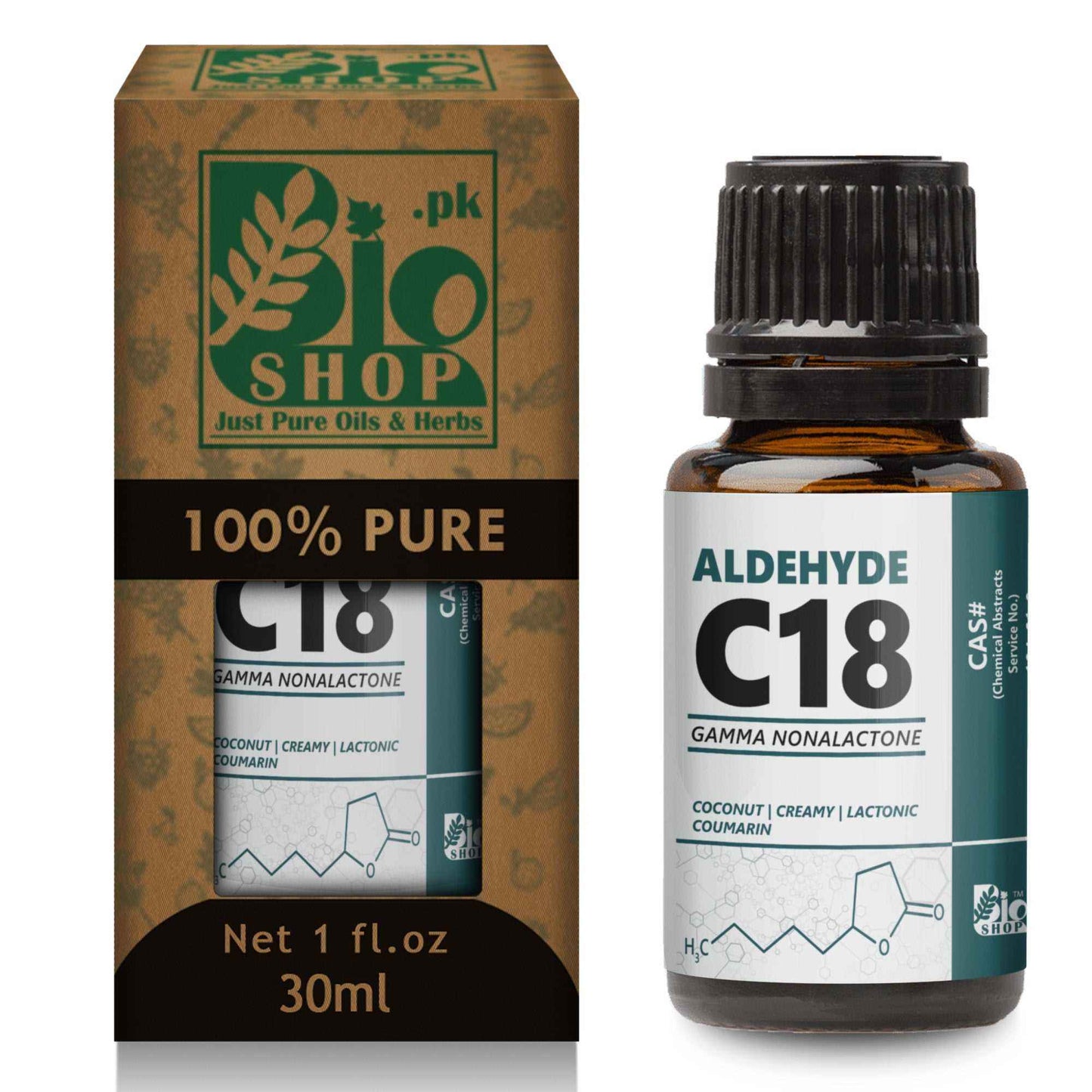
ALDEHYDE C18 (GAMMA NONALACTONE)
ALDEHYDE C18 (GAMMA NONALACTONE)
Olfactory Notes: The "Coconut" note; creamy, tropical, and lactonic.
Couldn't load pickup availability

Explore
Information About ALDEHYDE C18 (GAMMA NONALACTONE)
Key Features
✦ Gamma Nonalactone is a synthetic lactone aroma chemical with an intensely creamy, sweet coconut character widely used in perfumery and cosmetics.
✦ Delivers a rich, tropical coconut-milky effect at very low usage rates due to its low odor threshold and strong diffusion.
✦ Functions as a mid-to-base note fixative, adding warmth, depth, and tenacity to floral, gourmand, and oriental compositions.
✦ Used in iconic tropical and beachy fragrances, sunscreen-type scents, and coconut-heavy attars and food-inspired perfumes.
✦ Highly versatile across applications including fine fragrance, body care, hair care, candles, and home fragrance.
✦ Fully synthetic, vegan, and cruelty-free with no animal-derived components.
✦ Supplied at high purity (98%+) in cosmetic-grade quality, suitable for skin-safe formulations when used within recommended limits.
About ALDEHYDE C18 (GAMMA NONALACTONE)
Gamma Nonalactone, sold under the perfumery trade name Aldehyde C-18, is a cyclic ester belonging to the lactone class of aroma chemicals. Its CAS number is 104-61-0. Despite the word "aldehyde" in its trade name — a legacy of early 20th-century fragrance nomenclature — it contains no aldehyde functional group. It has been a fixture in commercial perfumery since the early 1900s, appearing in tropical, floral, and gourmand compositions across mass-market and luxury brands alike.
What makes Gamma Nonalactone exceptional is its extreme potency and distinctive coconut-creamy character. Even at concentrations as low as a few parts per million, it projects a convincing tropical coconut note. This makes it a cost-effective choice for formulators who need maximum impact from a minimal amount of material. Its chemical stability across a range of pH levels and temperatures also makes it suitable for both rinse-off and leave-on cosmetic applications. It pairs naturally with musks, vanillin, heliotropin, and tropical florals to create full, indulgent accords.
Bio Shop Pakistan supplies cosmetic-grade Gamma Nonalactone (Aldehyde C-18) suitable for DIY perfumers, cosmetic formulators, attar makers, and home fragrance crafters across Pakistan.
Olfactory Profile
SCENT DESCRIPTION
Aldehyde C-18 opens with an unmistakable burst of warm, tropical coconut — sweet, fatty, and intensely creamy. As it settles, a milky, lactonic richness emerges alongside soft peach-like fruitiness. The drydown is smooth and round, blending seamlessly into base notes with a lingering sweetness that evokes sun-warmed skin and sunscreen on a beach. Even in trace amounts, its presence is unmistakable and deeply evocative.
NOTE POSITION : Mid-Base
FRAGRANCE FAMILY : Gourmand · Fruity · Oriental
FACETS : Coconut · Creamy · Lactonic · Milky · Tropical
TENACITY : High — detectable for 24 to 36 hours on a blotter
SILLAGE : Medium — projects well in the opening, settles to a skin-close warmth in the drydown
Technical Specifications
Chemical Name : gamma-Nonalactone (Dihydro-6-pentyl-2(3H)-furanone variant / Tetrahydro-6-pentyl-2H-pyran-2-one)
CAS Number : 104-61-0
Synonyms : Aldehyde C-18, Coconut Aldehyde, gamma-Nonalactone, Nonanolide-1,4, Peach Lactone
Purity : 98% minimum
Appearance : Colorless to pale yellow oily liquid
Odor Threshold : Approximately 0.001 to 0.01 ppm (extremely low — use with care)
Solubility : Slightly soluble in water; freely soluble in ethanol, IPM, and fragrance oils
Specific Gravity : 0.960 to 0.970 at 20°C
Flash Point : Approximately 93°C (199°F)
Type : Synthetic lactone aroma chemical
Applications & Usage Guidelines
Fine Fragrance ★★★★★
Gamma Nonalactone is a cornerstone material in tropical, gourmand, and oriental fine fragrance compositions. It lends a creamy coconut warmth that gives heart and base accords richness and sweetness. Use it in sunscreen-type accords, beachy compositions, or as a soft creamy modifier in white florals and musks.
Attar & Oriental Blending ★★★★★
In attar formulation, Aldehyde C-18 is highly prized for adding a milky, sweet depth that complements oud, sandalwood, rose, and amber bases. It enhances tropical attar styles and adds an indulgent warmth to oriental blends. A very small addition can transform a sharp or dry accord into something lush and round.
Functional Fragrance ★★★★☆
It performs well in rinse-off products such as shampoos, conditioners, and shower gels where a coconut-tropical theme is desired. Performance and substantivity are acceptable in rinse-off contexts at lower usage rates. Always check stability and compliance for leave-on functional applications.
Cosmetics ★★★★☆
Used in body butters, lotions, and hair care products to impart a creamy coconut scent. It is skin-safe at recommended levels and lends an appealing sensory experience to tropical-themed personal care formulations. Ensure usage rates are kept within IFRA guidelines for leave-on skin products.
Home Fragrance ★★★★★
Gamma Nonalactone is excellent in candles, reed diffusers, and wax melts. Its sweet coconut character fills a room evenly and creates a relaxing tropical atmosphere. It blends well with vanilla, coconut absolute, and tropical musks in home fragrance applications.
IFRA & Usage Rate
RECOMMENDED USAGE RATES
Application : Recommended Rate
EDP : 3% to 8%
EDT : 2% to 5%
Body Lotion : 0.3% to 1%
Shampoo/Body Wash : 0.2% to 0.5%
Candle : 3% to 6%
Reed Diffuser : 5% to 10%
Soap (Bar) : 0.5% to 1.5%
IFRA 51st Amendment Limits (in finished product)
IFRA Category 1 (Lip products) : 0.01% — verify with current IFRA standard
IFRA Category 4 (Body lotion, leave-on) : 0.4% — verify with current IFRA standard
IFRA Category 5A (Face cream, leave-on) : 0.2% — verify with current IFRA standard
IFRA Category 9 (Rinse-off body/hair) : 1.0% — verify with current IFRA standard
IFRA Category 11A (Candles) : No restriction listed — verify with current IFRA standard
⚠️ Gamma Nonalactone has an extremely low odor threshold. Even trace amounts above intended rates can overpower a formula. Always weigh precisely using a 10% or 1% dilution.
⚠️ Cross-check all limits against the current IFRA 51st Amendment guidelines before finalizing formulas for commercial production.
⚠️ Not recommended for use near eyes. Keep concentration minimal in facial leave-on products.
Blending Guide
METHOD 1 — Dilution Before Use
Always work with Gamma Nonalactone as a pre-made 10% dilution in DPG, IPM, or ethanol. Its odor threshold is so low that working with it neat makes accurate dosing nearly impossible. A 10% dilution allows you to add it drop by drop with precision and avoid overloading your formula.
METHOD 2 — Coconut Accord Building
Use Gamma Nonalactone as the backbone of a coconut accord by combining it with coumarin for creaminess, ethyl vanillin for sweetness, and a hint of Iso E Super or woody amber for depth. Start at 0.5% of the total formula and build up slowly. This accord works in both perfume and body care applications.
METHOD 3 — Floral Softener
Add it at 0.1% to 0.3% in rose, jasmine, or tuberose compositions where you want to round off sharp green or indolic notes. It acts as a creamy bridge material, connecting floral heart notes to a sweet, warm base without dominating the composition.
BEST PAIRINGS
Vanillin → Deepens the sweet, dessert-like quality; adds warmth and richness
Coumarin → Creates a creamy, powdery coconut-almond accord
Ethyl Maltol → Amplifies the gourmand sweetness; great in food-type fragrances
Musk Ambrette (or Ambrox) → Adds skin warmth and lifts the coconut note beautifully
Rose Oxide → Creates a tropical rose accord with lychee and coconut nuance
Sandalwood (or Polysantol) → Blends seamlessly; delivers a creamy coconut-wood base
Ylang Ylang EO → Classic tropical pairing; reinforces the exotic, heady quality
AVOID
Avoid pairing at high concentrations with other powerful lactones such as gamma-Decalactone or delta-Undecalactone without careful balancing, as over-lactoning creates an artificial, candy-like effect that overwhelms compositions.
Perfumer's Note
Working with Gamma Nonalactone is a lesson in the power of restraint. I have seen beginners reach for it with excitement, add too much, and completely bury everything else in the formula under a wall of synthetic coconut. This material is deceptively powerful — a 10% dilution is not a luxury, it is a necessity. When used correctly, though, it is one of the most evocative and emotionally resonant materials available to a formulator. A trace amount in a white floral transforms something academic into something sensory and alive. It makes people close their eyes. That is a rare quality in any ingredient.
ADVANCED TIP
Try using Gamma Nonalactone at 0.05% to 0.1% in an oud or dark amber attar base as a hidden creamy modifier. At this level, the customer will not consciously register coconut — they will simply feel that the base is unusually smooth, round, and luxurious. This is the technique of using lactones as texture rather than identity, and it separates intermediate from advanced attar formulation.
Safety & Storage
Physical State : Liquid at room temperature
Skin Safety : Safe at recommended IFRA levels; avoid concentrated neat application to skin
Eye Contact : Irritant — avoid contact; rinse immediately with water if contact occurs
Ingestion : Not for consumption; keep out of reach of children
Ventilation : Work in a well-ventilated area; avoid prolonged inhalation of vapor
Storage : Store in a cool, dark place away from heat and direct sunlight
Shelf Life : 24 to 36 months in sealed container; may discolor slightly over time without affecting performance
Container : Store in original sealed glass or HDPE container; avoid reactive metals
Flammability : Combustible liquid — flash point approximately 93°C; keep away from open flame
FAQ
Q: What does Aldehyde C-18 actually smell like?
A: It smells exactly like fresh coconut — creamy, sweet, tropical, and slightly milky. It is one of the most recognizable aroma chemicals in perfumery.
Q: Is it really an aldehyde?
A: No. Despite the trade name, Aldehyde C-18 is a lactone (gamma-Nonalactone), not an aldehyde. The name is a historical naming convention from early 20th-century perfumery and is technically a misnomer.
Q: How much should I use in a perfume?
A: Start at 0.5% to 1% in a finished EDP, always pre-diluted to 10%. Its odor threshold is extremely low, so less is always more. Overdosing is the most common beginner mistake with this material.
Q: Can I use it in soap and lotion?
A: Yes, but keep rates conservative — around 0.5% to 1% in soap and 0.3% to 0.5% in leave-on lotions. Always verify against current IFRA limits before commercial production.
Q: How does it compare to natural coconut absolute or fractionated coconut oil?
A: Natural coconut absolute has a more complex, fatty, and nuanced character but is expensive and variable in quality. Gamma Nonalactone is far more potent, consistent, and affordable, but smells more synthetic at high doses. Fractionated coconut oil has virtually no scent at all. For fragrance formulation, Gamma Nonalactone is the standard choice; for carrier or base oil purposes, fractionated coconut oil is used instead.
Where Can You Safely Use ALDEHYDE C18 (GAMMA NONALACTONE)?
Discover how ALDEHYDE C18 (GAMMA NONALACTONE) performs across different applications—rated for safety, stability, and effectiveness.