Bio Shop
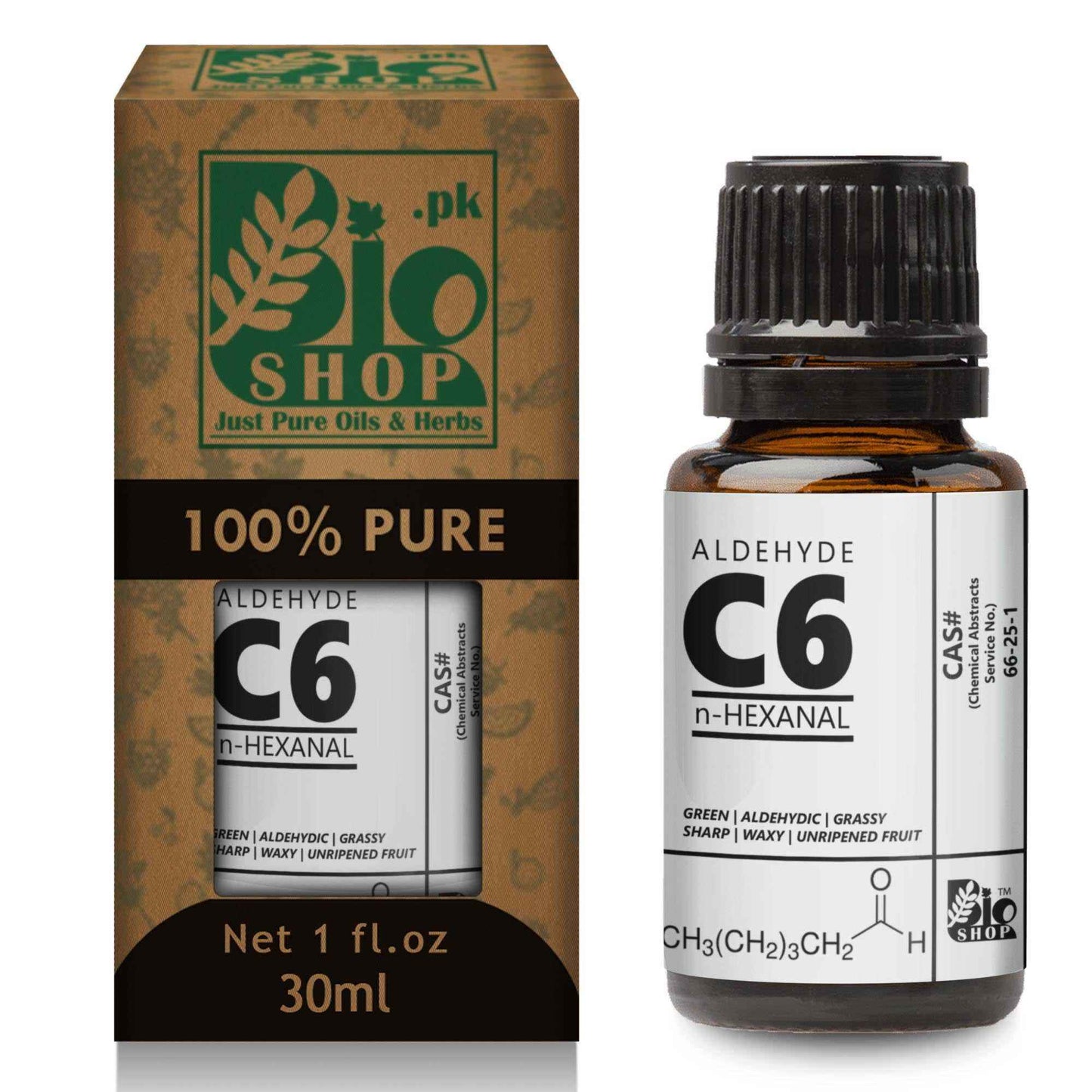
Aldehyde C6 (HEXANAL)
Aldehyde C6 (HEXANAL)
Olfactory Notes: Powerful "fresh-cut grass" and fatty green scent.
Couldn't load pickup availability
Explore
Information About Aldehyde C6 (HEXANAL)
Key Features
✦ Aldehyde C-6 (Hexanal, CAS 66-25-1) is a classic aliphatic aldehyde delivering an intense fresh, green, and fatty-waxy top note used at trace levels in perfumery
✦ Produces a crisp cut-grass, crushed leaf, and dewy-green effect that immediately lifts and naturalizes fragrance compositions
✦ Extremely potent — effective at 0.01 to 0.1% in fine fragrances; a little goes a very long way
✦ Core ingredient in chypre, fougere, floral aldehyde, and fresh-green perfume categories since the early twentieth century
✦ Widely used in household cleaners, laundry products, shampoos, and functional fragrances for a clean green character
✦ Synthetically produced and vegan-friendly; also naturally occurring in grass, apple peel, olive oil, and green vegetables
✦ Highly volatile top note with strong initial diffusion — ideal for boosting the opening phase of any formula
About Aldehyde C6 (HEXANAL)
Aldehyde C-6, known scientifically as hexanal or n-hexanal, is one of the foundational aliphatic aldehydes used in modern perfumery since the early twentieth century. It is a six-carbon straight-chain aldehyde produced naturally in plants through the enzymatic oxidation of unsaturated fatty acids, which explains its unmistakable association with freshly mown grass, crushed leaves, and raw green vegetables. Perfumers classify it within the aliphatic aldehyde series alongside C-7, C-8, C-9, C-10, C-11, and C-12 — each with its own olfactory character ranging from green and citrus-fatty to floral-waxy.
What makes Hexanal remarkable is its combination of extreme potency and transparent freshness. At concentrations below 0.05%, it can dramatically brighten an accord, lending a naturalistic, just-picked quality that is difficult to achieve with other synthetics. Unlike the soapy-floral character of Aldehyde C-12 or the citrusy-fatty quality of C-10, Hexanal sits firmly in pure green territory — evoking dewy morning foliage, garden vegetables, and sun-warmed lawn clippings. This singular quality makes it indispensable in naturalistic green accords, citrus reconstructions, and functional fragrance applications where freshness must be both immediate and convincing.
Bio Shop Pakistan supplies cosmetic-grade Aldehyde C-6 (Hexanal) suitable for DIY perfumers, cosmetic chemists, home fragrance crafters, and professional blenders across Pakistan who require a consistent and reliable source of this essential green top note aldehyde.
Olfactory Profile
SCENT DESCRIPTION: Aldehyde C-6 opens with a sharply fresh, green, and slightly fatty character that is immediately reminiscent of freshly cut grass and crushed vegetable leaves. It carries a waxy-vegetal transparency that diffuses rapidly into the air, creating an impression of open outdoor spaces and morning dew. At threshold levels, it adds a naturalistic, almost photorealistic greenness to compositions that few other materials can replicate. Concentrations above 0.5% turn harsh and pungent — careful dilution is not optional but essential.
NOTE POSITION: Top Note
FRAGRANCE FAMILY: Green · Aldehydic · Fresh
FACETS: Fresh · Green · Grassy · Fatty · Waxy
TENACITY: Low — 1 to 3 hours on skin; high initial diffusion with rapid dry-down
SILLAGE: Medium — strong opening projection that fades quickly; best used to enhance the first impression of a composition rather than for lasting presence
Technical Specifications
Chemical Name : Hexanal (n-Hexanal)
CAS Number : 66-25-1
Synonyms : Aldehyde C-6, Caproaldehyde, Hexyl Aldehyde, 1-Hexanal, n-Caproaldehyde, Hexanaldehyde
Purity % : 97% minimum (fragrance grade)
Appearance : Colorless to pale yellow mobile liquid
Odor Threshold : Approximately 4.5 ppb in air (extremely low)
Solubility : Slightly soluble in water; fully miscible with ethanol, IPM, DPG, and most fragrance carriers
Specific Gravity : 0.814 – 0.820 at 20°C
Flash Point : 32°C (90°F) — classified as a flammable liquid
Type : Synthetic (also naturally occurring in plants and food matrices)
Applications & Usage Guidelines
Fine Fragrance ★★★★★
Hexanal is a cornerstone green top note used across chypre, fougere, floral aldehyde, and aquatic fragrance families. It elevates the opening of a composition dramatically at 0.01 to 0.1%, giving it a naturalistic freshness that feels genuinely botanical. Iconic green fragrances of the 1970s and 1980s relied heavily on aliphatic aldehydes like this one.
Attar and Oriental Blending ★★★
Less traditional in attar-style compositions but capable of adding a surprising green lift to heavy rose, geranium, and animalic bases. Use at extreme restraint — 0.02 to 0.05% maximum — to avoid clashing with deep resinous and musky base notes. Works best in modern oriental interpretations rather than classical attars.
Functional Fragrance ★★★★
Excellent in household cleaners, dishwashing liquids, surface sprays, and laundry products where crisp green freshness signals cleanliness. At 0.05 to 0.2%, it creates the kind of sharp, clean opening that consumers associate with hygienic products. One of the most widely used aldehydes in the home care industry.
Cosmetics ★★
Usable in shampoos and body washes at very low levels to contribute green freshness to the rinse-off experience. Stability is better in wash-off products than in leave-on emulsions. Always conduct full safety assessment before use in leave-on formulas due to sensitization potential at elevated concentrations.
Home Fragrance ★★★
Works effectively in reed diffusers and wax melts to provide a green, naturalistic top note opening. High volatility makes it ideal for the initial burst of a room diffusion blend. Flash point of 32°C requires careful handling in candle work — follow wax manufacturer guidelines and applicable safety regulations.
IFRA & Usage Rate
Recommended Usage Rates
EDP (Eau de Parfum) : 0.02 – 0.10%
EDT (Eau de Toilette) : 0.02 – 0.08%
Body Lotion / Cream : 0.01 – 0.05%
Shampoo / Body Wash : 0.02 – 0.08%
Bar Soap : 0.02 – 0.10%
Candle (in finished wax) : 0.05 – 0.20%
Reed Diffuser : 0.05 – 0.30%
IFRA 51st Amendment — Key Category Limits
⚠️ Hexanal (CAS 66-25-1) is classified as a skin sensitizer under IFRA QRA guidelines. The following limits represent maximum permitted use levels. Always verify the current IFRA 51st Amendment standard at ifrafragrance.org before formulating.
Category 1 (Lip products) : Not recommended
Category 4 (Fine fragrance) : Approx. 0.16% — verify with IFRA standard
Category 5a (Body lotion) : Approx. 0.04% — verify with IFRA standard
Category 5b (Face cream) : Approx. 0.03% — verify with IFRA standard
Category 9 (Rinse-off body) : Approx. 0.13% — verify with IFRA standard
Category 11a (Fabric softener) : Approx. 0.06% — verify with IFRA standard
⚠️ Always perform a QRA calculation based on your formula's Consumer Product Category before finalizing usage level. These are indicative figures — the IFRA website publishes the authoritative current limits.
⚠️ Flash point of 32°C means Aldehyde C-6 is a flammable material. Handle away from heat sources, open flames, and sparks at all times.
Blending Guide
Method 1 — Pre-Dilution in DPG or IPM
Hexanal should never be used neat in formulation. Always pre-dilute to 1% or 10% in a neutral carrier such as dipropylene glycol or isopropyl myristate before weighing into your formula. This prevents accidental overdose and ensures even dispersion in the blend.
Method 2 — Green Accord Building
Combine Hexanal with Cis-3-Hexenol, Cis-3-Hexenyl Acetate, and Violet Leaf Absolute to construct a full-spectrum green accord. Hexanal contributes the cut-grass dryness while the hexenyl materials add lush, wet-green diffusion. Start with Hexanal at 0.02% of the total accord.
Method 3 — Top Note Brightening in Finished Formulas
Add a trace amount of Hexanal (0.01 to 0.05%) at the end of the blending process to brighten the top note of a completed formula. It works like a light switch — even a tiny addition can transform a flat, synthetic-smelling opening into something natural and vivid. Evaluate 24 hours after blending as the effect mellows and integrates.
BEST PAIRINGS
Violet Leaf Absolute → Deepens and anchors the green-vegetal character
Galbanum Resinoid → Creates a classic 1970s green chypre structure
Geranium Essential Oil → Adds rosy-green freshness and natural complexity
Hedione / Methyl Dihydrojasmonate → Brightens and adds floralcy to the green note
Bergamot / Lemon EO → Enhances citrus-green accord in the opening
Linalool → Softens the fatty-green edge with a floral-woody bridge
Oakmoss / Evernyl Methyl → Classic chypre base pairing; builds a natural green pyramid
Iso E Super → Adds woody diffusion that extends the green character
AVOID
Using undiluted — always pre-dilute before adding to formula
Concentrations above 0.5% in any application — odor becomes aggressively pungent and unpleasant
Combining with strong musks at high levels without a bridging floral — can produce an unbalanced sweaty-green effect
Exposure to caustic alkalis in soap bases at high pH — may affect stability; test in your specific formulation
Perfumer's Note
I have been using Aldehyde C-6 for years and it remains one of the most humbling materials in the palette — humbling because it demands absolute precision. A single extra drop can ruin an entire batch by pushing a beautiful floral-green opening into something reminiscent of a vegetable market in the rain. But when you get it right, it does something no other aldehyde does: it makes a fragrance feel alive. There is a biophilic quality to Hexanal that the brain immediately recognizes as real, as natural, as outdoors — even in a completely synthetic formula. That is the magic of working with molecules that plants themselves produce.
ADVANCED TIP: Try building a 1% master dilution of Hexanal in DPG and use it as a blending stock. Within that dilution, add a trace of Cis-3-Hexenol (roughly one part Hexanal to three parts Hexenol) to create a micro-accord that is far easier to dose than either material alone. This combined green stock integrates more smoothly into alcoholic bases and gives you finer control over the intensity of the green note. Test at 0.5%, 1%, and 2% of your total formula using this stock — you will quickly develop an intuition for exactly how much green your composition can hold.
Safety & Storage
Physical State : Colorless to pale yellow mobile liquid
Skin Safety : Potential skin sensitizer — use within IFRA limits; avoid repeated direct skin contact with concentrate; always dilute before use
Eye Contact : Irritant — avoid direct contact; if contact occurs, rinse immediately with clean water for 15 minutes and seek medical attention
Ingestion : Not for consumption under any circumstances; keep out of reach of children
Ventilation : Use in a well-ventilated workspace; avoid prolonged inhalation of vapors from concentrated material
Storage : Store in a cool, dark location between 5°C and 20°C, away from heat sources, direct sunlight, and ignition sources
Shelf Life : 12 to 24 months when stored in sealed container away from heat and light; aldehydes can oxidize over time — assess odor before use
Container : Amber glass or HDPE plastic recommended; avoid uncoated metal containers due to potential aldehyde-metal reactions
Flammability : Flammable liquid — flash point 32°C (90°F); keep away from open flames, sparks, and high-heat surfaces at all times
FAQ
Q: What does Aldehyde C-6 smell like?
A: It smells intensely fresh, green, and grassy — like freshly cut lawn, crushed leaves, or raw cucumber peel. It has a slightly fatty, waxy edge that makes it feel natural rather than synthetic.
Q: How much Aldehyde C-6 should I use in a perfume?
A: Start between 0.02% and 0.05% of your total formula. Always pre-dilute to 1% or 10% in a carrier before adding. Hexanal is extremely potent and overuse produces an unpleasant harsh-vegetal effect.
Q: Is Aldehyde C-6 safe for skin products?
A: It can be used at very low levels in skin-contact products within IFRA limits, but it is a classified skin sensitizer. Always work within IFRA 51st Amendment guidelines and perform a patch test or full safety assessment before marketing any product.
Q: Can I use Aldehyde C-6 in cold-process soap?
A: Yes, but with caution. Use within recommended limits (0.02 to 0.10%) and expect some scent fade during saponification as aldehydes can be volatile and reactive in high-pH environments. Test your specific formulation before scaling up production.
Q: How does Aldehyde C-6 compare to Aldehyde C-12 MNA?
A: These two aldehydes are very different despite sharing the aldehyde family. C-6 is a sharp, green, grassy top note with a short lifespan on skin. C-12 MNA (Methyl Nonyl Acetaldehyde) is a waxy, creamy, soapy-floral aldehyde most famous from Chanel No 5 with far greater tenacity. C-6 is used for natural green freshness while C-12 creates the classic aldehydic floral signature. They can complement each other in a complex formula but serve entirely different purposes.
Where Can You Safely Use Aldehyde C6 (HEXANAL)?
Discover how Aldehyde C6 (HEXANAL) performs across different applications—rated for safety, stability, and effectiveness.