


Bio Shop
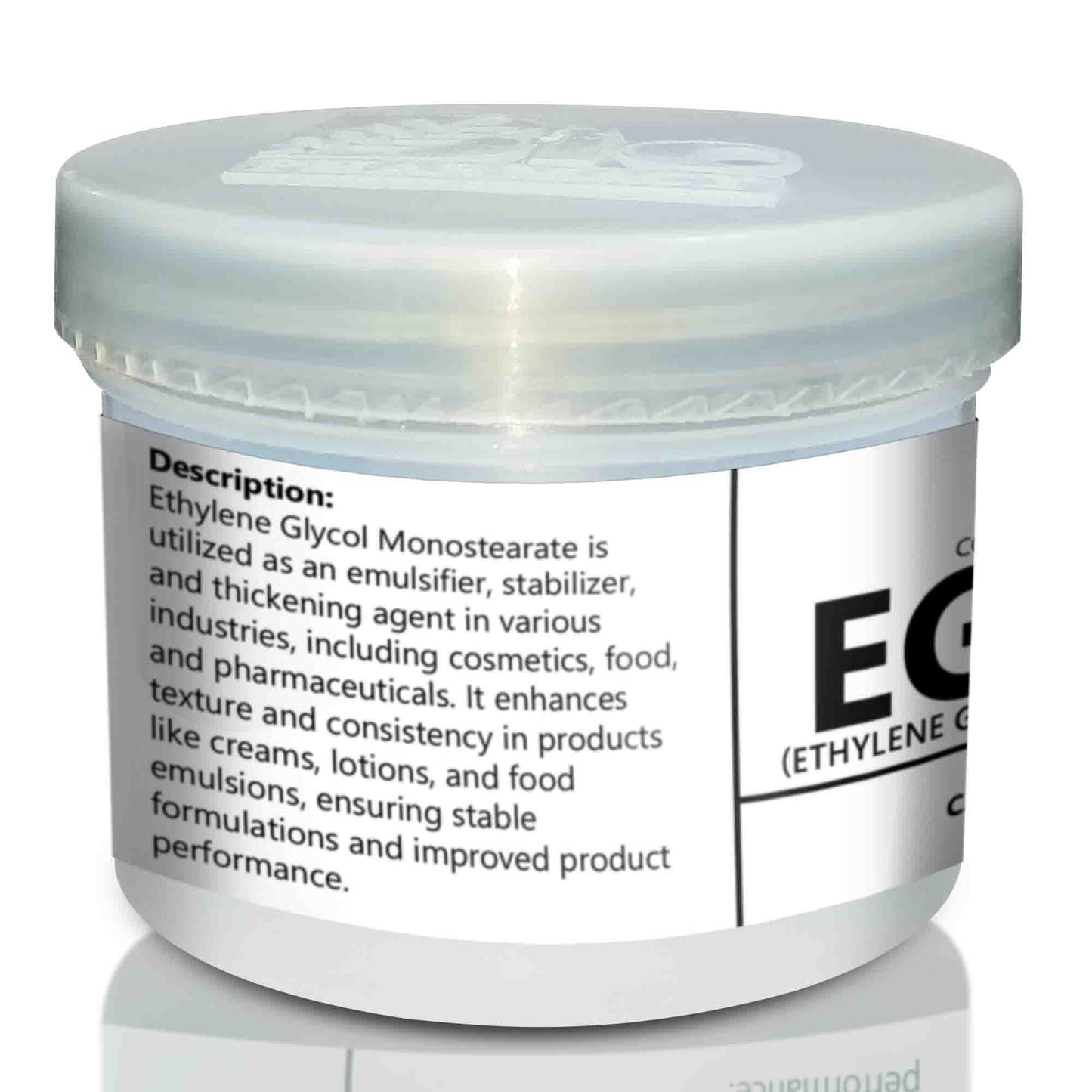
EGMS (Ethylene Glycol Monostearate)
EGMS (Ethylene Glycol Monostearate)
Key Functions: Pearlizes formulas, opacifies, thickens, and conditions skin.
Couldn't load pickup availability


Explore
Information About EGMS (Ethylene Glycol Monostearate)
✅ Key Features
✦ Primary pearlizing agent that creates a smooth nacreous sheen in rinse-off and leave-on cosmetic products
✦ Effective opacifier that gives shampoos, conditioners, and body washes a premium, high-end appearance
✦ Mild emollient that improves skin and hair softness and contributes a smooth sensory after-feel
✦ Thickening agent that enhances viscosity and body in liquid surfactant formulations
✦ Fully compatible with anionic, nonionic, and amphoteric surfactant systems used in most cosmetic bases
✦ Synthetically derived ester — vegan-friendly and free from animal-derived raw materials
✦ Established commercial ingredient used globally in mass-market and professional cosmetic products for decades
🔬 Description
EGMS, or Ethylene Glycol Monostearate, is a synthetic wax ester formed through the esterification of ethylene glycol with stearic acid. It presents as white waxy flakes or pearls at room temperature and has been a fundamental ingredient in cosmetic manufacturing for several decades. Its most recognizable function is creating the distinctive pearlescent appearance found in premium shampoos, body washes, and conditioning products on both professional and retail shelves.
What makes EGMS technically valuable is its ability to self-organize into lamellar crystalline structures when cooled from a molten state within an aqueous surfactant system. These layered microscopic crystals scatter and reflect light in a manner that closely mimics the iridescent quality of natural pearl, delivering a visual cue of quality and richness that consumers respond to strongly. Beyond aesthetics, EGMS simultaneously contributes mild thickening, improved emolliency, and a perceptibly smoother product texture in finished formulas.
Bio Shop Pakistan supplies cosmetic-grade Ethylene Glycol Monostearate (EGMS) suitable for DIY beauty makers, shampoo and conditioner formulators, salon product manufacturers, and professional cosmetic chemists.
📊 Technical Data
INCI Name : Glycol Stearate
Chemical Name : Ethylene glycol monostearate
CAS Number : 111-60-4
Molecular Formula : C20H40O3
Appearance : White waxy flakes or pearls
Odor : Faint waxy, mild
pH (1% solution) : Not Applicable (insoluble in cold water; pH measurement not relevant)
Solubility : Insoluble in cold water; dispersible in hot water with surfactants; soluble in warm oils and ethanol
Specific Gravity : 0.95 – 0.97 at 60°C
Flash Point : >100°C
HLB Value : 2.9 (lipophilic)
Recommended Use Level : 1–3% pearlizing agent; up to 5% as emollient or thickener
Type : Synthetic ester (monoester of ethylene glycol and stearic acid)
Shelf Life : 24 months when stored in sealed container under recommended conditions
🧪 Recommended Usage
Skincare (Creams, Serums, Lotions) ★★★★☆
EGMS performs well as an emollient and mild thickener in creams and lotions, contributing a smooth, non-greasy skin feel. Incorporate it into the oil phase at 70–75°C alongside cetearyl alcohol or other fatty alcohols for a stable, even emulsion.
Haircare (Shampoo, Conditioner, Masks) ★★★★★
EGMS is the benchmark pearlizing agent for shampoos and conditioners, producing a consistent nacreous sheen at just 1.5–2%. Add it to the hot surfactant base at 65–70°C, mix thoroughly, then cool slowly to develop full pearl crystallization across the batch.
Soap Making (Cold Process, Melt and Pour) ★★☆☆☆
EGMS does not saponify and shows poor stability in the high-pH environment of cold process soap, making it unsuitable for that application. In melt-and-pour bases it can contribute a mild sheen effect, though results are modest and consistency can vary.
Body Care (Scrubs, Butters, Balms) ★★★★☆
In body butters, lip balms, and solid balms, EGMS adds a silky emollient texture and subtle opacity that improves the visual and sensory finish of the product. Use at 1–3% in the oil or wax phase alongside shea butter, cocoa butter, or beeswax for best results.
Functional Cosmetics (Deodorants, Sunscreen, Baby Care) ★★★☆☆
EGMS can provide structural support and a smooth glide in stick deodorants and anhydrous sunscreen formulas when used alongside waxes. Exercise caution in baby care applications and always conduct patch testing before use in products targeting infants or young children.
💡 Pro Tip
Skincare (Creams, Serums, Lotions) ★★★★☆
EGMS performs well as an emollient and mild thickener in creams and lotions, contributing a smooth, non-greasy skin feel. Incorporate it into the oil phase at 70–75°C alongside cetearyl alcohol or other fatty alcohols for a stable, even emulsion.
Haircare (Shampoo, Conditioner, Masks) ★★★★★
EGMS is the benchmark pearlizing agent for shampoos and conditioners, producing a consistent nacreous sheen at just 1.5–2%. Add it to the hot surfactant base at 65–70°C, mix thoroughly, then cool slowly to develop full pearl crystallization across the batch.
Soap Making (Cold Process, Melt and Pour) ★★☆☆☆
EGMS does not saponify and shows poor stability in the high-pH environment of cold process soap, making it unsuitable for that application. In melt-and-pour bases it can contribute a mild sheen effect, though results are modest and consistency can vary.
Body Care (Scrubs, Butters, Balms) ★★★★☆
In body butters, lip balms, and solid balms, EGMS adds a silky emollient texture and subtle opacity that improves the visual and sensory finish of the product. Use at 1–3% in the oil or wax phase alongside shea butter, cocoa butter, or beeswax for best results.
Functional Cosmetics (Deodorants, Sunscreen, Baby Care) ★★★☆☆
EGMS can provide structural support and a smooth glide in stick deodorants and anhydrous sunscreen formulas when used alongside waxes. Exercise caution in baby care applications and always conduct patch testing before use in products targeting infants or young children.
👩🔬 Skin Type Suitability
In professional formulation practice, I treat EGMS as a dual-function workhorse — it handles the visual premium of pearlizing while quietly contributing texture improvement and mild emolliency in the same step. The single biggest mistake I see from new formulators is rushing the cooling phase. When you cool a pearlized shampoo too quickly or with aggressive mixing, the lamellar crystals form unevenly, leaving a grainy, streaky product instead of the smooth, consistent jewel-like sheen that defines a high-quality finish. The cooling curve is not a detail — it is the entire technique.
ADVANCED TIP: For peak pearl development in a standard SLES and CAPB shampoo system, premelt EGMS at 70–75°C directly into your hot surfactant blend at the 1.5–2% usage level. Stir until fully incorporated and the mixture is visually uniform. Begin cooling the batch, targeting a slow descent from 60°C to 40°C over 20 to 30 minutes using low-shear paddle or anchor agitation. Do not use high-shear mixing below 45°C under any circumstances. This controlled crystallization window is where lamellar structure formation occurs — disturbing it with high shear breaks up the forming crystals and destroys the pearl effect entirely. The result of correct technique is a bright, consistent, uniform pearl throughout the finished batch.
🧴 Formulation Ideas
Normal Skin : ★★★★★ — Provides smooth emolliency and improved skin texture without disrupting the natural skin barrier.
Dry Skin : ★★★★☆ — Contributes useful emollient properties and mild barrier support, though richer actives are typically needed alongside it.
Oily Skin : ★★★☆☆ — Suitable at low levels in rinse-off products but may feel slightly occlusive in leave-on applications on oily skin.
Combination : ★★★★☆ — Works well at moderate concentrations, particularly in rinse-off formats where residue on oilier zones is not a concern.
Sensitive Skin : ★★★☆☆ — Generally well-tolerated but patch testing is advised, as some individuals with ester sensitivity may experience mild irritation.
Mature Skin : ★★★★★ — Supports barrier function and delivers a plump, smooth skin feel that suits mature skin formulations well.
Acne-Prone : ★★☆☆☆ — Potentially comedogenic in leave-on products at higher use levels; best reserved for rinse-off applications in this skin type.
💧 Safety and Regulatory:
INCI Declared : Yes — Glycol Stearate must be declared on the ingredient list above 1% in EU-regulated cosmetics
EU Cosmetics Reg : Permitted — not listed in Annex II (prohibited substances) or Annex III (restricted substances); general cosmetic use permitted
Rinse-Off Limit : No established regulatory limit; industry standard use is 1–3%
Leave-On Limit : No established regulatory limit; industry standard use is 1–3%
Allergen Alert : No — not a recognized or classified cosmetic allergen
Skin Safety : Safe at recommended use levels with established global safety history
Eye Area Use : Use with caution — avoid direct eye contact; well-formulated rinse-off products are generally considered safe
Ingestion : Not for internal use
Pregnancy Use : Consult physician before use in formulations intended for pregnant consumers
Child Safety : Safe for children above 3 years of age at recommended levels; use in diluted rinse-off formats preferred
Ventilation : Not required under normal handling and formulation conditions
Storage : Cool dry place below 25°C, away from direct heat sources and prolonged sunlight exposure
Container : HDPE or glass preferred — avoid reactive metal containers
⚠️ EGMS is a synthetic ester. Individuals with documented sensitivity to stearic acid esters or ethylene glycol derivatives may experience mild skin irritation. Patch testing is recommended before use in leave-on products targeting sensitive or acne-prone skin. Avoid prolonged or direct contact with eyes during formulation handling.
Stability and Compatibility
Working pH Range : 4.0 – 8.0
Heat Stability : Stable up to 80°C; incorporate at 70–75°C in hot phase processing
Freeze-Thaw Stable : Yes — solid at room temperature; not adversely affected by freeze-thaw cycling
Emulsion Type : O/W and W/O
Emulsification Phase: Hot phase — melt and incorporate into oil phase or hot surfactant base at 70–75°C
Compatible With : Anionic surfactants (SLES, SLS), nonionic surfactants, amphoteric surfactants (CAPB), fatty alcohols (Cetearyl Alcohol, Cetyl Alcohol), silicones
Incompatible With : Strongly alkaline environments above pH 10; high concentrations of cationic surfactants may disrupt lamellar crystal formation and reduce pearl effect
Oxidation Risk : Low — no significant oxidation risk under normal storage and formulation conditions
Discoloration Risk : None under typical use conditions; possible slight yellowing if held at temperatures above 80°C for extended periods
Formulation Notes : Pearl crystal development is entirely dependent on controlled cooling rate — slow cooling from 60°C to 40°C with low-shear agitation is non-negotiable for a quality result. High-shear mixing during the crystallization window will destroy lamellar structure and eliminate the pearl effect.
❓ FAQs
Q: What exactly does EGMS do in a shampoo formula?
A: EGMS forms thin lamellar crystalline structures during controlled cooling in a surfactant base, scattering light in a way that creates a pearl or nacreous visual effect. It also contributes mild thickening and emolliency to the finished product alongside this visual function.
Q: At what temperature should I add EGMS to my formulation?
A: EGMS should be added to the hot surfactant or oil phase at 70–75°C where it melts completely and disperses uniformly. Controlled slow cooling from 60°C down to 40°C is then essential for proper lamellar crystal formation and peak pearl development.
Q: Can EGMS be used in cold process soap?
A: EGMS is not recommended for cold process soap because it does not saponify and performs poorly in high-pH environments above pH 10. It has only marginal application in melt-and-pour bases where a mild sheen effect is desired.
Q: Is EGMS safe for rinse-off products that contact the face?
A: Yes, EGMS is used widely in commercial rinse-off facial and body cleansers globally and is considered safe at typical use levels of 1–3%. It is not a restricted or prohibited ingredient under EU Cosmetics Regulation, and its safety profile is well-established across decades of use.
Q: How does EGMS compare to Glycol Distearate (EGDS) as a pearlizing agent?
A: Glycol Distearate (EGDS) is the diester form and generally produces a stronger, brighter, and denser pearl effect than EGMS due to its more tightly packed lamellar structures. EGMS, however, offers better emolliency, easier incorporation at lower use levels, and a softer, more subtle sheen — making it the preferred choice when a balance of visual effect and skin feel is the priority.
Where Can You Safely Use EGMS (Ethylene Glycol Monostearate)
Discover how EGMS (Ethylene Glycol Monostearate) performs across different products — rated for safety, stability, and effectiveness.


