


Bio Shop
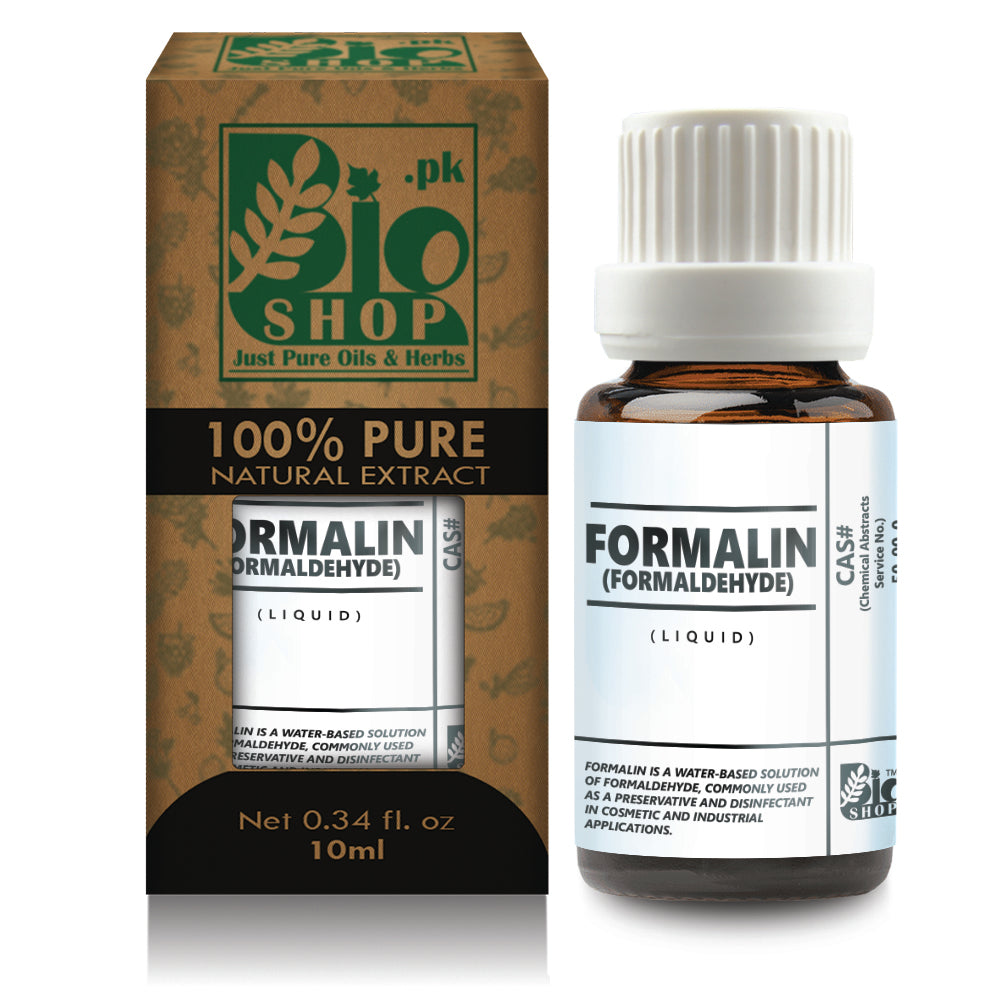
Formalin (Formaldehyde)
Formalin (Formaldehyde)
Key Functions: Broad-spectrum antimicrobial, preservative, biocide, nail hardener.Broad-spectrum antimicrobial, preservative, biocide, nail hardener.
Couldn't load pickup availability
Explore
Information About Formalin (Formaldehyde)
✅ Key Features
✦ Potent broad-spectrum preservative active against bacteria, yeast, and mold at very low concentrations.
✦ Effective as a cosmetic preservative at use levels as low as 0.01–0.05% free formaldehyde in finished formulas.
✦ Established role in professional nail hardener formulations where it cross-links nail plate keratin proteins.
✦ Supplied commercially as Formalin (37–40% aqueous solution) for accurate dispensing and controlled dosing.
✦ Primary application in rinse-off systems including shampoos, liquid soaps, and cleansing formulations.
✦ Fully water-soluble and compatible with water-phase preservation systems across a wide pH range.
✦ EU Annex V restricted ingredient requiring strict concentration control and mandatory labeling compliance.
🔬 Description
Formaldehyde (INCI: Formaldehyde) is a naturally occurring organic compound and one of the simplest aldehydes, with the chemical formula CH₂O. In cosmetics it is not used as a pure gas but as Formalin, an aqueous solution of 37 to 40 percent formaldehyde in water, typically stabilized with a small quantity of methanol. Historically, formaldehyde has been employed as a disinfectant and tissue preservative for over a century and found early application in nail care and cosmetic preservation beginning in the early twentieth century.
What distinguishes formaldehyde from most cosmetic preservatives is its exceptional biocidal potency at extremely low concentrations. It disrupts microbial cell function by cross-linking proteins and nucleic acids, producing irreversible bactericidal and fungicidal action. This same mechanism underlies its use in nail hardener formulas, where keratin cross-linking produces a measurably firmer nail plate surface.
Bio Shop Pakistan supplies cosmetic-grade Formalin (Formaldehyde) suitable for professional cosmetic chemists, nail product formulators, and regulatory-compliant cosmetic manufacturers.
📊 Technical Data
INCI Name : Formaldehyde
Chemical Name : Methanal
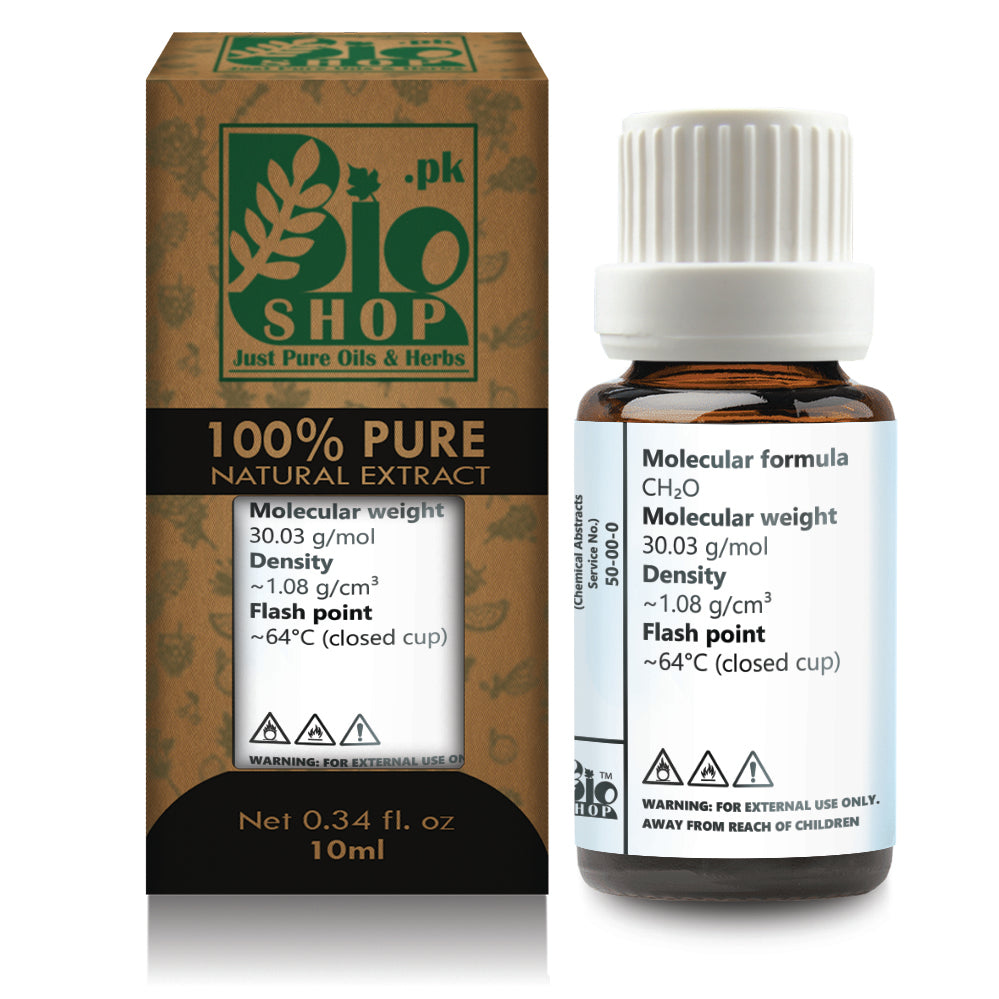
CAS Number : 50-00-0
Molecular Formula : CH₂O (HCHO)
Appearance : Colorless aqueous liquid (as Formalin); colorless gas in pure form
Odor : Sharp, pungent, suffocating
pH (1% solution) : 2.8 – 4.0
Solubility : Fully miscible with water, ethanol, and most polar solvents
Specific Gravity : 1.08 – 1.09 (37–40% Formalin solution at 20°C)
Flash Point : 85°C (Formalin solution, closed cup)
HLB Value : Not Applicable
Recommended Use Level : 0.01–0.2% as free formaldehyde in finished cosmetic product
Type : Preservative / Biocide / Nail Hardener
Shelf Life : 12–24 months — store above 15°C to prevent polymerization to paraformaldehyde
🧪 Recommended Usage
Skincare (Creams, Serums, Lotions)
Rating : ★★★☆☆
Formaldehyde is permitted in leave-on skincare at a maximum of 0.2% free formaldehyde, but sensitization risk makes it a non-preferred choice for long-contact formulations. If used, keep concentration at the minimum effective level, add to the water phase, and ensure EU mandatory labeling compliance at concentrations above 0.05%.
Haircare (Shampoo, Conditioner, Masks)
Rating : ★★★★☆
Rinse-off hair products represent one of the most practical applications for formaldehyde preservation due to limited skin contact time. Use at 0.05–0.1% free formaldehyde in shampoo and hair mask bases where broader preservation coverage is required.
Soap Making (Cold Process, Melt and Pour)
Rating : ★★☆☆☆
The high-pH alkaline environment of cold process soap significantly reduces formaldehyde's preservative efficacy, and more suitable alternatives are readily available. Not recommended for standard soap making applications.
Body Care (Scrubs, Butters, Balms)
Rating : ★★☆☆☆
Extended skin contact in body butters and balms elevates sensitization risk above acceptable levels for routine use. Rinse-off scrubs may permit use at strictly controlled low concentrations, but modern preservation alternatives are strongly preferred.
Nail Care (Nail Hardeners, Nail Treatments)
Rating : ★★★★★
Formaldehyde has a well-established role in professional nail hardener formulations, where it cross-links nail plate keratin to improve structural hardness and resistance. Use within permitted concentrations and verify current EU and national regulatory limits applicable to nail product categories specifically.
💡 Pro Tip
In professional cosmetic preservation work, I rarely reach for formaldehyde as a first choice in leave-on products, but in rinse-off systems where water activity is high and other preservatives struggle to deliver adequate broad-spectrum coverage, it remains a technically valid option at carefully controlled levels. Its strength lies in its immediate, irreversible biocidal action — properties that make it genuinely difficult to replace in certain high-water, low-pH rinse-off systems. The key discipline is maintaining absolute precision in concentration, because the gap between effective and problematic is narrow with this ingredient.
ADVANCED TIP: When incorporating Formalin into a rinse-off shampoo preservation system, always dilute the Formalin solution into the water phase at room temperature before combining with surfactants. Calculate your use level based on the actual free formaldehyde content of your specific Formalin batch — not the total solution weight. At 0.05–0.1% free formaldehyde, pair with a secondary preservative such as Phenoxyethanol at 0.3–0.5% to build a synergistic broad-spectrum system while keeping the formaldehyde contribution below the 0.05% mandatory labeling threshold where formulation parameters allow.
👩🔬 Skin Type Suitability
Normal Skin : ★★★☆☆ — Tolerated in rinse-off formats at regulated concentrations, but sensitization potential limits suitability in leave-on applications.
Dry Skin : ★★☆☆☆ — Formaldehyde can disrupt barrier integrity and aggravate moisture loss in already-compromised dry skin.
Oily Skin : ★★★☆☆ — Slightly better tolerated in rinse-off products, but repeated exposure still carries meaningful sensitization risk.
Combination : ★★☆☆☆ — Differing barrier conditions across T-zone and cheek areas make consistent tolerance unpredictable in leave-on formulations.
Sensitive Skin : ★☆☆☆☆ — A known contact allergen and primary sensitizer; formaldehyde is contraindicated for products targeting sensitive skin types.
Mature Skin : ★★☆☆☆ — Diminished barrier integrity in mature skin significantly elevates sensitization and irritation risk.
Acne-Prone : ★★☆☆☆ — Can cause irritation, disrupt the skin microbiome, and worsen inflammatory conditions; alternative preservatives are preferred.
🧴 Formulation Ideas
CONCEPT 1: Anti-Microbial Clarifying Shampoo
Usage Level : 0.05–0.1% (as free formaldehyde)
Key Ingredients: Sodium Laureth Sulfate, Cocamidopropyl Betaine, Glycerin, Citric Acid
Result : A high-water-activity rinse-off shampoo with reliable broad-spectrum microbial protection, suitable for professional-use environments where water quality and contamination risk may vary.
CONCEPT 2: Professional Nail Hardening Treatment
Usage Level : 0.1–0.2% as free formaldehyde (verify current regulatory limit for nail product category)
Key Ingredients: Nitrocellulose, Tosylamide/Formaldehyde Resin, Butyl Acetate, Ethyl Acetate
Result : A clear nail hardener that cross-links nail plate keratin proteins, producing measurably firmer, chip-resistant nails with regular professional application.
CONCEPT 3: Preservative-Boosted Liquid Hand Wash
Usage Level : 0.05% (as free formaldehyde)
Key Ingredients: Sodium Laureth Sulfate, Decyl Glucoside, Allantoin, Phenoxyethanol
Result : A rinse-off hand cleanser employing formaldehyde as part of a dual-preservative system for robust antimicrobial protection in high-use settings such as clinical or food service environments.
💧 Safety and Regulatory:
INCI Declared : Yes — mandatory labeling "contains formaldehyde" required when concentration in finished product exceeds 0.05%
EU Cosmetics Reg : Restricted — Annex V, Entry 5; max 0.2% as free formaldehyde in cosmetics; 0.1% in oral hygiene products; prohibited in aerosol dispensers
Rinse-Off Limit : 0.2% (as free formaldehyde)
Leave-On Limit : 0.2% (as free formaldehyde)
Allergen Alert : Yes — known contact allergen and primary sensitizer; may cause allergic contact dermatitis with repeated exposure
Skin Safety : Patch test advised; use at minimum effective concentration; not suitable for sensitive skin formulations
Eye Area Use : Avoid
Ingestion : Not for internal use
Pregnancy Use : Consult physician
Child Safety : Avoid in products for children under 3 years; exercise caution in rinse-off formulations for older children
Ventilation : Required — inhalation of formaldehyde vapor above 0.1 ppm is a recognized occupational health hazard
Storage : Store above 15°C to prevent paraformaldehyde precipitation; keep tightly sealed in a cool, ventilated area away from heat and ignition sources
Container : HDPE or glass — avoid reactive metals and open-top containers
⚠️ WARNING: Formaldehyde is classified as an IARC Group 1 carcinogen (carcinogenic to humans) and is a known skin sensitizer and respiratory irritant. Inhalation exposure must be strictly minimized during handling and formulation. This ingredient is prohibited in aerosol cosmetic products under EU Cosmetics Regulation. Handlers must comply with applicable occupational health and safety regulations and workplace exposure limits. Products must carry the declaration "contains formaldehyde" when free formaldehyde exceeds 0.05% in the finished formula.
Stability and Compatibility
Working pH Range : 3.0 – 8.0 (optimal preservative efficacy at pH 3.0–6.0)
Heat Stability : Stable up to 100°C; avoid prolonged exposure above 80°C; add to water phase at or below room temperature
Freeze-Thaw Stable : No — polymerizes to paraformaldehyde below 15°C; warming above 25°C redissolves the precipitate
Emulsion Type : Both — water-soluble; dissolves into water phase of O/W or W/O systems
Emulsification Phase: Cold or warm — add to water phase before emulsification; minimize high-heat exposure duration
Compatible With : Water-based systems, surfactant systems, polyols, alcohols, acidic pH buffers, most synthetic polymers and gums
Incompatible With : Strong oxidizing agents, strong alkalis above pH 9, reactive amines, high-concentration protein-rich raw materials
Oxidation Risk : Low — not subject to oxidative degradation under normal storage conditions
Discoloration Risk : Possible — may cause yellowing in formulas containing proteins, amino acids, or amine-bearing raw materials over time
Formulation Notes : Always calculate use level based on the actual free formaldehyde content of the specific Formalin batch — a 40% Formalin solution requires 0.5 g to deliver 0.2 g free formaldehyde per 100 g formula. Keep Formalin containers tightly sealed at all times to prevent vapor loss and off-gassing.
❓ FAQs
Q: What is the difference between Formalin and Formaldehyde?
A: Formaldehyde (HCHO) is the pure aldehyde compound existing as a gas at room temperature, while Formalin is a 37–40% aqueous solution of formaldehyde in water, typically stabilized with 10–15% methanol. In cosmetic formulation, Formalin is the commercially supplied form used to deliver formaldehyde at precisely controlled concentrations.
Q: What is the maximum permitted use level for Formaldehyde in a shampoo?
A: Under EU Cosmetics Regulation Annex V, Entry 5, the maximum permitted concentration is 0.2% as free formaldehyde in non-oral cosmetic products, including rinse-off products such as shampoos. Practical use levels of 0.05–0.1% free formaldehyde are sufficient in most rinse-off preservation systems, and keeping below 0.05% avoids the mandatory labeling requirement.
Q: Why does Formalin turn cloudy or form a white solid in storage?
A: Formalin stored below 15°C can polymerize to form paraformaldehyde, a white solid precipitate. This is a reversible process — gently warming the solution above 25°C with occasional mixing typically redissolves the precipitate and restores the solution to its clear state.
Q: Can Formaldehyde be used in baby products or formulations for sensitive skin?
A: Formaldehyde is not recommended for products targeting sensitive skin or children under 3 years of age due to its known sensitization potential and IARC Group 1 carcinogen classification. For these applications, well-tolerated alternatives such as Phenoxyethanol, Ethylhexylglycerin, or mild organic acid-based preservation systems should be selected.
Q: How does direct Formaldehyde compare to formaldehyde-releasing preservatives such as DMDM Hydantoin?
A: Formaldehyde-releasing preservatives such as DMDM Hydantoin, Imidazolidinyl Urea, and Diazolidinyl Urea achieve preservation by slowly releasing free formaldehyde over time, producing a more controlled and gradual antimicrobial effect than direct Formalin addition. Direct Formalin use delivers immediate high-efficacy biocidal action but requires tighter concentration management and carries identical labeling obligations — both approaches trigger the "contains formaldehyde" declaration when free formaldehyde in the finished product exceeds 0.05%.
Where Can You Safely Use Formalin (Formaldehyde)
Discover how Formalin (Formaldehyde) performs across different products — rated for safety, stability, and effectiveness.


