Bio Shop
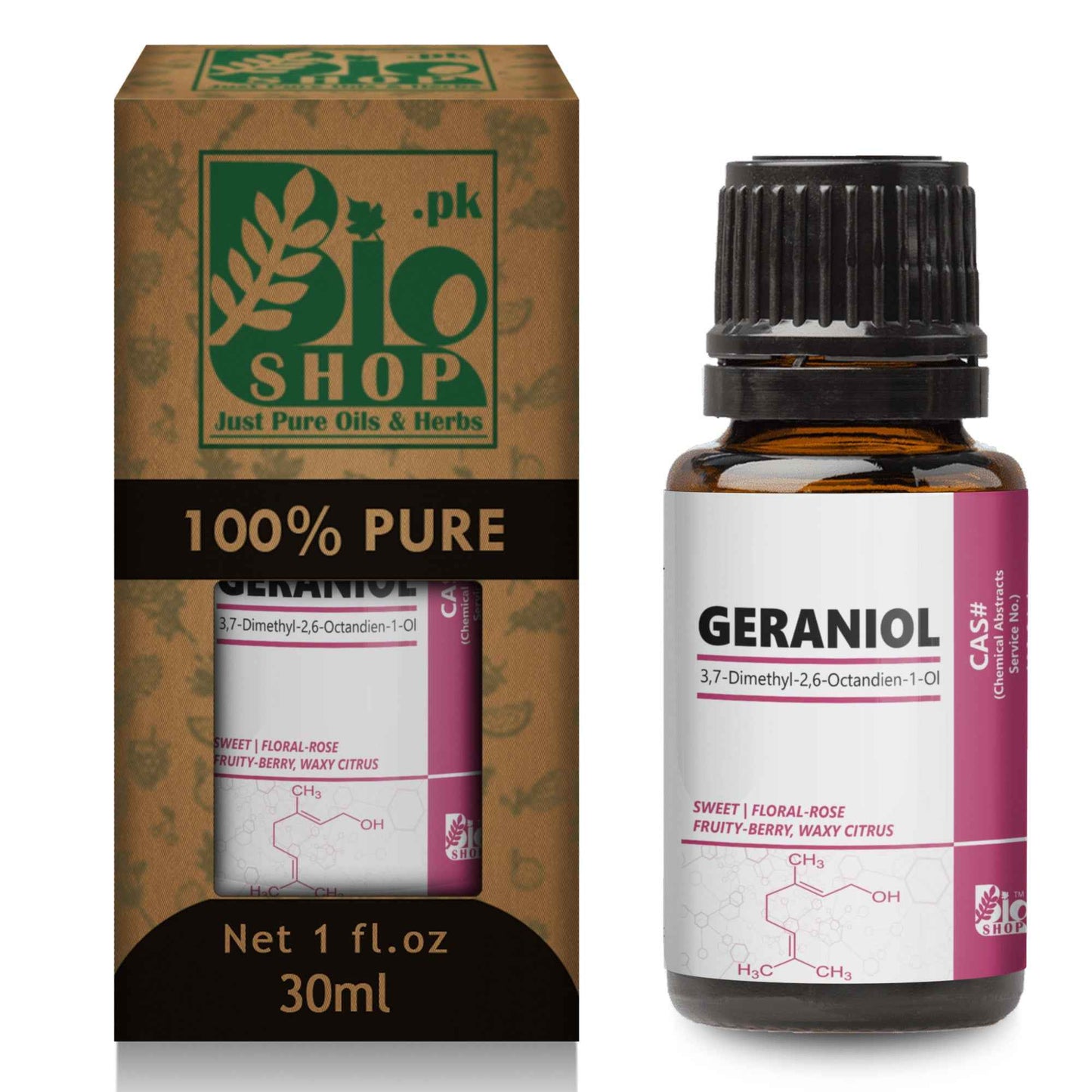
Geraniol
Geraniol
Olfactory Notes: Sweet, fruity-rosy; fresher than Geraniol.
Couldn't load pickup availability
Explore
Information About Geraniol
Key Features
✦ Naturally occurring monoterpene alcohol with a fresh, sweet, rosy and lychee-like aroma — one of the most important floral aroma chemicals in perfumery
✦ Found naturally in rose oil, palmarosa, geranium, citronella and lemongrass — available as both natural-isolated and synthetic-identical material
✦ Dual-function ingredient: valued for its fragrance character and its documented antimicrobial and antioxidant activity in cosmetic formulations
✦ Essential building block for rose, geranium, neroli, muguet, and oriental floral accords used by perfumers worldwide
✦ Excellent performance across alcoholic perfume, soap, shampoo, lotion, and home fragrance applications with good stability
✦ Vegan and cruelty-free; widely used in natural, organic, and halal-certified cosmetic and fragrance products
✦ Listed as an EU 26 allergen — requires declaration on cosmetic product labels when present above threshold concentrations
About Geraniol
Geraniol is one of the oldest and most studied aroma chemicals in the perfumer's palette. It was first isolated in the 19th century from geranium and rose oils and has remained a cornerstone of floral perfumery ever since. Chemically it is an acyclic monoterpene alcohol closely related to linalool, nerol, and citronellol — a family of compounds that collectively define the character of rose, geranium, and citrus-floral fragrances. It occurs naturally in over 160 plant species and is a significant component of Bulgarian rose absolute, Turkish rose oil, palmarosa essential oil, and citronella oil. Its widespread natural occurrence has made it one of the most thoroughly safety-assessed fragrance ingredients in existence.
What distinguishes geraniol from other rosy aroma chemicals is the complexity it brings to a formula. It is not simply a one-dimensional rose note. There is a fresh citrus lift at the opening, a full rosy floral heart, and a soft, warm, slightly green drydown that reads as natural and botanical rather than synthetic. This multi-layered quality makes it an exceptionally useful blending material across a wide range of fragrance families — from transparent florals to rich orientals. Its documented antimicrobial activity also adds functional value in rinse-off and leave-on personal care applications beyond pure scent performance.
Bio Shop Pakistan supplies cosmetic-grade geraniol suitable for DIY perfumers, soap and lotion makers, independent fragrance blenders, and professional cosmetic formulators working with floral, oriental, and natural-style compositions.
Olfactory Profile
SCENT DESCRIPTION : Geraniol opens with a bright, citrusy lift before settling into its signature character — a full, rich, rosy floral warmth that is sweet without being cloying. The mid-stage reveals a lychee-like fruitiness that adds depth and a contemporary freshness to the classic rose impression. There is a slight waxy, green quality in the background that keeps the note from reading as purely synthetic. The drydown is soft, warm, and smooth with a faint powdery trail reminiscent of rose petals pressed gently into warm skin.
NOTE POSITION : Mid — with a brief citrusy top lift
FRAGRANCE FAMILY : Floral · Citrus-Floral · Oriental-Floral
FACETS : Rosy · Sweet · Citrusy · Waxy · Lychee
TENACITY : Medium-High — active on skin for 6 to 10 hours; good substantivity in leave-on products
SILLAGE : Medium — projects with a natural, approachable presence; radiates warmth rather than projection
Technical Specifications
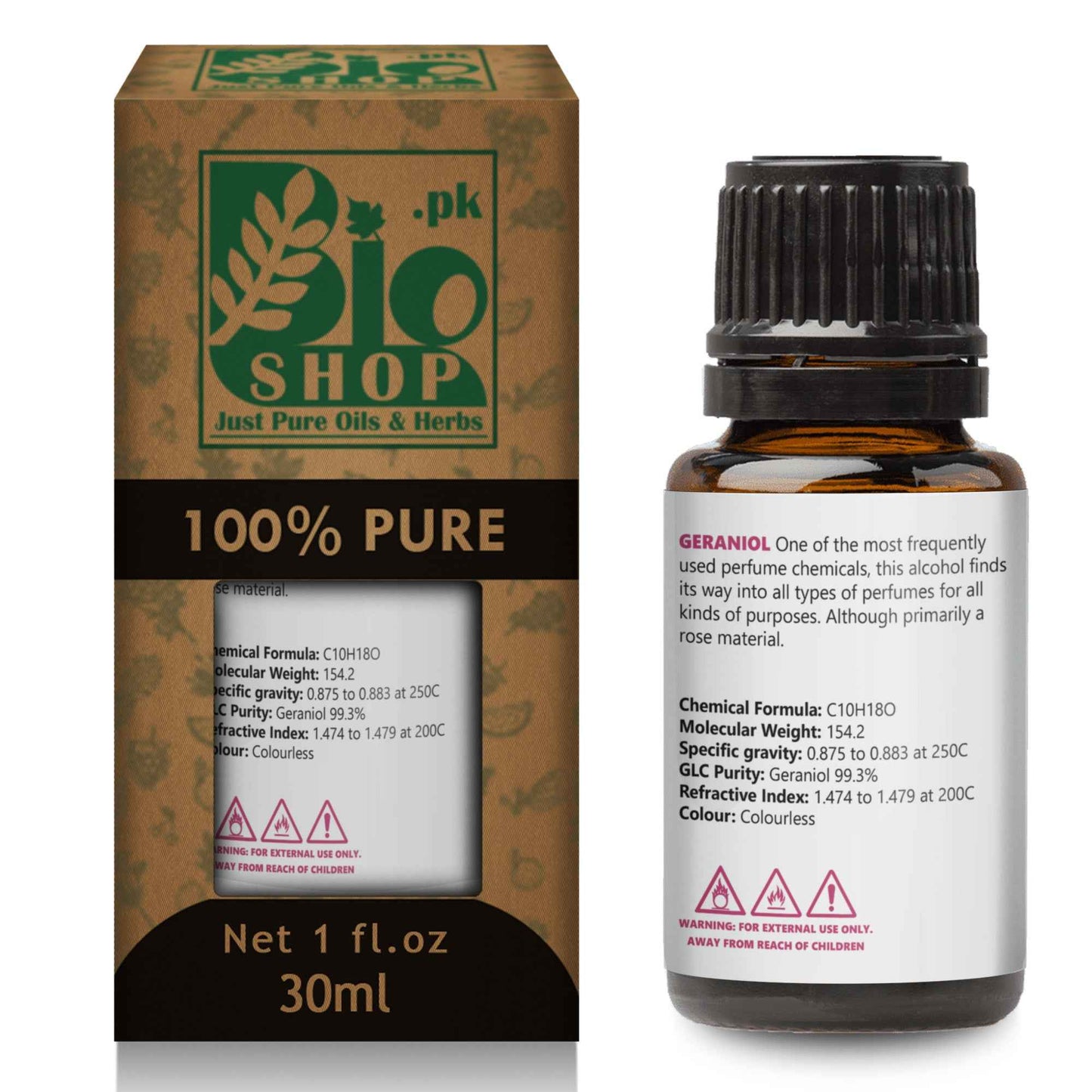
Chemical Name : 3,7-Dimethylocta-2,6-dien-1-ol
CAS Number : 106-24-1
Synonyms : Geranyl Alcohol, Lemonol, trans-Geraniol, (E)-Geraniol, FEMA 2507
Purity : 98% minimum (verify with current batch COA)
Appearance : Colorless to pale yellow oily liquid
Odor Threshold : Approximately 0.04 to 0.1 ppm — moderately low; detectable at low concentrations
Solubility : Soluble in ethanol, fixed oils, and most fragrance carriers; poorly soluble in water; soluble in propylene glycol with agitation
Specific Gravity : 0.874 to 0.882 g/cm³ at 20°C
Flash Point : Approximately 101 to 104°C — verify with SDS from current batch
Refractive Index : 1.469 to 1.478 at 20°C
Type : Natural-identical synthetic / also available as naturally isolated from palmarosa or citronella
Applications & Usage Guidelines
Fine Fragrance ★★★★★
Geraniol is a pillar of classical and contemporary floral perfumery. It is indispensable in rose, geranium, neroli, and muguet accords and adds a natural-smelling complexity to oriental and chypre bases. Use at 1% to 15% in EDP and EDT compositions depending on the desired floral intensity and accord structure. Note EU allergen declaration requirements above 0.01% in leave-on and 0.1% in rinse-off products.
Attar and Oriental Blending ★★★★★
Geraniol is a traditional material in South Asian and Middle Eastern attar making, where it is central to gulab (rose) attars and rosy oriental compositions. It blends harmoniously with sandalwood, oud, rose absolute, and musks in classic Indian and Arabic perfumery styles. Use at 2% to 20% in oil-based attar compositions for a rich, authentic rose character.
Functional Fragrance ★★★★☆
Performs excellently in shampoos, conditioners, body washes, and fabric care products. Its antimicrobial activity adds functional value beyond scent in personal care and cleaning product applications. Good stability in surfactant systems at recommended usage levels makes it a practical choice for industrial and home formulation.
Cosmetics ★★★★☆
Widely used in creams, lotions, lip products, and body oils to add a rosy floral character. Compatible with a broad range of cosmetic ingredients and stable across typical pH and temperature ranges. Pre-mix in a small amount of carrier oil or emollient before adding to water-phase emulsions for best dispersion.
Home Fragrance ★★★★☆
Effective in reed diffusers, candles, room sprays, and incense where a natural floral note is desired. Adds warmth and naturalness to rose and floral home fragrance accords. Combines well with citrus top notes and musk bases for well-rounded room fragrance compositions.
IFRA & Usage Rate
Recommended Usage Rates
Application : Recommended Rate
EDP (Eau de Parfum) : 2.0% to 15.0%
EDT (Eau de Toilette) : 1.0% to 10.0%
Body Lotion : 0.5% to 2.0%
Shampoo / Body Wash : 0.5% to 2.0%
Candle : 3.0% to 8.0%
Reed Diffuser : 5.0% to 15.0%
Bar Soap : 1.0% to 3.0%
IFRA 51st Amendment Limits (Selected Categories)
IFRA Category 1 (Lip products) : 0.05%
IFRA Category 2 (Deodorant / Axillary) : 0.70%
IFRA Category 3 (Eye area) : 0.50%
IFRA Category 4 (Fine fragrance) : 15.30%
IFRA Category 5a (Body lotion, leave-on) : 3.10%
IFRA Category 5b (Face cream, leave-on) : 3.10%
IFRA Category 6 (Mouthwash — not applicable) : Not permitted for fragrance use
IFRA Category 9 (Rinse-off body / hair) : 6.90%
IFRA Category 11a (Fabric softener) : 3.00%
IFRA Category 12 (Candles) : No restriction specified — follow GMP
⚠ Geraniol is classified as an EU 26 declared fragrance allergen. It must be listed by name on cosmetic product labels when its concentration exceeds 0.001% in leave-on products and 0.01% in rinse-off products under EU cosmetic regulations. Formulators selling into EU-regulated or EU-aligned markets must comply.
⚠ Always verify current IFRA amendment status and obtain the latest QRA calculations from your fragrance safety assessor before commercial production.
⚠ Geraniol can oxidize on exposure to air to form sensitizing compounds. Store sealed and away from light. Use antioxidants such as BHT or tocopherol in oxygen-sensitive formulations.
Blending Guide
Usage Method 1 — Direct Addition in Alcoholic Perfumery
Geraniol is a liquid at room temperature and fully miscible with perfumer's alcohol at all standard usage levels. Add directly to your concentrate or dilution at the required weight percentage. Allow the finished fragrance to macerate for a minimum of 48 to 72 hours before evaluation, as geraniol integrates and softens considerably during maceration. Its citrusy opening note will fade and the rosy heart will come forward with rest.
Usage Method 2 — Carrier Pre-Blending for Cosmetics and Oils
For oil-based products including attars, body oils, and cream perfumes, geraniol is directly miscible with fixed oils, fractionated coconut oil, jojoba, and other cosmetic carriers. For water-containing emulsions, pre-disperse in a small portion of emollient or propylene glycol at the oil phase stage. This ensures uniform distribution throughout the emulsion without layering or separation.
Usage Method 3 — Accord Building as a Structural Material
Geraniol excels as a structural backbone material in rose, geranium, and neroli accords rather than simply as a modifier. Build your accord by establishing the geraniol level first at 30 to 60% of the accord weight, then layer supporting materials such as citronellol for creaminess, phenyl ethyl alcohol for body, and rose oxide for metallic character. This layered approach produces accords that read as natural and multi-dimensional in the final fragrance.
BEST PAIRINGS
Citronellol → Adds creamy, soft-rose depth and rounds the slightly sharp citrus edge of geraniol
Rose Absolute / Rose Otto → Amplifies authenticity; geraniol and rose absolute together approach the real flower
Phenyl Ethyl Alcohol → Contributes sweet, honey-rose body and bridges geraniol into the heart
Linalool → Creates a soft, lavender-rose bridge; elegant and unisex
Rose Oxide → Adds metallic, watery character that modernizes the geraniol rose note
Sandalwood (Santalol / Sandela)→ Grounds the floral note with warm, creamy wood depth for oriental builds
Neroli / Petitgrain → Combines for a fresh, citrus-floral chypre quality ideal for summer compositions
Eugenol → Adds a clove-spice accent that bridges geraniol into carnation and oriental accords
Vetiver (Vetiveryl Acetate) → Creates a rosy-earthy contrast that is sophisticated and long-lasting
Ylang Ylang Essential Oil → Intensifies tropical floral richness with a creamy, banana-floral dimension
AVOID
At very high concentrations in final products geraniol can create a slightly harsh, sharp edge. If this occurs, balance with citronellol or linalool rather than increasing other materials. Avoid combining at high levels with strongly oxidizing ingredients in leave-on cosmetics without antioxidant protection, as geraniol is susceptible to oxidative degradation which can both diminish fragrance quality and increase skin sensitization risk.
Perfumer's Note
Geraniol is the vocabulary of the rose — not the complete sentence, but the essential words without which nothing reads correctly. I have used it at every level of fragrance work, from simple DIY soap blends to structured fine fragrance accords, and it remains one of the materials I return to most consistently. What it does in a formula is subtly architectural: it gives floral compositions a naturalness and a living quality that purely synthetic roses never quite achieve on their own. Even in non-rose contexts — a muguet, a neroli, a delicate white floral — a small addition of geraniol introduces a warmth and roundness that stops the composition from reading as flat or chemical. It is one of those materials where knowing when not to use it is as important as knowing how to use it.
ADVANCED TIP : Create a working rose base using geraniol as the foundation before adding any rose absolute or other expensive naturals. Combine geraniol at 40%, citronellol at 30%, phenyl ethyl alcohol at 20%, and rose oxide at 0.5%, with the remaining percentage filled by eugenol and linalool to taste. Evaluate this synthetic rose base in alcohol at 10% dilution and refine until the character satisfies you. Once this base is dialed in, adding even 1 to 2% of real rose absolute on top of this synthetic foundation will produce an accord that rivals formulations using three to four times the volume of expensive rose absolute. This technique is widely used in professional perfumery to extend costly naturals without sacrificing olfactory quality.
Safety & Storage
Physical State : Colorless to pale yellow oily liquid at room temperature; pleasant rosy odor
Skin Safety : Safe at recommended usage levels; a known EU 26 allergen — always dilute before skin application; avoid undiluted prolonged skin contact; patch testing recommended for sensitive individuals
Eye Contact : Avoid direct contact; if contact occurs, rinse immediately with clean water for 15 minutes and seek medical advice if irritation continues
Ingestion : Not for internal use in cosmetic or fragrance context; keep away from children; do not consume
Ventilation : Use in adequately ventilated workspace; avoid prolonged inhalation of concentrated vapors during large-scale blending operations
Storage : Store in a sealed container in a cool, dark, dry location away from heat and direct sunlight; ideal temperature 10 to 20°C; protect from air exposure to minimize oxidation
Shelf Life : Minimum 24 months when stored correctly in sealed, nitrogen-purged or airtight containers; addition of 0.1% BHT or tocopherol extends shelf life and reduces oxidation risk
Container : Amber glass, HDPE, or aluminum containers are preferred; avoid PET for long-term storage; always seal tightly after each use
Flammability : Flash point approximately 101 to 104°C; not classified as a standard flammable liquid under normal storage but keep away from open flame and heat sources
FAQ
Q: What is the difference between geraniol and geranium essential oil?
A: Geraniol is a single isolated aroma chemical — one of the key components found inside geranium essential oil. Geranium essential oil is a complex natural oil containing geraniol alongside citronellol, linalool and dozens of other compounds. Geraniol gives you precise dosing control; geranium oil gives you natural complexity.
Q: Does geraniol need to be declared as an allergen on product labels?
A: Yes. Geraniol is on the EU list of 26 declared fragrance allergens. It must be listed by name on leave-on cosmetic products when present above 0.001% and on rinse-off products above 0.01%. Formulators targeting EU or EU-aligned markets must comply with this requirement.
Q: Can geraniol go rancid or degrade over time?
A: Yes, geraniol is susceptible to oxidation on prolonged exposure to air and light. Oxidized geraniol can develop a sharper, less pleasant odor and may increase skin sensitization risk. Always store in sealed, airtight containers and consider adding a small amount of antioxidant such as BHT or tocopherol in formulations with a long shelf life.
Q: What is the recommended starting usage rate for a beginner building a rose accord?
A: Start at 5 to 10% geraniol in your alcohol dilution and evaluate at 10% total fragrance load in perfumer's alcohol. This gives you a clear sense of its character before layering other materials. Adjust upward to increase floral intensity, and introduce citronellol and phenyl ethyl alcohol to build fullness.
Q: How does geraniol compare to citronellol for rose-type formulations?
A: Both are core rose aroma chemicals but with distinct personalities. Geraniol is brighter, more citrusy, and fresher with a rosy-lychee character. Citronellol is softer, creamier, and more diffuse with a gentle powdery-rose quality. Professional rose accords use both together — typically geraniol for lift and definition, citronellol for body and softness. Using either alone produces a one-dimensional result compared to their combined effect.
Where Can You Safely Use Geraniol?
Discover how Geraniol performs across different applications—rated for safety, stability, and effectiveness.