Bio Shop
Hydrogen peroxide
Hydrogen peroxide
Key Functions: Bleaches hair, disinfects skin, brightens complexion, and oxidizes pigment.
Couldn't load pickup availability

Explore
Information About Hydrogen peroxide
✅ Key Features
✦ Effective bleaching and lightening agent for hair coloring and developer formulations
✦ Releases nascent oxygen to provide antiseptic and antimicrobial action on skin
✦ Used in professional hair developer creams at 3% to 12% concentrations
✦ Active ingredient in teeth whitening gels and oral care cosmetic products
✦ Assists in acne spot treatments through controlled oxidation of bacteria
✦ Synthetically produced but decomposes into water and oxygen leaving no harmful residue
✦ Must be used within strict concentration limits to ensure skin and scalp safety
🔬 Description
Hydrogen peroxide is a simple inorganic compound composed of hydrogen and oxygen, first discovered in 1818 by Louis Jacques Thenard. It has been used in cosmetic and personal care applications for over a century, most notably as a hair bleaching agent and topical antiseptic. In its pure form it is a pale blue liquid, but cosmetic grades are sold as clear, colorless aqueous solutions at controlled concentrations.
What makes hydrogen peroxide uniquely valuable in cosmetics is its oxidative mechanism. Upon application, it decomposes into water and oxygen, and this released oxygen breaks down melanin pigment in hair and can lighten superficial skin discoloration. In hair coloring systems, it activates permanent dye precursors and lifts the hair cuticle to allow color penetration. This dual function as both a bleaching agent and a chemical activator makes it irreplaceable in professional hair color chemistry.
Bio Shop Pakistan supplies cosmetic-grade hydrogen peroxide suitable for hair colorists, salon professionals, DIY beauty formulators, and cosmetic product manufacturers.
📊 Technical Data
INCI Name : Hydrogen Peroxide
Chemical Name : Hydrogen Peroxide
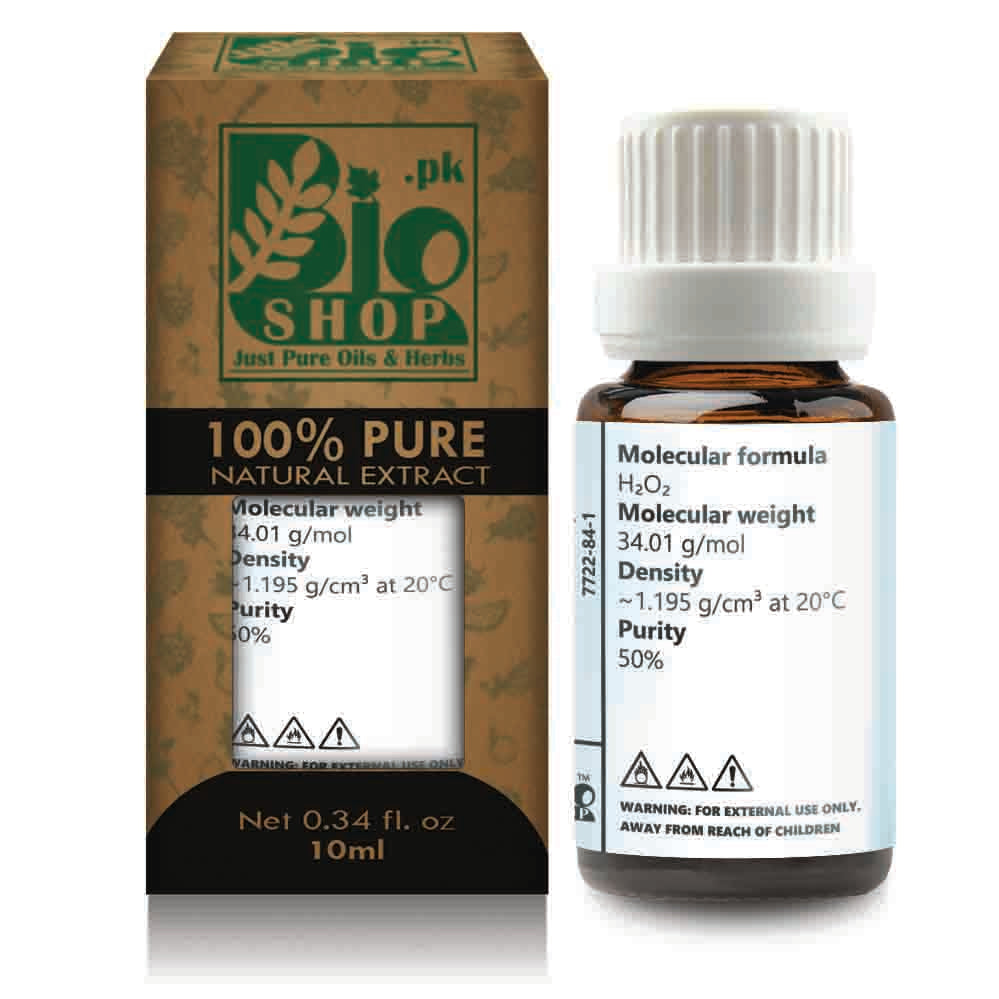
CAS Number : 7722-84-1
Molecular Formula : H2O2
Appearance : Clear, colorless liquid
Odor : Slightly sharp, characteristic
pH (1% solution) : 3.0 to 4.5
Solubility : Fully miscible in water
Specific Gravity : 1.01 (3% solution) to 1.04 (12% solution)
Flash Point : Not flammable (aqueous solutions below 52%)
HLB Value : Not Applicable
Recommended Use Level : 3% to 12% in hair products; 1% to 3% in skin products
Type : Oxidizing Agent / Bleaching Agent / Antiseptic
Shelf Life : 6 to 12 months (sealed, stored away from light and heat)
🧪 Recommended Usage
META TITLE
Hydrogen Peroxide – Bleaching & Antiseptic Agent | Bio Shop Pakistan
META DESCRIPTION
Buy cosmetic-grade hydrogen peroxide at Bio Shop Pakistan. Ideal for hair bleaching, skin lightening formulations, and antiseptic cosmetic products.
SEO DESCRIPTION
Hydrogen peroxide (INCI: Hydrogen Peroxide) is a powerful oxidizing agent widely used in cosmetic and personal care formulations. With the chemical formula H2O2, this clear liquid serves as a bleaching agent in hair lightening products, a mild antiseptic in oral care formulations, and an active ingredient in skin brightening treatments. Hydrogen peroxide works by releasing nascent oxygen upon contact with organic tissue, making it effective for disinfection and controlled oxidation in cosmetic chemistry. It is commonly found in hair developer creams, teeth whitening gels, acne spot treatments, and ear care drops. Cosmetic-grade hydrogen peroxide is available in concentrations ranging from 3% to 12% for personal care applications, with higher concentrations reserved for professional salon use. Formulators must handle this ingredient with strict attention to concentration limits and pH stability. Bio Shop Pakistan supplies cosmetic-grade hydrogen peroxide for DIY beauty formulators, salon professionals, and cosmetic manufacturers across Pakistan.
KEY FUNCTIONS
Hydrogen Peroxide Key Functions: Bleaches hair, disinfects skin, brightens complexion, and oxidizes pigment.
FIELD 1 — KEY FEATURES
✦ Effective bleaching and lightening agent for hair coloring and developer formulations
✦ Releases nascent oxygen to provide antiseptic and antimicrobial action on skin
✦ Used in professional hair developer creams at 3% to 12% concentrations
✦ Active ingredient in teeth whitening gels and oral care cosmetic products
✦ Assists in acne spot treatments through controlled oxidation of bacteria
✦ Synthetically produced but decomposes into water and oxygen leaving no harmful residue
✦ Must be used within strict concentration limits to ensure skin and scalp safety
FIELD 2 — DESCRIPTION
Hydrogen peroxide is a simple inorganic compound composed of hydrogen and oxygen, first discovered in 1818 by Louis Jacques Thenard. It has been used in cosmetic and personal care applications for over a century, most notably as a hair bleaching agent and topical antiseptic. In its pure form it is a pale blue liquid, but cosmetic grades are sold as clear, colorless aqueous solutions at controlled concentrations.
What makes hydrogen peroxide uniquely valuable in cosmetics is its oxidative mechanism. Upon application, it decomposes into water and oxygen, and this released oxygen breaks down melanin pigment in hair and can lighten superficial skin discoloration. In hair coloring systems, it activates permanent dye precursors and lifts the hair cuticle to allow color penetration. This dual function as both a bleaching agent and a chemical activator makes it irreplaceable in professional hair color chemistry.
Bio Shop Pakistan supplies cosmetic-grade hydrogen peroxide suitable for hair colorists, salon professionals, DIY beauty formulators, and cosmetic product manufacturers.
FIELD 3 — TECHNICAL DATA
INCI Name : Hydrogen Peroxide
Chemical Name : Hydrogen Peroxide
CAS Number : 7722-84-1
Molecular Formula : H2O2
Appearance : Clear, colorless liquid
Odor : Slightly sharp, characteristic
pH (1% solution) : 3.0 to 4.5
Solubility : Fully miscible in water
Specific Gravity : 1.01 (3% solution) to 1.04 (12% solution)
Flash Point : Not flammable (aqueous solutions below 52%)
HLB Value : Not Applicable
Recommended Use Level : 3% to 12% in hair products; 1% to 3% in skin products
Type : Oxidizing Agent / Bleaching Agent / Antiseptic
Shelf Life : 6 to 12 months (sealed, stored away from light and heat)
FIELD 4 — RECOMMENDED USAGE
Hair Coloring and Bleaching ★★★★★
Hydrogen peroxide is the industry-standard developer in permanent hair color and bleach formulations. Use at 3% (10 vol) for deposit-only color, 6% (20 vol) for one to two levels of lift, and 9% to 12% for high-lift bleaching with professional supervision.
Oral Care (Teeth Whitening, Mouthwash) ★★★★☆
Widely used in whitening toothpastes and rinses at 1% to 3% concentration. Ensure formulations maintain a mildly acidic to neutral pH and include humectants to reduce oral tissue sensitivity.
Skincare (Spot Treatments, Brightening) ★★★☆☆
Can be used in targeted acne spot treatments and mild skin brightening products at very low concentrations of 1% to 3%. Prolonged or repeated skin contact should be avoided as it can cause irritation and dryness.
Ear and Wound Care Cosmetics ★★★☆☆
Used in cosmetic ear cleaning drops and mild antiseptic washes at 3% concentration. Always formulate with stabilizers and ensure the product is buffered to a safe pH range.
Nail Care (Whitening, Prep) ★★★☆☆
Effective in nail whitening soaks and pre-manicure sanitizing solutions at 2% to 3%. Limit contact time to a few minutes and follow with a moisturizing treatment to prevent nail and cuticle dehydration.
💡 Pro Tip
n my formulation work, I treat hydrogen peroxide as a reactive ingredient that demands respect in every formula it enters. The most common mistake I see is failing to stabilize it properly, which leads to rapid decomposition, loss of efficacy, and even container swelling. I always add a chelating agent like EDTA or phytic acid to sequester trace metals that catalyze premature breakdown, and I keep the formulation pH between 3.0 and 4.5 for maximum shelf stability.
ADVANCED TIP: When formulating a hair developer cream, premix 0.05% disodium EDTA and 0.1% stannate-based stabilizer into your aqueous phase before adding hydrogen peroxide at your target volume strength. Maintain pH at 3.5 with phosphoric acid buffer, and always fill containers to minimize headspace oxygen. This approach can extend shelf stability from 6 months to over 12 months.
👩🔬 Skin Type Suitability
Normal Skin : ★★★☆☆ — Safe at low concentrations for occasional spot treatment but not suited for daily use.
Dry Skin : ★★☆☆☆ — Can strip moisture and worsen dryness; use only in rinse-off products with added emollients.
Oily Skin : ★★★☆☆ — Mild antibacterial action may help with surface bacteria but can irritate if overused.
Combination : ★★★☆☆ — Apply only to targeted oily or blemished zones; avoid dry areas entirely.
Sensitive Skin : ★☆☆☆☆ — High risk of irritation and redness; generally not recommended for sensitive skin types.
Mature Skin : ★★☆☆☆ — Oxidative stress can accelerate signs of aging; avoid prolonged or repeated application.
Acne-Prone : ★★★☆☆ — Can reduce surface bacteria in spot treatments but may cause peeling and dryness at higher levels.
🧴 Formulation Ideas
CONCEPT 1: Professional Hair Developer Cream (20 Volume)
Usage Level : 6% hydrogen peroxide
Key Ingredients: Cetearyl Alcohol, Ceteareth-20, Disodium EDTA, Phosphoric Acid
Result : A stable, creamy 20-volume developer that mixes smoothly with permanent hair color for reliable one-to-two-level lift.
CONCEPT 2: Brightening Acne Spot Gel
Usage Level : 2% hydrogen peroxide
Key Ingredients: Carbomer 940, Aloe Vera Extract, Glycerin, Triethanolamine
Result : A clear, lightweight gel for targeted blemish treatment that disinfects and mildly lightens post-acne marks overnight.
CONCEPT 3: Whitening Nail Soak Solution
Usage Level : 3% hydrogen peroxide
Key Ingredients: Purified Water, Lemon Extract, Sodium Bicarbonate, Glycerin
Result : A simple soak that gently whitens yellowed or stained nails in five to ten minutes while keeping cuticles hydrated.
💧 Safety and Regulatory:
INCI Declared : Yes — required in all cosmetic products containing hydrogen peroxide
EU Cosmetics Reg : Restricted — Annex III, permitted up to 12% in hair products, lower limits for other uses
Rinse-Off Limit : Up to 4% in skin products; up to 12% in hair products (EU)
Leave-On Limit : Up to 2% in skin products; up to 0.1% in oral products (EU)
Allergen Alert : No — not a classified allergen, but strong irritant at higher concentrations
Skin Safety : Patch test advised; irritating above recommended levels
Eye Area Use : Avoid — causes serious eye irritation and potential corneal damage
Ingestion : Not for internal use
Pregnancy Use : Consult physician — limited safety data for cosmetic application during pregnancy
Child Safety : Avoid for children under 12; professional supervision required for hair use on minors
Ventilation : Recommended — especially when working with concentrations above 6%
Storage : Cool dry place away from direct light and heat; store below 25°C
Container : HDPE or dark PET plastic; avoid metal containers and reactive materials
⚠️ WARNING: Hydrogen peroxide is a strong oxidizer. Concentrations above 12% can cause chemical burns. Always wear gloves and eye protection during handling. Keep away from flammable materials. Never mix with reducing agents, acetone, or organic solvents.
Stability and Compatibility
Working pH Range : 3.0 to 4.5 (most stable)
Heat Stability : Decomposes rapidly above 50°C; never heat directly
Freeze-Thaw Stable : Yes (aqueous solutions)
Emulsion Type : Not applicable — used in aqueous or gel phases
Emulsification Phase: Not applicable
Compatible With : Water-based gels, carbomer systems, cellulose thickeners, EDTA chelators, phosphoric acid buffers
Incompatible With : Reducing agents, metal ions (iron, copper, manganese), strong alkalis, organic solvents, catalase enzymes
Oxidation Risk : High — it is the oxidizer; protect from catalytic decomposition with chelating agents
Discoloration Risk : Possible — can bleach dyes, pigments, and certain botanical extracts on contact
Formulation Notes : Always add hydrogen peroxide as the last step in formulation and avoid high-shear mixing which introduces air and accelerates decomposition. Include 0.02% to 0.1% chelating agent to prevent metal-catalyzed breakdown.
❓ FAQs
Q: What concentration of hydrogen peroxide is safe for cosmetic use at home?
A: For home use, 3% (10 volume) is the safest general-purpose concentration. Concentrations above 6% should only be used in hair products and ideally under professional guidance. Always perform a patch test before applying any hydrogen peroxide product to skin.
Q: Can hydrogen peroxide be used as a daily facial skin lightening treatment?
A: No, daily use on facial skin is not recommended. Hydrogen peroxide is an oxidizer that can damage the skin barrier, cause dryness, and increase sensitivity with repeated application. Use it only as an occasional spot treatment at 1% to 2%.
Q: Why does my hydrogen peroxide solution bubble and lose strength over time?
A: Hydrogen peroxide naturally decomposes into water and oxygen, especially when exposed to light, heat, or trace metal contamination. Store it in opaque or dark containers below 25°C and add a chelating agent like EDTA to extend its shelf life significantly.
Q: Can I mix hydrogen peroxide with vitamin C or niacinamide in a formulation?
A: No, both vitamin C (ascorbic acid) and niacinamide are reducing agents that will react with hydrogen peroxide, neutralizing all active ingredients and potentially generating heat or gas. These must always be kept in separate products.
Q: How does hydrogen peroxide compare to benzoyl peroxide for acne treatment?
A: Benzoyl peroxide is a more targeted and sustained acne treatment because it penetrates into pores and releases oxygen gradually over hours. Hydrogen peroxide works only on the skin surface and decomposes within minutes, making it less effective for ongoing acne management. For serious acne formulations, benzoyl peroxide is the preferred active.
Where Can You Safely Use Hydrogen peroxide
Discover how Hydrogen peroxide performs across different products — rated for safety, stability, and effectiveness.
Great quality product