Bio Shop
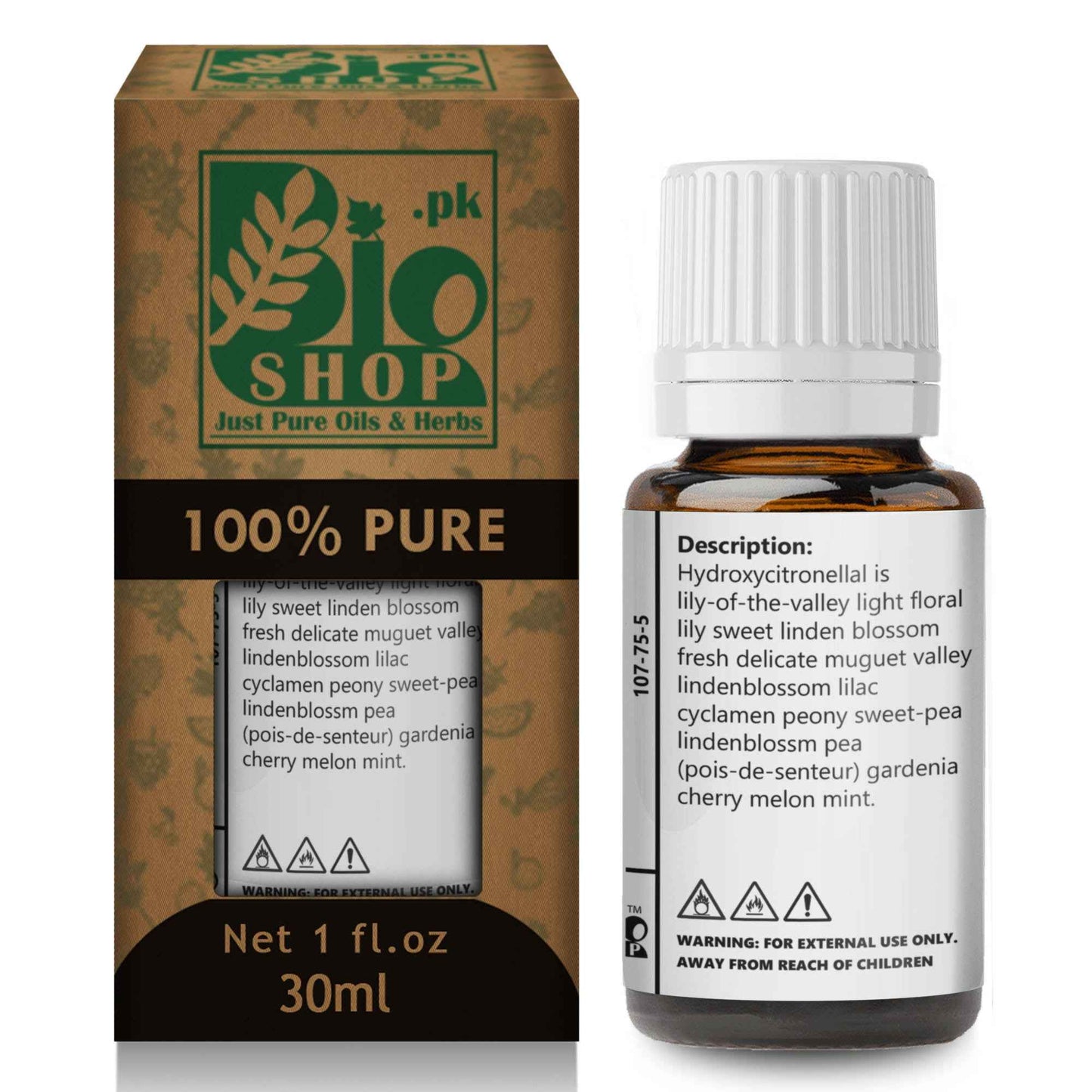
Hydroxycitronellal
Hydroxycitronellal
Olfactory Notes: Classic, sweet, and green "Lily of the Valley" scent.
Couldn't load pickup availability

Explore
Information About Hydroxycitronellal
Key Features
✦ Synthetic aroma chemical with a sweet, fresh lily-of-the-valley and muguet character — one of perfumery's most iconic floral building blocks.
✦ Core material for muguet, white floral, and fresh bouquet accords used in fine fragrance and functional perfumery worldwide.
✦ Featured in legendary compositions including Diorissimo (Christian Dior), Anais Anais (Cacharel), and numerous classic floral perfumes.
✦ Excellent blending versatility — harmonises with rose, jasmine, citrus, violet, woody, and green notes.
✦ Broad application range covering fine fragrance, body care, home fragrance, household cleaners, and fabric softeners.
✦ IFRA-registered ingredient — safe at recommended levels; always observe 51st Amendment limits for leave-on applications.
✦ Vegan and cruelty-free — 100% synthetically produced with no animal-derived ingredients or by-products.
About Hydroxycitronellal
Hydroxycitronellal is a synthetic aldehyde-type aroma chemical first synthesised in the early 1900s. It rapidly became one of the most recognisable floral materials in the perfumer's palette, valued for its ability to reproduce the delicate, dewy scent of lily-of-the-valley — a flower notoriously difficult to extract in natural form. Its rise through the twentieth century coincided with the golden age of fine fragrance, and it remains in widespread commercial and artisan use today.
What sets hydroxycitronellal apart is its exceptional diffusivity and bridging quality. Even at low concentrations it projects a bright, clean floral character that lifts an entire composition. It transitions smoothly between top and heart notes, providing both immediate freshness and lasting floral depth. Its compatibility with citrus aldehydes, musks, sandalwood, and rose materials makes it indispensable for classical and contemporary fragrance construction alike.
Bio Shop Pakistan supplies cosmetic-grade hydroxycitronellal suitable for DIY perfumers, independent fragrance houses, cosmetic formulators, and home crafters who require a reliable, high-purity floral building block for their creations.
Olfactory Profile
SCENT DESCRIPTION
Hydroxycitronellal opens with a bright, dewy freshness that settles quickly into a soft, sweet floral heart unmistakably reminiscent of lily-of-the-valley in full bloom. A subtle green undergrowth quality runs alongside the signature muguet character, lending it a naturalistic, garden-fresh impression. A mild powdery softness emerges on the dry-down, adding warmth and depth without heaviness. The overall effect is clean, luminous, and classically floral.
NOTE POSITION : Top-Mid
FRAGRANCE FAMILY : Floral / Fresh Floral / White Floral
FACETS : Muguet · Lily · Dewy · Powdery · Green
TENACITY : Medium — 6 to 8 hours on skin; good persistence in blends
SILLAGE : Medium — projects well at low concentrations; diffusive and airy in character
Technical Specifications
Chemical Name : 3,7-Dimethyl-7-hydroxyoctanal
CAS Number : 107-75-5
Synonyms : Laurine, Cyclalia, Fixol, Muguet Aldehyde, 7-Hydroxy-3,7-dimethyloctanal
Purity : 99%+ (cosmetic grade)
Appearance : Colorless to pale yellow clear liquid
Odor Threshold : Approximately 1 ppb — potent material; use with precision
Solubility : Soluble in ethanol, IPM, and DPG; slightly soluble in water
Specific Gravity : 0.918 – 0.924 at 25°C
Flash Point : 95°C (203°F)
Type : Synthetic
Applications & Usage Guidelines
Fine Fragrance ★★★★★
Hydroxycitronellal is a cornerstone material for fine fragrance formulation, delivering the classic muguet and lily-of-the-valley note found in countless iconic perfumes. Use it as the primary floral accord in the heart or as a fresh modifier bridging the top and mid-note transition. Its diffusivity means small amounts create significant presence.
Attar & Oriental Blending ★★★★
In attar and oriental formulations, hydroxycitronellal softens heavy base notes and introduces a fresh, floral lift that prevents compositions from becoming too dense or oppressive. It blends beautifully with rose attar, oud bases, and sandalwood, adding a dewy contrast to rich, resinous profiles.
Functional Fragrance ★★★★
Widely used in fabric softeners, household cleaners, and air care products where its fresh, clean floral note communicates cleanliness and quality effectively. Its reasonable stability in rinse-off and diluted systems makes it a practical and cost-effective functional fragrance ingredient.
Cosmetics ★★★
Suitable for body lotions, creams, and hair care at IFRA-compliant levels, where its mild, pleasant scent enhances consumer product appeal. Always observe recommended usage limits for leave-on applications. Stability test in your specific base before commercial production.
Home Fragrance ★★★★★
An excellent performer in reed diffusers, wax melts, and candles, projecting well in ambient conditions and providing a classic fresh-floral character. A flash point of 95°C makes it suitable for most candle and diffuser applications without significant safety concerns.
IFRA & Usage Rate
RECOMMENDED USAGE RATES
EDP : 0.8 – 1.0%
EDT : 0.5 – 0.8%
Body Lotion : 0.3 – 0.5%
Shampoo/Body Wash : 0.1 – 0.2%
Candle : 2.0 – 4.0%
Reed Diffuser : 5.0 – 10.0%
Bar Soap : 0.3 – 0.5%
IFRA 51ST AMENDMENT LIMITS (in finished product)
Category 1 (Lip Products) : 0.6%
Category 2 (Deodorant Spray) : 0.2%
Category 3 (Eye Area Cosmetics) : 0.6%
Category 4 (Fine Fragrance) : 1.0%
Category 5a (Body Lotion / Face Cream) : 0.6%
Category 5b (Hand Cream) : 0.6%
Category 7a (Rinse-off Hair Products) : 0.2%
Category 9 (Rinse-off Body Products) : 0.2%
Category 11a (Fabric Treatment) : 0.2%
⚠️ Hydroxycitronellal is a recognised skin sensitizer at elevated concentrations. Always stay within IFRA limits for all leave-on applications.
⚠️ EU Cosmetics Regulation requires label declaration if present above 0.001% in leave-on and 0.01% in rinse-off finished products.
⚠️ Verify current limits at ifrafragrance.org before any commercial formulation. Limits are subject to periodic amendment.
Blending Guide
USAGE METHODS
As a Primary Floral Note
Use hydroxycitronellal at 0.5–1.0% in fine fragrance to anchor a muguet or lily-of-the-valley accord. At this concentration it delivers maximum floral impact and becomes the defining character of the composition. This is how it appears in classical fine fragrance construction.
As a Floral Modifier
At 0.1–0.3%, hydroxycitronellal adds a dewy, fresh softness to rose, jasmine, or citrus compositions without dominating them. This approach is ideal in oriental and chypre bases where subtle floral freshness is needed as a counterpoint to heavier base materials.
As a Freshness Booster
Used at 0.05–0.1%, it contributes a clean, airy lift to functional fragrances, home care products, and fabric softeners. At this low concentration it registers as general freshness rather than an identifiable floral note — useful when you want brightness without a floral signature.
BEST PAIRINGS
Rose Oxide → Enhances the dewy, fresh character of rose muguet accords
Hedione (Methyl Dihydrojasmonate) → Creates a luminous, diffusive white floral heart
Linalool → Adds lavender-floral softness and extends the top note
Violet Leaf Absolute → Introduces green, watery depth beneath the muguet character
Iso E Super → Provides woody transparency and projects the floral outward
Sandalwood (Sandalore / Javanol) → Anchors the floral note and adds creamy warmth on dry-down
Galaxolide → Blends seamlessly to build a soft, lasting musk-floral base
AVOID
Exceeding 1.0–1.5% in leave-on products — beyond IFRA limits and increases sensitization risk with no added benefit.
Combining with strong phenolics (eugenol, isoeugenol) at high concentrations — the combination can produce medicinal or jarring facets that are difficult to correct.
Perfumer's Note
Hydroxycitronellal is one of those materials I return to again and again — not because it is complicated, but because it does its job with effortless clarity. There is something almost architectural about it: it opens a composition, defines a space, and invites everything else in. When I am building a muguet accord from scratch, hydroxycitronellal is always the first material I reach for. It does not just smell like lily-of-the-valley — it communicates the feeling of standing in a garden after rain. That quality is rare and, in practical terms, irreplaceable by any single natural material at comparable cost and consistency.
ADVANCED TIP
To build a convincing naturalistic muguet accord, combine hydroxycitronellal (0.6%) with cis-3-Hexenol (0.05%) for a green stem freshness, Bourgeonal (0.1%) for crystalline dewy lift, and Hedione (0.3%) for diffusion and radiance. This four-material mini-accord reads as a believable natural muguet heart and can be dropped into almost any fresh or floral composition at 1.0–2.0% of the total formula — it scales cleanly without losing coherence.
Safety & Storage
Physical State : Clear liquid at room temperature
Skin Safety : Known sensitizer — use strictly within IFRA limits; patch test recommended for all leave-on applications
Eye Contact : Irritant — avoid direct contact; flush immediately with clean water for 15 minutes if contact occurs
Ingestion : Not for internal use under any circumstances — keep out of reach of children
Ventilation : Work in a well-ventilated area; avoid prolonged inhalation of undiluted material
Storage : Cool, dark location away from heat and direct sunlight; ideal storage temperature 15–25°C
Shelf Life : 2 years from manufacture date when stored correctly in a sealed container
Container : Store in original amber glass or HDPE container; avoid contact with reactive metals
Flammability : Flash point 95°C — not classified as flammable under standard storage conditions; keep away from open flame
FAQ
Q: What does hydroxycitronellal smell like?
A: It has a sweet, fresh, floral scent closely resembling lily-of-the-valley and muguet. A dewy, clean character defines the top, with mild powdery softness appearing on the dry-down.
Q: Can I use hydroxycitronellal in soap making?
A: Yes, at 0.3–0.5% in finished bar soap. Keep within IFRA rinse-off limits and note that bar soap applications have a lower permitted concentration than fine fragrance.
Q: Is hydroxycitronellal safe for skin products?
A: It is safe within IFRA limits — up to 0.6% in leave-on body products and 1.0% in fine fragrance. It is a recognised sensitizer, so never exceed recommended levels and always perform a stability and compatibility test in your specific base.
Q: Is it a good ingredient for beginners?
A: Yes — it is widely available, affordable, easy to measure, and extremely versatile. Its pleasant, recognisable scent makes it simple to evaluate in blends and it works across almost every application category.
Q: How does hydroxycitronellal compare to natural lily-of-the-valley?
A: Lily-of-the-valley cannot be commercially extracted from the natural flower — no viable essential oil or absolute exists at scale. Hydroxycitronellal is therefore not a substitute for a natural extract; it is the primary standard against which all muguet reconstructions in fine and functional perfumery are built.
Where Can You Safely Use Hydroxycitronellal?
Discover how Hydroxycitronellal performs across different applications—rated for safety, stability, and effectiveness.