Bio Shop
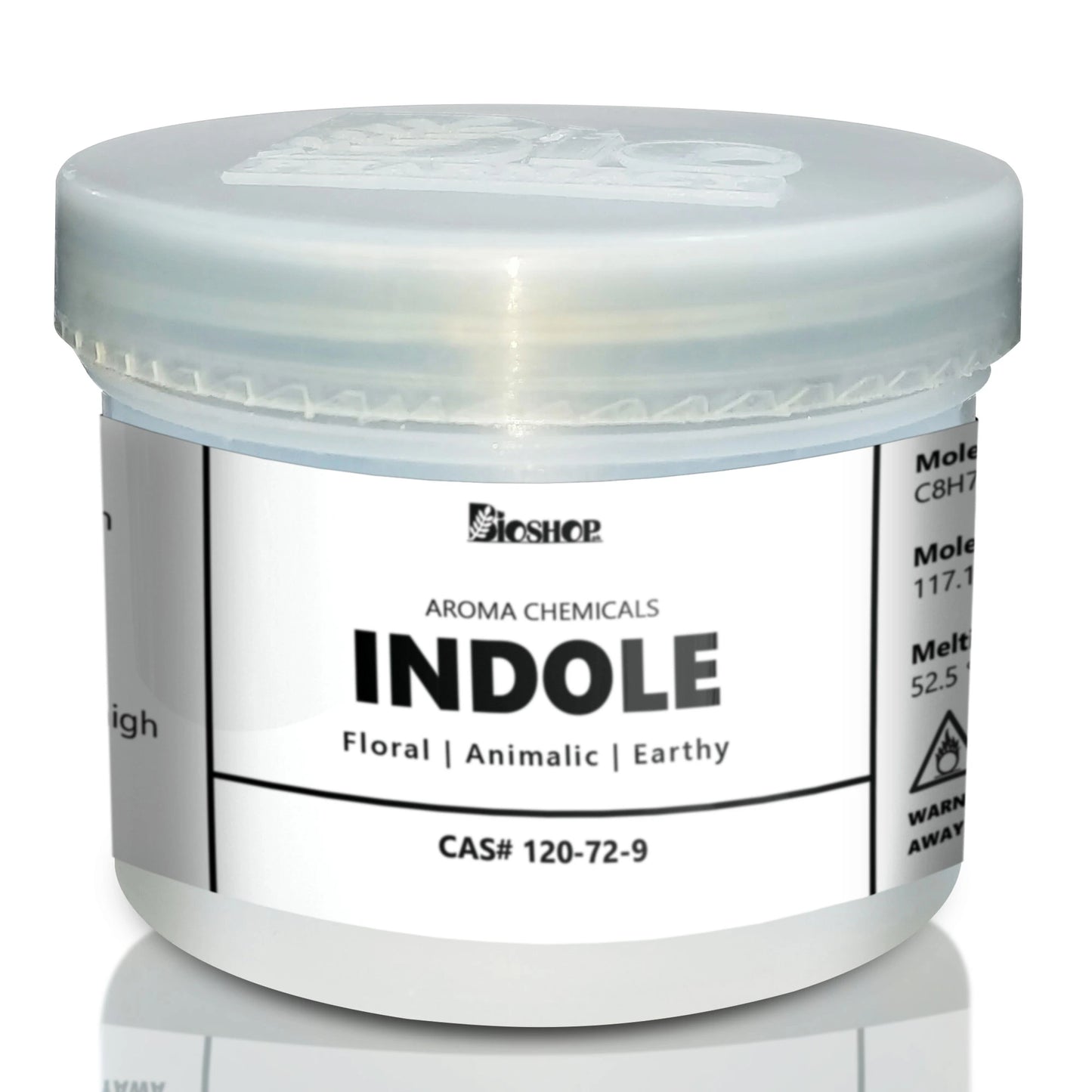
Indole
Indole
Olfactory Notes: Powerful, animalic-floral; gives "depth" to Jasmine notes.
Couldn't load pickup availability
Explore
Information About Indole
Key Features
✦ Bicyclic aromatic aroma chemical — the key molecule responsible for the narcotic depth in jasmine, tuberose, and orange blossom
✦ Dose-dependent character — soft and floral at 0.01 to 0.1%, animalic and fecal at higher concentrations, requiring careful calibration
✦ Essential building block for jasmine accords, white floral bases, chypre hearts, and oriental compositions
✦ Functions as a fixative — slows evaporation of surrounding materials and improves tenacity of floral blends
✦ Used in iconic fragrances including Chanel No. 5, Joy by Jean Patou, and Fracas by Robert Piguet
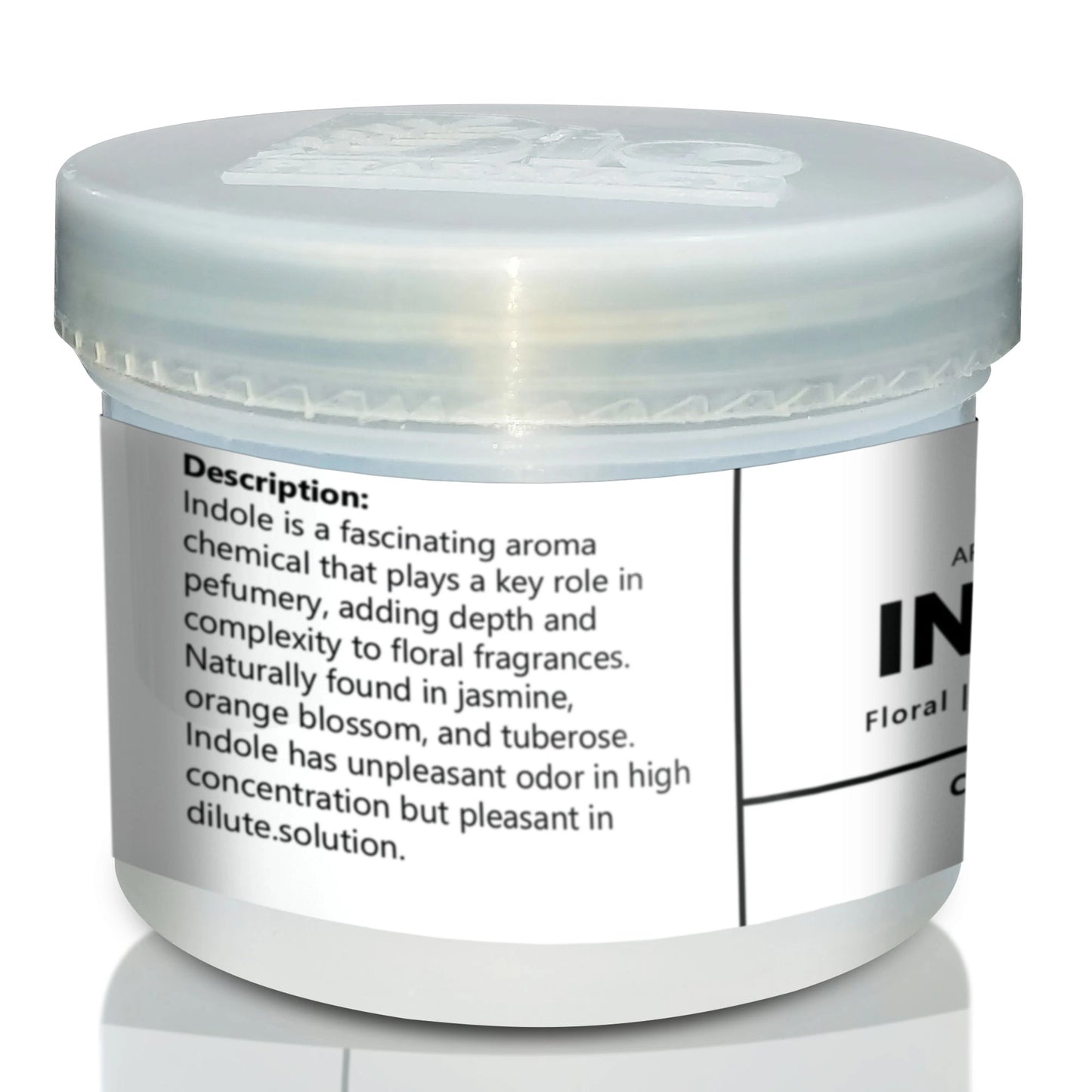
✦ Occurs naturally in jasmine absolute, ylang ylang, orange blossom, and gardenia — synthetic indole provides consistent purity and supply
✦ Vegan and not animal-derived — synthetic origin with no animal testing required
About Indole
Indole was first isolated in 1866 by Adolf von Baeyer during experiments on coal tar derivatives. Its presence in jasmine absolute was later identified as central to that flower's characteristic heady and slightly animalic quality. Perfumers of the early twentieth century quickly recognized that small quantities of indole added a living, breathing dimension to floral compositions that no other material could replicate. It became a cornerstone of the classical French perfumery tradition and remains a standard material in any serious formulator's kit today.
What makes indole genuinely unusual is its extreme dose-sensitivity. The same molecule that smells soft, warm, and floral at 100 parts per million takes on an unmistakably animalic and excremental character at higher concentrations. This duality is not a flaw — it is precisely what perfumers exploit. A trace of indole in a jasmine accord signals to the subconscious mind that the flower is real and alive. Pushing it further into a darker oriental or animalic direction requires only a slight increase in concentration, giving the perfumer tremendous expressive range from a single material.
Bio Shop Pakistan supplies cosmetic-grade indole suitable for fine fragrance development, attar blending, oriental and white floral accord construction, scented candles, reed diffusers, and cosmetic applications where authentic floral warmth is required.
Olfactory Profile
SCENT DESCRIPTION : Indole at low doses opens with a warm, narcotic floral quality — the soft, almost milky sweetness found at the heart of fresh jasmine and tuberose. As concentration rises a distinctly animalic and faintly fecal character emerges, earthy and alive in the way that real flowers in bloom can be on a humid night. At trace levels in a blend it is virtually invisible yet fundamentally transformative, lending a biological warmth and fullness that synthetic florals alone cannot achieve. Experienced blenders describe its effect as the difference between a photograph of a flower and the flower itself.
NOTE POSITION : Mid to Base
FRAGRANCE FAMILY : White Floral · Oriental · Animalic
FACETS : Narcotic · Jasmine · Animalic · Milky · Earthy
TENACITY : High — 8 to 14 hours on skin, longer on fabric
SILLAGE : Medium to High — intimate and enveloping at low doses, assertive and penetrating at higher concentrations
Technical Specifications
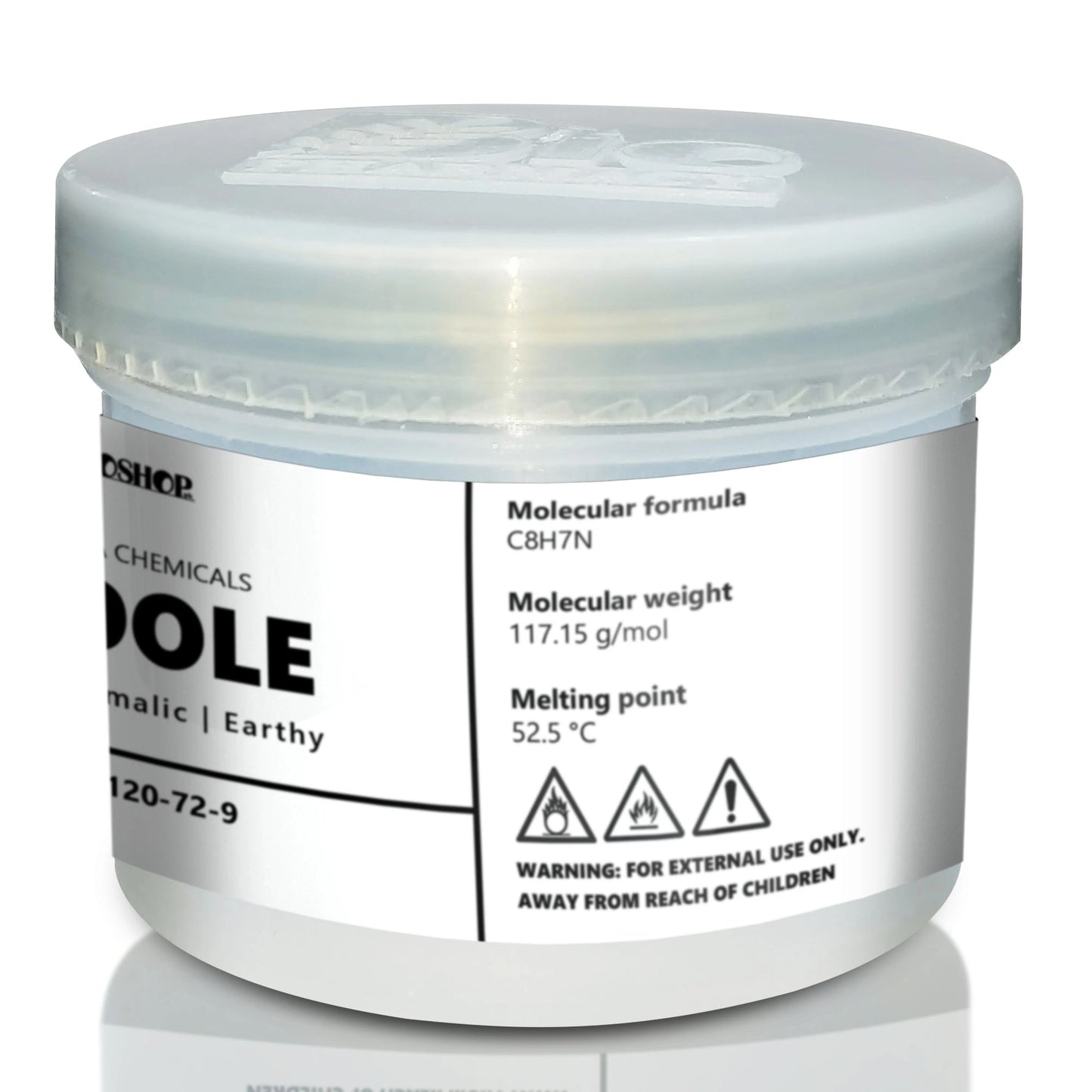
Chemical Name : 2,3-Benzopyrrole (Benzo[b]pyrrole)
CAS Number : 120-72-9
Synonyms : 1-Benzazole · 1-Benzo[b]pyrrole · 2,3-Benzopyrrole · Ketole
Purity : 98% minimum (GC)
Appearance : White to off-white crystalline flakes or solid — liquefies above 52°C
Odor Threshold : Approximately 0.001 ppm — extremely potent
Solubility : Freely soluble in ethanol, DPG, IPM, and most fragrance carriers · Practically insoluble in cold water
Specific Gravity : 1.22 g/cm³ at 20°C
Flash Point : 121°C (250°F) closed cup
Melting Point : 52 to 54°C
Type : Synthetic (nature-identical — occurs naturally in jasmine, tuberose, orange blossom)
Applications & Usage Guidelines
Fine Fragrance ★★★★★
Indole is an essential material in fine fragrance work. It is the primary contributor to the narcotic, living quality of jasmine, tuberose, and gardenia accords. Without indole a jasmine base smells clean and pleasant but unconvincing — with it the accord breathes. Use between 0.05 and 0.5% in the finished formula.
Attar & Oriental Blending ★★★★★
In attar and oriental composition indole bridges floral hearts and animalic base notes with exceptional elegance. Pakistani and Gulf attar blenders have historically used natural jasmine absolute for this quality — synthetic indole replicates that character at a fraction of the cost. Pair with oud bases, musks, and tobacco notes for maximum effect.
Functional Fragrance ★★★☆☆
Indole can be used in functional fragrance applications such as fabric conditioners and detergents where a floral note is required, but its animalic facet must be carefully managed at these use levels. Keep concentrations at 0.01 to 0.05% in the fragrance compound to preserve a clean floral effect.
Cosmetics ★★★☆☆
Indole can be incorporated into body lotions, creams, and hair care products within a fragrance compound at low usage rates. It is not recommended as a standalone cosmetic active. In alkaline formulations indole may contribute to slight discoloration over time — formulate and test accordingly.
Home Fragrance ★★★★☆
Indole performs well in reed diffusers and wax melts where its fixative properties and slow evaporation rate provide excellent longevity. In candles it blends smoothly into the wax and throws a convincing white floral character on burn. Keep candle usage rates conservative to avoid animalic overpowering on hot throw.
IFRA & Usage Rate
RECOMMENDED USAGE RATES IN FINISHED PRODUCT
EDP (Eau de Parfum) : 0.1 to 0.5%
EDT (Eau de Toilette) : 0.05 to 0.3%
Body Lotion / Cream : 0.02 to 0.1%
Shampoo / Body Wash : 0.01 to 0.05%
Candle (wax weight) : 0.05 to 0.2%
Reed Diffuser : 0.1 to 0.5%
Bar Soap : 0.05 to 0.15%
Note: These are usage rates within the finished product. Indole is typically used as a component of a larger fragrance compound rather than as a standalone material. Dose carefully — the animalic character becomes dominant above 0.5% in most base compositions.
IFRA 51ST AMENDMENT STATUS
Indole is not listed as a restricted or prohibited material in the IFRA 51st Amendment (2023). There are no specified category limits for indole under the current IFRA framework.
⚠️ While indole is IFRA unrestricted, it is an extremely potent material. Always perform quantitative risk assessment (QRA) within your complete fragrance compound, particularly for leave-on products and rinse-off applications where cumulative skin exposure must be evaluated.
⚠️ Indole is a solid at room temperature (melting point 52 to 54°C). Pre-dissolve in warm ethanol or DPG before incorporation. Do not add directly to cold wax or water-based formulations without pre-dissolution.
Blending Guide
METHOD 1 — JASMINE ACCORD CONSTRUCTION
Indole is the animating heart of any authentic jasmine accord. Begin with a base of Hedione or Hedione HC (jasmine diffusion), add cis-3-Hexenol at trace levels for green freshness, layer benzyl acetate for fruity-floral sweetness, and introduce indole at 0.05 to 0.1% of the compound to deliver narcotic warmth. The indole percentage determines how alive and heady the accord feels. Adjust last — small changes produce large perceptual shifts.
METHOD 2 — ORIENTAL AND ANIMALIC CONTRAST
In oriental bases indole functions as a bridge between the floral mid-notes and darker base materials. Blend indole with civet substitute, castoreum accord, or synthetic musks such as Habanolide and Exaltolide to create a warm, animalic undertow beneath a floral heart. This technique is the structural foundation of classic oriental chypre fragrances and many historical attars.
METHOD 3 — TUBEROSE AND WHITE FLORAL AMPLIFICATION
Tuberose accords benefit enormously from small additions of indole. Combine with methyl benzoate, eugenol, benzyl benzoate, and salicylates to build the creamy, almost rubbery richness that defines authentic tuberose. Add indole last and evaluate at 24-hour intervals — the note evolves considerably as the blend matures.
BEST PAIRINGS
Hedione / Hedione HC → Jasmine diffusion and radiance — classical pairing
Benzyl Acetate → Fruity-floral jasmine sweetness
Methyl Benzoate → Tuberose and white floral richness
Eugenol → Spiced floral depth and clove-like warmth
Benzyl Benzoate → Fixation and balsamic floral softness
Amyl Salicylate → Powdery floral smoothness and tenacity
Iso E Super → Woody floral modernity and diffusion
Civet / Castoreum Sub → Animalic oriental base construction
Ylang Ylang EO → Natural indolic floral amplification
Oud Base → Attar-style oriental heart construction
AVOID
Do not combine indole at concentrations above 0.1% with strong green or fresh citrus top notes in the same brief — the animalic facet will clash against clean accords. In ozonic or aquatic fragrances indole is generally out of character and will destabilize the clean aesthetic of the composition.
Perfumer's Note
I have used indole in every serious white floral I have ever built. There is simply no substitute for what it does — not jasmine absolute, not ylang ylang, not any other material. What indole contributes is not a scent in the ordinary sense. It is more like the feeling of biological presence, the quality that makes a synthetic floral accord stop smelling like a formula and start smelling like a living thing. The first time a student perfumer correctly doses indole into a jasmine base and smells the result, they understand immediately why it has been used in fine fragrance for over a century. The transformation is not subtle.
ADVANCED TIP
Prepare a 1% dilution of indole in pure ethanol and allow it to rest for 48 hours before use — freshly dissolved indole can have a slightly harsh character that mellows with time. When evaluating your indole percentage in a jasmine or tuberose accord, do not judge immediately after blending. Evaluate on a blotter at one hour, four hours, and twenty-four hours. The indolic character integrates and softens significantly as the blend matures. Many formulators who believe they have overdosed indole are simply evaluating too early. This patience-based technique will save you from premature reformulation and prevent unnecessary reduction of an ingredient that needs time to find its place in a blend.
Safety & Storage
Physical State : Solid crystalline flakes at room temperature · Liquid above 52°C
Skin Safety : May cause sensitization in some individuals at undiluted or high concentrations · Always dilute before skin contact · Perform patch test before use in leave-on products
Eye Contact : Avoid direct contact · Rinse thoroughly with water for 15 minutes if exposure occurs · Seek medical advice if irritation persists
Ingestion : Not for internal use · Keep away from children · Seek immediate medical attention if swallowed
Ventilation : Use in well-ventilated space · Avoid prolonged inhalation of concentrated vapor or heated fumes
Storage : Store in a cool, dry, well-ventilated location away from direct sunlight and heat sources · Keep container tightly sealed
Shelf Life : 24 to 36 months when stored correctly · Indole can slowly oxidize and yellow with age — discoloration does not always indicate loss of odor quality but verify by evaluation
Container : Amber glass or sealed HDPE container · Avoid prolonged storage in clear plastic
Flammability : Flash point 121°C — not classified as flammable under standard handling conditions · Exercise normal precautions around open flame during heated processing
FAQ
Q: Why does indole smell different at different concentrations?
A: Indole is a dose-dependent material. At low concentrations below 0.1% it reads as warm, narcotic, and floral. At higher concentrations the same molecule produces distinctly animalic and fecal character. This is a fundamental chemical property, not a quality issue.
Q: How do I work with indole since it is a solid?
A: Pre-dissolve indole in warm ethanol or DPG at a 1% to 10% dilution before use. Never try to disperse the solid flakes directly into a finished blend. A 1% solution in ethanol is the most convenient working dilution for fine fragrance work.
Q: Is indole safe for use in skin care and body products?
A: Indole is safe in cosmetic and personal care products at the usage rates specified and when used as part of a properly formulated fragrance compound. It is not recommended at undiluted or high concentrations. Perform QRA and patch testing for any leave-on application.
Q: Can I use indole in candles and wax products?
A: Yes. Indole blends well into soy, paraffin, and coconut wax. Its high flash point and low required usage level make it suitable for candle applications. Pre-dissolve in fragrance oil before blending into wax and keep concentration in the finished candle below 0.2% to avoid an overpowering animalic throw.
Q: How does synthetic indole compare to the indole present in jasmine absolute?
A: Jasmine absolute contains indole as one of many hundreds of constituents, where it is naturally balanced by other floral, green, and waxy components. Synthetic indole is the isolated pure molecule and is therefore far more concentrated and directional. Synthetic indole gives the perfumer precise control over indolic character that working with jasmine absolute alone cannot provide. Most professional jasmine accords use both — absolute for naturalness and complexity, synthetic indole for targeted adjustment of narcotic depth.
Where Can You Safely Use Indole?
Discover how Indole performs across different applications—rated for safety, stability, and effectiveness.