Bio Shop
Labdanum Resinoid
Labdanum Resinoid
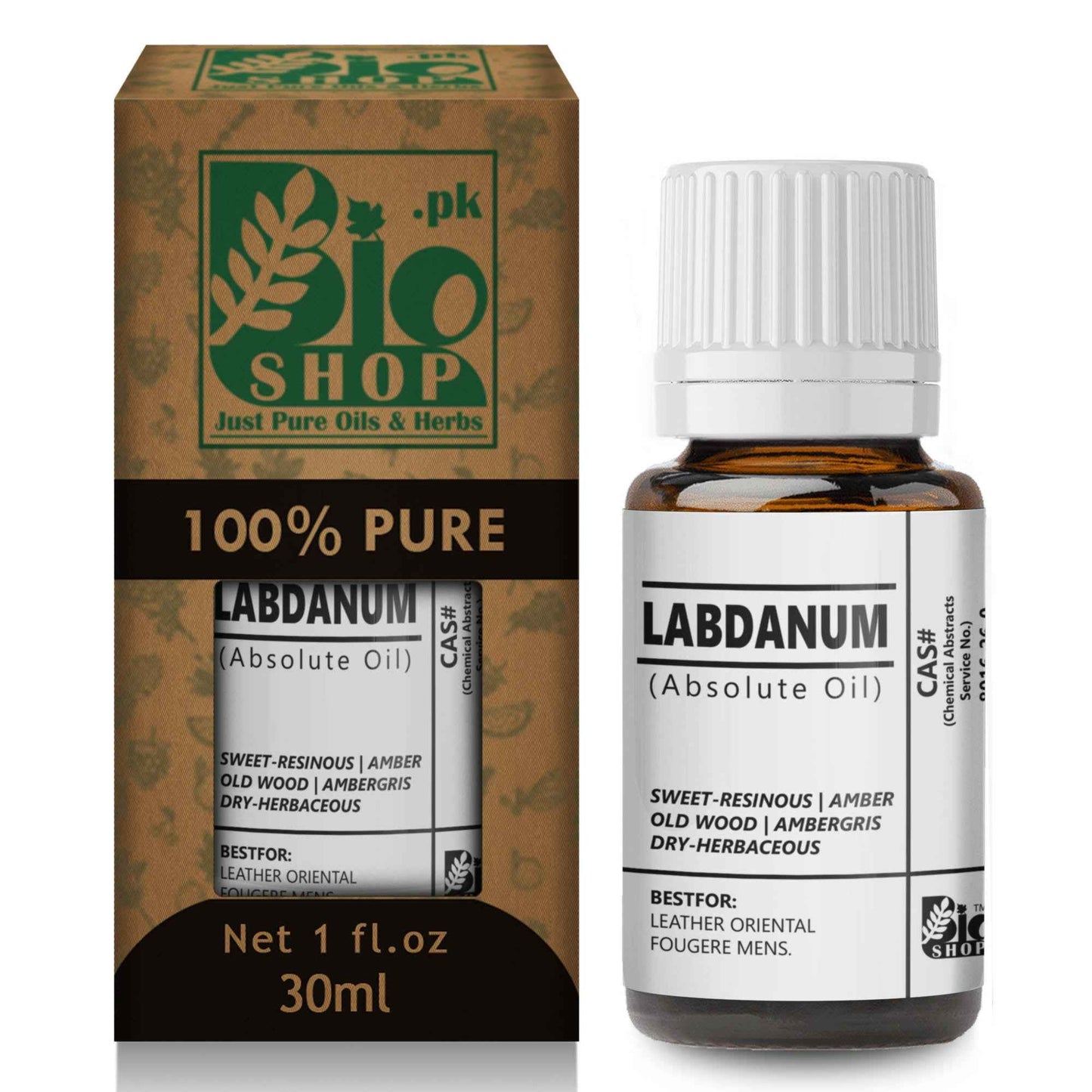
Olfactory Notes & Usage: Deep, resinous, leathery, and ambery base note.
Couldn't load pickup availability
Explore
Information About Labdanum Resinoid
Key Features
✦ Natural resinoid extracted from Cistus ladanifer (rock rose), native to the Mediterranean — one of perfumery's oldest raw materials
✦ Delivers a deep, warm, animalic-amber character — a structural cornerstone of chypre, oriental, and leather fragrance families
✦ Exceptional fixative — anchors lighter top and heart notes and dramatically extends overall fragrance longevity
✦ Acts as a harmonizer in complex bases, rounding out harsh edges and blending disparate materials into a cohesive accord
✦ Used in legendary fragrance classics: Chanel No. 5, Mitsouko, Shalimar, Opium, and virtually every historical chypre
✦ 100% plant-derived from the gum-resin of cistus shrubs — vegan and cruelty-free
✦ Highly concentrated — effective at trace levels; even 0.05–0.1% transforms the character of a base blend
About Labdanum Resinoid
Labdanum resinoid is a thick, dark natural extract produced by solvent extraction of the crude gum-resin secreted by Cistus ladanifer, the rock rose shrub indigenous to Spain, Portugal, Morocco, and the wider Mediterranean coastline. Its history in human use spans over three millennia. Ancient Egyptians prized it for kyphi incense and embalming rituals, importing it from the Eastern Mediterranean long before organized trade routes existed. The crude labdanum resin was historically harvested by combing the beards and flanks of goats that grazed through cistus thickets — a method documented by Herodotus in the fifth century BCE. Today, modern production uses steam distillation and solvent extraction on harvested plant material, but the ingredient's character remains as ancient and complex as its origins.
What makes labdanum resinoid exceptional among natural perfumery materials is the sheer density of its chemical composition. It contains upwards of 200 identified volatile and semi-volatile compounds including labdanolic acid, ledol, cembrene, various labdane diterpenes, acetophenone derivatives, and a complex array of terpenoids. This chemical density produces a simultaneously animalic, leathery, mossy, ambery, and faintly sweet olfactory profile that no single synthetic molecule can fully replicate. It is the foundational material of the chypre family — sitting alongside oakmoss absolute and bergamot in what perfumers consider the defining triad of twentieth-century fine fragrance architecture. Its ability to unify, anchor, and deepen a blend has made it irreplaceable across centuries of perfumery tradition.
Bio Shop Pakistan supplies cosmetic-grade Labdanum Resinoid suitable for fine fragrance development, attar and mukhallat blending, oriental perfumery bases, incense and home fragrance applications, and advanced leave-on and rinse-off cosmetic formulations where color is not a critical parameter.
Olfactory Profile
SCENT DESCRIPTION : Labdanum resinoid opens with a dense, warm animalic depth — the scent of sun-warmed resin on stone, dry skin, and aged leather left in a warm room. As it breathes and develops, rich amber and balsamic facets surface, threaded with earthy, mossy undertones and a faint tobacco-like sweetness. A quiet incense quality runs beneath the entire profile — dry, woody, and resinous without any sharp edges. On a skin blotter, it evolves slowly over hours, revealing increasing warmth, intimacy, and complexity with every dry-down stage.
NOTE POSITION : Base
FRAGRANCE FAMILY : Oriental · Chypre · Leather
FACETS : Amber · Animalic · Leathery · Mossy · Incense
TENACITY : Very High — 24 to 48+ hours on blotter and skin
SILLAGE : Medium — projects warm and close at application; becomes an intimate skin scent on deep dry-down
Technical Specifications
Chemical Name : Cistus ladanifer resin extract (complex diterpene and terpenoid mixture)
CAS Number : 8016-26-0
Synonyms : Labdanum Extract, Cistus Resinoid, Rock Rose Resinoid, Labdanum Gum Resinoid, Labdanum Resin Extract
Purity % : 100% neat resinoid — no diluent or carrier added
Appearance : Dark brown to black semi-solid or viscous paste at room temperature
Odor Threshold : Approximately 0.01–0.1 ppm (verify with supplier)
Solubility : Soluble in ethanol and fixed oils; insoluble in water
Specific Gravity : 1.01 – 1.06 at 20°C (verify with supplier)
Flash Point : Above 100°C (verify with supplier)
Type : Natural
Applications & Usage Guidelines
Fine Fragrance : ★★★★★
Labdanum resinoid is a classical base-note material in fine perfumery and has been for over a century. It provides structural depth and warmth in chypre, oriental, amber, and leather compositions. Used at 0.5–2.0% in a total perfume formula, it adds gravity, longevity, and a lived-in quality that cannot be replicated by synthetics alone.
Attar & Oriental Blending : ★★★★★
In traditional attar, mukhallat, and Arabic-style oriental compositions, labdanum resinoid serves as the defining resinous anchor of the base accord. It blends with seamless depth alongside oud, sandalwood, rose, ambergris, and musks. For authentic oriental bases targeting the Pakistani and Gulf market aesthetic, it is an essential ingredient.
Functional Fragrance : ★★★☆☆
Performs well in incense sticks, dhoop cones, and reed diffusers where its deep character excels without color restrictions. In candles, it requires pre-melting before incorporation into wax. Performance in functional wash-off products is limited due to potential sensitization concerns and IFRA rate restrictions.
Cosmetics : ★★☆☆☆
Labdanum resinoid can function as a fragrance component in creams, lotions, and hair care at very low percentages. Its dark brown-black color severely restricts use in light-colored formulations. IFRA restrictions on leave-on categories must be carefully observed; it is not suitable for lip products or children's products.
Home Fragrance : ★★★★☆
Excellent for incense, dhoop, bakhoor blends, and reed diffusers where its deep, smoky-amber warmth is a genuine asset. In candles, effective at 0.5–1.5% of wax weight. Its very high tenacity means it delivers strong lasting performance at economical inclusion rates, making it cost-effective for home fragrance production.
IFRA & Usage Rate
Recommended Usage Rates
Application : Usage Rate
EDP : 0.5 – 3.0%
EDT : 0.3 – 2.0%
Body Lotion : 0.1 – 0.5% (observe IFRA leave-on limits)
Shampoo/Body Wash : 0.1 – 0.3% (observe IFRA rinse-off limits)
Candle : 0.5 – 1.5% of total wax weight
Reed Diffuser : 1.0 – 3.0% of diffuser base blend
Soap (Cold Process) : 0.3 – 0.8%
IFRA 51st Amendment — Key Category Limits
IFRA Category 4 (Fine Fragrance — EDP/EDT) : 1.8% maximum
IFRA Category 5a (Body Lotion, leave-on skin) : 0.5% maximum
IFRA Category 8 (Rinse-off products, shampoo) : 0.9% maximum
IFRA Category 9 (Soap, bar and liquid) : 0.9% maximum
IFRA Category 3 (Lip and mucous membrane products) : Not recommended
⚠️ Always verify current IFRA 51st Amendment limits at ifrafragrance.org before production.
⚠️ Labdanum resinoid is a known skin sensitizer at elevated concentrations — patch testing is mandatory for all leave-on formulations.
⚠️ Not suitable for lip care, baby products, or products intended for children.
⚠️ Figures above are based on standard IFRA guidance — verify with supplier certificate of analysis for your specific batch.
Blending Guide
Method 1 — Warm Dilution Before Use
Labdanum resinoid is extremely viscous at room temperature and cannot be measured or poured neat with any precision. Place the closed container in a water bath at 40–45°C for 10–15 minutes until the material softens and flows. Alternatively, prepare a working solution at 10–30% in high-proof perfumer's alcohol, DPG, or IPM and store in a dark glass bottle. Always work from this dilution rather than the raw resinoid.
Method 2 — As a Structural Fixative Base
Introduce labdanum resinoid as the first material when constructing an oriental or chypre base. Build the accord outward from it — layering musks, woody materials, and balsamic resins on top. Its function here is gravitational: it slows the evaporation rate of every other ingredient in the base and creates a seamless, extended dry-down that lighter materials alone cannot achieve.
Method 3 — Trace Dosing for Skin-Like Depth
In fresh, aquatic, or clean floral compositions, labdanum resinoid can be used at 0.05–0.15% in the final blend as an almost invisible modifier. At this trace level it adds warmth, intimacy, and an animalic skin quality without making the fragrance read as oriental. This technique is responsible for the characteristic "skin scent" effect in many modern designer fragrances.
BEST PAIRINGS
Oakmoss Absolute → Classic chypre triad — the foundational pairing of twentieth-century fine perfumery
Oud Oil → Deep oriental base — labdanum amplifies oud's leathery-resinous facets and extends longevity
Rose Absolute → Floral-oriental bridge — makes rose richer, warmer, and significantly more tenacious
Ambroxan → Modern amber skin accord — labdanum adds depth and animalic complexity to ambroxan's clean radiance
Iso E Super → Woody-animalic diffusion — lifts labdanum's heaviness into a projecting, modern woody accord
Vetiver → Earthy-leather pairing — adds smoky, green depth; excellent for fougère and leather bases
Benzyl Benzoate → Resin fixative carrier — softens viscosity and extends dry-down; a classical formulary pairing
Cistus Essential Oil → True cistus family accord — intensifies the natural labdanum character with bright resinous facets
AVOID
⚠️ Do not pair with delicate aquatic, ozone, or aldehydic notes at standard usage rates — labdanum will overwhelm light accords; use only at trace levels if combining.
⚠️ Avoid in any formulation where color is a critical quality parameter — it will stain light products.
⚠️ Do not use undiluted in any product that contacts the eye area or mucous membranes.
Perfumer's Note
Working with labdanum resinoid is one of the most instructive exercises in understanding what natural complexity actually means. It does not behave like a single-molecule aroma chemical — it resists being defined, categorized, or confined to a single role in a composition. When I use it, I think of it as the dark matter of a fragrance: you cannot always isolate it by smell alone, but remove it and everything loses its cohesion. It is the reason a chypre feels like a chypre rather than a collection of ingredients. It is the reason certain oriental compositions feel ancient and weighted with memory. In Pakistani and Middle Eastern attar traditions, materials of this character — heavy, resinous, deeply bodied — are not supporting players. They are the soul of the composition. Labdanum belongs in that category without question.
ADVANCED TIP: Prepare a 10% labdanum resinoid solution in DPG as your dedicated working stock. When building an oriental or amber base, add this solution at 8–15% of your base weight before introducing musks. The labdanum will function as a molecular anchor — slowing musk evaporation rates, smoothing the transition from heart to base, and creating the characteristic warm-skin effect on dry-down. Test your base on a skin strip at 24 and 48 hours rather than only on blotter paper. Labdanum's full character does not reveal itself until it has had time to interact with skin chemistry, and your formulation decisions should reflect what it becomes at hour twelve — not hour one.
Safety & Storage
Physical State : Semi-solid to viscous paste at room temperature; liquefies and pours above 35–40°C
Skin Safety : Known sensitizer — mandatory patch testing for all leave-on products; strict IFRA compliance required
Eye Contact : Avoid all direct contact with eyes; rinse thoroughly with clean water for 15 minutes if exposure occurs
Ingestion : Not for internal use under any circumstances; keep out of reach of children
Ventilation : Adequate ventilation recommended when handling open containers or warming large quantities
Storage : Store tightly sealed in a cool, dry place away from direct sunlight and heat sources
Shelf Life : 3 – 5 years when stored correctly; resinoids may thicken further over time but remain usable
Container : Dark glass jar or HDPE container; avoid prolonged contact with unlined metal containers
Flammability : Flash point above 100°C — not classified as highly flammable under standard handling conditions
FAQ
Q: What exactly is Labdanum Resinoid and how is it different from an essential oil?
A: Labdanum resinoid is obtained by solvent extraction of the crude gum-resin from Cistus ladanifer, not by steam distillation. This produces a thicker, darker, more complex extract that retains the full resinous body of the plant material. An essential oil would only capture the volatile fraction and lack labdanum's characteristic fixative depth.
Q: How do I handle and measure Labdanum Resinoid — it is almost solid at room temperature?
A: Warm the sealed container in a water bath at 40–45°C for 10–15 minutes until the material softens and becomes pourable. For ongoing work, pre-dilute to a 10–20% solution in DPG or perfumer's alcohol and use that as your daily working stock. Never microwave the container directly.
Q: What is the maximum safe percentage for use in an EDP sold to consumers?
A: IFRA 51st Amendment Category 4 sets the limit at 1.8% in fine fragrance applications. Starting at 0.5–1.0% is strongly recommended — at these levels labdanum delivers full impact. Always verify against the current IFRA guidelines at ifrafragrance.org before finalizing a commercial formula.
Q: Will Labdanum Resinoid visibly discolor my creams, soaps, or powders?
A: Yes, significantly. It is a dark brown to black material and will visibly discolor any light-colored product even at low percentages. Restrict its use to dark-colored or naturally colored formulations, or use it only in fragrance compounds where the final dose in the finished product is extremely low.
Q: How does Labdanum Resinoid compare to Labdanum Absolute?
A: Both come from the same Cistus ladanifer source but differ in extraction method and character. The absolute is produced via alcohol extraction of the concrete and yields a more refined, slightly more floral and less earthy profile with better clarity. The resinoid is heavier, darker, more animalic, and earthier — with superior fixative power and greater tenacity. The resinoid is the preferred choice when maximum depth and longevity are the priority; the absolute is preferred when a cleaner, more refined amber-floral quality is needed.
Where Can You Safely Use Labdanum Resinoid?
Discover how Labdanum Resinoid performs across different applications—rated for safety, stability, and effectiveness.
Doosri baar order kiya. Same mossy animalic balsamic character. Koi batch variation nahi. Bio Shop reliable supplier hai natural resins ke liye. Highly recommend to Pakistani fragrance community.
Mere attar collection mein labdanum add karne se poori range premium ho gayi. Amber accord zyada authentic aur complex. Customers fark feel karte hain. Bio Shop labdanum quality genuine resinoid hai. Professional perfumers ke liye must have ingredient.
Islamabad mein 3 din mein aayi. Resinoid bottle properly sealed tha - koi leakage nahi. Viscous material ko properly handle kiya Bio Shop ne. Quality genuine - real cistus character immediately feel hua. Repeat order karoonga.
Labdanum isobutyl quinoline aur birch tar ka leather accord - intense aur realistic. Labdanum ne warmth aur balsamic depth di jo leather note ko authentic banaya. Bio Shop isobutyl quinoline 10% DPG mein bhi rakhta hai. Quality excellent.
Labdanum concentrated hoti hai - 2-3% mein bhi clear impact. Zyada dalne ki zaroorat nahi. Pehli baar zyada dal diya - composition heavy ho gayi. Balance zaroori hai. Quality Bio Shop ki excellent. 4 stars kyunke pehli baar guidance nahi thi.
Great learning experience! Labdanum is indeed very powerful - start at 2-3% in your fragrance compound and evaluate before adding more. Its complex animalic character can easily dominate if overdosed. Less is more with natural resins!