Bio Shop
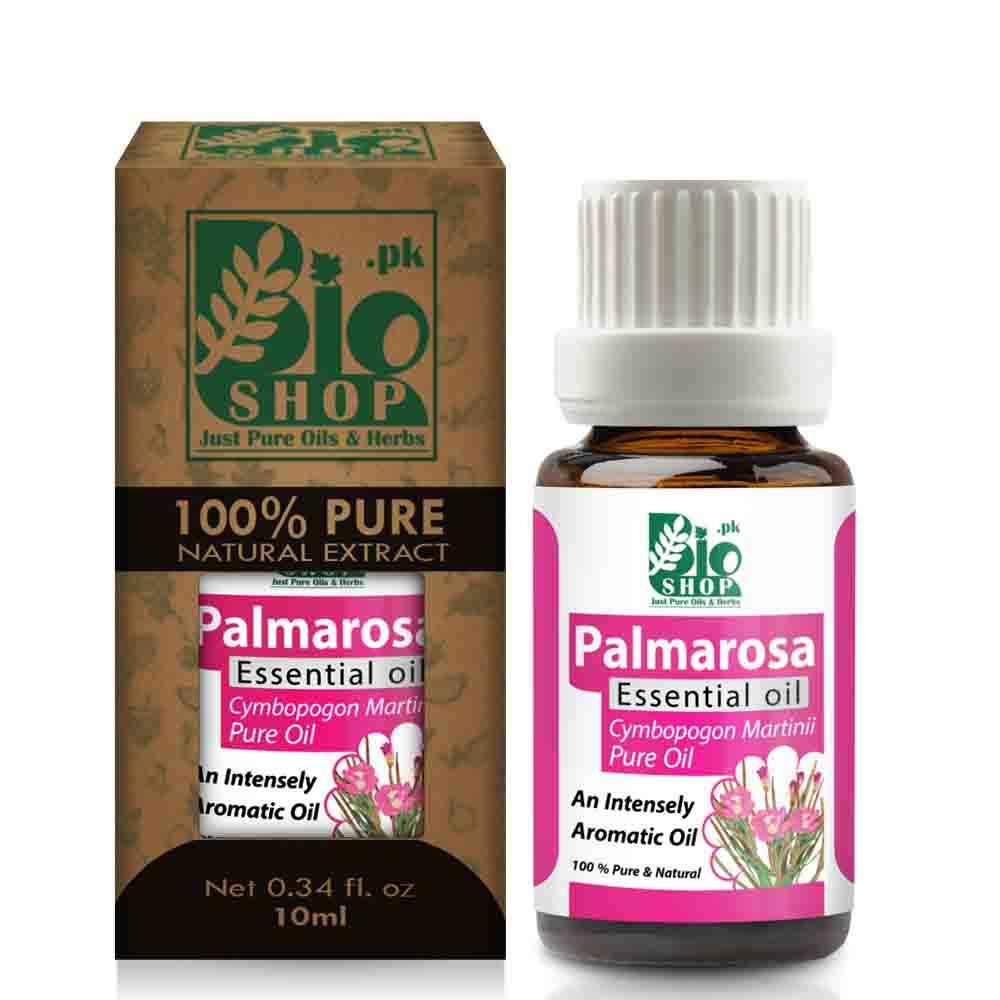
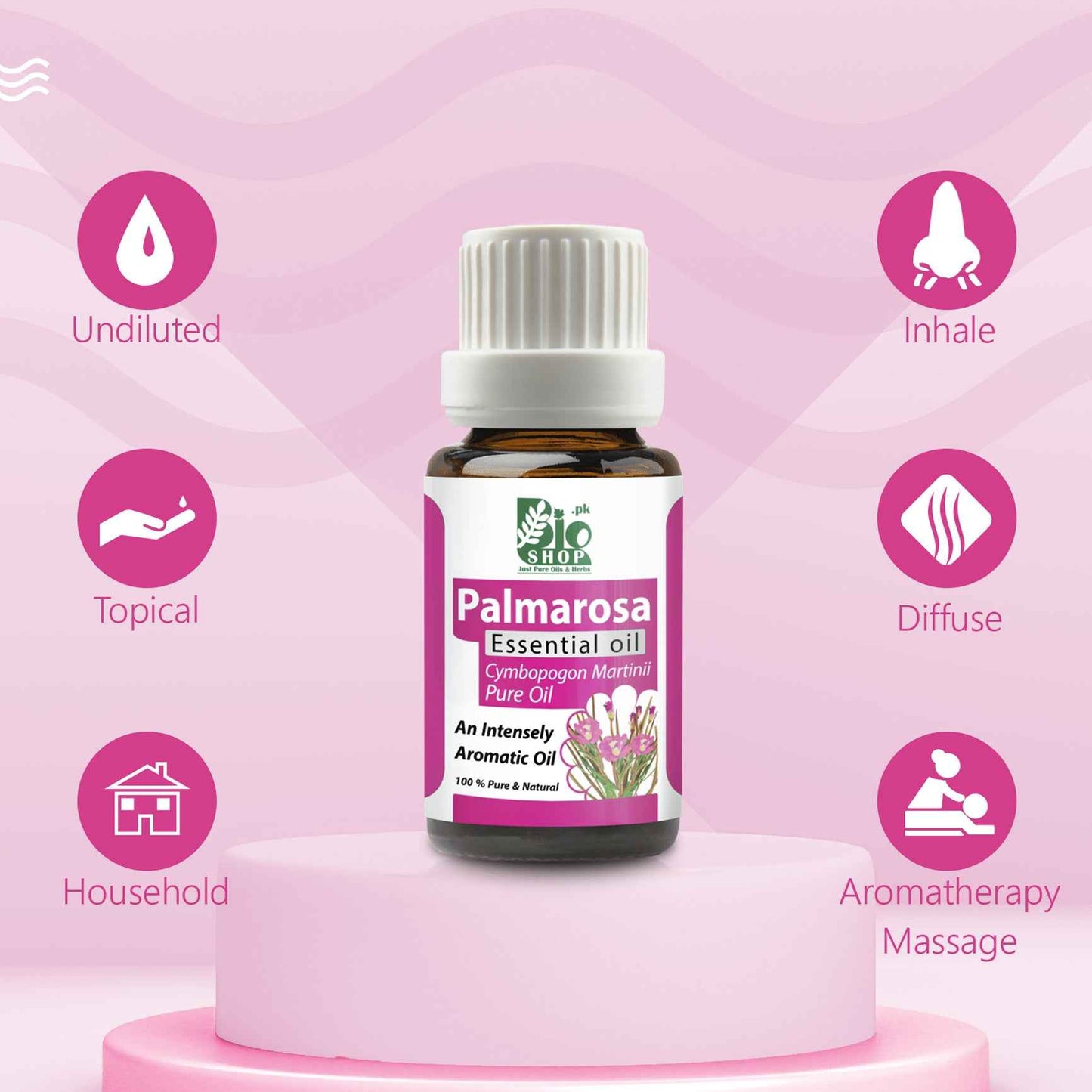
Palmarosa Essential oil
Palmarosa Essential oil
Olfactory Notes: Floral · Green · RosySweet-fresh · Lightly herbaceous
Couldn't load pickup availability
Explore
Information About Palmarosa Essential oil
Key Features
✦ Pure steam-distilled essential oil from Cymbopogon martinii grass, primarily sourced from India and Nepal
✦ Exceptionally high natural geraniol content (75–92%) delivering a genuine rosy-floral note at low usage rates
✦ Dual-function ingredient — valued equally as a perfumery raw material and a skin-active cosmetic agent
✦ Natural, vegan, and cruelty-free with no animal-derived components or testing
✦ Cost-effective rose alternative — widely used to extend or replace rose absolute in oriental and floral blends
✦ EU allergen declaration required for geraniol above 0.01% in leave-on and 0.1% in rinse-off products
✦ Soluble in alcohol and fixed oils — suitable for perfume bases, carrier oil blends, and emulsified formulations
About Palmarosa Essential oil
Palmarosa essential oil is steam-distilled from the aerial parts of Cymbopogon martinii var. martinii, a wild-growing grass native to India, where it is known locally as rosha grass or Indian geranium grass. The plant has been cultivated for its essential oil since at least the 19th century, when it was historically traded under the name Indian or Turkish geranium oil — often used to adulterate genuine rose oil due to its strikingly similar scent profile. India remains the world's dominant producer, with significant cultivation in Rajasthan, Maharashtra, and Uttar Pradesh, as well as growing production in Nepal and Guatemala.
What sets palmarosa apart from other grass-derived oils is its exceptional geraniol purity. Unlike lemongrass, which is dominated by citral, or citronella, which features citronellal, palmarosa yields an oil that is predominantly geraniol and geranyl acetate — the very compounds responsible for the characteristic rosy-fresh quality of rose and geranium oils. This makes it simultaneously useful as a perfumery material, a natural antimicrobial agent in cosmetics, and a skin-conditioning active. Its fragrance is considered softer and more approachable than geranium, with less of the minty-green character, making it highly versatile across floral, oriental, and functional formulations.
Bio Shop Pakistan supplies cosmetic-grade palmarosa essential oil suitable for DIY perfumers, attar blenders, natural skincare formulators, soap makers, hair care product developers, and home fragrance crafters across Pakistan.
Olfactory Profile
SCENT DESCRIPTION : Palmarosa opens with a luminous, rosy-fresh brightness underpinned by a soft geranium-like floralcy. As it develops, a gentle sweetness and a faintly waxy, green nuance emerge, giving the oil warmth and complexity beyond a simple rose impression. The dry-down retains a clean, slightly herbaceous, lingering floralcy that reads as natural and transparent on skin. It is rounder and less astringent than geranium, and lighter and more airy than Bulgarian rose absolute.
NOTE POSITION : Top-Mid
FRAGRANCE FAMILY : Floral · Green · Aromatic
FACETS : Rosy · Geranium-like · Waxy-green · Sweet-fresh · Lightly herbaceous
TENACITY : Medium — 4 to 6 hours on skin, longer on dry-down in formulations
SILLAGE : Medium — projects softly and naturally without excessive diffusion; integrates well without overpowering
Technical Specifications
Chemical Name : Cymbopogon martinii herb oil
CAS Number : 8014-19-5
Synonyms : Rosha grass oil · Indian geranium oil · Motia oil · Cymbopogon martinii var. martinii oil
Purity : 100% pure essential oil (no carrier added)
Appearance : Pale yellow to light olive-yellow mobile liquid
Odor Threshold : Very low — geraniol detectable from approximately 0.04 ppm
Solubility : Soluble in alcohol (ethanol) and fixed oils; practically insoluble in water
Specific Gravity : 0.879 – 0.896 at 20°C (verify with supplier CoA)
Flash Point : Approximately 71–75°C (verify with supplier CoA)
Refractive Index : 1.470 – 1.478
Type : Natural — 100% steam-distilled essential oil
Applications & Usage Guidelines
Fine Fragrance : ★★★★★
Palmarosa is a classic natural building block in fine fragrance, used across floral, chypre, oriental, and green compositions. Its high geraniol content allows it to function as a transparent rose extender, a fresh heart note, or a naturalising bridge between synthetic florals. It blends seamlessly in both alcohol-based EDPs and EDTs without disrupting top-note clarity.
Attar & Oriental Blending : ★★★★★
In traditional attar and mukhallat formulation, palmarosa has been used for decades as a cost-accessible rosy element in oudh, musk, and floral bases. It harmonises particularly well with sandalwood, rose absolute, and geranium bourbon, making it indispensable in South Asian and Middle Eastern style compositions. Its naturalness is also valued in ruh and dehn attar formats.
Skincare & Cosmetics : ★★★★☆
Beyond its scent, palmarosa oil is regarded as a functional skin-care ingredient. Its geraniol content provides mild antimicrobial and cell-regenerating properties, making it a useful addition to facial serums, moisturisers, and body butters. Usage in leave-on products requires compliance with EU geraniol allergen labelling thresholds and IFRA guidelines.
Soap & Hair Care : ★★★★☆
Palmarosa performs well in cold-process and melt-and-pour soaps, retaining a noticeable floral character through saponification — particularly when used above 1.5%. In shampoos and conditioners, it contributes both fragrance and mild scalp-conditioning properties. Rinse-off applications offer more formulation headroom relative to IFRA limits.
Home Fragrance & Candles : ★★★☆☆
Palmarosa can be used in reed diffusers, room sprays, and soy or coconut wax candles, though its mid-range flash point requires attention in candle applications. Its rosy-green scent adds naturalness to home fragrance blends, and it pairs well with woody and citrus accords in diffuser compositions. Candle usage should be tested for throw performance before commercial production.
IFRA & Usage Rate
RECOMMENDED USAGE RATES
EDP (Eau de Parfum) : 2.0 – 8.0%
EDT (Eau de Toilette) : 1.5 – 5.0%
Body Lotion / Cream : 0.5 – 1.5%
Shampoo / Body Wash : 0.5 – 2.0%
Cold Process Soap : 1.0 – 3.0%
Reed Diffuser : 10 – 25%
Candle (soy/coconut wax) : 3.0 – 6.0%
Facial Serum / Spot Treatment : 0.1 – 0.5%
IFRA 51ST AMENDMENT LIMITS
(Based on geraniol content — primary sensitising constituent of palmarosa)
⚠️ Palmarosa essential oil contains high levels of geraniol, a listed EU fragrance allergen. Mandatory declaration on finished product labels is required when geraniol exceeds 0.01% in leave-on products and 0.1% in rinse-off products under EU Cosmetics Regulation 1223/2009.
IFRA Category 1 (Lip products) : 0.06% maximum
IFRA Category 2 (Deodorant / Antiperspirant) : 0.3% maximum
IFRA Category 3 (Eye-area products) : 0.3% maximum
IFRA Category 4 (Fine fragrance / unrinsed on skin) : 2.7% maximum
IFRA Category 5A (Body lotion / face cream) : 1.0% maximum
IFRA Category 5B (Hand cream) : 1.0% maximum
IFRA Category 6 (Mouthwash — not recommended) : Not applicable
IFRA Category 9 (Rinse-off body / shampoo) : 4.5% maximum
IFRA Category 11A (Unscented soap) : 2.0% maximum
IFRA Category 12 (Candles / non-skin contact) : No restriction set
⚠️ All IFRA limits apply to the finished product. Verify the current IFRA 51st Amendment standards at ifrafragrance.org before commercial production.
Blending Guide
USAGE METHOD 1 — Direct Dissolution in Alcohol
For perfume and cologne applications, palmarosa dissolves cleanly in cosmetic ethanol (90–96%). Add palmarosa after your base and heart materials are blended, as its brightness can help lift and illuminate heavier accords. Allow the formula to mature for a minimum of 48 hours before final evaluation.
USAGE METHOD 2 — Dilution in Fixed Oil for Skincare and Attar
For carrier-based skin applications and non-alcoholic attar formats, dilute palmarosa in a neutral fixed oil such as fractionated coconut, jojoba, or sweet almond oil. A 10% dilution in carrier oil provides a versatile pre-diluted material suitable for roll-on attars, facial serums, and massage blends. Shake or stir well before each use to ensure consistent distribution.
USAGE METHOD 3 — Direct Addition to Soap or Detergent Base
In cold-process soap, add palmarosa essential oil at trace alongside other fragrance materials. For melt-and-pour or liquid soap bases, stir in below 60°C to preserve volatility. Combining palmarosa with clove bud or cedarwood in soap helps anchor the top note and extend longevity through the cure period.
BEST PAIRINGS
Rose Absolute / Rose Otto → Amplifies and naturalises the rosy character; creates fuller rose accord
Geranium Bourbon → Adds green, minty lift and sharpens the floral edge
Sandalwood (Mysore / Australian) → Grounds palmarosa in warm, creamy depth; classic oriental base
Oud / Agarwood → Rosy-floral brightness contrasting smoky-animalic depth; essential in mukhallat
Vetiver → Earthy, smoky counterpoint that adds gravity to the composition
Ylang Ylang → Tropical, heady richness layered over the clean floralcy
Bergamot → Fresh citrus opening that enhances palmarosa's brightness and transparency
Cedarwood Atlas → Woody dryness to balance sweetness; extends base longevity
Litsea Cubeba → Lemony, bright top note that adds sparkling contrast
Labdanum Absolute → Warm, resinous depth transforming the composition toward oriental territory
AVOID
Pairing palmarosa with very heavy, unprocessed smoke or tar-dominant materials (e.g., crude birch tar, cade oil) without careful balancing, as these can clash with its clean floralcy. In candles, avoid combining with high concentrations of clove or cinnamon bark oil, as this may push flash point concerns and create unpredictable hot-throw performance.
Perfumer's Note
Palmarosa is one of those materials I reach for when I need naturalness without budget strain. It occupies a unique position in the palette — it reads floral and rosy without ever smelling synthetic, and yet it blends with the docility of a well-behaved synthetic. In attar formulation especially, I use it as a naturalness anchor: a few percent of palmarosa in an otherwise synthetic floral accord immediately shifts the character toward something that smells genuinely hand-crafted. It is the unsung workhorse of the South Asian perfumer's kit.
ADVANCED TIP : Try building a cost-effective rose soliflore using palmarosa as the primary material (4–5%) alongside a small amount of phenyl ethyl alcohol (2–3%) for the aqueous-rosy dimension, geranium bourbon (0.5–1%) for green lift, and just a trace of rose oxide (0.02–0.05%) for that distinctive damascone-like metallic rose facet. A soft musk base under this accord — iso e super or habanolide at 1–2% — will give the rose surprising longevity and projection without a single drop of rose absolute. This construction performs excellently in EDPs, body mists, and attar bases.
Safety & Storage
Physical State : Mobile pale yellow liquid at room temperature
Skin Safety : Dilute before skin application — do not apply neat. Leave-on products: max 1.0% per IFRA guidelines. Patch test recommended for sensitive skin. High geraniol content is a known sensitiser at elevated concentrations.
Eye Contact : Avoid contact with eyes. If contact occurs, rinse thoroughly with clean water for 15 minutes and seek medical advice if irritation persists.
Ingestion : Not for internal use. Keep out of reach of children. If swallowed, do not induce vomiting — contact a poison control centre immediately.
Ventilation : Use in well-ventilated workspace. Avoid prolonged inhalation of undiluted vapours, particularly in enclosed spaces.
Storage : Store in a tightly sealed dark glass or aluminium container, away from direct light, heat, and moisture. Ideal storage temperature: 10–25°C.
Shelf Life : 2 to 3 years when stored correctly. Geraniol-rich oils are susceptible to oxidation — discard if scent becomes sharp, metallic, or rancid.
Container : Dark glass (amber), aluminium, or HDPE. Do not store in clear plastic or PET containers.
Flammability : Combustible liquid. Flash point approximately 71–75°C. Keep away from open flames, sparks, and high-heat sources during handling and candle production.
FAQ
Q: Can I apply palmarosa essential oil directly to my skin without diluting it?
A: No. Always dilute palmarosa in a carrier oil or cosmetic base before skin contact. For leave-on use such as serums and lotions, a safe concentration is 0.5–1.0%. Undiluted application risks sensitisation, especially with repeated exposure.
Q: Is palmarosa a good substitute for rose absolute in perfumery?
A: It is an excellent functional substitute for extending or replacing a portion of rose absolute. It will not replicate the full complexity of rose — particularly the deeper damascone and honied facets — but it delivers a credible, natural rosy-floral note at a fraction of the cost. Most commercial rose accords use it as a backbone.
Q: Does palmarosa retain its scent in cold-process soap?
A: Yes, palmarosa is one of the better-performing essential oils in cold-process soap. The high geraniol content survives saponification reasonably well, delivering a soft rosy note in the finished bar. For stronger retention, use at 2–3% and pair with a fixative such as cedarwood or benzyl benzoate.
Q: Is palmarosa essential oil safe to use in baby or children's products?
A: Not recommended without specialist guidance. Palmarosa contains high levels of geraniol, a listed sensitising allergen, and the developing immune systems of young children are more vulnerable to sensitisation reactions. Consult a qualified cosmetic chemist before including it in products intended for infants or children.
Q: How does palmarosa compare to geranium essential oil in formulation?
A: Both oils share geraniol as a primary constituent, but they differ in character and complexity. Geranium bourbon has a sharper, more complex scent with pronounced green, minty, and fruity facets alongside the rosy quality. Palmarosa is softer, cleaner, and more linear — rosy without the complexity. Palmarosa is generally easier to blend and more forgiving in concentration, while geranium brings greater character and lift to a composition.
Where Can You Safely Use Palmarosa Essential oil?
Discover how Palmarosa Essential oil performs across different applications—rated for safety, stability, and effectiveness.