


Bio Shop
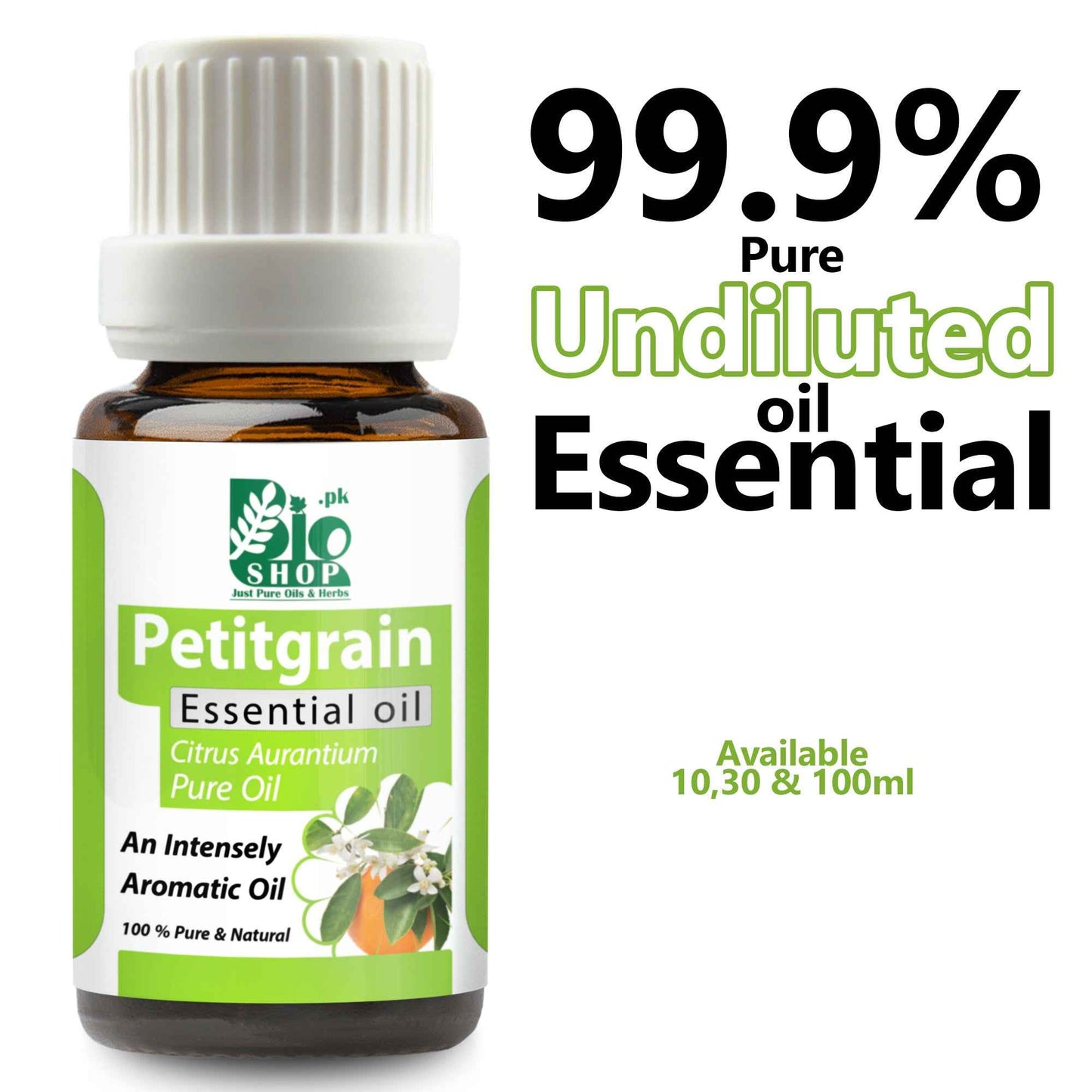
Petitgrain Essential Oil
Petitgrain Essential Oil
Olfactory Notes: Citrusy · Green · Bitter · Fresh · Woody · Slightly Floral
Couldn't load pickup availability


Explore
Information About Petitgrain Essential Oil
Key Features
✦ 100% pure steam-distilled essential oil from Citrus aurantium var. amara leaves and twigs
✦ Fresh, woody-green, lightly floral aroma — a classic backbone of colognes and fougères
✦ High in linalyl acetate and linalool — delivers clean, smooth, refined top-to-mid performance
✦ Excellent in fine fragrance, eau de cologne, body wash, shampoo, and natural deodorant
✦ Blends seamlessly with neroli, bergamot, cedarwood, vetiver, and lavender
✦ Vegan and cruelty-free — no animal-derived ingredients or testing
✦ IFRA-compliant at recommended usage rates — always verify current limits before
About Petitgrain Essential Oil
Petitgrain Essential Oil takes its name from the French for "little grains," a reference to the small unripe fruits that were originally harvested alongside the leaves in early distillation. Today, the oil is produced exclusively from the leaves and young twigs of the bitter orange tree (Citrus aurantium var. amara), the same botanical species that yields neroli from its blossoms and bitter orange peel oil from its rind. The finest petitgrain bigarade comes from Paraguay, which has become the world's dominant supplier, alongside traditional producers in France, Italy, and Morocco. Each origin offers subtle aromatic differences — Paraguayan petitgrain is notably crisp and woody, while French bigarade carries a softer, more floral-green nuance.
What makes petitgrain exceptional is its structural versatility. Its primary constituents, linalyl acetate and linalool, provide a clean, smooth freshness that neither competes with nor overshadows other materials in a blend. It is one of the few natural essential oils that performs reliably in both classic European-style colognes and in modern aromatic orientals. Perfumers prize it for its ability to lift heavy base notes, add transparency to florals, and give aromatic fougères their characteristic green-freshness. In functional applications, its antimicrobial properties and refreshing scent make it equally at home in hair care, deodorant, and skin care formulations.
Bio Shop Pakistan supplies cosmetic-grade petitgrain essential oil suitable for DIY perfumers, natural fragrance formulators, hair and skin care product developers, attar blenders, and home fragrance crafters across Pakistan.
Olfactory Profile
SCENT DESCRIPTION : Petitgrain opens with a bright, crisp burst of green citrus leaf — clean, light, and slightly sharp. As it evolves, a smooth woody-floral heart emerges, carrying soft linalool florality and a dry, herbaceous greenness. The drydown is warm and refined with a faint woody-amber quality that anchors compositions without adding heaviness. It is simultaneously fresh and sophisticated — a rare combination that has kept petitgrain central to classical perfumery for centuries.
NOTE POSITION : Top to Mid
FRAGRANCE FAMILY : Aromatic Citrus · Woody Green · Floral Citrus
FACETS : Fresh · Woody · Green · Floral · Herbaceous
TENACITY : Medium — 4 to 6 hours on skin; longer on fabric and in base-heavy compositions
SILLAGE : Medium — projects cleanly without overpowering; excellent in spray applications
Technical Specifications
Chemical Name : Citrus aurantium subsp. amara leaf oil
CAS Number : 8014-17-3
Synonyms : Petitgrain Bigarade Oil · Bitter Orange Leaf Oil · Citrus Bigarade Leaf Oil · Citrus Aurantium Leaf Oil
Purity : 100% pure natural essential oil (verify with certificate of analysis from supplier)
Appearance : Pale yellow to light amber clear liquid
Odor Threshold : Very low — potent; detectable at trace concentrations
Solubility : Soluble in alcohol and fixed oils; insoluble in water
Specific Gravity : 0.875 – 0.895 at 20°C (verify with supplier CoA)
Flash Point : Approximately 66 – 72°C (verify with supplier CoA)
Type : Natural — steam-distilled essential oil
Key Constituents : Linalyl acetate (40–70%) · Linalool (15–25%) · Alpha-terpineol · Geraniol · Neryl acetate
Applications & Usage Guidelines
Fine Fragrance : ★★★★★
Petitgrain is a foundational material in classic Eau de Cologne, fougère, and chypre compositions. It provides the fresh, green-citrus lift that defines aromatic masculines and clean unisex fragrances. Use at 1–5% as a top-note brightener or at higher rates as a featured accord.
Attar & Oriental Blending : ★★★★
It adds a refreshing, transparent green note that lifts heavy oud, musk, and amber bases in attar compositions. Particularly effective in light aromatic attars and fresh floral-woody blends. Balances richness without compromising traditional character.
Hair & Skin Care : ★★★★★
Petitgrain is widely used in shampoo, conditioner, scalp serums, body wash, and facial toners for both its fresh scent and reported antimicrobial activity. It complements herbal and citrus-forward personal care product lines effectively.
Natural Deodorant & Functional Fragrance : ★★★★
Its clean, non-cloying freshness and antimicrobial profile make it a popular choice in natural deodorant sticks, spray deodorants, and room sprays. Pairs well with tea tree, lavender, and cedarwood in functional blends.
Home Fragrance : ★★★★★
Excellent in reed diffusers, room sprays, and pot pourri. Its crisp green freshness elevates home fragrance compositions and works especially well in fresh-clean and botanical-inspired room scents. Moderate performance in candles — flash point should be verified before wax application.
IFRA & Usage Rate
RECOMMENDED USAGE RATES
EDP (Eau de Parfum) : 3 – 8%
EDT (Eau de Toilette) : 5 – 12%
Body Lotion / Cream : 0.5 – 2%
Shampoo / Body Wash : 0.5 – 2%
Candle (soy/paraffin) : 3 – 6% (verify flash point with supplier before use)
Reed Diffuser : 10 – 25%
Bar Soap : 1 – 3%
Room Spray : 2 – 5%
Natural Deodorant : 0.5 – 1.5%
IFRA 51ST AMENDMENT LIMITS
⚠️ Petitgrain Bigarade (Citrus aurantium subsp. amara leaf oil) is listed in the IFRA 51st Amendment as a skin sensitizer material. Limits apply due to its linalool and linalyl acetate content.
IFRA Category 4 (fine fragrance, spray) : Up to 6.4% (verify at ifrafragrance.org)
IFRA Category 5A (body lotion, face cream) : Up to 2.6% (verify at ifrafragrance.org)
IFRA Category 9 (rinse-off, shampoo) : Up to 12.5% (verify at ifrafragrance.org)
IFRA Category 11A (non-skin contact, candle) : Not restricted under Category 11A
⚠️ Always verify current IFRA 51st Amendment limits at ifrafragrance.org before finalizing any formulation. Limits are subject to revision. Usage rates above are general guidance only.
⚠️ EU Cosmetics Regulation requires allergen labeling for linalool and linalyl acetate above 0.001% (leave-on) and 0.01% (rinse-off) thresholds. Petitgrain oil will typically trigger these thresholds at any practical usage rate.
Blending Guide
USAGE METHOD 1 — TOP NOTE BRIGHTENER
Add petitgrain at 1–5% in the top note phase of alcoholic perfume or cologne to provide clean green-citrus lift. It integrates best when combined with bergamot or lemon, which share similar ester-rich profiles. Avoid adding to the base blend first — petitgrain's brightness is most effective when evaluated at the top.
USAGE METHOD 2 — ACCORD BUILDING
Build a classic petitgrain-neroli-bergamot accord (equal parts, 1:1:1) as a fresh citrus floral starting point. Add cedarwood or sandalwood at 5–10% to ground the accord and add longevity. This accord is the structural backbone of traditional Eau de Cologne.
USAGE METHOD 3 — FUNCTIONAL PRODUCT FRAGRANCE
In shampoo, body wash, or deodorant, disperse petitgrain directly into the fragrance component before addition to base. Keep usage at 0.5–2% for rinse-off and 0.5–1.5% for leave-on products. Blend with tea tree and eucalyptus for an herbal-fresh functional scent.
BEST PAIRINGS
Bergamot → Amplifies citrus freshness; classic cologne combination
Neroli → Creates the iconic Eau de Cologne floral-citrus heart
Lavender → Softens the green edge; perfect for aromatic fougères
Cedarwood → Adds dry warmth and longevity; balances the top note
Vetiver → Earthy-smoky contrast; creates sophisticated aromatic depth
Sandalwood → Smooth, creamy grounding; elevates to fine fragrance quality
Rosemary → Herbal sharpness; reinforces aromatic and functional profile
Ylang Ylang → Floral richness; use in small amounts to avoid overwhelming
Geranium → Green floral harmony; excellent in natural unisex blends
Clary Sage → Herbaceous complexity; classic in eau de toilette masculines
AVOID
Using petitgrain at very high rates in leave-on skin products without IFRA compliance review — linalool and linalyl acetate are EU-listed skin sensitizers. Avoid combining with other high-sensitizer materials (oakmoss, jasmine absolute, cinnamon bark) in leave-on formulations without patch testing and regulatory review.
Perfumer's Note
Petitgrain is one of those materials I return to constantly, not because it is flashy, but because it is honest. When a fragrance feels muddy or overwrought, a small addition of petitgrain — even at 0.5% — opens it up like a window. It has a transparency that very few naturals can match. In oriental and attar work, I use it specifically to separate layers that are clinging together — it creates negative space in a composition, which is far harder to achieve than adding more depth. Paraguayan bigarade is my personal preference for cologne and aromatic work, but when I want a softer, more floral green, I reach for the French origin material. Both are irreplaceable, and I often keep both in the studio.
ADVANCED TIP
Try building a petitgrain-forward eau de cologne using the 4-2-1 ratio: four parts petitgrain bigarade, two parts bergamot, one part neroli. Add this accord at 8–10% into 85% ethanol, then round out with 0.5% vetiver and 0.5% orris for depth. Let the blend macerate for a minimum of 10 days at room temperature before evaluation. The petitgrain will lose its initial sharpness and reveal a smooth, rounded freshness that reads as significantly more expensive than its component cost suggests.
Safety & Storage
Physical State : Clear pale yellow to light amber liquid at room temperature
Skin Safety : Possible skin sensitizer at high concentrations — dilute before skin application; always patch test; observe IFRA limits for leave-on products
Eye Contact : Avoid — rinse thoroughly with water if contact occurs; seek medical attention if irritation persists
Ingestion : Not for internal use — keep away from children; seek medical attention if ingested
Ventilation : Use in a well-ventilated workspace; avoid prolonged inhalation of undiluted vapors
Storage : Store in a tightly sealed, dark glass or aluminum container away from heat, light, and moisture; ideal storage temperature 10–20°C
Shelf Life : 2–3 years from manufacture date when stored correctly; oxidation will accelerate if stored improperly — discard if odor turns sharp or sour
Container : Dark amber glass, HDPE, or aluminum — avoid clear glass and plastic containers that are not chemical-resistant
Flammability : Combustible liquid — flash point approximately 66–72°C; keep away from open flame and heat sources (verify exact flash point with supplier CoA)
FAQ
Q: What does petitgrain smell like?
A: Fresh, woody, and green with a light floral quality. It is clean and crisp, similar to the smell of bitter orange leaves in a garden — not sweet, not heavy, but refined.
Q: Is petitgrain the same as neroli or bitter orange oil?
A: No. All three come from the same tree (Citrus aurantium) but from different parts. Neroli is distilled from the blossoms, bitter orange peel oil from the fruit rind, and petitgrain from the leaves and twigs. Each has a distinct aroma and application profile.
Q: Can I use petitgrain in candles?
A: Yes, but verify the flash point with your supplier's CoA before use. Use at 3–6% in soy or paraffin wax. Natural essential oils can behave differently in wax compared to synthetic fragrance oils, so test thoroughly.
Q: Does petitgrain comply with IFRA standards?
A: Petitgrain bigarade is listed in the IFRA 51st Amendment as a sensitizer with usage limits in skin-contact applications. Always check current limits at ifrafragrance.org before finalizing any formulation, especially for leave-on cosmetic and fine fragrance products.
Q: How does petitgrain compare to linalool or linalyl acetate used separately?
A: Petitgrain is a complete natural oil containing both linalyl acetate and linalool alongside many supporting minor constituents — this complexity gives it a more rounded, natural, and multidimensional character that isolated aroma chemicals cannot fully replicate. Synthetic linalyl acetate is brighter and more linear; petitgrain is greener, slightly woody, and more alive. For natural perfumery and clean beauty positioning, petitgrain is the preferred choice; for precise cost-controlled formulation, the isolates offer consistency and predictability.
Where Can You Safely Use Petitgrain Essential Oil?
Discover how Petitgrain Essential Oil performs across different applications—rated for safety, stability, and effectiveness.
User friendly
Achieved desired results


