Bio Shop
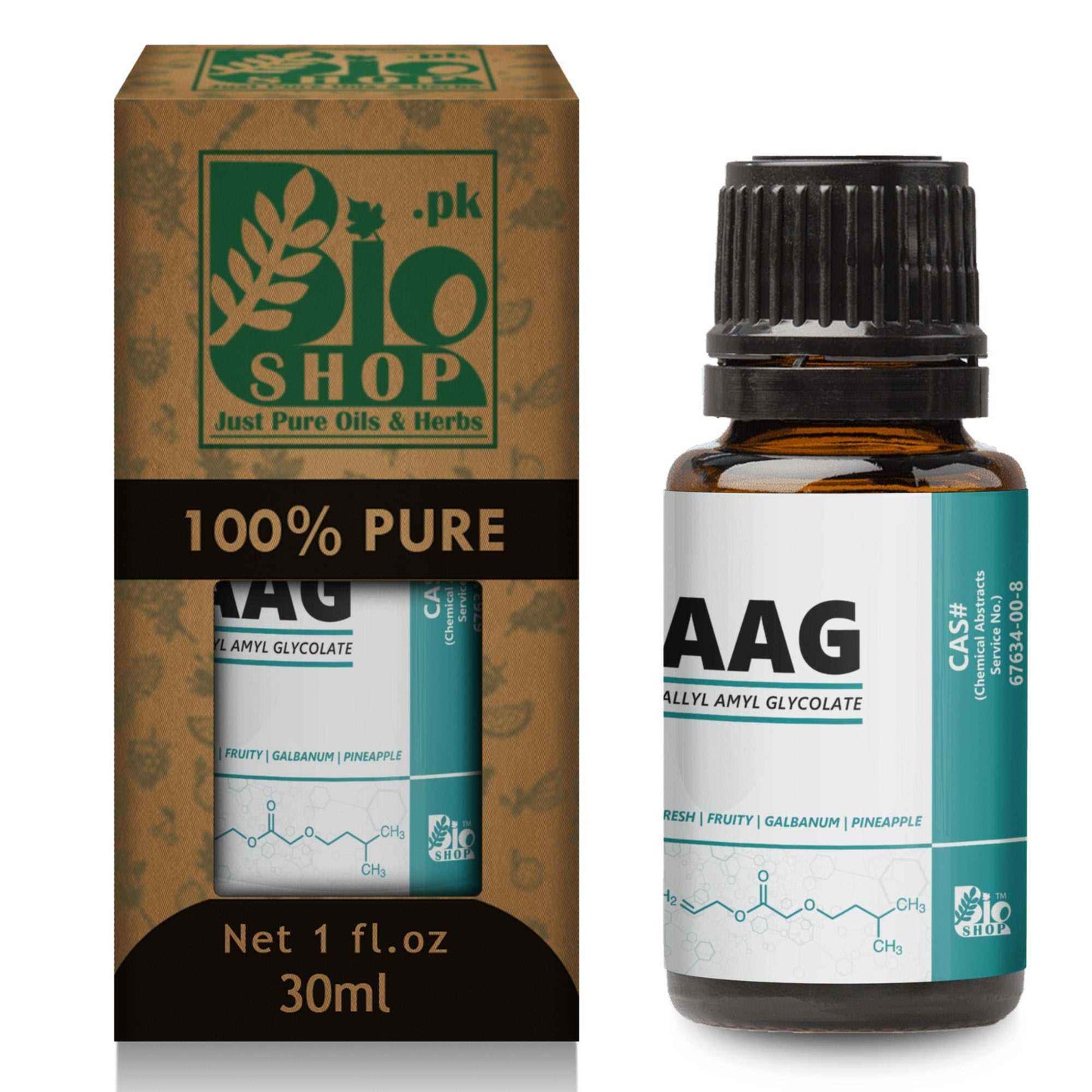
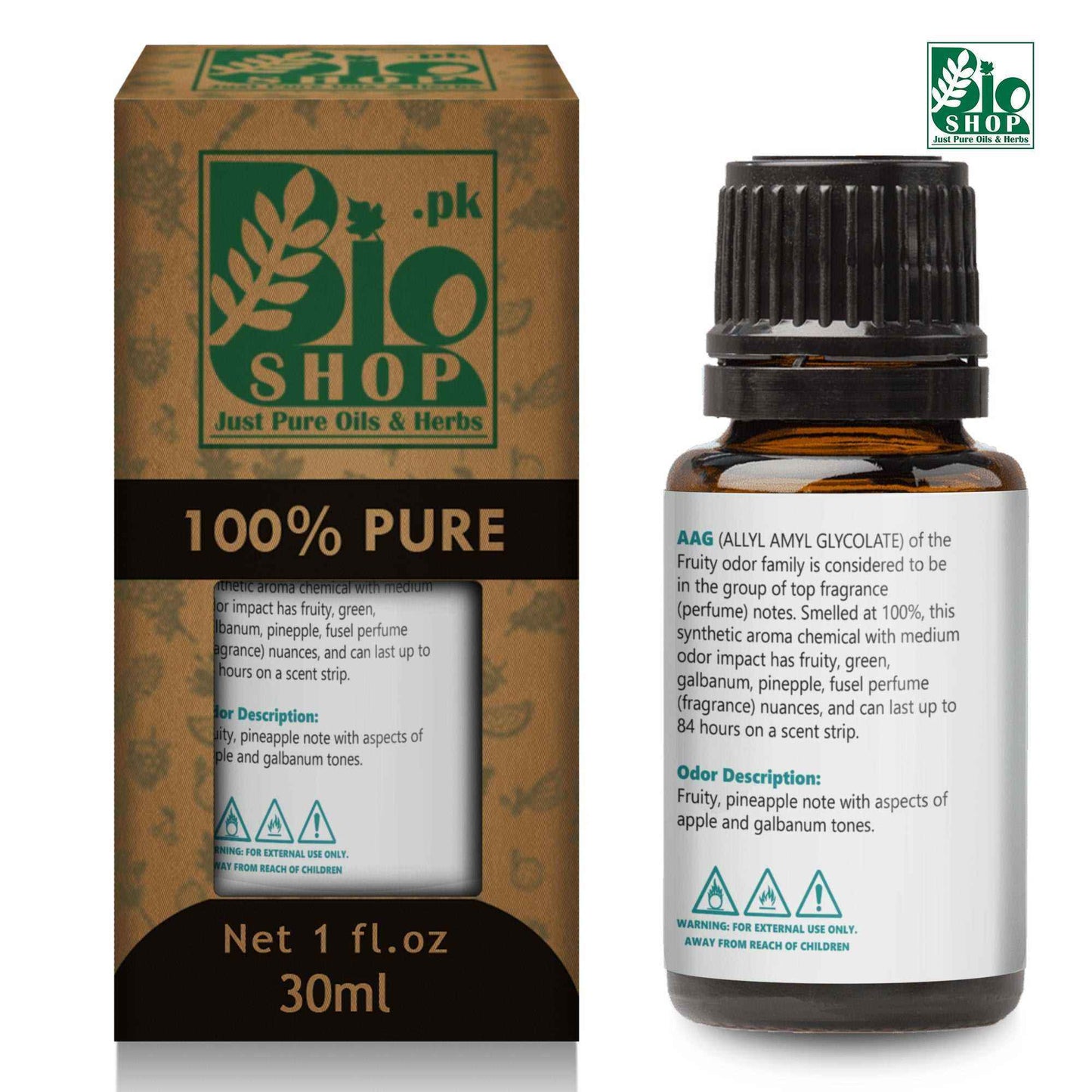
AAG (Allyl Amyl Glycolate)
AAG (Allyl Amyl Glycolate)
Olfactory Notes: Modern pineapple & metallic "galbanum" top note.
Couldn't load pickup availability
Explore
Information About AAG (Allyl Amyl Glycolate)
Key Features
✦ Powerful fresh-green synthetic ester delivering watery, fruity-aquatic top notes at very low use levels — active even at 0.05 percent of formula
✦ Signature character evokes green apple peel, watermelon rind, cucumber water, and dewy cut grass with a clean aquatic undertone
✦ Foundational material in the aquatic and fougère fragrance genre; widely used in Cool Water-style and fresh masculine compositions
✦ Excellent performance in functional fragrance applications including shampoos, body washes, and fabric softeners due to its bright, lifting radiance
✦ Synthetic ester — fully vegan, consistent batch-to-batch, and free from animal-derived components
✦ IFRA-restricted material — must be used within current IFRA 51st Amendment category limits due to sensitization potential of the allyl group
✦ Acts as a green-aquatic lift agent in complex blends; even trace amounts brighten heavy woody, floral, or oriental bases significantly
About AAG (Allyl Amyl Glycolate)
Allyl amyl glycolate is a synthetic aroma chemical first developed in the mid-20th century as perfumers began searching for materials capable of reproducing the sensation of freshness, water, and green nature that eluded natural raw materials. As part of the glycolate ester family, AAG was a significant contributor to the aquatic fragrance revolution of the 1980s and 1990s when perfumers began constructing compositions that smelled of open water, sea air, and dewy green landscapes. Its clean, modern character stood in contrast to the heavy oriental and chypre traditions of earlier decades and helped define an entire generation of masculine and fresh-unisex fragrances.
What distinguishes AAG from other fresh materials is the specificity and vividness of its green-aquatic impression. Where materials like Calone deliver a melon-marine aquatic and Hedione provides a transparent jasmine-fresh effect, AAG occupies a precise niche of green-fruit freshness — the smell of watermelon rind, sliced cucumber, and the inner pith of a green apple all at once, lifted on a current of clean air. It is not simply a top note that disappears — at the right concentration it contributes a persistent fresh green character that runs through the heart of a composition and keeps it feeling alive. Its intensity demands discipline: overuse produces a synthetic, chemical-smelling sharpness that overwhelms rather than refreshes.
Bio Shop Pakistan supplies cosmetic-grade allyl amyl glycolate suitable for fine fragrance development, functional fragrance blending, fougère and aquatic accord construction, and professional DIY perfumery work across all product formats.
Olfactory Profile
SCENT DESCRIPTION : AAG opens with an immediate, vivid burst of green-watery freshness — like the moment a watermelon is cut open or cucumber is sliced on a warm day. There is a crisp, slightly fruity facet reminiscent of green apple skin alongside a clean aquatic undertone that reads as dewy and natural rather than synthetic or marine. At lower concentrations the green character softens into a transparent, airy freshness that functions almost like a window in a composition, letting light and air into darker or heavier accords. It is one of the most instantly recognizable materials in modern perfumery.
NOTE POSITION : Top Note / Top-Mid Note
FRAGRANCE FAMILY : Aquatic / Green / Fresh Fruity
FACETS : Green Apple · Watermelon Rind · Cucumber · Dewy · Aquatic
TENACITY : Low to Medium — 2 to 4 hours on a blotter; fixation improves significantly in functional formats and with proper anchoring materials in the base
SILLAGE : Medium — projects a bright, clean green-aquatic radiance in the opening that transitions smoothly; diffuses well in spray applications
Technical Specifications
Chemical Name : Allyl amyl glycolate (Allyl 2-(pentyloxy)acetate)
CAS Number : 67634-00-8
Synonyms : AAG, Allyl Amyl Glycollate, Amyl Allyl Glycolate
Purity : 97% – 99% (verify with supplier batch certificate)
Appearance : Colorless to very pale yellow clear liquid
Odor Threshold : Approximately 2 to 5 ppb; highly impactful at trace concentrations
Solubility : Soluble in perfumer's alcohol and fixed oils; practically insoluble in water
Specific Gravity : 0.960 – 0.985 at 20°C (verify with supplier batch certificate)
Flash Point : Approximately 75°C (verify with supplier SDS)
Type : Synthetic
Applications & Usage Guidelines
Fine Fragrance ★★★★★
AAG is most effective in alcoholic fine fragrance where its fresh-green burst performs at its best. It is a cornerstone material in aquatic, fougère, green floral, and fresh masculine compositions. Use between 0.05 and 0.3 percent of the total formula for a natural green lift; higher concentrations must stay within IFRA limits.
Functional Fragrance ★★★★★
AAG performs exceptionally in rinse-off functional products including shampoos, body washes, shower gels, and fabric care. Its fresh green character survives the dilution and water rinsing process well, delivering a clean, vibrant impression on wet hair and skin. One of its strongest applications outside fine fragrance.
Attar and Oriental Blending ★★★
In small trace amounts, AAG can be used to lift and brighten otherwise dense oriental, oud, or floral attar compositions. It functions as a contrast element — a sliver of freshness cutting through a heavy base. It is not a traditional attar material but serves a deliberate modern modification role in contemporary mukhallat work.
Cosmetics ★★★
AAG can be incorporated into creams, lotions, and hair care products as a fragrance contributor at concentrations within IFRA leave-on category limits. It adds a fresh green character to cosmetic formulations but must be used carefully due to sensitization risk. Not suitable for lip or eye-area products.
Home Fragrance ★★★
In reed diffusers and room sprays, AAG contributes a bright fresh opening to home fragrance blends. Performance in candles is moderate — some flash-off occurs at pouring temperatures but enough character remains to contribute to cold throw. Best used as a supporting fresh note rather than a primary material in home fragrance.
IFRA & Usage Rate
Recommended Usage Rates
EDP (Eau de Parfum) : 0.05% – 0.3%
EDT (Eau de Toilette) : 0.05% – 0.2%
Body Lotion (Leave-on) : 0.02% – 0.1%
Shampoo / Body Wash : 0.1% – 0.5%
Candle : 0.1% – 0.3%
Reed Diffuser : 0.3% – 0.8%
Soap (Rinse-off) : 0.1% – 0.3%
IFRA 51st Amendment Limits (Allyl Amyl Glycolate — Key Categories)
Category 1 (Lip products) : Not recommended
Category 3 (Eye area / Face products) : 0.01% — verify with current IFRA standard
Category 4 (Fine Fragrance / EDP / EDT) : 0.3% — verify with current IFRA standard
Category 5A (Body lotion, leave-on) : 0.1% — verify with current IFRA standard
Category 5B (Face cream, leave-on) : 0.05% — verify with current IFRA standard
Category 7A (Rinse-off body / hair) : 0.5% — verify with current IFRA standard
Category 9 (Fabric softener) : 0.1% — verify with current IFRA standard
Category 11A (Candles) : Verify with current IFRA standard
⚠️ AAG contains an allyl functional group which is associated with dermal sensitization potential. Always stay within IFRA 51st Amendment category limits. Do not apply undiluted to skin. Patch testing is recommended before incorporation into leave-on cosmetic products.
⚠️ All IFRA limits stated above are indicative. Always verify against the most current IFRA amendment published at ifrafragrance.org before finalizing any commercial formula.
Blending Guide
Usage Method 1 — Direct Addition to Alcohol Base
AAG is freely soluble in perfumer's alcohol and can be added directly to an alcoholic concentrate at your calculated usage rate. Because of its intensity, always weigh rather than estimate by drop — even small overages produce an unwanted synthetic sharpness. Add to your base concentrate first, allow 24 to 48 hours of maceration, and evaluate on a blotter before finalizing the formula.
Usage Method 2 — Green-Aquatic Accord Pre-Build
Build a pre-blended green-aquatic accord by combining AAG with Calone 1951 at a 4-to-1 ratio (AAG dominant) in a carrier of dipropylene glycol or diethyl phthalate. Add violet leaf absolute or galbanum at trace levels to deepen the green facet. This pre-built accord can then be used at 3 to 8 percent of your total formula to introduce a complete fresh-aquatic green effect without calibrating individual materials each time.
Usage Method 3 — Contrast Brightener in Heavy Bases
In oriental, oud-heavy, or dark floral compositions, add AAG at 0.02 to 0.08 percent as an invisible brightener. At these trace levels it does not read as identifiably aquatic or green — it simply opens the composition, adds transparency, and prevents the opening from feeling closed or suffocating. This technique is widely used in niche perfumery to modernize classical heavy-base structures.
Best Pairings
Calone 1951 → Amplifies the aquatic facet; classic pairing for marine and ozonic accords
Violet Leaf Absolute → Deepens the green character; adds a natural, vegetal, dewy quality
Galbanum Resinoid → Intensifies sharp green bite; creates a powerful green-fresh opening accord
Hedione / Methyl Dihydrojasmonate → Adds a transparent floral freshness that lifts and extends the AAG effect
Dihydromyrcenol → Classic fougère pairing; creates the cool, fresh-green masculine accord structure
Lemon / Bergamot EO → Citrus brightness amplifies the fresh opening and adds natural lift
Iso E Super → Adds woody transparency and diffusion that extends AAG's freshness into the dry-down
Avoid
Do not pair AAG at high levels with heavy animalic materials such as civet, castoreum, or indoles — the freshness contrast is too extreme and creates an incoherent accord. Avoid combining with very heavy resins or thick balsams as the top-note brightness of AAG disappears before the base materials develop, leaving a disconnected opening. Do not use at levels above IFRA limits in a misguided attempt to increase freshness — the effect becomes harsh and chemical rather than fresh and natural.
Perfumer's Note
AAG is one of those materials that reveals the difference between a perfumer who measures and one who merely pours. In my experience working with it across dozens of aquatic and green fresh compositions, the most common mistake is always the same: too much. At 0.3 percent of a formula it is vivid, radiant, and alive. At 0.6 percent it becomes shrill, synthetic, and reminiscent of cleaning products rather than nature. The discipline of restraint with AAG is what separates a convincing fresh-aquatic from a chemical-smelling disappointment. When used correctly — as a precise instrument rather than a generous pour — it is one of the most effective and versatile materials in the modern palette. It is also one of the great democratic materials of contemporary perfumery: inexpensive, consistent, and capable of transforming the character of an entire composition with less than a tenth of a gram.
ADVANCED TIP : Create what I call a green waterfall effect by layering AAG with two other materials in a 5-3-2 ratio: AAG at 5 parts, violet leaf absolute at 3 parts, and a trace of stemone (violet/iris leaf material) at 2 parts, all pre-dissolved in a small amount of perfumer's alcohol. Allow this micro-accord to sit for 48 hours before adding it to your main formula at 0.5 to 1.0 percent of the total concentrate. The resting period allows the green facets to harmonize rather than compete, producing a natural, multidimensional green freshness that reads as far more complex and realistic than AAG alone. The stemone anchors the violet-green character and extends it subtly into the heart, preventing the typical rapid fade that affects AAG when used without green anchors.
Safety & Storage
Physical State : Colorless to pale yellow clear mobile liquid at room temperature
Skin Safety : Sensitizer — always dilute before skin contact; stay within IFRA limits; avoid undiluted application
Eye Contact : Avoid contact; if exposure occurs flush with clean water for 15 minutes and seek medical advice
Ingestion : Not for internal use; seek medical advice immediately if accidentally ingested
Ventilation : Use in a ventilated workspace; concentrated vapors may cause mild irritation to respiratory tract with prolonged exposure
Storage : Store sealed in a cool, dark place away from heat sources and direct sunlight; keep away from open flame
Shelf Life : 2 to 3 years when stored correctly in sealed conditions; monitor for color change or off-note development over time
Container : Dark glass bottle preferred; HDPE containers acceptable for short-term storage; avoid PVC or thin plastics
Flammability : Flash point approximately 75°C; keep away from open flame and high heat sources during handling
FAQ
Q: What does AAG smell like at working dilution?
A: At 3 to 5 percent in alcohol it smells vividly of green apple skin, sliced watermelon rind, and fresh cucumber with a clean aquatic undertone. It is immediately recognizable as the fresh-green note in countless aquatic and sport colognes.
Q: How much AAG should I use in an EDP formula?
A: Start at 0.05 to 0.1 percent of your total formula and evaluate before increasing. AAG is extremely powerful — most effective results come from staying between 0.1 and 0.3 percent maximum. Always stay within the IFRA Category 4 limit.
Q: Can AAG be used in soap making?
A: Yes, but within IFRA rinse-off limits which are typically around 0.3 to 0.5 percent. It performs well in cold process and hot process soap, contributing a fresh green character to the finished bar. Verify the exact limit with the current IFRA standard before formulating.
Q: Is AAG safe for leave-on products like lotions?
A: Yes, but at strictly controlled low concentrations within IFRA leave-on limits, typically around 0.1 percent or below. It is not suitable for lip products or eye-area formulations. Patch testing is recommended due to its sensitization potential.
Q: How does AAG compare to Calone 1951 for aquatic effects?
A: AAG and Calone are complementary rather than interchangeable. Calone delivers a distinctly melon-marine, sea-water aquatic impression. AAG is greener, fruitier, and more terrestrial — closer to fresh fruit and dewy vegetation than open ocean. The two are frequently used together in aquatic accords to create a fuller, more dimensional fresh-water impression, with Calone providing the marine depth and AAG providing the green-fruity top lift.
Where Can You Safely Use AAG (Allyl Amyl Glycolate)?
Discover how AAG (Allyl Amyl Glycolate) performs across different applications—rated for safety, stability, and effectiveness.
Quality product. Packing or handling during transportation must be focused plus delivery must be ensured timely.