Bio Shop
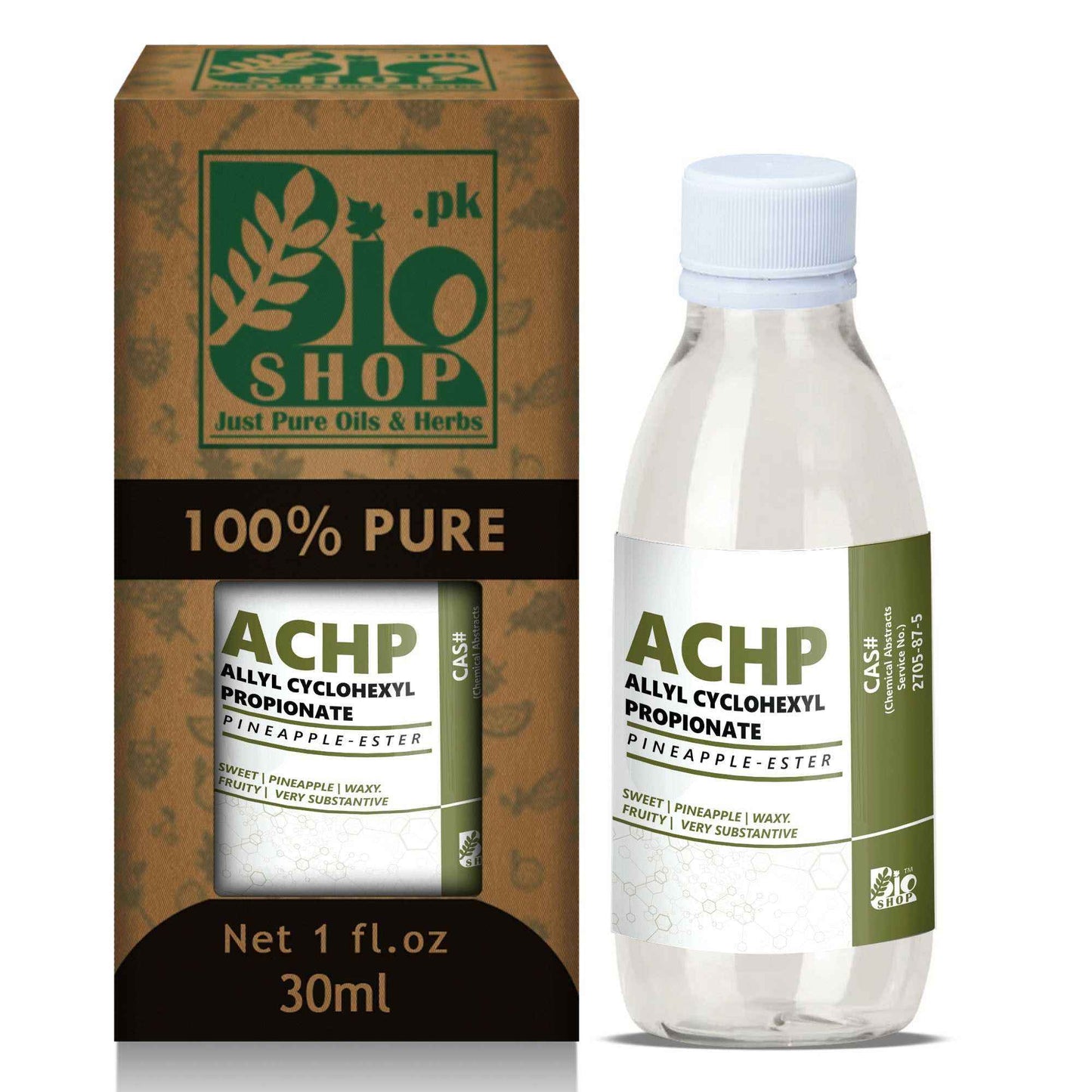
ACHP (Allyl Cyclohexyl Propionate)
ACHP (Allyl Cyclohexyl Propionate)
Olfactory Notes: Fruity, pineapple-like with a fresh apple facet.
Couldn't load pickup availability


Explore
Information About ACHP (Allyl Cyclohexyl Propionate)
Key Features
✦ Synthetic ester aroma chemical with a powerful, ripe pineapple and tropical fruity scent profile used across fine fragrance and functional applications
✦ Extremely high diffusion and sillage for its concentration — a small percentage goes a long way in any formulation
✦ Highly versatile in fruity, tropical, green, and marine fragrance families — blends smoothly with citruses, florals, and musks
✦ Effective in both leave-on and rinse-off applications including EDP, EDT, shampoo, body wash, and soap
✦ Stable in alcohol-based fine fragrance and reed diffuser bases — reliable performance in retail-grade products
✦ Vegan and cruelty-free — no animal-derived ingredients or animal testing involved in production
✦ Used in globally recognized tropical and fruity fragrance accords by major fragrance houses since the mid-20th century
About ACHP (Allyl Cyclohexyl Propionate)
Allyl Cyclohexyl Propionate (ACHP) is a synthetic aroma chemical belonging to the aliphatic ester family. It was developed as part of the broader mid-century effort to create powerful, diffusive fruity notes that natural raw materials could not achieve at scale or consistency. ACHP rapidly became a standard material in perfumery for its ability to evoke ripe pineapple, tropical fruits, and a faintly green waxy character that adds dimension to fruity compositions.
What makes ACHP particularly notable among fruity aroma chemicals is its exceptional tenacity-to-concentration ratio. Even at usage rates below one percent in a finished product, ACHP broadcasts a vivid and recognizable tropical-fruity presence. Its ester structure allows it to integrate seamlessly into both fresh citrus-led compositions and richer oriental bases where it provides contrast and lift. It is one of the few synthetic materials that performs effectively across fine fragrance, functional fragrance, and household product categories with minimal modification to the formula.
Bio Shop Pakistan supplies cosmetic-grade Allyl Cyclohexyl Propionate suitable for DIY perfumers, independent fragrance studios, cosmetic product developers, and home-based formulators looking to build professional-quality tropical and fruity scent profiles.
Olfactory Profile
SCENT DESCRIPTION
ACHP opens with an immediate burst of ripe, juicy pineapple — bright, slightly tart, and unmistakably tropical. As it settles, a soft green and waxy quality emerges underneath the fruit, giving the material more depth than a simple ester note. The overall impression is fresh and vibrant with a clean, synthetic clarity that sits beautifully in a blend without clashing. It evaporates relatively quickly but leaves behind a faint fruity sweetness that transitions well into heart notes.
NOTE POSITION : Top / Top-Mid
FRAGRANCE FAMILY : Fruity · Tropical · Green
FACETS : Pineapple · Tropical · Waxy · Green · Fresh
TENACITY : Medium — approximately 4 to 6 hours on skin, longer on fabric and in diffusers
SILLAGE : High — projects strongly even at low concentrations, noticeable from a distance in leave-on products
FIELD 4 — Technical Specifications
Chemical Name : Allyl 3-cyclohexylpropanoate
CAS Number : 2705-87-5
Synonyms : Allyl Cyclohexane Propionate · Allyl Cyclohexylpropionate · ACHP
Purity % : 97% minimum (verify with certificate of analysis)
Appearance : Colorless to pale yellow clear liquid
Odor Threshold : Approximately 0.01 to 0.05 ppm — extremely potent
Solubility : Insoluble in water · Soluble in ethanol, IPM, and fragrance bases
Specific Gravity : 0.946 to 0.952 at 20°C
Flash Point : Approximately 77°C to 82°C
Type : Synthetic — ester class aroma chemical
Technical Specifications
Chemical Name : Allyl 3-cyclohexylpropanoate
CAS Number : 2705-87-5
Synonyms : Allyl Cyclohexane Propionate · Allyl Cyclohexylpropionate · ACHP
Purity % : 97% minimum (verify with certificate of analysis)
Appearance : Colorless to pale yellow clear liquid
Odor Threshold : Approximately 0.01 to 0.05 ppm — extremely potent
Solubility : Insoluble in water · Soluble in ethanol, IPM, and fragrance bases
Specific Gravity : 0.946 to 0.952 at 20°C
Flash Point : Approximately 77°C to 82°C
Type : Synthetic — ester class aroma chemical
Applications & Usage Guidelines
Fine Fragrance : ★★★★★
ACHP is highly valued in EDP and EDT construction for fruity tropical accords. It delivers immediate olfactory impact in the top note and is used in pineapple, mango, and citrus-forward compositions. Start at 0.5% and evaluate — it is powerful and can dominate if over-used.
Attar and Oriental Blending : ★★★★
In attars and oil-based oriental blends, ACHP introduces a refreshing tropical lift that contrasts well with heavy woody and resinous bases. It works particularly well when paired with ambrette seed, sandalwood, or floral musks to brighten heavy oil bases without breaking the character.
Functional Fragrance : ★★★★
ACHP performs reliably in shampoos, body washes, and household cleaners where a fresh tropical identity is desired. Its rinse-off performance is acceptable at recommended usage rates and it survives moderate pH conditions found in typical surfactant systems.
Cosmetics : ★★★
Suitable for creams, lotions, and body butters at low concentrations where a light fruity background note is desired. Stability in emulsions is generally good but patch testing is recommended for leave-on skin applications given its sensitization history at high doses.
Home Fragrance : ★★★★
In reed diffusers and wax melts, ACHP diffuses aggressively and fills a room with a tropical-fruity character quickly. Candle performance is good when properly anchored with base notes. Blends well with coconut, vanilla, and citrus materials in home fragrance applications.
IFRA & Usage Rate
Recommended Usage Rates by Application
EDP (Eau de Parfum) : 0.5% to 2.0%
EDT (Eau de Toilette) : 0.3% to 1.5%
Body Lotion / Cream : 0.2% to 0.8%
Shampoo / Body Wash : 0.1% to 0.5%
Candle (finished wax) : 1.0% to 3.0%
Reed Diffuser (in carrier) : 2.0% to 6.0%
Soap (cold process / melt) : 0.3% to 1.0%
IFRA 51st Amendment Reference Limits (Approximate)
ACHP is included in the IFRA standards as a material requiring category-based concentration limits due to skin sensitization potential at elevated doses.
Category 1 (Fine fragrance applied to skin) : Approximately 1.0% in finished product
Category 4 (Body lotion, leave-on) : Approximately 0.5% in finished product
Category 9 (Rinse-off — shampoo, body wash) : Approximately 2.0% in finished product
Category 11 (Candles, reed diffusers) : Generally not restricted
⚠️ Always verify current IFRA 51st Amendment limits at ifrafragrance.org before finalizing formulas for commercial products. The values above are reference estimates — always use the official IFRA published table as your primary source.
⚠️ ACHP has skin sensitization potential at high concentrations. Stay within recommended usage limits and perform RIFM safety assessments for leave-on products.
Blending Guide
Usage Method 1 — Alcohol-Based Fine Fragrance
Dissolve ACHP directly in perfumer's alcohol (IPP or DPG carrier optional) before adding other materials. Add at the start of your formula to allow it to integrate fully. Evaluate at 24 hours and 72 hours as its character softens slightly after rest.
Usage Method 2 — Oil-Based Attars and Rollers
Pre-dilute ACHP to 10% in DPG or IPM before incorporating into oil blends. This prevents over-dosing and allows precise control. Stir thoroughly as ACHP can stratify slightly in dense carrier oils when added neat.
Usage Method 3 — Functional and Rinse-Off Products
Add ACHP to your fragrance premix before blending into the base. In surfactant-heavy systems, use a solubilizer such as polysorbate 20 at a ratio of 1:4 (ACHP to solubilizer) to maintain clarity and performance.
BEST PAIRINGS
Hedione → Adds soft jasmine depth and diffusion that lifts the pineapple note
Linalool → Rounds off the sharpness and creates a floral-fruity bridge
Iso E Super → Gives woody-amber body and longevity to an otherwise short-lived top note
Bergamot EO → Brightens the citrus dimension and creates a fresh tropical citrus accord
Coconut Aldehyde → Intensifies the tropical character into a full coconut-pineapple accord
Galaxolide → Anchors ACHP with a clean musk that gives the fruity note a silky dry-down
Violet Leaf Abs → Adds green, ozonic contrast that transforms the tropical note into a coastal accord
AVOID
ACHP can become aggressively synthetic and sharp when paired with other high-intensity esters such as allyl amyl glycolate or ethyl maltol at full strength. Avoid stacking multiple high-diffusion fruity materials without a grounding agent.
Perfumer's Note
When I reach for ACHP in a formula, I am not looking to build a photo-realistic pineapple accord — I am looking for energy. This material has an almost reckless generosity in the way it projects. A single drop opens up an entire blend and signals tropical brightness to the nose before any other material has a chance to register. That quality — immediacy — is rare in a palette that increasingly values subtlety. ACHP earns its place in a working collection not because it is refined, but because it is honest about what it does and does it without hesitation. I use it to tell the nose that something interesting is coming, and then I let better-behaved materials finish the story.
ADVANCED TIP
Try building a coconut-pineapple aldehyde accord using ACHP at 0.8%, gamma-decalactone at 0.4%, and coumarin at 0.2% in a linalool carrier at 98.6%. Rest this premix for 48 hours before evaluating. The coumarin will soften the sharp edges of ACHP, gamma-decalactone will introduce creamy stone-fruit depth, and the linalool carrier will act as a natural diffuser that prevents the ester note from reading as synthetic in the finished blend.
Safety & Storage
Physical State : Clear liquid at room temperature — handle accordingly
Skin Safety : Potential skin sensitizer at elevated concentrations — follow IFRA limits for all leave-on applications · Dilute before skin contact
Eye Contact : Irritant — avoid direct eye exposure · Rinse immediately with water for 15 minutes if contact occurs
Ingestion : Not for consumption · Keep away from food and beverages · Seek medical attention if ingested
Ventilation : Use in well-ventilated areas · Avoid prolonged inhalation of concentrated vapor
Storage : Store in a cool, dark place between 10°C and 25°C · Away from heat sources and direct sunlight
Shelf Life : 24 to 36 months when stored correctly in sealed container
Container : Store in original amber glass or HDPE container · Avoid PET plastic for long-term storage
Flammability : Combustible liquid · Flash point approximately 77–82°C · Keep away from open flame during handling
FAQ
Q: How much ACHP should I use in a basic EDT formula?
A: Start at 0.5% to 1.0% in your finished EDT. ACHP is very powerful — evaluate your trial at 24 and 48 hours before increasing. Most professional formulators keep it below 1.5% in alcohol-based fine fragrance.
Q: Can I use ACHP in cold process soap?
A: Yes, at 0.3% to 0.8% in the finished soap bar. ACHP can fade somewhat during saponification but retains a light tropical-fruity character. Anchoring it with a fixative such as Iso E Super or a resin-based material improves longevity in soap.
Q: Is ACHP safe for leave-on skin products like body lotion?
A: Yes, but only within IFRA limits — approximately 0.5% in the finished lotion. Above this level, skin sensitization risk increases. Always conduct patch testing for commercial leave-on formulations and reference the current IFRA 51st amendment guidelines.
Q: Does ACHP work well in reed diffusers and candles?
A: Reed diffusers are one of ACHP's strongest applications. Its high diffusivity makes it excellent for filling a room quickly. In candles, use at 1% to 3% in the wax load and anchor it with base notes to prevent it from burning off too quickly at the top of the melt pool.
Q: How does ACHP compare to natural pineapple absolute or other pineapple materials?
A: Pineapple absolute is not commercially available in practical quantities for most formulators. Among synthetic pineapple materials, ACHP is more green and waxy compared to allyl hexanoate which reads as sharper and more synthetic. Ethyl 2-methylbutyrate offers a crisper apple-pineapple character. ACHP is the most rounded and blendable of the three and is the standard choice for building pineapple-tropical accords in professional perfumery.
Where Can You Safely Use ACHP (Allyl Cyclohexyl Propionate)?
Discover how ACHP (Allyl Cyclohexyl Propionate) performs across different applications—rated for safety, stability, and effectiveness.