Bio Shop
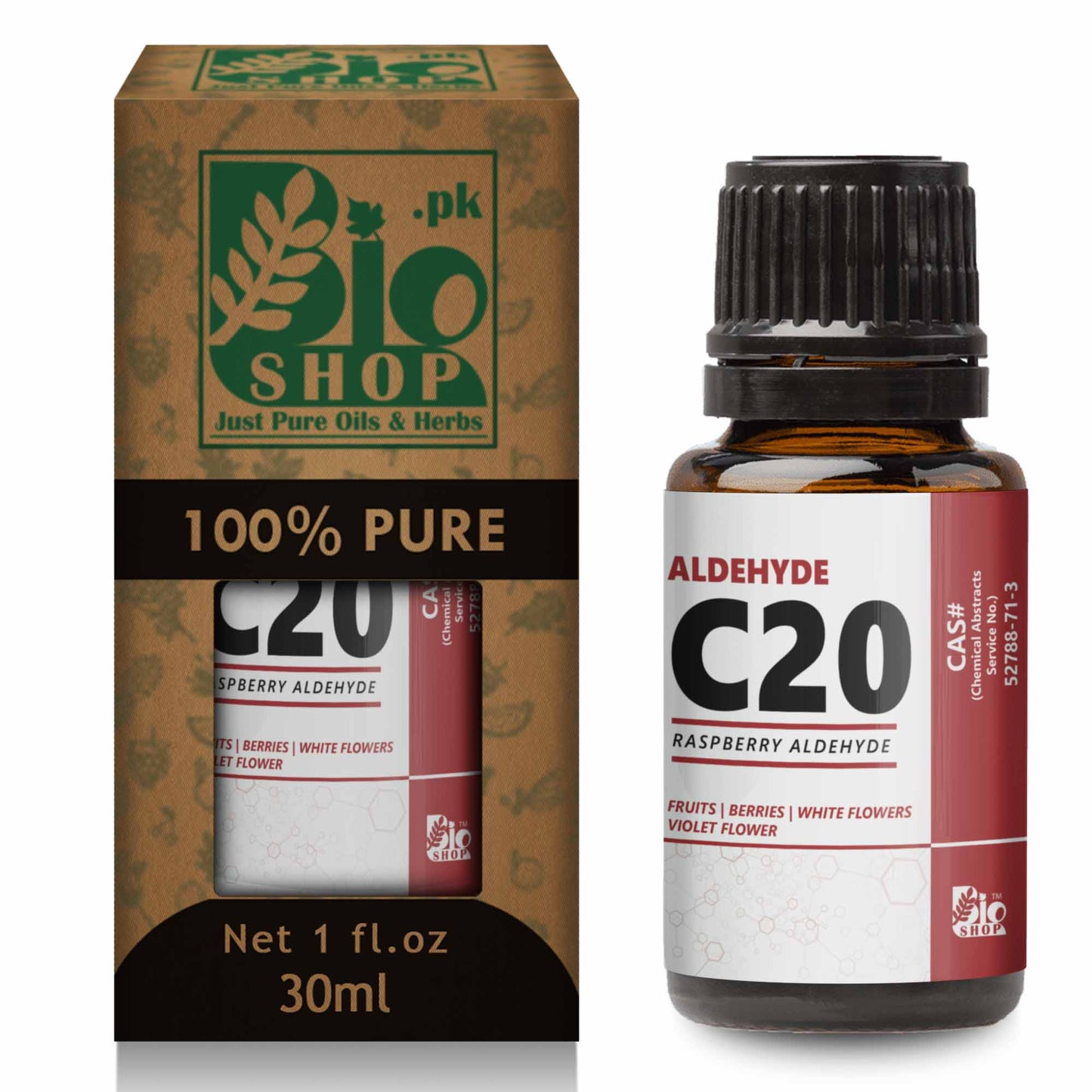
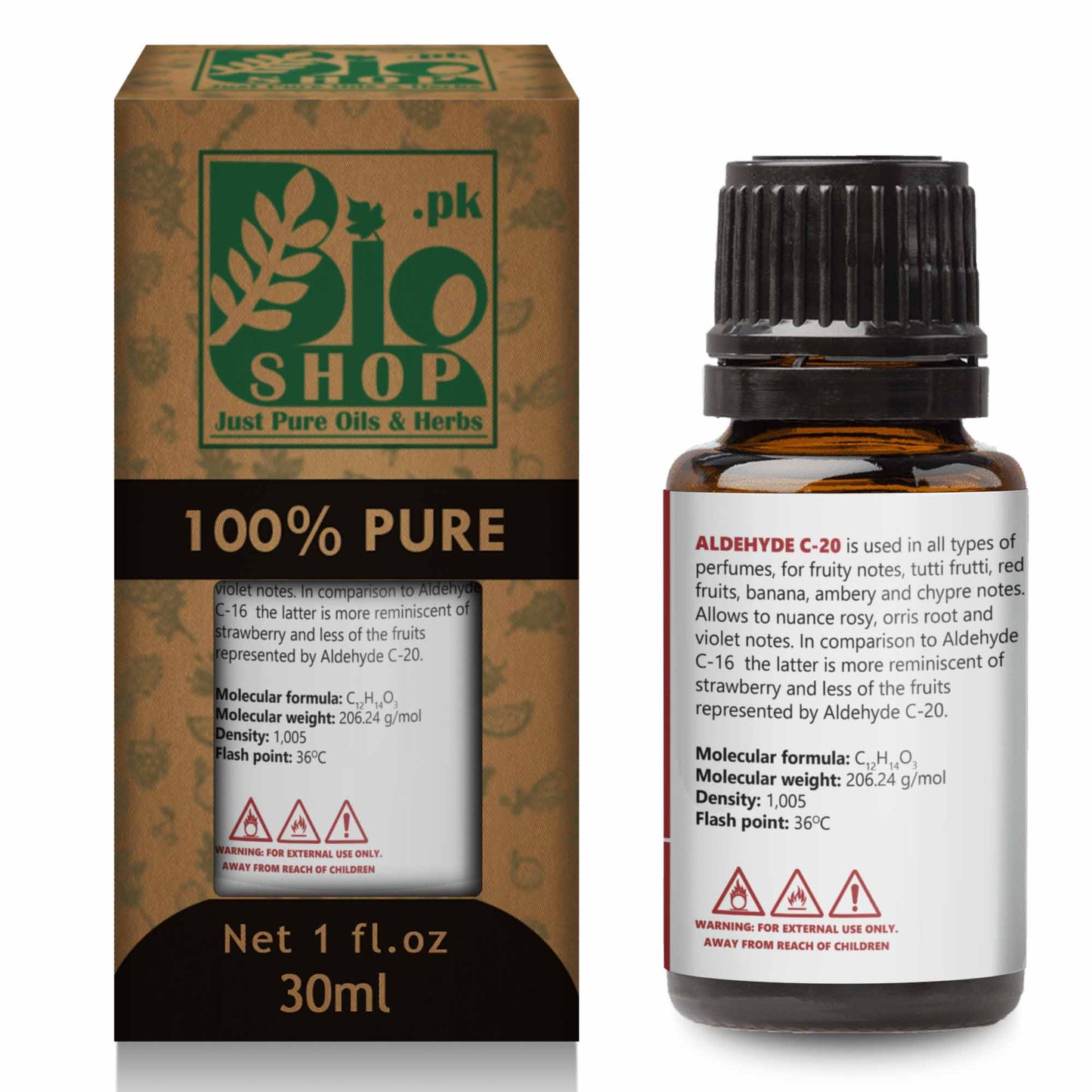
Aldehyde C20 (Raspberry Aldehyde)
Aldehyde C20 (Raspberry Aldehyde)
Olfactory Notes: Raspberry-like; sweet, berry, and jammy facets.
Couldn't load pickup availability
Explore
Information About Aldehyde C20 (Raspberry Aldehyde)
Key Features
✦ Synthetic aroma chemical delivering an intense, sweet, fresh raspberry and fruity character with very high diffusion power
✦ Chemically known as 4-(4-Hydroxyphenyl)-2-butanone — a ketone despite the aldehyde trade name — with CAS 5471-51-2
✦ Ultra-low use rate required due to extremely low odor threshold — typically 0.05% to 1% in finished products
✦ White crystalline solid at room temperature — must be melted or pre-dissolved in warm carrier before blending
✦ Widely used in fruity florals, gourmand perfumes, body lotions, shampoos, and candles worldwide
✦ Vegan and cruelty-free — no animal-derived components, suitable for halal and vegan beauty formulations
✦ Featured in classic and contemporary fruity floral fragrances; a key material in raspberry, peach, and berry accords
About Aldehyde C20 (Raspberry Aldehyde)
Aldehyde C-20, sold under the trade name Raspberry Aldehyde, is a synthetic aroma chemical first identified in the early 20th century as the compound responsible for the characteristic scent of fresh raspberries. Its IUPAC name is 4-(4-Hydroxyphenyl)-2-butanone and it belongs to the ketone functional group, though the fragrance industry historically classified it under the aldehyde series due to the naming conventions of the era. It is found naturally in raspberries, blackberries, and peaches at trace levels, but commercial production is entirely synthetic to ensure purity, consistency, and supply stability.
What sets Aldehyde C-20 apart is the extraordinary intensity of its aroma relative to concentration. It is active at parts-per-billion levels, which means even a fraction of a percent can transform a formula entirely. This makes it both a powerful creative tool and a material that demands careful handling and precise dosing. Its solid form at room temperature requires melting or pre-dissolution before use, but it offers excellent alcohol solubility, making it ideal for spray perfumery. The note is unmistakably sweet and fruity, with a bright top-note quality that adds freshness and a juicy character to blends.
Bio Shop Pakistan supplies cosmetic-grade Aldehyde C-20 (Raspberry Aldehyde) suitable for DIY perfumers, independent fragrance houses, cosmetic formulators, and home crafters working with fruity floral, gourmand, and berry-forward creations.
Olfactory Profile
SCENT DESCRIPTION : Aldehyde C-20 opens with a vivid, candied raspberry burst that is intensely sweet and unmistakably fruity. The heart reveals a slightly floral warmth reminiscent of fresh rose petals layered over ripe berries. There is a soft, jammy quality that gives it a gourmand depth without heaviness. At full dry-down, a clean, faintly powdery sweetness lingers on the skin.
NOTE POSITION : Top-Mid
FRAGRANCE FAMILY : Fruity · Gourmand · Floral-Fruity
FACETS : Sweet · Berry · Jammy · Fresh · Powdery
TENACITY : Medium-High — perceptible for 5 to 8 hours at standard usage rates
SILLAGE : High — projects strongly even at low concentrations due to ultra-low odor threshold; radiates well in warm conditions
Technical Specifications
Chemical Name : 4-(4-Hydroxyphenyl)-2-butanone
CAS Number : 5471-51-2
Synonyms : Raspberry Ketone, Frambinone, Oxyphenylon, Rheosmin, p-Hydroxybenzyl Acetone, FEMA 2588
Purity : 98% minimum (verify with current batch COA)
Appearance : White to off-white crystalline powder or solid
Odor Threshold : Approximately 1 to 10 ppb — extremely potent
Solubility : Soluble in ethanol and propylene glycol; practically insoluble in water; slightly soluble in IPM and fixed oils
Specific Gravity : Approximately 1.09 g/cm³ (liquid state above melting point)
Flash Point : Greater than 100°C (212°F) — verify with SDS from current batch
Melting Point : 82 to 84°C
Type : Synthetic
Applications & Usage Guidelines
Fine Fragrance ★★★★★
Aldehyde C-20 is a cornerstone of fruity floral and gourmand perfumery. It adds a luminous, juicy raspberry top note that elevates floral hearts and anchors berry accords. Use at 0.1 to 0.5% in EDP and EDT formulas to add freshness without overpowering the composition.
Attar and Oriental Blending ★★★★☆
Raspberry note pairs surprisingly well with rose, oud, and sandalwood in Middle Eastern and Subcontinental style attars. It softens heavy resinous blends and adds a fruity sweetness that appeals to contemporary tastes. Use at 0.05 to 0.2% to avoid a synthetic candy effect in traditional attars.
Functional Fragrance ★★★★☆
Works effectively in shampoos, body washes, conditioners, and skin lotions where a fresh fruity note is desired. Good rinse-off performance and compatibility with surfactant systems make it a practical choice for functional personal care applications at 0.1 to 0.5%.
Cosmetics ★★★★☆
Suitable for body lotions, creams, and light leave-on products where a fruity scent is part of the product identity. Stable in typical cosmetic pH ranges. Pre-dissolve in a small amount of warm carrier oil or propylene glycol before incorporating into emulsions.
Home Fragrance ★★★★☆
Performs well in candles, reed diffusers, and wax melts as a bright fruity top note. Blends with vanilla, peach, and floral bases for gourmand home fragrance accords. In candles, test for wick performance as crystalline materials require thorough blending with wax at correct temperatures.
IFRA & Usage Rate
Recommended Usage Rates
Application : Recommended Rate
EDP (Eau de Parfum) : 0.1% to 0.5%
EDT (Eau de Toilette) : 0.05% to 0.3%
Body Lotion : 0.05% to 0.3%
Shampoo / Body Wash : 0.1% to 0.5%
Candle : 0.2% to 1.0%
Reed Diffuser : 0.5% to 2.0%
Bar Soap : 0.1% to 0.5%
IFRA 51st Amendment Status
Aldehyde C-20 (4-(4-Hydroxyphenyl)-2-butanone, CAS 5471-51-2) does not appear on the IFRA 51st Amendment restricted or prohibited ingredients list as of the latest update. No specific IFRA amendment limit applies to this material. Standard industry safe usage rates and good manufacturing practice apply.
⚠ Raspberry Ketone is also a registered flavoring substance (FEMA 2588). Do not confuse fragrance grade material with dietary supplement grade Raspberry Ketone — these are different application contexts with different regulatory requirements.
⚠ Due to its extremely low odor threshold, always weigh usage rates on a precision scale. Even slight overdosing produces an artificial candy effect that is difficult to correct in a formula.
⚠ Always verify current IFRA status and safety data with your supplier before commercial production.
Blending Guide
Usage Method 1 — Pre-dissolution in Warm Alcohol
Aldehyde C-20 is a solid at room temperature with a melting point of 82 to 84°C. For perfume applications, dissolve it in a small portion of perfumer's alcohol warmed to around 40 to 50°C, stir until fully dissolved, then add the remaining alcohol. This ensures even distribution and avoids crystallization in the finished bottle.
Usage Method 2 — Carrier Dilution for Cosmetics
For lotions, creams, and oil-based products, pre-melt the required quantity of Aldehyde C-20 in a small volume of propylene glycol or IPM at gentle heat. Add this solution to your formulation during the cool-down phase after emulsification to minimize volatility loss. Use at no more than 0.3% in leave-on skin products.
Usage Method 3 — Direct Addition for Candles and Wax Melts
Weigh the required amount of Aldehyde C-20 crystals and add them directly to your melted wax at the correct fragrance addition temperature (typically 65 to 70°C for soy wax). Stir thoroughly until fully incorporated. Test for fragrance load compatibility and wick performance before scaling production.
BEST PAIRINGS
Rose Absolute / Rose Otto → Creates a classic raspberry rose accord; elegant and feminine
Violet Leaf Absolute → Adds green, dewy freshness that amplifies the berry quality
Ethyl Maltol → Intensifies the sweet gourmand character for dessert accords
Lychee Furanone (Lychee Ether) → Combines for a multi-dimensional mixed berry impression
Geranium Essential Oil → Adds a natural rosy, slightly herbaceous bridge note
Sandalwood (Santalol / Sandela) → Anchors the fruity top note for lasting depth in oriental blends
Vanilla Absolute / Vanillin → Produces a warm, jammy, confectionery effect in gourmand work
Citrus Accords (Lemon/Bergamot) → Lifts the raspberry note with brightness and sparkling freshness
AVOID
Avoid combining at high concentrations with other very sweet or candy-like aroma chemicals such as Ethyl Butyrate or Methyl Anthranilate without careful restraint — the combination can push into overly synthetic fruity territory. Also avoid prolonged direct heat exposure during formulation as it may cause some volatility loss.
Perfumer's Note
Working with Aldehyde C-20 is an exercise in discipline. This is one of the most potent aroma chemicals in a perfumer's palette — a material where the line between a beautiful raspberry flourish and an overwhelming synthetic candy bomb is measured in hundredths of a percent. I approach it the way a chef approaches saffron: its value lies entirely in restraint. When used correctly, it gives a formula that luminous, ripe-fruit quality that signals freshness to the wearer before any other note is consciously registered. It is not a background material. It announces itself. Used well, it convinces you that real raspberries were somehow pressed into the bottle.
ADVANCED TIP : Instead of adding Raspberry Aldehyde directly into a fragrance compound at full strength, create a 1% dilution in perfumer's alcohol first. Working from a 1% dilution gives you far more control over incremental additions and prevents accidental overdosing. When building a raspberry-rose accord, start with 0.05% of the 1% dilution in your test formula (effectively 0.0005% of pure material), then assess after 24 hours of maceration. The compound blooms significantly in alcohol over time. What smells thin on day one often reaches full character by day three. This patience-based dosing approach separates professional results from amateur ones.
Safety & Storage
Physical State : White crystalline solid at room temperature; melts above 82°C
Skin Safety : Generally considered safe at recommended fragrance use levels; avoid prolonged undiluted skin contact; always dilute before use
Eye Contact : Avoid contact; if contact occurs, rinse thoroughly with clean water for 15 minutes and seek medical advice if irritation persists
Ingestion : Not for internal use in fragrance or cosmetic applications; keep away from children; do not confuse with dietary supplement products
Ventilation : Work in a well-ventilated area when handling molten material; avoid inhaling vapors or dust from crystalline form
Storage : Store in a cool, dry place away from direct sunlight and heat sources; ideal storage temperature is 15 to 25°C
Shelf Life : Minimum 24 months when stored correctly in sealed original container away from heat and light
Container : Store in original sealed container; HDPE, glass, or aluminum containers are appropriate; avoid prolonged storage in PET
Flammability : Flash point greater than 100°C — not classified as flammable under standard storage conditions; keep away from open flame when in molten state
FAQ
Q: What is Aldehyde C-20 and is it actually an aldehyde?
A: Aldehyde C-20 is the trade name for Raspberry Ketone (4-(4-Hydroxyphenyl)-2-butanone). Despite the name, it is chemically a ketone, not an aldehyde. The aldehyde naming series in the fragrance industry is a historical convention that does not always reflect actual chemistry.
Q: It is a solid — how do I dissolve it for use in perfume?
A: Warm a small portion of your perfumer's alcohol to around 40 to 50°C and stir the crystals in until fully dissolved. Then combine with the rest of your formula. Pre-making a 1% or 10% dilution is the most practical approach for ongoing formulation work.
Q: Why does my formula smell overpoweringly like candy even though I used very little?
A: Aldehyde C-20 has an extremely low odor threshold — it is active at parts-per-billion concentrations. If your formula smells synthetic or too strong, reduce the quantity significantly. Working from a 1% dilution in alcohol gives you the precision needed to dose it correctly.
Q: Is Aldehyde C-20 safe to use in rinse-off and leave-on cosmetics?
A: Yes, it is used commercially in shampoos, body washes, and lotions. For leave-on products, stay within 0.05 to 0.3% in the finished product. Always conduct a patch test and refer to your region's cosmetic ingredient safety regulations before commercial use.
Q: How does Aldehyde C-20 compare to natural raspberry extract or raspberry seed oil?
A: They are entirely different materials serving different purposes. Raspberry seed oil is a fixed carrier oil with no significant scent. Natural raspberry aroma from fruit extract is unstable, costly, and very faint. Aldehyde C-20 is a synthetic aroma chemical that captures the characteristic raspberry scent compound with far greater intensity, stability, and consistency than any natural extract currently available at commercial scale.
Where Can You Safely Use Aldehyde C20 (Raspberry Aldehyde)?
Discover how Aldehyde C20 (Raspberry Aldehyde) performs across different applications—rated for safety, stability, and effectiveness.