Bio Shop
Aldehyde C8 (10% in DPG)
Aldehyde C8 (10% in DPG)
Olfactory Notes: Intense orange peel and fatty citrus profile.
Couldn't load pickup availability

Explore
Information About Aldehyde C8 (10% in DPG)
Key Features
✦ Short-chain aliphatic aldehyde delivering a sharp, fatty, orange-peel citrus character with a clean waxy drydown
✦ Essential top-note material in classic aldehydic fragrances — the backbone of the aldehyde C-series used since the early 20th century
✦ Extremely low odour threshold (approx. 0.7 ppb) — effective at very small concentrations, making it highly economical
✦ Occurs naturally in sweet orange, lemon, and lime peel oils — suitable for naturally-positioned and semi-natural formulations
✦ Excellent diffuser and lifter — adds brightness, sillage, and radiance to citrus, floral, aquatic, and chypre bases
✦ Useful in functional fragrance applications including detergents, fabric care, and household products for a fresh clean opening
✦ Vegan and cruelty-free synthetic aroma chemical — no animal-derived raw materials involved
About Aldehyde C8 (10% in DPG)
Aldehyde C-8, known by its IUPAC name Octanal or commonly as Caprylic Aldehyde, is a straight-chain aliphatic aldehyde with eight carbon atoms. It is one of the foundational members of the C-aldehyde series — a group of synthetic aroma chemicals that revolutionised fine fragrance formulation in the early twentieth century. The discovery and application of aliphatic aldehydes, particularly in compositions like Chanel No. 5 (1921), introduced a new abstract quality to perfumery that could not be achieved with natural materials alone. Aldehyde C-8 was among the earliest of these materials to find widespread use and continues to be a staple in professional fragrance formulation today.
What makes Aldehyde C-8 technically distinctive is its extremely low odour threshold combined with its short-chain fatty character. Unlike the longer-chain aldehydes such as C-11 or C-12 which lean more waxy and powdery, Octanal sits at the sharper, more citrus-dominant end of the aldehyde spectrum. It evaporates quickly and is primarily a top-note contributor, making it invaluable for constructing bright, radiant fragrance openings. Its natural occurrence in citrus peel oils gives formulators additional flexibility when building naturally-derived or nature-identical accords without sacrificing performance.
Bio Shop Pakistan supplies cosmetic-grade Aldehyde C-8 (Octanal) suitable for DIY perfumers, fragrance students, attar blenders, and professional formulators working in fine fragrance, functional fragrance, and home care product development across Pakistan.
Olfactory Profile
SCENT DESCRIPTION : Aldehyde C-8 opens with a sharp, clean burst of fatty citrus — evoking freshly grated orange peel and sun-warmed rind with an almost soapy brightness underneath. The initial impact is diffusive and radiant, spreading quickly and lifting any blend it enters. As it dries, the fatty waxy quality becomes more apparent, leaving a clean abstract trail that reads as fresh and airy rather than heavy. At trace levels it imparts an almost luminous glow to floral and citrus compositions.
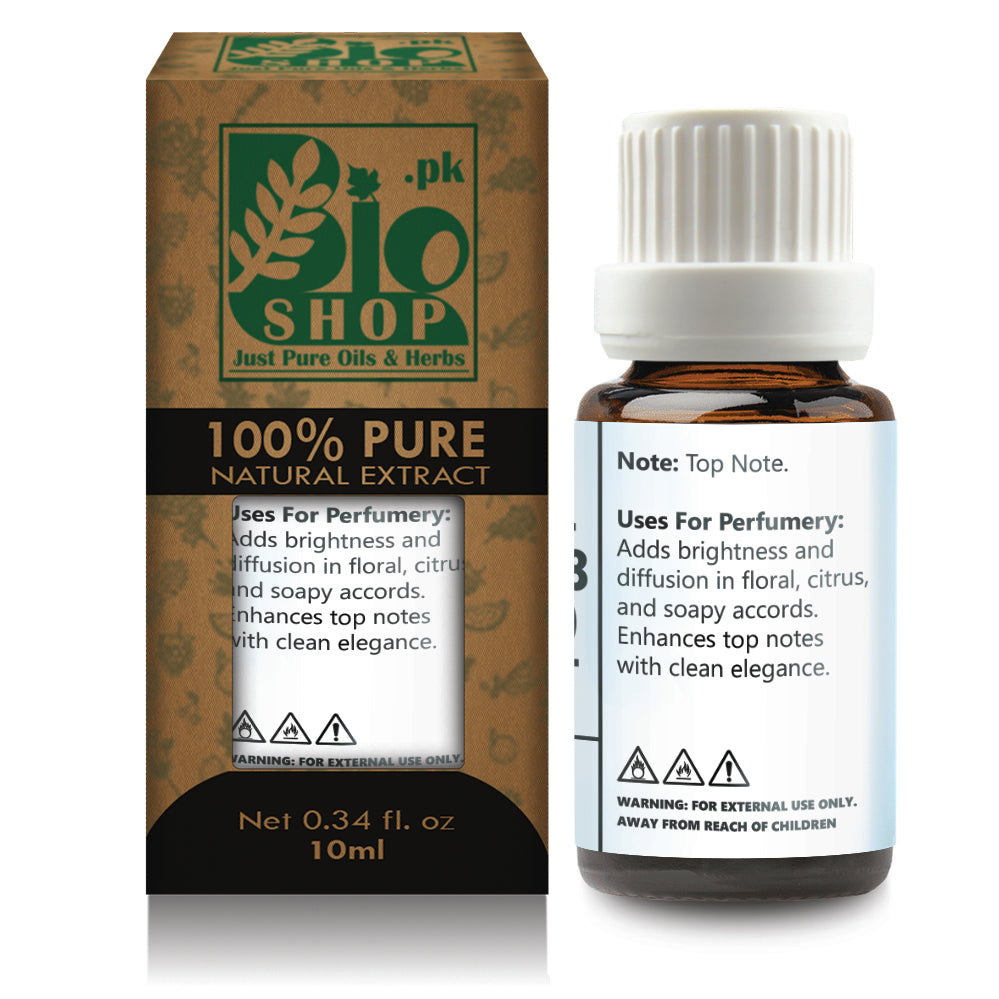
NOTE POSITION : Top Note
FRAGRANCE FAMILY : Aldehyde · Citrus · Fresh
FACETS : Fatty · Orange Peel · Waxy · Soapy · Citrus-Clean
TENACITY : Low — dissipates within 1 to 2 hours on skin, longer on blotter (2 to 3 hours)
SILLAGE : High on initial application — very diffusive and radiant in the opening; fades quickly as it is a volatile top note
FIELD 4 — Technical Specifications
Technical Specifications
Chemical Name : Octanal (n-Octyl Aldehyde)
CAS Number : 124-13-0
Synonyms : Aldehyde C-8, Caprylic Aldehyde, n-Octanal, Octyl Aldehyde, 1-Octanal
Purity % : 98% minimum (perfumery grade)
Appearance : Colourless to pale yellow clear liquid
Odour Threshold : Approximately 0.7 ppb (very low — use with care)
Solubility : Insoluble in water; fully soluble in alcohol, IPM, and fragrance oils
Specific Gravity : 0.820 – 0.825 at 20°C
Flash Point : Approximately 52°C (126°F)
Type : Synthetic (also occurs naturally in citrus peel oils — semi-natural origin possible)
Applications & Usage Guidelines
Fine Fragrance ★★★★★
Aldehyde C-8 is a cornerstone top-note material in fine fragrance, particularly in aldehydic, citrus, and classic floral compositions. It provides the bright, abstract lift that defines the opening of iconic aldehydic perfumes. Use at 0.1 to 0.5% in EDP and EDT concentrations for a radiant, soapy-citrus header.
Attar and Oriental Blending ★★★☆☆
In oriental and attar blending, Aldehyde C-8 is used sparingly to add a clean modern lift to otherwise heavy, resinous, or musky compositions. It can freshen up oud-based or ambery bases without overpowering their depth. Keep usage below 0.2% as the sharp character can feel out of place in traditionally warm compositions.
Functional Fragrance ★★★★☆
Aldehyde C-8 performs well in household and laundry fragrance applications where a fresh, clean opening is commercially desirable. Its citrus-fatty profile reads as clean and hygienic, making it a good fit for dishwashing liquid, detergents, and fabric softeners. It is cost-effective at these applications given its low effective use rate.
Cosmetics ★★★☆☆
In body lotions, creams, and light cosmetic formulations, Aldehyde C-8 can contribute a fresh clean note to the product experience. However, its volatility limits its lasting contribution and it must be properly stabilised in formulations with high aqueous content. Usage rates should remain very low — typically 0.05 to 0.15%.
Home Fragrance ★★★★☆
In reed diffusers, room sprays, and candles, Aldehyde C-8 contributes bright citrus diffusiveness and adds an airy, clean character to blends. It works well in combination with citrus top notes, light woods, and clean musks. Flash point must be respected in candle applications — keep wick testing thorough.
IFRA & Usage Rate
RECOMMENDED USAGE RATES
EDP (Eau de Parfum) : 0.1 – 0.5%
EDT (Eau de Toilette) : 0.05 – 0.3%
Body Lotion / Cream : 0.05 – 0.15%
Shampoo / Body Wash : 0.05 – 0.1%
Candle : 0.1 – 0.5%
Reed Diffuser : 0.2 – 1.0%
Soap (Bar) : 0.05 – 0.2%
IFRA 51st Amendment — Key Category Limits
Category 4 (Fine Fragrance) : Not specifically restricted — apply standard IFRA guidance and QRA
Category 5 (Body Lotion) : Not specifically restricted — recommended self-limitation applies
Category 9 (Soap) : Not specifically restricted at standard use levels
⚠️ Octanal has a very low odour threshold (approx. 0.7 ppb). Overuse will cause an unpleasant sharp, rancid-fatty character. Always start at the lower end of usage rates and evaluate carefully.
⚠️ Highly flammable liquid — flash point approximately 52°C. Store away from heat and open flame. Follow local fire safety regulations during handling.
⚠️ Skin sensitisation potential exists at high concentrations. Keep dermal use rates conservative and always perform a patch test protocol before commercial production.
Blending Guide
METHOD 1 — DIRECT ADDITION TO ALCOHOL BASE
Dissolve Aldehyde C-8 in a small amount of perfumer's alcohol (96% ethanol) before adding to the rest of the formula. This ensures even distribution given its high volatility and prevents any localised concentration in the batch. Add early in the blending process as a top-note header, not as a modifier added at the end.
METHOD 2 — PRE-DILUTION FOR CONTROL
Because Octanal is so potent at trace levels, many perfumers pre-dilute it to 10% in DPG or IPM before use. This makes micro-dosing far easier and more consistent across batches. Label your dilution clearly and recalculate usage rates accordingly in your formula.
METHOD 3 — BLENDING INTO A CITRUS ACCORD
When building a citrus accord, introduce Aldehyde C-8 as the abstract lift on top of naturals like lemon, bergamot, and sweet orange essential oils. It bridges the gap between the natural citrus character and a clean, modern freshness that naturals alone cannot fully achieve.
BEST PAIRINGS
Bergamot EO → Amplifies citrus brightness and adds abstract lift to the accord
Lemon EO → Sharpens the peel facet and extends top-note radiance
Neroli EO → Creates a luminous floral-aldehydic opening with soapy depth
Iso E Super → Smooth woody-cedar background that supports the aldehydic brightness
Hedione → Airy jasmine diffusiveness that softens the sharp fatty edge
Linalool → Softens the opening and bridges the aldehyde into a floral heart
Musks (Habanolide) → Clean musk base that echoes the soapy facet and extends longevity
Cedarwood Atlas EO → Grounding wood note that balances Octanal's volatility
AVOID
Heavy animalic bases (civet, castoreum accords) — the fatty character of Octanal can amplify rancid notes unpleasantly
High phenolic materials — potential stability and odour interaction issues
Extremely alkaline formulations — aldehydes are unstable at high pH (above 8.5), leading to rapid degradation
Perfumer's Note
Working with Aldehyde C-8 is a lesson in restraint and precision. It is one of the few materials in the perfumer's palette where the difference between a radiant, sunlit opening and an unpleasant fatty-rancid disaster is measured in fractions of a percent. When you get the dose right, Octanal does something extraordinary — it makes a fragrance feel open, bright, and airy in a way that no natural citrus oil alone can replicate. It gives compositions a sense of space and light. When overdosed, it smells like old cooking fat left near a window. This material demands respect and careful evaluation at every concentration point.
ADVANCED TIP : Try building what perfumers call a micro-aldehydic accord — blend Aldehyde C-8 at 0.1%, Aldehyde C-9 (Nonanal) at 0.05%, and Aldehyde C-10 (Decanal) at 0.05% in your formula. This layering of short-chain aldehydes creates a more complex, rounded aldehydic lift rather than a single sharp note. Evaluate the trio against just using C-8 alone and you will immediately appreciate how the blended approach adds sophistication and smoothness to the opening while maintaining brightness. This technique is a hallmark of classical European fine fragrance construction.
Safety & Storage
Physical State : Clear colourless to pale yellow liquid at room temperature
Skin Safety : Potential irritant and sensitiser at elevated concentrations — use within recommended rates; patch test before production
Eye Contact : Irritant — avoid contact; flush with clean water for 15 minutes if contact occurs and seek medical advice
Ingestion : Not for consumption — toxic if swallowed; keep out of reach of children
Ventilation : Use in a well-ventilated area; prolonged inhalation of vapours is not recommended
Storage : Store in a cool, dry place away from direct sunlight, heat sources, and open flame; keep tightly sealed
Shelf Life : 12 to 24 months when stored correctly in sealed container away from light and heat
Container : Glass or HDPE container recommended; avoid reactive metals
Flammability : Flammable liquid — flash point approximately 52°C; keep away from ignition sources and open flame
FAQ
Q: What does Aldehyde C-8 smell like on its own?
A: On its own it smells sharp, fatty, and strongly of orange peel with a soapy-waxy edge. It is quite harsh at full strength — always evaluate in a diluted blend or at 10% dilution in DPG.
Q: How much Aldehyde C-8 should I use in a perfume formula?
A: Start at 0.1% in your EDP formula and evaluate. Because of its very low odour threshold it is highly effective at small concentrations. Going above 0.5% risks an unpleasant fatty overload in most formulas.
Q: Can I use Aldehyde C-8 in soap making?
A: Yes, but with caution. Aldehydes can be unstable in high-pH environments like cold process soap. Keep usage rates low (0.05 to 0.15%) and expect some modification of the scent character after saponification.
Q: Is Aldehyde C-8 safe for skin application in perfume?
A: At recommended usage rates in finished fragrance it is considered safe for normal skin. Avoid using at high concentrations on skin directly. As with all aroma chemicals, perform a patch test and follow IFRA guidelines.
Q: How does Aldehyde C-8 compare to natural orange peel essential oil?
A: They are related but distinctly different. Sweet orange EO delivers a full, rounded natural citrus character with warmth and sweetness. Aldehyde C-8 isolates and amplifies only the sharp, fatty-aldehydic facet of the peel — more abstract, more diffusive, and with far greater radiance at trace levels. Octanal is not a substitute for orange EO but a complement that adds an abstract citrus lift that naturals cannot fully replicate on their own.
Where Can You Safely Use Aldehyde C8 (10% in DPG)?
Discover how Aldehyde C8 (10% in DPG) performs across different applications—rated for safety, stability, and effectiveness.