Bio Shop
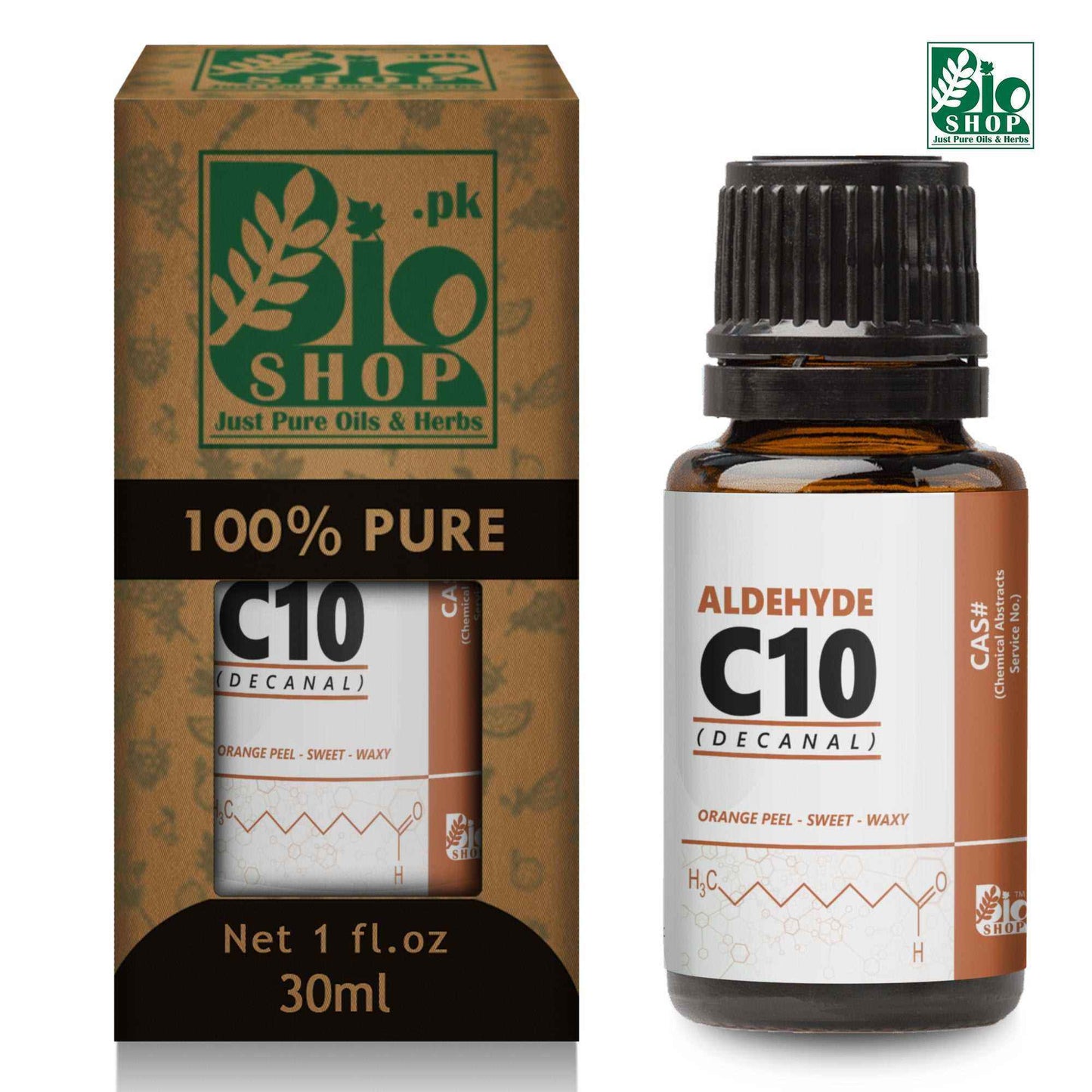
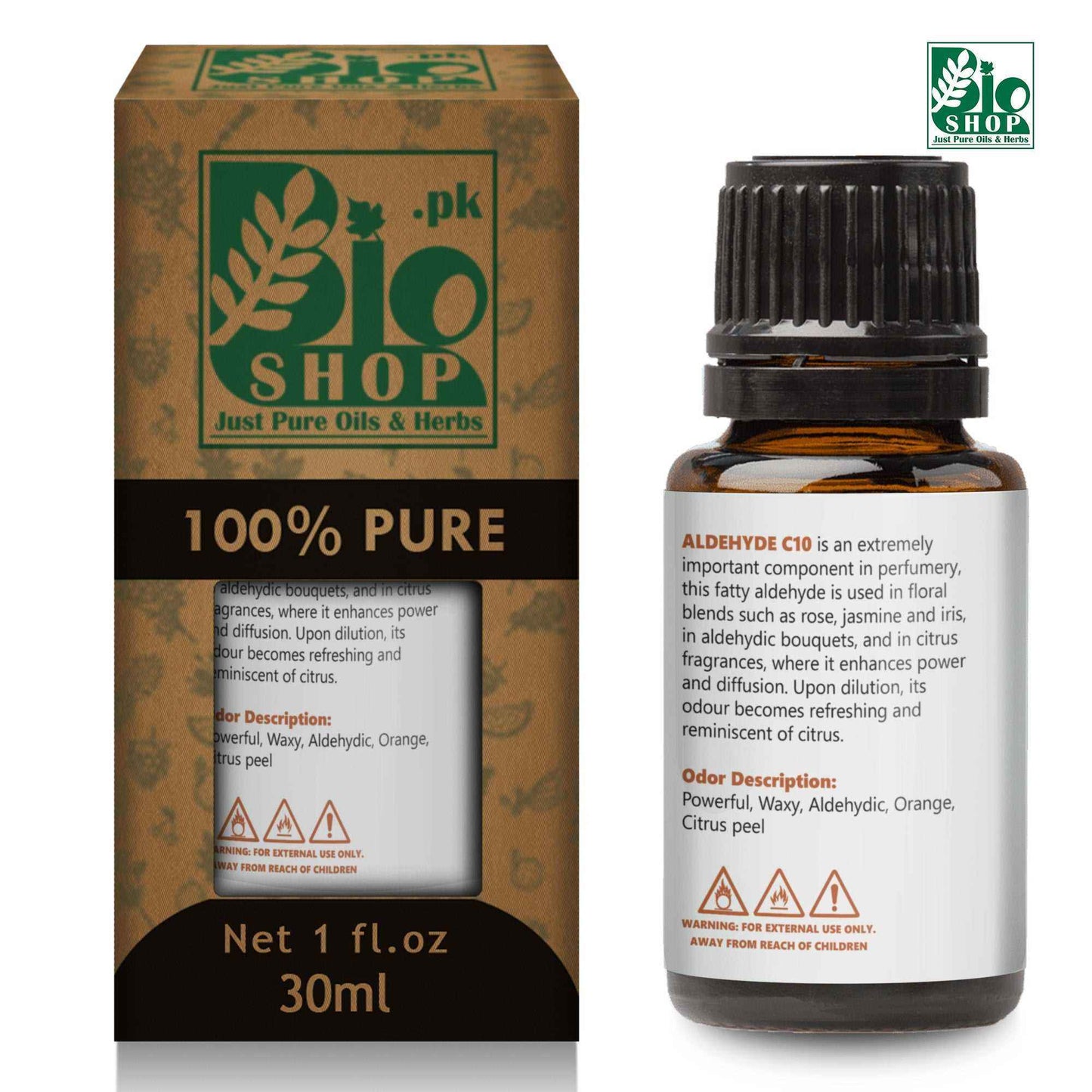
Aldehyde C10 (Decanal)
Aldehyde C10 (Decanal)
Olfactory Notes: Sharp, waxy, and powerful orange-peel citrus.
Couldn't load pickup availability
Explore
Information About Aldehyde C10 (Decanal)
Key Features
✦ Aldehyde C10 (Decanal) is a fatty aldehyde with a bright, waxy, orange-peel and citrus-soapy character used extensively in fine fragrance
✦ Provides exceptional diffusion and lift — even trace amounts radiate powerfully, making it one of the most impactful top-note materials available
✦ A building block of classic aldehydic perfumery, used in iconic floral aldehydic and citrus-aldehydic fragrance families
✦ Naturally present in citrus peel oils, sweet orange, and lemongrass — the synthetic version offers consistent purity and superior cost efficiency
✦ Suitable for fine fragrance, functional fragrance, rinse-off cosmetics, candles, and home fragrance applications
✦ Must be used in precise micro-dosages — overdose creates an overpowering soapy or harsh chemical note
✦ Vegan, cruelty-free, and free from animal-derived raw materials
About Aldehyde C10 (Decanal)
Aldehyde C10, known by its chemical name Decanal, is one of the classic aliphatic aldehydes that revolutionized modern perfumery in the early twentieth century. The use of synthetic aldehydes — including C10, C11, and C12 — enabled perfumers to create a new category of fragrance built on luminosity, airiness, and abstract sophistication. Decanal occurs naturally in orange peel, citronella, and lemongrass oils, but is produced synthetically for fragrance use to ensure purity and batch consistency. Its history is inseparable from the golden age of French haute parfumerie, where aldehydes transformed floral compositions into something far more radiant and diffusive.
What makes Aldehyde C10 particularly distinctive among the aldehyde series is its citrus-dominant character. While C11 leans more waxy-floral and C12 turns toward metallic-violet-rose, C10 sits at the brighter, fresher end of the aldehyde spectrum — closer to squeezed orange peel with a clean soapy underpinning. This makes it the most accessible and versatile aldehyde in the series for beginners while remaining a precision tool in the hands of skilled formulators. Its volatility ensures it rises quickly in a blend, creating an immediate olfactory impact that draws attention and amplifies the entire top accord.
Bio Shop Pakistan supplies cosmetic-grade Aldehyde C10 (Decanal) suitable for DIY perfumers, home fragrance crafters, cosmetic formulators, and professional perfumery students across Pakistan looking to explore classical and contemporary aldehydic formulation.
Olfactory Profile
SCENT DESCRIPTION : Aldehyde C10 opens with a sharp, effervescent burst of orange peel and fresh citrus zest — bright, clean, and intensely diffusive. Beneath the citrus immediacy lies a creamy waxiness reminiscent of freshly rendered soap and warm linen. At low concentrations it imparts a luminous, almost sparkling quality to any accord it touches. The overall impression is clean, radiant, and unmistakably aldehydic — abstract yet familiar.
NOTE POSITION : Top to Top-Mid
FRAGRANCE FAMILY : Aldehydic · Citrus · Floral
FACETS : Waxy · Citrus-peel · Soapy · Luminous · Orange
TENACITY : Medium — 4 to 8 hours at recommended usage rates
SILLAGE : High — extremely diffusive even at 0.1%, projects well beyond skin contact and dominates the opening phase of any blend
Technical Specifications
Chemical Name : Decanal (n-Decanal)
CAS Number : 112-31-2
Synonyms : Capric Aldehyde, Decyl Aldehyde, n-Decyl Aldehyde, Aldehyde C-10, Decaldehyde, 1-Decanal
Purity : 95% minimum (fragrance grade)
Appearance : Colorless to pale yellow clear mobile liquid
Odor Threshold : Approximately 0.0001 ppm (extremely potent — very low odor threshold)
Solubility : Insoluble in water. Soluble in ethanol, IPM, DPG, and fragrance carrier oils
Specific Gravity : 0.825 – 0.832 at 20°C
Flash Point : Approximately 52°C (126°F)
Type : Synthetic (nature-identical — occurs naturally in citrus peel oils)
Applications & Usage Guidelines
Fine Fragrance ★★★★★
Aldehyde C10 is a staple of fine fragrance formulation, particularly in floral aldehydic, citrus-aldehydic, and classic-style compositions. It provides the radiant, effervescent quality that defines the aldehydic fragrance family. Use at 0.05 to 0.4% in the finished fragrance compound depending on the intensity desired.
Attar & Oriental Blending ★★★★☆
In traditional attar and oriental perfumery, a micro-dose of Aldehyde C10 adds unexpected brightness and diffusion to heavy oud, musk, and resinous bases. It lifts dense accords and creates an interesting contrast between the ethereal top and the heavy base. Use with caution at 0.02 to 0.1% to avoid overwhelming the oriental character.
Functional Fragrance ★★★★☆
Aldehyde C10 performs well in shampoos, body washes, soaps, and household cleaners where a clean, citrus-soapy character is desired. It reinforces the perception of cleanliness and freshness in rinse-off products. Usage rates in functional applications are typically 0.1 to 0.5% of the fragrance compound.
Cosmetics ★★★☆☆
Suitable for use in leave-on cosmetics such as body lotions and creams at carefully controlled rates. IFRA limits must be strictly observed due to sensitization potential. Avoid use in lip products and eye-area products.
Home Fragrance ★★★★☆
Excellent for reed diffusers, room sprays, and wax melts where its high diffusivity creates a strong and immediate olfactory impact. Candle performance is good though citrus notes can fade faster under heat. Best combined with supporting citrus and floral materials to extend the life of the note.
IFRA & Usage Rate
RECOMMENDED USAGE RATES IN FINISHED PRODUCT
Application : Usage Rate (as % of finished product)
EDP : 0.1 – 0.4%
EDT : 0.05 – 0.3%
Body Lotion : 0.05 – 0.1%
Shampoo/Body Wash : 0.1 – 0.3%
Candle : 0.05 – 0.2% (of fragrance load)
Reed Diffuser : 0.1 – 0.5% (of fragrance compound)
Soap (cold process) : 0.1 – 0.3%
IFRA 51ST AMENDMENT LIMITS (as % in finished product)
IFRA Category 1 (Lip products, toys) : 0.01%
IFRA Category 2 (Deodorant/Antiperspirant) : 0.05%
IFRA Category 4 (Fine Fragrance — leave-on) : 0.40%
IFRA Category 5 (Body Lotion — leave-on) : 0.10%
IFRA Category 7 (Rinse-off hair products) : 0.30%
IFRA Category 8 (Rinse-off body products) : 0.30%
IFRA Category 9 (Shampoo) : 0.50%
IFRA Category 11 (Leave-on face products) : 0.07%
⚠️ Decanal is a known skin sensitizer. Always respect IFRA limits.
⚠️ Not recommended for leave-on lip products at meaningful levels.
⚠️ Always perform skin sensitization assessment in final formulation.
⚠️ Verify current limits at ifrafragrance.org before formulating for commercial sale.
Blending Guide
USAGE METHOD 1 — PRE-DILUTION IN ETHANOL
Aldehyde C10 is extremely potent and difficult to measure accurately at the neat level. Dilute to 10% in perfumer's alcohol (ethanol) before use. This gives you a workable material where 1 drop represents 0.1 parts of the raw aldehyde, enabling much better creative control. Most professional perfumers work exclusively with pre-diluted aldehydes.
USAGE METHOD 2 — ALDEHYDE ACCORD BUILDING
Build a multi-aldehyde accord using C10, C11, and C12 at equal or varying ratios before incorporating into your fragrance. This creates a richer, more complex aldehydic character than any single aldehyde alone. A common starting point is C10 at 40%, C11 at 35%, C12 at 25% of the accord blend.
USAGE METHOD 3 — CITRUS LIFT TECHNIQUE
Add Aldehyde C10 at 0.05 to 0.1% to a citrus-forward blend to dramatically extend the perception of freshness and brightness. Citrus materials like bergamot and lemon are highly volatile and fade quickly — C10 acts as a structural anchor that maintains the citrus character well into the heart phase.
BEST PAIRINGS
Bergamot → Amplifies citrus brightness, creates sparkling citrus-aldehydic opening
Neroli → Adds floral depth, classic pairing in Chypre and aldehydic florals
Rose Absolute → Creates the iconic aldehydic rose accord
Iris Concrete → Adds powdery violet-root complexity, enhances waxiness
Linalool → Softens harshness, bridges aldehyde into the floral heart
Sandalwood → Grounds the aldehyde, adds creamy depth to the dry-down
Hedione → Extends radiance and diffusion throughout the mid and base
Ambrette Seed → Adds a musky-fruity character that complements the citrus facet
AVOID
Avoid combining with heavy phenolic materials (eugenol, isoeugenol) at high concentrations as discoloration and harsh clashing notes can result. Avoid using neat (undiluted) in any calculation — pre-dilute always.
Perfumer's Note
Working with Aldehyde C10 is one of the first real tests of restraint in perfumery. New formulators consistently overuse it — the effect is immediate and thrilling at higher doses, but the result is a harsh, strident soapiness that dominates everything. The true magic of this material only reveals itself when you learn to let it operate in the background: a fraction of a percent, quietly lifting everything around it, adding that quality the French call "souffle" — a breath, a lightness, an airiness that cannot be achieved by any other material. It transforms a heavy floral from something beautiful into something radiant.
ADVANCED TIP : Try building a 10% pre-dilution of Aldehyde C10 in DPG (dipropylene glycol) rather than ethanol for oil-based and attar applications. DPG slows the volatility of the aldehyde slightly, extending its persistence in carrier oils where ethanol-diluted versions tend to dissipate too quickly. Start at 0.5% of this 10% dilution in your attar base — meaning 0.05% actual aldehyde — and evaluate after 24 hours of maceration before adjusting upward.
Safety & Storage
Physical State : Clear mobile liquid at room temperature
Skin Safety : Potential sensitizer — always respect IFRA limits. Perform patch test. Avoid undiluted skin contact.
Eye Contact : Irritant. Do not allow contact with eyes. Flush with water for 15 minutes if contact occurs. Seek medical attention.
Ingestion : Not for internal use. Keep away from children. Contact poison control if ingested.
Ventilation : Use in well-ventilated workspace. Vapors are potent and may cause headache or irritation with prolonged inhalation.
Storage : Store in a cool, dark place away from heat and sunlight. Keep container tightly sealed when not in use.
Shelf Life : 12 to 24 months when stored properly. Aldehydes are prone to oxidation — reseal immediately after use.
Container : Store in original amber glass or dark PET container. Avoid reactive metals. Do not store in open containers.
Flammability : Combustible. Flash point approximately 52°C. Keep away from open flame and heat sources.
FAQ
Q: What does Aldehyde C10 smell like on its own?
A: Neat, it smells sharp, intense, and citrus-waxy with an orange-peel quality. At low dilution it becomes luminous and clean. It is not a pleasant standalone material — its value is entirely in blending.
Q: How much should a beginner use in their first fragrance blend?
A: Start with a 10% pre-dilution in ethanol and add just 1 to 2 drops per 100ml of your fragrance. Evaluate after 24 hours before adding more. Less is always more with aldehydes.
Q: Why does my blend smell like detergent after adding Aldehyde C10?
A: You have used too much. The soapy-detergent impression is the hallmark of overdosed aldehydes. Reduce usage to 0.05 to 0.1% of your finished formula and the effect becomes elegant rather than harsh.
Q: Is Aldehyde C10 safe for skin application?
A: Yes, within IFRA limits. For leave-on skin products the limit is 0.1% in body lotion and 0.4% in fine fragrance. Always formulate within these limits and never apply the undiluted material directly to skin.
Q: How does Aldehyde C10 compare to Aldehyde C11 and C12 in use?
A: C10 is the brightest and most citrus-forward of the three, sitting at the fresh-clean end of the aldehyde spectrum. C11 moves toward a more waxy-rose-floral character, and C12 turns metallic and violet-like. C10 is the most accessible entry point for aldehyde formulation and is the best choice for citrus and clean floral accords.
Where Can You Safely Use Aldehyde C10 (Decanal)?
Discover how Aldehyde C10 (Decanal) performs across different applications—rated for safety, stability, and effectiveness.