Bio Shop
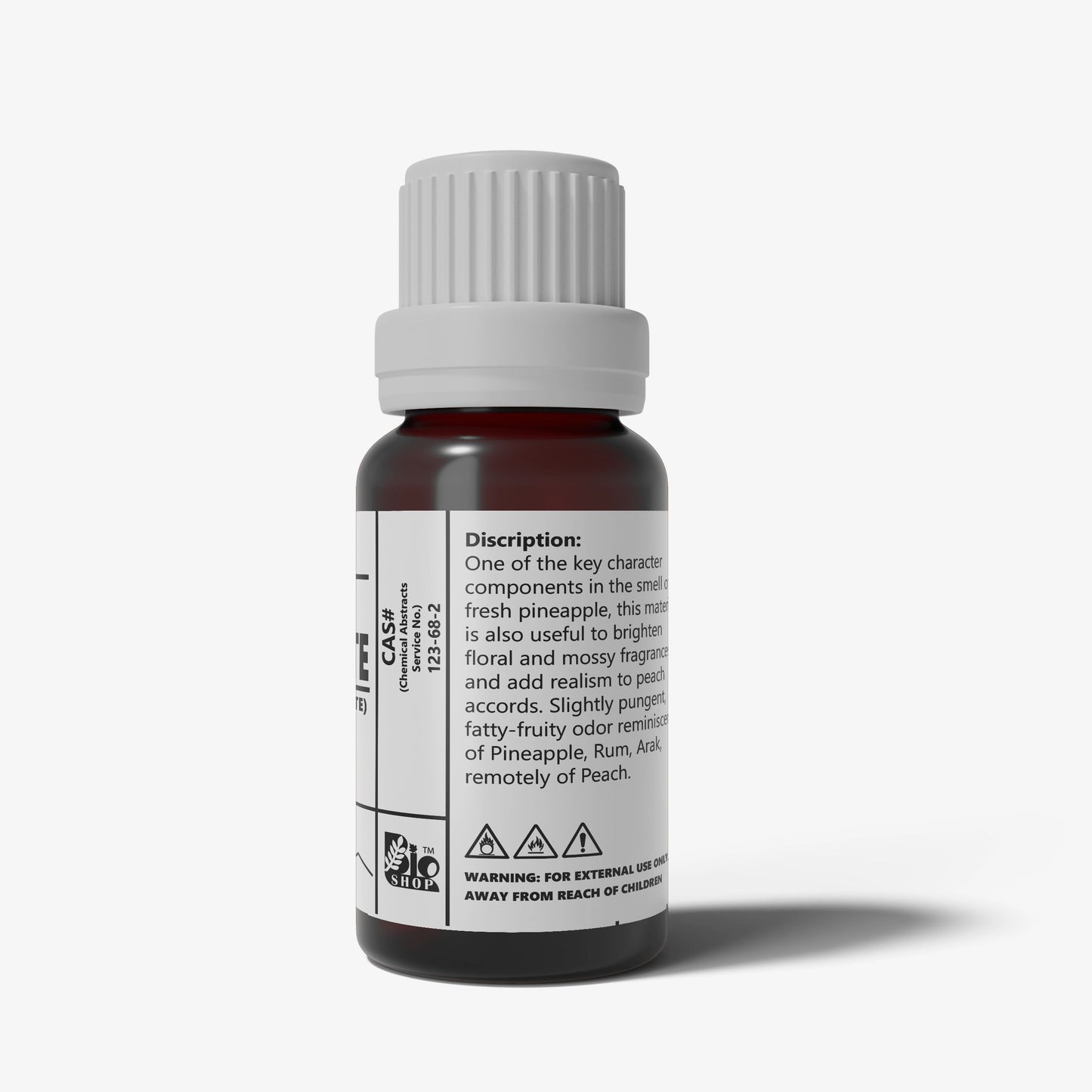
Allyl Caproate (allyl hexanoate)
Allyl Caproate (allyl hexanoate)
Olfactory Notes: Sweet, Fruity-pineapple juicy, fresh, Arak, Pine
Couldn't load pickup availability

Explore
Information About Allyl Caproate (allyl hexanoate)
Key Features
✦ Intensely fruity tropical aroma with authentic pineapple, mango, and green winey facets — effective at trace concentrations due to extremely low odor threshold
✦ Synthetic ester corresponding to a naturally occurring compound in pineapple fruit — suitable for natural-type tropical reconstructions
✦ Excellent performance in home fragrance applications including candles and reed diffusers where skin-contact IFRA restrictions do not apply
✦ Broad blending utility — lifts fruity-floral, green-fruity, and ozonic accords with a juicy, high-impact top note burst
✦ IFRA 51st Amendment restricted material — must be used within category-specific limits in all skin-contact formulations
✦ Vegan and cruelty-free — no animal-derived components or animal testing
✦ Soluble in alcohol and fragrance diluents — easy to incorporate into perfume bases, soap fragrance blends, and diffuser concentrates
About Allyl Caproate (allyl hexanoate)
Allyl Caproate, systematically named allyl hexanoate, is the allyl ester of hexanoic acid (caproic acid). It belongs to the class of allylic esters widely used in flavor and fragrance manufacturing and is registered under FEMA number 2032, reflecting its long-standing recognition as a safe flavor substance at appropriate use levels. The compound occurs naturally in pineapple, passion fruit, and certain tropical species, which gives it strong credibility in natural-type and authentic tropical fragrance reconstructions. Its history in perfumery traces back to the mid-twentieth century when synthetic esters became foundational tools for building the fruit note palette that modern consumers recognize in everything from fine fragrance to fabric softeners.
What distinguishes Allyl Caproate from simpler esters like ethyl butyrate or isoamyl acetate is the combination of its allyl backbone with the medium-chain hexanoic acid moiety. This structure produces an odor character that is simultaneously tropical and green — ripe pineapple in the foreground, with a faint winey and slightly cheesy depth that gives the note natural complexity rather than synthetic flatness. Its odor detection threshold is exceptionally low, measured in the low parts-per-billion range, which means even a fraction of a percent inclusion creates a clearly perceptible tropical lift in a finished composition. This potency demands precision in formulation and makes it a cost-efficient choice for high-impact fruit effects.
Bio Shop Pakistan supplies cosmetic-grade Allyl Caproate suitable for DIY perfumers, soap and candle crafters, household product formulators, and professional fragrance blenders seeking authentic pineapple-tropical character in their compositions.
Olfactory Profile
SCENT DESCRIPTION : Allyl Caproate opens with a burst of ripe, juicy pineapple — intensely tropical and slightly effervescent on first impression. Beneath the pineapple character lies a green, winey dimension that gives the note a sense of naturalistic depth and prevents it from reading as synthetic candy. At very high concentrations it can reveal a faintly cheesy, fermented undertone reminiscent of overripe tropical fruit, which skilled formulators use to add realism to fruit accord constructions. The overall impression is sunny, lush, and unapologetically tropical — one of the most recognizable fruit aroma chemicals in the perfumer's palette.
NOTE POSITION : Top / Top-Mid
FRAGRANCE FAMILY : Fruity · Tropical · Green Fruity
FACETS : Pineapple · Tropical · Winey · Green · Juicy
TENACITY : Medium — 3 to 6 hours in blend; short-lived solo but well-anchored when combined with appropriate fixatives
SILLAGE : Medium-High — projects strongly at low concentrations due to low odor threshold; perceptible at distance in diffuser and candle applications
Technical Specifications
Chemical Name : Allyl hexanoate
CAS Number : 123-68-2
Synonyms : Allyl Caproate · Allyl n-Hexanoate · 2-Propenyl Hexanoate · Prop-2-en-1-yl hexanoate
Purity : 98% minimum (verify with supplier lot COA)
Appearance : Colorless to pale yellow clear mobile liquid
Odor Threshold : Approximately 2–5 ppb (parts per billion) — extremely potent
Solubility : Freely soluble in ethanol, IPM, DPG, and most fragrance diluents; practically insoluble in water
Specific Gravity : 0.884 – 0.892 at 20°C
Flash Point : Approximately 68°C (154°F)
Refractive Index : 1.423 – 1.427 at 20°C
Boiling Point : Approximately 186°C
Molecular Formula : C9H16O2
Molecular Weight : 156.22 g/mol
Type : Synthetic (naturally occurring in trace quantities in pineapple and passion fruit)
FEMA Number : 2032
Applications & Usage Guidelines
Fine Fragrance — ★★★★☆
Allyl Caproate is a specialist top-note tool in fine fragrance rather than a structural backbone material. It excels in tropical, fruity-floral, and aquatic-ozonic compositions where a burst of pineapple brightness is desired in the opening. Use with caution within IFRA 51st Amendment limits for leave-on skin-contact products — the permitted levels are low, so precision dosing is essential to achieve effect without exceeding compliance thresholds.
Attar and Oriental Blending — ★★★☆☆
Traditional attar compositions occasionally incorporate tropical fruit facets to create modern, contemporary oriental accords that appeal to younger audiences. Allyl Caproate can contribute a lively, fruity freshness to otherwise rich, resinous compositions — a small percentage blended with oud, amber, and musks creates a fruity-oriental character gaining popularity in the Gulf and South Asian market. Dose conservatively and ensure overall blend compliance with IFRA skin limits.
Functional Fragrance — ★★★★☆
In rinse-off functional products such as shampoos, shower gels, and bar soaps, Allyl Caproate performs well and is permitted at higher levels than in leave-on applications. Its tropical lift makes products feel premium and refreshing. Formulators working with fabric care products and detergents can use it effectively to create bright, fruity-fresh laundry signatures.
Home Fragrance — ★★★★★
Candles, reed diffusers, room sprays, and incense are the strongest application category for Allyl Caproate because IFRA skin-contact restrictions do not apply and higher usage levels can be employed. The material throws exceptionally well in diffuser bases and wax matrices, delivering a vivid tropical pineapple character that fills a room. It pairs beautifully with coconut, vanilla, and floral materials in summer-themed home fragrance products.
Cosmetics and Personal Care — ★★☆☆☆
Leave-on cosmetic products including body lotions, face creams, and deodorants present the most restrictive environment for Allyl Caproate due to its sensitization potential and the very low IFRA limits that apply to these categories. It can be incorporated at trace levels in fragrance concentrates destined for these bases but requires rigorous QRA calculation to confirm the in-use concentration remains compliant. Not recommended for lip products.
IFRA & Usage Rate
RECOMMENDED USAGE RATES IN FINISHED PRODUCT
Application : Typical Usage Rate
EDP (Eau de Parfum) : 0.05 – 0.10% in final formula
EDT (Eau de Toilette) : 0.03 – 0.08% in final formula
Body Lotion : 0.001 – 0.003% (trace only — sensitization risk)
Shampoo / Body Wash : 0.01 – 0.05%
Bar Soap : 0.02 – 0.08%
Candle : 0.10 – 0.30% in finished candle
Reed Diffuser : 0.20 – 0.80% in diffuser base
Note: Allyl Caproate is extremely potent due to its very low odor threshold. Even at 0.05% in an EDP it contributes a clearly perceptible tropical lift. Start at the low end of each range and scale up in 0.01% increments.
IFRA 51ST AMENDMENT COMPLIANCE
Allyl Caproate (CAS 123-68-2) is a RESTRICTED material under the IFRA 51st Amendment due to its skin sensitization potential. The following limits apply to the concentration of Allyl Caproate in the FINISHED PRODUCT:
IFRA Category : Finished Product Limit
Category 1 : 0.001% (lip and oral area products)
Category 2 : 0.001% (deodorant body sprays, facial products)
Category 3 : 0.001% (eye area products)
Category 4 : 0.02% (fine fragrance — EDP, EDT, EDC, splash)
Category 5A : 0.003% (body lotion, hand cream, leave-on body products)
Category 5B : 0.002% (face moisturizer, leave-on face products)
Category 5C : 0.003% (hand cream)
Category 5D : 0.001% (baby leave-on products)
Category 6 : Prohibited (products applied to mucous membranes)
Category 7A : 0.005% (rinse-off hair products)
Category 7B : 0.002% (leave-on hair products)
Category 9 : 0.04% (rinse-off body and face products)
Category 10A : 0.08% (household rinse-off — laundry, dishwash)
Category 10B : 0.04% (household spray products)
Category 11A : No restriction specified (candles — non-skin contact)
Category 11B : No restriction specified (incense, reed diffusers)
Category 12 : No restriction specified (air fresheners, car diffusers)
⚠️ These limits are for the ingredient concentration in the FINISHED product — not in the fragrance concentrate. Always back-calculate from fragrance-use level to confirm final product compliance.
⚠️ Verify all limits against the official IFRA 51st Amendment standards document before commercial production. Limits cited above are for guidance and may require confirmation against the most current published amendment.
⚠️ A Quantitative Risk Assessment (QRA) is recommended for any leave-on skin application.
Blending Guide
METHOD 1 — TROPICAL ACCORD CONSTRUCTION
Allyl Caproate serves as the pineapple top-note anchor in tropical accords. Build a base of Ethyl Butyrate and Isoamyl Acetate for general fruitiness, then add Allyl Caproate at 0.05–0.15% of the total accord to introduce the distinctly pineapple-tropical dimension. Support with Hedione or Methyl Dihydrojasmonate to add a creamy-floral bridge, and ground the accord with a touch of Coumarin or Benzyl Benzoate to prevent it from reading as purely synthetic.
METHOD 2 — FINE FRAGRANCE TOP NOTE BOOST
In an existing floral or fruity-floral formula that needs more opening impact, Allyl Caproate can be added as a precision top-note booster at 0.03–0.08% of the final formula. Dissolve in a small quantity of ethanol or DPG before adding to the main fragrance blend to ensure even dispersion. Evaluate the formula on a strip at 15 minutes, 1 hour, and 3 hours to confirm the top note contribution does not overwhelm and transitions gracefully into the heart.
METHOD 3 — HOME FRAGRANCE AND CANDLE APPLICATION
For candle or reed diffuser blends, Allyl Caproate can be used more generously at 0.2–0.5% of the fragrance concentrate. Pre-blend with compatible carriers such as DPG, IPM, or Isopropyl Myristate, then incorporate into the fragrance blend before adding to wax or diffuser base. Pair with Coconut Aldehyde (Gamma Nonalactone) and Vanillin to create a tropical-coconut-cream signature popular in summer-themed home fragrance ranges.
BEST PAIRINGS
Ethyl Butyrate → Amplifies the fruity pineapple character; creates a fuller tropical fruit suite
Methyl Dihydrojasmonate → Adds a creamy-floral bridge that softens the sharp green-winey edge
Hedione (HC) → Lifts and diffuses the tropical note; adds radiance and transparency
Gamma Nonalactone → Introduces coconut creaminess; classic pineapple-coconut pairing
Ambroxan → Grounds the volatile top note; extends tenacity through to a warm amber base
Linalool → Smooths the green facet; floral-fruity transition accord
Bergamot EO → Natural citrus-green that harmonises with the winey-fruity character
Dihydromyrcenol → Adds a fresh, ozonic-metallic dimension for tropical-aquatic accords
Galaxolide → Musk fixative that extends overall tenacity and softens dry-down
AVOID PAIRING WITH
Heavy phenolics such as Eugenol and Isoeugenol at high concentrations — the contrast between tropical fruitiness and clove spice creates an unpleasant medicinal-fruity dissonance unless very carefully balanced. Avoid combining with strong animalic materials such as Civet, Castoreum bases, or high concentrations of indolic musks — the fruity-tropical character clashes with pronounced animalic depth at standard dosage levels.
Perfumer's Note
In my formulation work, Allyl Caproate occupies a very specific and irreplaceable position — it is the material I reach for when a composition needs genuine tropical conviction rather than a generic impression of fruitiness. What I find compelling about it is the slight winey, fermented undertone beneath the immediate pineapple impact. That undertone is what separates a realistic tropical accord from something that smells like fruit candy. Used at around 0.05% in a fine fragrance concentrate, it provides a top-note burst that fades gracefully into the floral heart without leaving an obvious chemical signature behind. The challenge is that its potency means the margin between effective and overpowering is narrow — which is actually what makes working with it interesting. It rewards precision and rewards the formulator who takes time to evaluate at multiple dilutions before committing to a final level.
ADVANCED TIP
When using Allyl Caproate in a soap fragrance intended for bar soap production, create a 10% dilution in DPG first rather than adding the neat material directly to your fragrance concentrate. This improves dispersion uniformity and prevents concentration spikes at the micro level within the soap matrix. At the formulation stage, evaluate your finished soap fragrance blend on a smear test — apply a small quantity to the back of your hand and assess the tropical lift after 10 minutes. If the pineapple reads clearly at that stage, you are likely at or near the effective threshold for rinse-off performance. If it is absent, increase by 0.01% increments and re-evaluate before scaling to batch production.
Safety & Storage
Physical State : Clear mobile liquid at room temperature
Skin Safety : IFRA-restricted sensitizer — use only within 51st Amendment category limits; avoid undiluted skin contact; conduct patch testing in cosmetic applications
Eye Contact : Irritant — avoid eye contact; if contact occurs flush with clean water for 15 minutes and seek medical attention if irritation persists
Ingestion : Not for internal use — fragrance ingredient only; keep away from food, beverages, and food-contact surfaces
Ventilation : Work in a well-ventilated area or under a fume hood when handling large quantities; vapor inhalation at high concentrations may cause respiratory irritation
Storage : Store in a tightly sealed container away from heat, sparks, and direct sunlight; recommended storage temperature 10°C – 25°C
Shelf Life : 24 months from date of manufacture when stored correctly in sealed original container; ester hydrolysis can occur on prolonged exposure to moisture
Container : Store in glass or high-density polyethylene (HDPE) containers; avoid prolonged contact with PET or soft plastics which may be permeated by the ester
Flammability : Combustible liquid — flash point approximately 68°C; keep away from open flame and ignition sources during handling and production
FAQ
Q: What does Allyl Caproate smell like?
A: It smells like ripe, juicy pineapple with a green, slightly winey depth. At very high concentrations it can develop a faint overripe or fermented tropical fruit facet that adds realism to fruit accords.
Q: Can I use Allyl Caproate in handmade soaps and body washes?
A: Yes, it is suitable for rinse-off products at compliant levels. Keep finished product concentration within the IFRA 51st Amendment limits for Category 9 (rinse-off body products) and Category 7A (rinse-off hair products). Avoid using above these limits due to sensitization potential.
Q: Why is the usage rate for body lotion so much lower than for candles?
A: IFRA sets limits based on consumer exposure. Leave-on skin products like body lotion allow prolonged skin contact which increases sensitization risk, so limits are very restrictive. Candles and diffusers are non-skin-contact applications so much higher levels are permitted and safe.
Q: How do I work with Allyl Caproate safely given its low odor threshold?
A: Always prepare a 1% or 10% dilution in DPG or ethanol before evaluation — never assess the neat material as your benchmark for formula inclusion. Because even 0.05% in a finished formula is clearly perceptible, always add it last in small increments and re-evaluate after each addition before scaling up.
Q: How does Allyl Caproate compare to natural pineapple extract or pineapple absolute?
A: True pineapple absolute is commercially rare, expensive, and highly variable in odor profile between batches. Allyl Caproate is a consistent, cost-efficient synthetic that captures the core pineapple-tropical character reliably across every batch. Natural pineapple materials tend to carry additional enzymatic, slightly sulfurous nuances absent in the synthetic, but for most fragrance applications Allyl Caproate paired with supporting esters produces a more stable and impactful tropical accord than natural pineapple extracts currently available to the market.
Where Can You Safely Use Allyl Caproate (allyl hexanoate)?
Discover how Allyl Caproate (allyl hexanoate) performs across different applications—rated for safety, stability, and effectiveness.