Bio Shop
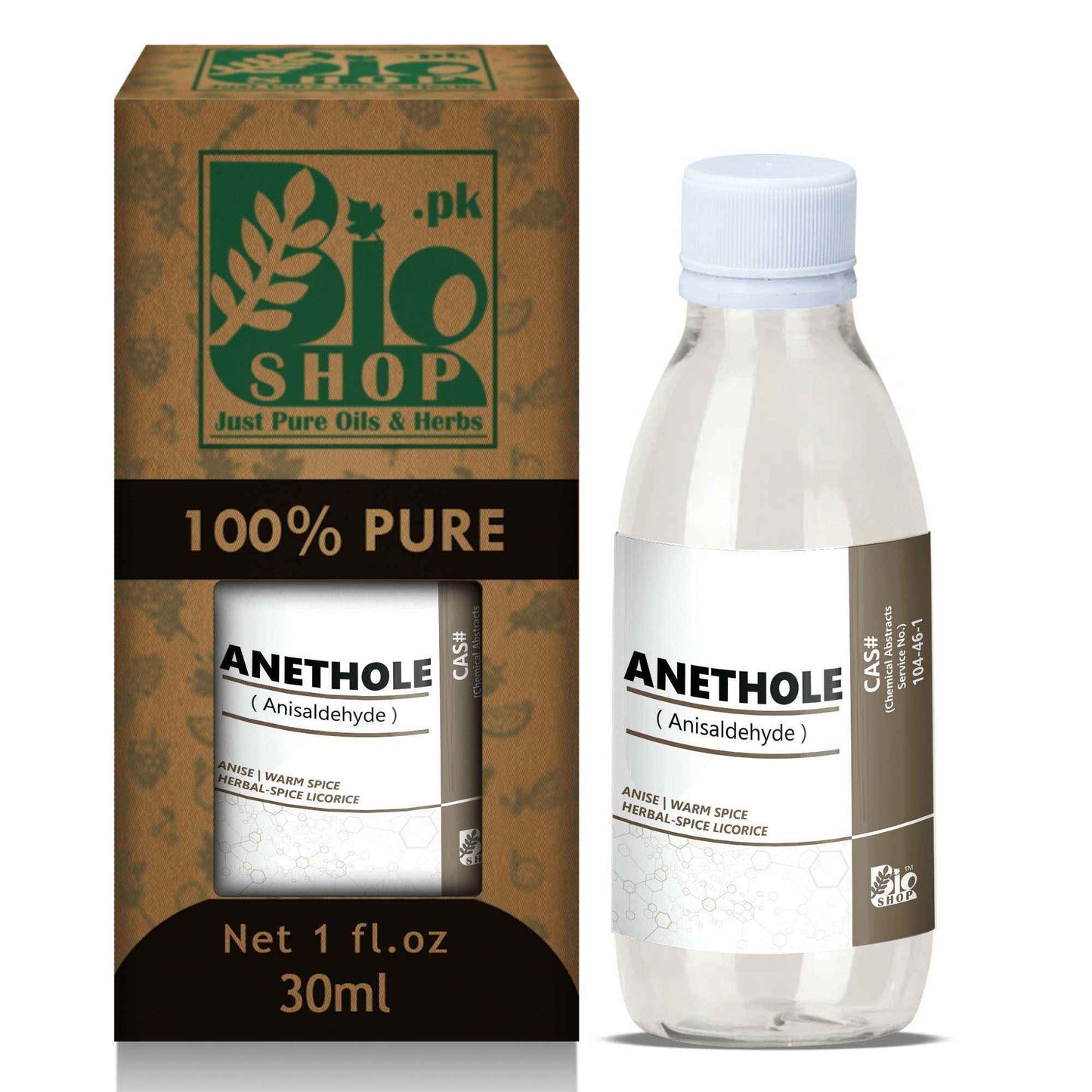
Anethole
Anethole
Olfactory Notes: Sweet anise, licorice, and clean herbal profile.
Couldn't load pickup availability


Explore
Information About Anethole
Key Features
✦ Trans-anethole isolate delivering a potent sweet, anisic, fennel-like aroma with exceptional diffusion power
✦ Core building block in oriental, fougere, and gourmand fragrance families used by professional perfumers worldwide
✦ Naturally found in star anise, fennel seed, and anise essential oils — this is the isolated aromatic compound
✦ Works at extremely low concentrations due to a very low odour threshold, making it highly economical to use
✦ Widely used in reed diffusers, candles, incense, and home fragrance applications with excellent diffusion
✦ Suitable for attar and mukhallat blending where anisic and spice accords are required
✦ Vegan and cruelty-free synthetic isolate — no animal-derived ingredients or testing involved
About Anethole
Anethole is a phenylpropanoid compound that occurs naturally in the essential oils of anise, star anise, fennel, tarragon, and licorice. First identified and isolated in the early 19th century, it was one of the earliest aromatic compounds studied by organic chemists and has remained a cornerstone of the flavour and fragrance industry for over a century. Its commercial form is almost exclusively the trans isomer, which carries the desirable sweet anisic odour, while the cis isomer has an unpleasant character and is typically absent in cosmetic-grade material.
What makes anethole particularly special is its extraordinary odour intensity combined with a clean, sweet, almost candy-like character that blends seamlessly into a wide range of fragrance families. It is not merely a spice note — it adds depth, warmth, and a recognisable naturalness to compositions. Even minute additions of anethole can transform an ordinary oriental or fougere into something memorable. Its semi-crystalline physical nature at cooler temperatures is a useful quality indicator, as high-purity trans-anethole solidifies near 20–21°C.
Bio Shop Pakistan supplies cosmetic-grade anethole suitable for DIY perfumers, attar blenders, soap makers, home fragrance crafters, and professional formulators working across Pakistan who require a reliable and correctly specified source of this essential aroma chemical.
Olfactory Profile
SCENT DESCRIPTION
Anethole opens with a sharp, intensely sweet anisic burst that immediately conjures star anise and fresh fennel seed. As it settles, it reveals a warm, slightly herbal and spicy softness with a faint woody undertone that gives it more depth than simple liquorice candy. At low concentrations it becomes gentle and almost floral in its sweetness, lending a smooth naturalness to any composition. Its tenacity is surprisingly strong for such a clean, transparent material.
NOTE POSITION : Mid to Base
FRAGRANCE FAMILY : Spicy Oriental · Gourmand · Herbal Aromatic
FACETS : Sweet · Anisic · Fennel · Spicy · Warm
TENACITY : High — 8 to 12 hours on skin, longer on fabric
SILLAGE : Medium to High — diffuses well in alcohol-based formats; projects clearly even at low dosage
Technical Specifications
Chemical Name : (E)-1-Methoxy-4-(prop-1-en-1-yl)benzene
CAS Number : 4180-23-8
Synonyms : Trans-Anethole · para-Propenylanisole · Anise Camphor · Isoestragole (verify with supplier)
Purity % : 99% minimum (cosmetic/fragrance grade)
Appearance : Colourless to very pale yellow liquid above 21°C; white crystalline solid below 20°C
Odour Threshold : 0.01 to 0.05 ppm (extremely low — handle with care)
Solubility : Practically insoluble in water; freely soluble in ethanol, IPM, and fragrance oils
Specific Gravity : 0.983 to 0.988 at 20°C
Flash Point : Approximately 90°C (closed cup)
Type : Natural isolate / Synthetic
Applications & Usage Guidelines
Fine Fragrance ★★★★★
Anethole is a classic modifier in oriental, chypre, fougere, and gourmand fine fragrance. It adds sweetness and anisic brightness to a mid or base structure without overpowering other materials. Use at 0.1% to 1.5% in an EDP for a clear anisic effect. Iconic fragrance families like spicy fougeres and anisic orientals rely on it as a core building block.
Attar and Oriental Blending ★★★★★
In attar and mukhallat perfumery, anethole is an essential spice-sweet modifier that pairs beautifully with oud, musk, rose, and amber bases. It intensifies the warmth of oriental compositions and adds a recognisable Pakistani and Middle Eastern anisic character. Start at 0.2% and adjust to blend — it integrates very naturally with natural attar bases.
Functional Fragrance ★★★★☆
Anethole performs well in soap, detergent, and household fragrance systems where its anisic-sweet character is valued. IFRA limits apply for leave-on products, so rinse-off formats are more forgiving. It blends well with lavender, citrus, and mint bases in functional applications to create clean, fresh anisic accords.
Cosmetics ★★★☆☆
Use in cosmetic applications is restricted due to skin sensitisation potential and IFRA limits. It can be used in rinse-off formats such as shampoos and body washes at low levels. Leave-on applications like lotions and creams require adherence to strict IFRA limits and are generally not recommended at meaningful fragrance levels.
Home Fragrance ★★★★★
Anethole excels in candles, reed diffusers, and incense due to its powerful diffusion, good hot throw in wax, and excellent cold diffusion in reeds. It is a key ingredient in anisic, spice, and licorice-themed home fragrance blends. Use at 1% to 5% in reed diffuser bases and 0.5% to 3% in candle wax for excellent performance.
IFRA & Usage Rate
RECOMMENDED USAGE RATES
EDP (Eau de Parfum) : 0.3% – 1.5%
EDT (Eau de Toilette) : 0.2% – 1.0%
Body Lotion (leave-on) : 0.02% – 0.05% (IFRA restricted)
Shampoo / Body Wash : 0.1% – 0.3%
Candle : 0.5% – 3.0%
Reed Diffuser : 1.0% – 5.0%
Soap (bar) : 0.2% – 0.8%
IFRA 51ST AMENDMENT LIMITS (trans-Anethole)
Category 1 (Lip products) : 0.01%
Category 3 (Eye area / face) : 0.01%
Category 4 (Fine fragrance on skin) : Verify current limit with IFRA database
Category 5 (Leave-on body/face) : 0.05%
Category 7 (Rinse-off body/hair) : 0.20%
Category 9 (Soap/detergent) : 0.50%
Category 11 (Candles/incense) : No restriction listed
⚠️ Anethole is a known skin sensitiser at elevated concentrations. Always stay within IFRA limits for leave-on products.
⚠️ Do not use neat or at high concentrations on skin without dilution.
⚠️ Lip and eye-area products require maximum caution — restrict to 0.01% or exclude entirely.
⚠️ Always confirm latest IFRA 51st Amendment values at ifrafragrance.org before production.
Blending Guide
METHOD 1 — Dilution Before Use
Due to its very low odour threshold and high intensity, pre-dilute anethole in a carrier such as DPG, IPM, or perfumer's alcohol at 10% before use. This gives you far better control over dosing and avoids accidental over-addition. A 10% dilution means each drop is manageable in small-batch work.
METHOD 2 — Spice Anchor in Oriental Bases
Use anethole as a sweet-spicy anchor in oriental and attar bases by adding it at 0.3–0.8% alongside eugenol, cinnamic aldehyde, and vanillin. It ties spice and warmth together into a cohesive oriental character and prevents the composition from becoming too harsh or sharp.
METHOD 3 — Home Fragrance Modifier
In reed diffusers and candles, blend anethole with eugenol, iso E super, and woody ambers to build a warm spice home fragrance. It diffuses strongly at room temperature and carries well through reeds. Add at the end of blending after other materials are combined to preserve its top-mid freshness.
BEST PAIRINGS
Star Anise EO → Reinforces and naturalises the anisic character
Eugenol → Creates a classic spicy oriental base
Vanillin → Adds sweet gourmand depth and rounds harsh edges
Coumarin → Builds a fougere-like anisic warmth
Rose Oxide → Creates a fresh anisic floral combination
Iso E Super → Adds woody diffusion and modern texture
Labdanum Abs → Deep oriental base with anisic-resinous warmth
Lavender EO → Classic fougere pairing with anisic sweetness
Cinnamic Aldehyde → Intensifies the spice-sweet oriental direction
AVOID
Avoid combining anethole with heavy citruses at high concentrations as the pairing can create an off-putting medicinal accord. Keep citrus dosages low when anethole is present or use citrus at a top note level only.
Perfumer's Note
I find anethole to be one of the most misunderstood ingredients in the palette — beginners tend to use far too much of it and wonder why their blend smells like toothpaste or a digestive. The real art is using it in the 0.2 to 0.5% range where it stops being a recognisable anise note and becomes something more elusive — a sweetness with personality, a warmth that feels familiar but not literal. In Middle Eastern and Pakistani attar traditions, anethole-rich materials like star anise and fennel have been used for centuries, and there is a genuine emotional resonance in these compositions for local audiences that makes it a commercially and creatively powerful choice for anyone formulating for the South Asian and Gulf markets.
ADVANCED TIP
Try combining anethole at 0.15% with methyl anthranilate at 0.3% in an oriental musk base. The anisic sweetness of anethole interacts with the grape-like floral quality of methyl anthranilate to produce a surprisingly rich, almost wine-like gourmand depth. This combination is particularly effective in EDP alcohol bases where both materials can diffuse at different rates, giving the composition an evolving sweetness from the first spray through dry-down.
Safety & Storage
Physical State : Liquid above 21°C; crystalline solid at cooler temperatures
Skin Safety : Known sensitiser — use within IFRA limits; do not apply undiluted to skin
Eye Contact : Irritant — avoid contact; rinse thoroughly with water if contact occurs
Ingestion : Not for internal consumption in fragrance-grade form; keep out of reach of children
Ventilation : Use in a ventilated workspace; high concentrations of vapour may cause irritation
Storage : Store in a sealed container away from heat, sunlight, and open flame
Shelf Life : 2 to 3 years in properly sealed container; check for discolouration or crystallisation over time
Container : Amber glass or HDPE plastic; avoid PET for long-term storage
Flammability : Combustible — flash point approximately 90°C; keep away from open flames and high heat sources
FAQ
Q: What does anethole smell like?
A: Anethole smells intensely sweet, anisic, and fennel-like — essentially the pure aromatic molecule behind the scent of star anise and liquorice. At low concentrations it becomes soft and almost floral-sweet.
Q: How much anethole should I use in my perfume?
A: Start at 0.1% to 0.3% in a finished EDP. Because its odour threshold is extremely low, a very small amount goes a long way. Pre-dilute to 10% in DPG or alcohol for better accuracy when working in small batches.
Q: Is anethole safe to use in soap and body wash?
A: Yes, in rinse-off formats like soap and body wash it can be used up to approximately 0.2–0.5% within IFRA guidelines. Leave-on products like lotions require much stricter limits due to sensitisation potential.
Q: Can I use anethole in candles and reed diffusers?
A: Yes, it performs excellently in both. Candles can use 0.5% to 3% and reed diffusers can use 1% to 5%. There are no IFRA restrictions for these non-skin-contact formats and anethole has a strong, pleasant diffusion profile.
Q: How does synthetic anethole compare to star anise essential oil?
A: Synthetic or isolated trans-anethole is essentially the same molecule as the primary component of star anise oil, but far more concentrated and consistent. Star anise oil contains 80–90% anethole alongside minor components that add complexity. Pure anethole is sharper, cleaner, and more potent — use it for controlled anisic effects, and use star anise oil when you want the full natural character with subtle herbal-green nuances.
Where Can You Safely Use Anethole?
Discover how Anethole performs across different applications—rated for safety, stability, and effectiveness.