


Bio Shop
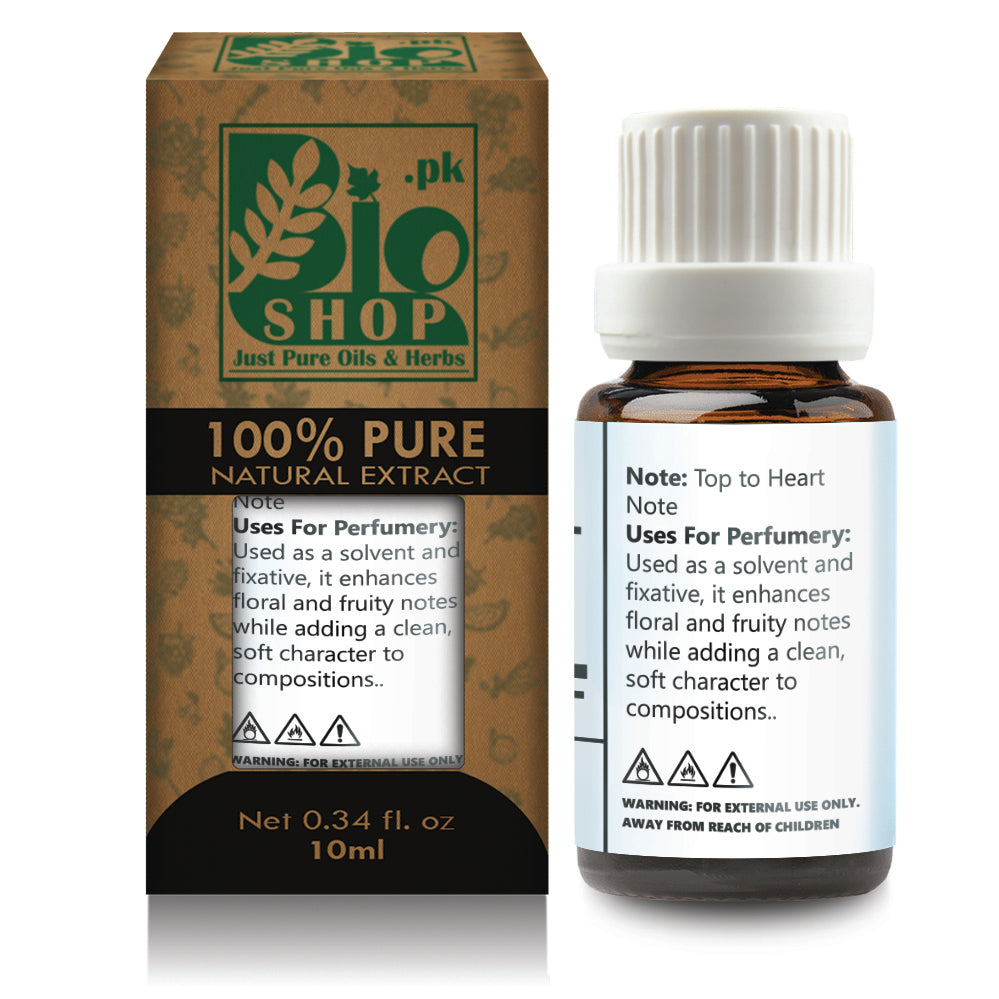
Benzyl Alcohol
Benzyl Alcohol
Olfactory Notes: Mild floral-fruity scent; often used as a solvent.
Couldn't load pickup availability

Explore
Information About Benzyl Alcohol
Key Features
✦ Dual-function ingredient — acts as both a fragrance solvent and a broad-spectrum cosmetic preservative in a single component
✦ Contributes a mild, faintly sweet floral-balsamic note found naturally in jasmine, ylang ylang, and hyacinth
✦ Excellent solvent power — dissolves resins, musks, and fragrance materials that are poorly soluble in pure alcohol
✦ Widely used in fine fragrance, hair dye formulations, nail care, and leave-on skincare as a solvent base
✦ EU-regulated allergen — requires label declaration when used above 0.001% in leave-on and 0.01% in rinse-off cosmetics
✦ Naturally occurring in jasmine absolute, Peru balsam, and ylang ylang — also produced synthetically for cosmetic-grade purity
✦ Vegan, animal-product free — suitable for vegan-certified formulations when sourced from synthetic production
About Benzyl Alcohol
Benzyl Alcohol is one of the simplest and most broadly used aromatic alcohols in formulation chemistry. First isolated from Peruvian balsam resin in the 19th century, it occurs naturally in the essential oils of jasmine, ylang ylang, hyacinth, and carnation. Its clean, reproducible character and multifunctional profile made it an early standard in both the perfume and pharmaceutical industries. Commercial cosmetic-grade Benzyl Alcohol today is synthesized from benzyl chloride or toluene, delivering consistent purity above 99 percent.
What sets Benzyl Alcohol apart from other fragrance solvents is its combination of properties in one molecule. Unlike IPM or DPG, which are purely functional carriers, Benzyl Alcohol contributes a genuine olfactory dimension — a soft, powdery-sweet floral warmth — while simultaneously acting as a solubiliser and antimicrobial preservative. At concentrations of 0.5 to 1.0 percent in emulsions, it provides meaningful bacteriostatic activity, reducing the need for synthetic preservative blends. This triple utility makes it cost-effective for formulators working at small and medium scale.
Bio Shop Pakistan supplies cosmetic-grade Benzyl Alcohol suitable for perfumers, soap and shampoo formulators, lotion makers, and home fragrance crafters who require a reliable, pure solvent and fixative base ingredient.
Olfactory Profile
SCENT DESCRIPTION : Benzyl Alcohol presents a gentle, slightly sweet, floral-balsamic impression that is soft and unobtrusive rather than assertive. It carries a powdery warmth reminiscent of fresh jasmine petals with a faint almond-like undertone on dry down. As a standalone odorant it is mild and low-impact, functioning more as a softening modifier than a headline note. In a blend, it rounds sharp edges and adds a rounded, slightly creamy character to floral and oriental accords.
NOTE POSITION : Base (fixative role) / Mid modifier in floral blends
FRAGRANCE FAMILY : Floral · Balsamic · Powdery
FACETS : Sweet · Powdery · Floral · Balsamic · Soft Almond
TENACITY : Low — the scent contribution dissipates within 1 to 2 hours; its primary role is functional
SILLAGE : Low — intimate projection; scent is perceptible close to skin only, making it a background modifier rather than a sillage driver
Technical Specifications
Chemical Name : Phenylmethanol (Benzenemethanol)
CAS Number : 100-51-6
Synonyms : Benzyl Alcohol · Phenylcarbinol · Alpha-Hydroxytoluene · Benzenemethanol
Purity % : 99.0% minimum (cosmetic grade)
Appearance : Clear, colorless, slightly viscous liquid
Odor Threshold : Approximately 1.0 ppm (vary by panel — verify with supplier)
Solubility : Slightly soluble in water (4 g per 100 mL at 20°C); miscible with ethanol, diethyl ether, acetone, fixed oils
Specific Gravity : 1.043 – 1.047 at 20°C
Flash Point : 93°C (199°F) — closed cup
Boiling Point : 205°C
Type : Naturally occurring aromatic alcohol; commercially produced synthetically for cosmetic grade
Applications & Usage Guidelines
Fine Fragrance : ★★★★☆
Benzyl Alcohol serves primarily as a co-solvent and blending agent in alcoholic perfumery rather than a featured note. It helps dissolve polar and semi-polar aroma materials in ethanol-based EDPs and EDTs, improving clarity and stability. Its mild floral softness can subtly round harsh synthetics when used at 0.5 to 2 percent of the fragrance compound.
Attar and Oriental Blending : ★★★★★
Benzyl Alcohol is directly relevant to attar and oriental work because it occurs naturally in jasmine absolute and ylang ylang — core attar materials. Used as a DPG alternative or carrier supplement in oil-based attars, it lends authenticity and helps anchor heavier resins and musks. Oriental and floral oriental accords benefit from its balsamic warmth at low usage levels.
Functional Fragrance : ★★★★☆
In shampoos, conditioners, body washes, and household products, Benzyl Alcohol works as both a fragrance modifier and a preservative booster. Its stability in surfactant systems is good, and it helps maintain fragrance clarity in rinse-off applications. Its dual preservative function can reduce overall preservative loading in some formulation systems.
Cosmetics and Skincare : ★★★★☆
Benzyl Alcohol is widely used in emulsions, creams, serums, and lotions as a preservative at 0.5 to 1.0 percent and as a solvent at higher levels. EU Cosmetics Regulation mandates label declaration as an allergen above 0.001 percent in leave-on products. It is stable across a wide pH range and compatible with most emulsifier systems.
Home Fragrance : ★★★☆☆
In candles and reed diffusers, Benzyl Alcohol can be used as a co-solvent for fragrance materials with limited solubility. Its flash point of 93°C means it is generally safe for candle applications when used at low inclusion levels. It is not a primary home fragrance carrier and should be considered a supplementary solvent rather than a core diffusion material.
IFRA & Usage Rate
Application : Typical Usage Rate
EDP / EDT : 0.5 – 2.0% of fragrance compound (solvent role)
Body Lotion (leave-on) : 0.5 – 1.0% (preservative); up to 4.0% (solvent)
Shampoo / Body Wash : 0.5 – 1.5% (preservative + fragrance modifier)
Soap (cold process) : 1.0 – 3.0% of fragrance oil blend
Candle : Up to 2.0% of total wax weight (co-solvent role)
Reed Diffuser : 2.0 – 5.0% of diffuser base (solvent function)
Attar / Oil Perfume : 1.0 – 4.0% of blend
IFRA 51ST AMENDMENT LIMITS (Benzyl Alcohol — Restricted Substance)
⚠️ Benzyl Alcohol is a classified skin sensitizer (GHS Category 1B) and an IFRA restricted ingredient. It is also an EU mandatory declared allergen in finished cosmetic products.
IFRA Category : Maximum in Finished Product
Category 1 (Lip products): 1.0%
Category 2 (Deodorant spray / body spray): 1.0%
Category 3 (Eye area, face wash, etch): 4.0%
Category 4 (Fine fragrance — EDP, EDT, EDC): Not restricted — verify current IFRA standard
Category 5a–5d (Leave-on body, face, hand, baby): 4.0% (baby: 0.08% — verify with IFRA standard)
Category 6 (Mouthwash, toothpaste): Verify with IFRA standard
Category 7a–7b (Rinse-off and leave-on hair): 4.0% – 9.0% — verify with IFRA standard
Category 8 (Colour cosmetics): 4.0%
Category 9 (Rinse-off body — soap, shower): 9.0%
Category 10a–10b (Household sprays, fabric softener): Verify with IFRA standard
Category 11a–11b (Candles, air fresheners): No restriction currently
⚠️ EU Allergen Declaration: Must be listed in the ingredient declaration of finished cosmetic products when the concentration exceeds 0.001% in leave-on products and 0.01% in rinse-off products.
⚠️ Always verify current IFRA 51st Amendment limits directly at ifrafragrance.org before finalising formulations for sale.
Blending Guide
METHOD 1 — AS A FRAGRANCE SOLVENT IN COMPOUND BUILDING
Benzyl Alcohol is used to dissolve difficult aroma materials — particularly solid musks, high-molecular-weight fixatives, and natural absolutes — before incorporating them into an ethanol or DPG base. Pre-dissolve challenging materials in Benzyl Alcohol at a ratio of 1 part solid to 3 to 5 parts Benzyl Alcohol, warm gently to 40°C if needed, then blend the resulting solution into your fragrance compound. This prevents haziness and improves oil clarity in the final perfume.
METHOD 2 — AS A PRESERVATIVE COMPONENT IN EMULSIONS
Add Benzyl Alcohol to the oil phase of an emulsion at 0.5 to 1.0 percent of the total formula weight. It is compatible with most emulsifiers, thickeners, and active ingredients across a pH range of 3 to 8. For maximum antimicrobial efficacy, combine with phenoxyethanol or a paraben at reduced levels to achieve a broad-spectrum preservation system while keeping individual component concentrations low.
METHOD 3 — AS A BASE NOTE SOFTENER IN FLORAL ACCORDS
In jasmine, ylang ylang, and white floral compositions, Benzyl Alcohol contributes the same soft balsamic background that natural jasmine absolute would provide. Use at 1.0 to 4.0 percent of the fragrance compound to add roundness and body to accords that feel sharp or linear. It pairs naturally with Benzyl Acetate, Linalool, and Indole in jasmine-type bases.
BEST PAIRINGS
Benzyl Acetate → Creates an authentic jasmine impression; the two are the dominant constituents of natural jasmine absolute
Ylang Ylang EO → Enhances creamy floral character; Benzyl Alcohol is a major component of ylang ylang oil
Indole → Adds animalic depth and naturalistic complexity to floral structures
Linalool → Provides a fresh, clean lift that balances Benzyl Alcohol's sweetness
Peru Balsam resinoid → Deepens balsamic oriental character; both share related aromatic architecture
Eugenol → Builds spiced floral accords; combines well in carnation and oriental bases
ISO E Super → Adds woody diffusion contrast to Benzyl Alcohol's close, powdery warmth
Hedione → Magnifies floral diffusion while Benzyl Alcohol anchors the base
AVOID
Benzyl Alcohol should not be used as a primary carrier in candles at levels above 3 percent of the wax weight, as combustion behaviour at higher concentrations has not been uniformly established across all wax systems. Avoid use in baby products without strict reference to IFRA baby category limits and medical guidance given sensitization risk at even low concentrations.
Perfumer's Note
I return to Benzyl Alcohol in almost every session where I am building a classical floral or oriental accord, not for its scent alone but for what it does to the structural skeleton of a blend. It is the quiet mortar between the more expressive aromatic bricks. Benzyl Alcohol does not announce itself — it simply makes every material around it sit more comfortably, smoothing out the abrasiveness of synthetic aldehydes, filling gaps between top notes and bases, and lending that slightly powdery warmth that you recognise in real jasmine absolute even when the budget does not allow for the natural. It is, in short, a workhorse ingredient that serious formulators take for granted — until they remove it and realise how much the blend depended on its presence.
ADVANCED TIP: Build a minimal jasmine reconstruction using only three materials — Benzyl Alcohol at 20%, Benzyl Acetate at 55%, and Indole at 0.5% — diluted to 10% in DPG. This three-material skeleton will give you a structurally credible jasmine base that you can evaluate in isolation. From that base, layer in Linalool, Methyl Anthranilate, and Eugenol to add complexity. Using Benzyl Alcohol this way — as a structural scaffold rather than a background additive — teaches you exactly how much of jasmine's naturalness comes from this single molecule.
Safety & Storage
Physical State : Clear, colorless liquid at room temperature
Skin Safety : Mild skin sensitizer at elevated concentrations — use within IFRA limits; patch test recommended for leave-on products; may cause irritation in undiluted form
Eye Contact : Irritant — avoid direct eye contact; flush immediately with water for 15 minutes if contact occurs and seek medical attention
Ingestion : Harmful if swallowed in quantity — not for internal use; keep away from children
Ventilation : Use in a well-ventilated area; vapors at high concentration can cause headache and dizziness
Storage : Store in a cool, dry, well-ventilated area away from heat sources and direct sunlight; keep tightly sealed to prevent oxidation and moisture absorption
Shelf Life : 24 months from date of manufacture when stored correctly in sealed original container
Container : Store in HDPE, glass, or stainless steel — avoid prolonged contact with PVC or polystyrene containers
Flammability : Combustible liquid — flash point 93°C; keep away from open flames and high-heat sources; not considered flammable under normal ambient handling conditions
FAQ
Q: Can I use Benzyl Alcohol as a preservative in my face cream?
A: Yes, at 0.5 to 1.0 percent of the total formula it provides useful antimicrobial activity in emulsions. However it is classified as an EU allergen and must be declared on your label above 0.001 percent in leave-on products.
Q: Is Benzyl Alcohol the same as rubbing alcohol or isopropyl alcohol?
A: No. Benzyl Alcohol is an aromatic alcohol (phenylmethanol) with a mild floral scent and very different chemistry to isopropyl alcohol or ethanol. It is not interchangeable with either as a sanitiser or dilution base.
Q: Can I add Benzyl Alcohol directly to my attar or oil perfume base?
A: Yes. It is fully miscible with fragrance oils and DPG. Use it at 1 to 4 percent of the blend to add softness, improve resin solubility, and contribute a faint jasmine-balsamic tonality to oriental and floral oil-based compositions.
Q: Does Benzyl Alcohol affect candle burn performance?
A: At low inclusion levels — typically under 2 percent of wax weight — it is generally safe as a co-solvent for fragrance compounds. At higher levels it may affect scent throw or combustion characteristics. Always conduct burn testing when introducing it to a new candle formulation.
Q: How does cosmetic-grade synthetic Benzyl Alcohol compare to the Benzyl Alcohol naturally present in jasmine absolute?
A: Chemically they are identical — the same molecule. The difference is that in jasmine absolute, Benzyl Alcohol exists alongside hundreds of other trace constituents that give the absolute its full natural complexity. Synthetic cosmetic-grade Benzyl Alcohol is purer and more consistent, making it easier to control in formulations, but it lacks the nuance of the absolute when used in isolation.
Where Can You Safely Use Benzyl Alcohol?
Discover how Benzyl Alcohol performs across different applications—rated for safety, stability, and effectiveness.


