


Bio Shop
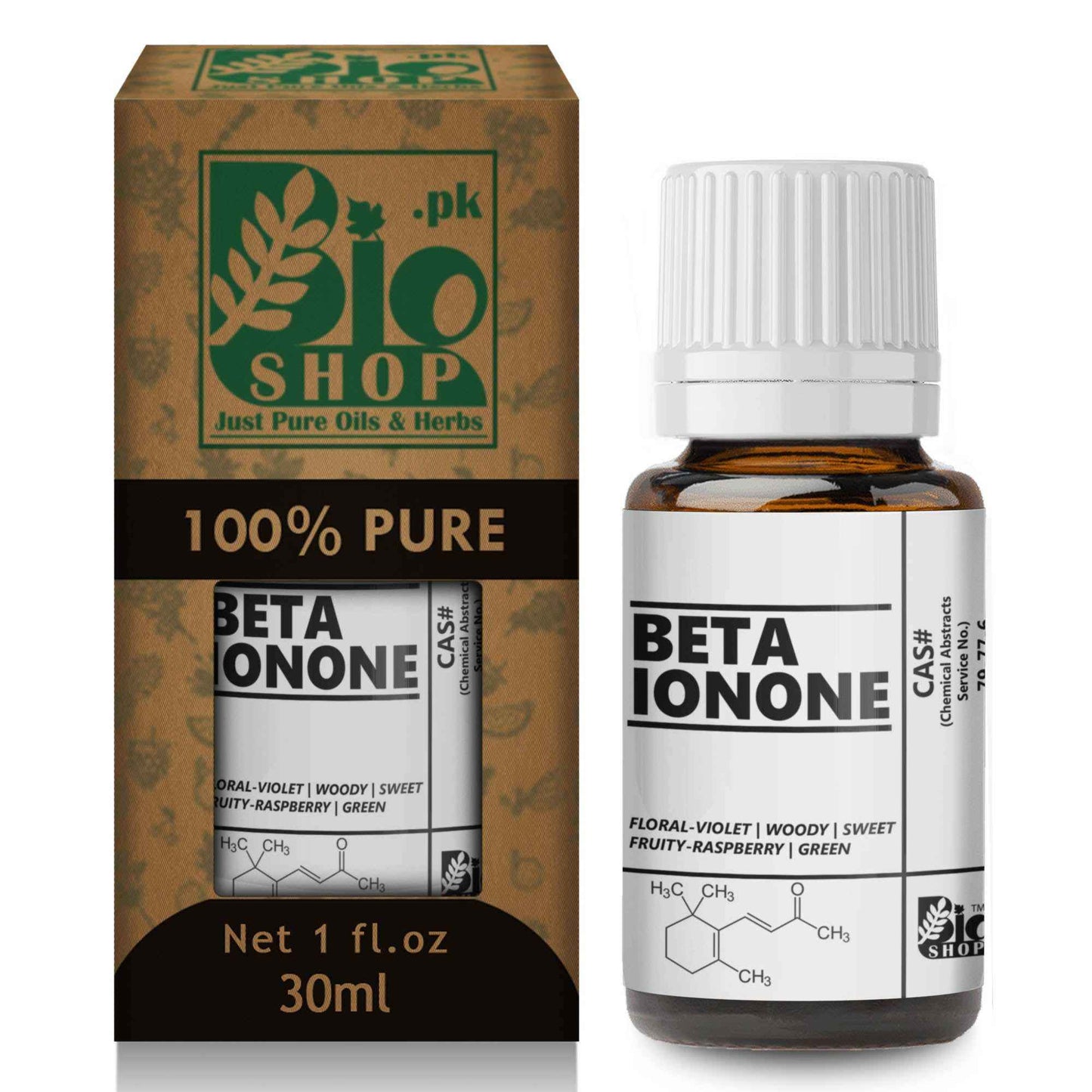
Beta Ionone
Beta Ionone
Olfactory Notes: Warm, woody-violet with a distinct "raspberry" facet.
Couldn't load pickup availability
Explore
Information About Beta Ionone
Key Features
✦ Powerful woody-violet aroma chemical with iconic cedarwood and fruity raspberry facets
✦ Isomer of alpha ionone — delivers a deeper, more woody and tenacious character
✦ Core ingredient in violet soliflores, oriental blends, floral chypres, and classic attars
✦ Exceptional tenacity and diffusion — longevity of 8 to 12+ hours on skin
✦ Performs well in leave-on and rinse-off applications within IFRA limits
✦ Vegan, cruelty-free synthetic — consistent quality across every batch
✦ Cosmetic-grade purity — suitable for fine fragrance, personal care, and home fragrance
About Beta Ionone
Beta Ionone is a synthetic aroma chemical first isolated in the late 19th century as researchers studied the fragrant compounds found in violet flowers and orris root. It belongs to the ionone family — cyclic ketones derived from the degradation of carotenoids — and has since become a cornerstone ingredient in professional and DIY perfumery worldwide. Its long history spans over a century of use in both iconic designer fragrances and traditional attars.
What sets beta ionone apart from its isomer, alpha ionone, is its pronounced woody and cedarwood-like character. Where alpha ionone leans violet and powdery, beta ionone goes deeper — rooty, woody, and softly fruity with a raspberry undertone that adds warmth without sweetness. This duality makes it uniquely versatile: it functions both as a modifier to sharpen floral accords and as a base anchor to give compositions lasting depth and structure.
Bio Shop Pakistan supplies cosmetic-grade beta ionone suitable for fine fragrance development, attar blending, personal care formulation, and home fragrance applications.
Olfactory Profile
SCENT DESCRIPTION : Beta Ionone opens with a rich, woody-violet impression — rooty and dense, like walking through a forest floor carpeted with violet leaves. A warm raspberry undertone adds quiet fruitiness without turning sweet. As it dries down, a clean cedarwood quality emerges, dry and slightly powdery. It has a meditative, deep quality that grounds any composition it enters.
NOTE POSITION : Mid-Base
FRAGRANCE FAMILY : Woody · Floral · Oriental
FACETS : Woody · Violet · Cedarwood · Raspberry · Powdery
TENACITY : Very High — 10 to 14 hours on skin and fabric
SILLAGE : Medium-High — projects well in the opening, then settles into a close, intimate dry-down
Technical Specifications
Chemical Name : (E)-4-(2,6,6-Trimethylcyclohex-2-en-1-yl)but-3-en-2-one
CAS Number : 14901-07-6
Synonyms : β-Ionone · Cyclogeranylacetone · 4-(2,6,6-Trimethyl-2-cyclohexenyl)-3-buten-2-one · Irisone Beta
Purity : 95% minimum (cosmetic grade)
Appearance : Colorless to pale yellow clear liquid
Odor Threshold : Approximately 0.007 ppb in air — extremely potent, use with care
Solubility : Freely soluble in ethanol and carrier oils · Practically insoluble in water
Specific Gravity : 0.944 – 0.950 at 20°C
Flash Point : Approximately 78°C (verify with SDS)
Type : Synthetic
Applications & Usage Guidelines
Fine Fragrance : ★★★★★
Beta Ionone is a staple in fine fragrance development, particularly in violet soliflores, woody florals, chypres, and oriental bases. It provides lasting depth and a natural warmth that reads as both classic and contemporary. Iconic references include Dior Fahrenheit, Chanel No. 5 base structure, and many violet-family EDPs.
Attar and Oriental Blending : ★★★★★
In attar and oriental perfumery, beta ionone integrates seamlessly with oud, sandalwood, rose, and musk bases. It adds a rooty-woody depth that elevates traditional blends without overpowering them. An essential modifier for serious Pakistani and Middle Eastern formulators.
Functional Fragrance : ★★★★☆
Suitable for use in body lotions, creams, and hair conditioners within IFRA-compliant usage levels. Its tenacity makes it effective even in rinse-off formats where many aroma chemicals fade quickly. Best used in combination with a fixative to maximize carry-through.
Cosmetics : ★★★★☆
Beta Ionone is used in prestige skincare and hair care products to impart a subtle, lasting fragrance signature. It is stable in most cosmetic matrices and does not significantly affect color in transparent formulas. Always conduct patch and stability testing before production.
Home Fragrance : ★★★★★
Exceptional performance in reed diffusers, incense sticks, and wax candles due to its high diffusion and long tenacity. In diffusers it provides a clean woody-violet room scent that is neither sharp nor cloying. In candles, its throw is warm and full, especially when blended with musks or floral aldehydes.
IFRA & Usage Rate
Usage Rates (Approximate — in final product)
EDP : 5% – 15% (in fragrance compound as percentage of final blend)
EDT : 3% – 8%
Body Lotion : 0.5% – 1.5%
Shampoo/Body Wash : 0.3% – 1.0%
Candle : 2% – 6%
Reed Diffuser : 5% – 15%
Soap (Rinse-Off) : 0.5% – 1.0%
IFRA 51st Amendment Limits (Approximate — verify at ifrafragrance.org)
Category 4 (Fine Fragrance, EDP, EDT) : ~5.4% in final product
Category 5a (Body Lotion, Cream) : ~1.0% in final product
Category 9 (Shampoo, Shower Gel) : ~2.0% in final product
Category 11a (Rinse-off general) : ~2.0% in final product
Category 12 (Candle, Air freshener) : No restriction under current data
⚠️ Beta Ionone is an IFRA-restricted material based on QRA skin sensitization data. Always calculate the final product concentration, not concentrate concentration.
⚠️ Odor threshold is extremely low — use a precision scale. Even small overages will cause imbalance in your formula.
⚠️ Not intended for use near eyes or on lips at any concentration. See IFRA Category 1 and 3 limits.
Blending Guide
Method 1 — Direct Dilution in Alcohol
Dilute beta ionone to 10% in IPM or DPG before weighing into your fragrance formula. This prevents misdosing due to its extreme potency and allows easier blending. Start at 0.5% in your total formula and scale up in 0.1% increments.
Method 2 — Pre-Blend with Musks as a Base Module
Combine beta ionone with Iso E Super, Habanolide, or Galaxolide to create a woody-musk base module. This base can then be lifted with rose oxide or geranium for a violet-rose oriental effect. Pre-blending also tames the raw woodiness of beta ionone in isolation.
Method 3 — Layering in Attar Construction
In traditional attar making, add beta ionone to your sandalwood or oud base before introducing florals. Its rooty, cedarwood character forms a natural bridge between resinous woods and delicate rose or jasmine. This technique is widely used in high-quality Pakistani and Gulf-style attars.
BEST PAIRINGS
Rose Absolute / Rose Otto → Creates a deep, rooty rose effect reminiscent of classic rose attars
Iso E Super → Amplifies woody diffusion and adds a cedarwood-metal accord
Sandalwood (Mysore / Synthetic) → Deepens the creaminess; produces a classic oriental base
Orris Butter / Orris Concrete → Perfect synergy — true violet-iris accord with natural elegance
Raspberry Ketone → Enhances the fruity facet; useful in gourmand-oriental blends
Labdanum Absolute → Adds animalic, amber depth for oriental and chypre bases
Hedione / Methyl Dihydrojasmonate → Lifts the florality and adds airiness to the woody structure
Musk Ambrette / Habanolide → Smooth, clean base anchor that prolongs the ionone effect
AVOID
Avoid combining at high doses with alpha isomethyl ionone — cumulative skin sensitization risk increases and the profile becomes muddy and indistinct.
Perfumer's Note
Beta ionone is, in my experience, one of the most underestimated building blocks a formulator can have. Most beginners associate it only with violets, but its true power lies in that woody-cedarwood drydown — the quality that makes a fragrance feel rooted, grounded, and sophisticated. I use it not just in violet compositions, but in almost every oriental, chypre, and woody musk I develop. Even at 0.3% in a finished EDT, it changes the character of the base from thin to structured.
ADVANCED TIP: Try using beta ionone as a "wood enhancer" rather than a violet note. In your next woody oriental formula, replace 20% of your synthetic sandalwood with beta ionone and observe how it sharpens the cedarwood impression and adds a fruity-rooty depth that sandalwood alone cannot provide. Keep the total beta ionone under 1% in the finished fragrance to avoid overpowering the accord — its detection threshold is extremely low and its tenacity is unforgiving.
Safety & Storage
Physical State : Clear to pale yellow liquid at room temperature
Skin Safety : Restricted — follow IFRA 51st Amendment limits for each product category. May cause sensitization at elevated concentrations. Dilute before skin contact.
Eye Contact : Avoid direct contact. Rinse immediately with water for 15 minutes if contact occurs. Seek medical attention if irritation persists.
Ingestion : Not for consumption. If ingested, do not induce vomiting. Seek immediate medical attention.
Ventilation : Use in a well-ventilated workspace. Avoid prolonged inhalation of undiluted material. Use a mask when handling large quantities.
Storage : Store in a cool, dark, dry location away from heat, light, and oxidizing agents. Ideal temperature: 10°C – 25°C.
Shelf Life : 24 to 36 months when stored correctly in sealed containers
Container : Store in original amber glass or HDPE containers only. Avoid contact with reactive metals or rubber seals.
Flammability : Combustible liquid. Keep away from open flames and ignition sources. Flash point approximately 78°C.
FAQ
Q: What does beta ionone smell like?
A: It smells woody, violet, and slightly fruity — like fresh violet flowers layered over dry cedarwood with a quiet raspberry undertone. It is deeper and woodier than alpha ionone, which is softer and more powdery.
Q: How much beta ionone should I use in a perfume formula?
A: Start at 0.3% to 1% in your total fragrance formula. It is extremely potent — its odor threshold is well below 1 ppb — so small amounts create a strong effect. Always weigh on a 0.01g precision scale.
Q: Is beta ionone safe for skin products?
A: Yes, within IFRA limits. The 51st Amendment restricts it based on sensitization data. For body lotions, stay under approximately 1% in the final product. Always verify the current IFRA guideline at ifrafragrance.org before production.
Q: Can I use beta ionone in soy or paraffin candles?
A: Yes, beta ionone performs well in candles with a good hot and cold throw. Use between 2% and 6% in the final wax. Blend with musks or floral bases for a complete candle accord.
Q: How does beta ionone compare to alpha ionone?
A: Alpha ionone is soft, powdery, and classically violet — it reads as a top-mid note with moderate tenacity. Beta ionone is woodier, deeper, and more persistent — a true base note with exceptional longevity. Both are useful, but beta ionone provides more structural power and diffusion in a finished fragrance. Many professional formulas use both together to capture the full ionone character.
Where Can You Safely Use Beta Ionone?
Discover how Beta Ionone performs across different applications—rated for safety, stability, and effectiveness.


