Skip to product information
1 of 2

Bio Shop

Birch Tar Oil

Birch Tar Oil

Regular price Rs.900.00
Regular price Sale price Rs.900.00
Sale Sold out
Shipping calculated at checkout.

Olfactory Notes: Leather · Smoky · Woody · Tarry · Phenolic · Campfire

Weight
Quantity
🚚 Estimated delivery time:
View full details

Explore

Information About Birch Tar Oil

Key Features

✦ Smoky, leathery, tar-like base note from destructive distillation of birch bark
✦ The classic backbone of leather and Cuir de Russie accords
✦ Extremely powerful — use in trace amounts only
✦ Very high tenacity; anchors and fixes a composition
✦ Featured in iconic leather and smoky fragrances across history
✦ IFRA-restricted material — must be dosed within current limits
✦ Plant-derived and vegan-friendly

About Birch Tar Oil

Birch Tar Oil is obtained by the destructive (dry) distillation of the bark of the birch tree, Betula pendula. The technique is ancient, with birch tar used for centuries as an adhesive, leather treatment, and medicinal preparation long before it entered perfumery. Its smoky, tarry odor became the signature of Russian leather, where birch tar treated the hides themselves.

What makes birch tar special is its uncompromising smoke-and-leather character. It is one of the few materials that can build a convincing leather impression on its own, contributing phenolic, creosote-like, and campfire facets that no synthetic single material fully replaces. Because it is so potent and dark, it is used in trace quantities and demands a confident hand.

Bio Shop Pakistan supplies cosmetic-grade Birch Tar Oil suitable for leather accords, smoky oriental and woody perfumes, traditional attar and bakhoor blending, and niche masculine compositions.

Olfactory Profile

SCENT DESCRIPTION: A dense, smoky aroma of tar, charred wood, and worn leather. Phenolic and creosote-like at full strength, it softens into birch-smoke and campfire warmth on dilution. There is a dry, slightly medicinal edge reminiscent of old leather boots and bonfire embers. Deep, brooding, and unmistakably rugged.

NOTE POSITION: Base
FRAGRANCE FAMILY: Leather · Smoky · Woody
FACETS: Tarry · Leathery · Phenolic · Smoky · Campfire
TENACITY: Very High — 24+ hours on skin and blotter
SILLAGE: High — projects strongly even at trace dosage

Technical Specifications

Chemical Name : Birch Tar Oil (rectified), Betula pendula bark distillate
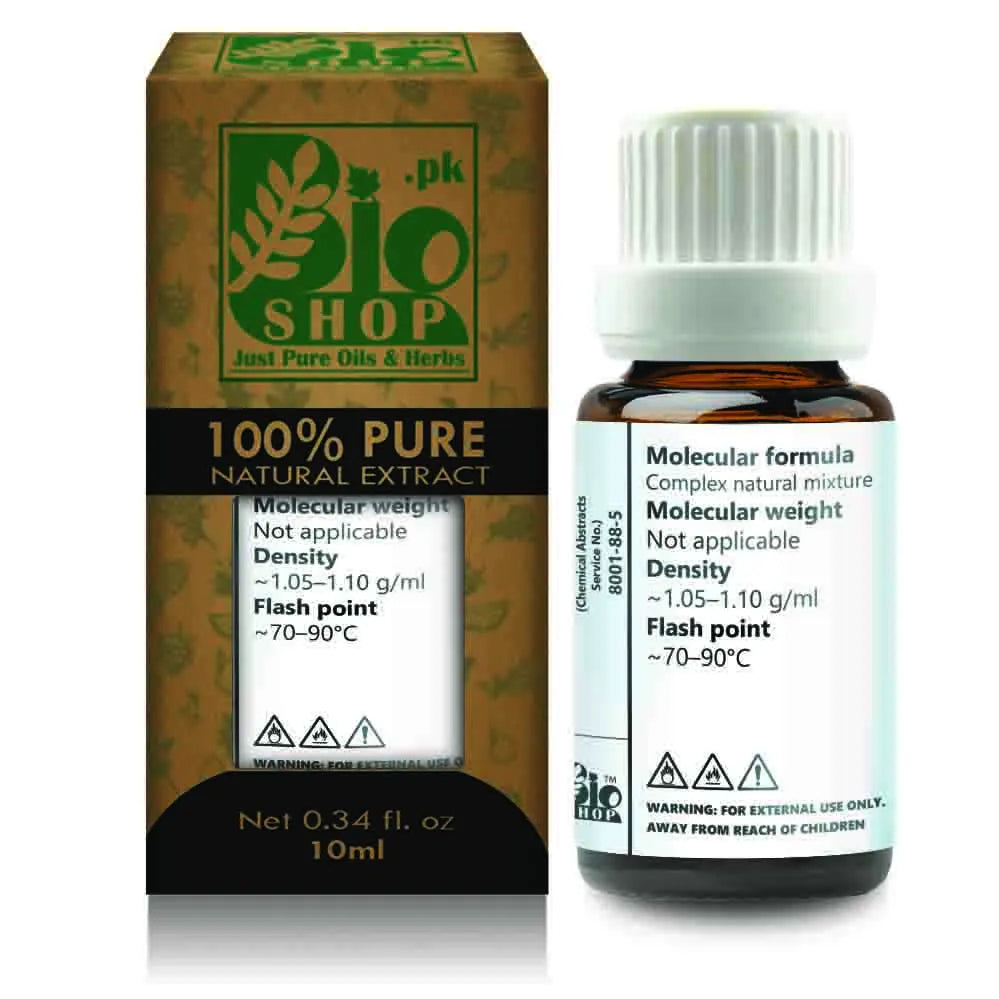
CAS Number : 8001-88-5
Synonyms : Birch Tar, Oleum Rusci, Rectified Birch Tar Oil, Betula Oil
Purity % : verify with supplier
Appearance : Dark brown to black viscous oily liquid
Odor Threshold: Very low — extremely powerful
Solubility : Soluble in alcohol and oils; insoluble in water
Specific Gravity : verify with supplier
Flash Point : verify with supplier
Type : Natural (destructive distillation of birch bark)

Applications & Usage Guidelines

Adds smoky depth and leathery backbone to mukhallat, oud, and bakhoor-style compositions. Pairs naturally with oud, labdanum, and resins.

Functional Fragrance ★★☆☆☆
Limited use due to strong color and odor strength. Occasionally used in masculine soaps and shaving products at very low levels.

Cosmetics ★☆☆☆☆
Rarely used in cosmetics due to dark color and discoloration risk. Best avoided in leave-on skincare.

Home Fragrance ★★★★☆
Excellent for smoky candles, incense, and rustic leather-themed diffusers where its color is not an issue.

IFRA & Usage Rate

Typical formulation guidance (use sparingly):

EDP : 0.01 – 0.5%
EDT : 0.01 – 0.3%
Body Lotion : not recommended (discoloration)
Shampoo/Body Wash: trace only, verify
Candle : 0.1 – 1%
Reed Diffuser : 0.1 – 1%
Soap : 0.05 – 0.5%

⚠️ Birch Tar Oil is an IFRA-restricted material due to polycyclic aromatic hydrocarbon (PAH) content. Crude birch tar is more heavily restricted than rectified grades. IFRA 51st Amendment sets specific maximum levels per product category, and exact limits vary by isomer and grade.

⚠️ Do not rely on the rates above as compliance figures. Verify current category limits and PAH specifications against the official source at ifrafragrance.org and confirm grade with your supplier CoA.

Blending Guide

Method 1 — Dilute first
Always pre-dilute to 1% or 10% in perfumer's alcohol or DPG before use. Undiluted birch tar overwhelms a blend and is hard to dose accurately.

Method 2 — Build a leather base
Combine trace birch tar with isobutyl quinoline, castoreum-type accords, and styrax to construct a full leather note.

Method 3 — Smoke seasoning
Add a single drop of dilution to woody or oriental blends to introduce smoke and grit without taking over.

BEST PAIRINGS

Labdanum → Deepens amber-leather warmth
Oud → Reinforces smoky, animalic oriental character
Styrax → Smooths and rounds the leather effect
Isobutyl Quinoline → Builds dry, tannic leather
Vetiver → Adds earthy, smoky woodiness
Cade Oil → Amplifies tar and smoke (use with caution)

AVOID
Avoid in delicate florals, fresh citrus, and pale cosmetic bases where its smoke and dark color clash or stain.

Perfumer's Note

Birch tar is one of those materials that humbles you the first time. A single careless drop can ruin a 100ml batch, but used with restraint it gives a leather accord a soul that no synthetic alone can match. I treat it as seasoning, not structure — a whisper of campfire behind the leather.

ADVANCED TIP: Make a 1% dilution in alcohol and dose by the single drop. For a Russian-leather effect, blend birch tar dilution with isobutyl quinoline and a touch of styrax at roughly 1:2:2, then anchor with labdanum. Let it macerate two weeks before judging — the raw tar edge mellows considerably with rest.

Safety & Storage

Physical State : Dark viscous liquid
Skin Safety : Use diluted only; restricted material, follow IFRA limits
Eye Contact : Avoid; flush with water if exposed
Ingestion : Do not ingest; keep away from food
Ventilation : Use in well-ventilated area; strong fumes
Storage : Cool, dark place away from light and heat
Shelf Life : 2–3 years sealed; verify with supplier
Container : Amber glass with tight cap; stains plastic
Flammability : Combustible; keep away from open flame

FAQ

Q: What does Birch Tar Oil smell like?
A: Smoky, leathery, and tarry — like a campfire and old leather. It is one of the most powerful smoke notes in perfumery.

Q: How much should I use?
A: Trace amounts only, typically well under 0.5% in fine fragrance. Always pre-dilute to 1% first.

Q: Why is my birch tar so dark and thick?
A: That is normal. Birch tar is naturally a dark brown to black viscous oil and will stain skin, clothing, and plastic.

Q: Is Birch Tar Oil IFRA restricted?
A: Yes, it is restricted due to PAH content. Confirm current category limits at ifrafragrance.org before formulating.

Q: How does it compare to synthetic leather materials like Suederal or IBQ?
A: Synthetics give cleaner, more controllable leather notes, but birch tar adds authentic natural smoke and depth they cannot fully replicate. Many perfumers use a small amount of birch tar alongside synthetics for realism.

Where Can You Safely Use Birch Tar Oil?

Discover how Birch Tar Oil performs across different applications—rated for safety, stability, and effectiveness.

Alcoholic Perfume
8
Good
Anti-perspirants/Deo
2
Stability Issues
Creams and Lotions
1
Major Problems
Lipsticks
0
Not Recommended
Talcum Powder
2
Stability Issues
Tablet Soap
4
Slight Issues
Liquid Soap
3
Discoloration
Shampoo
2
Stability Issues
Hair Conditioner
1
Major Problems
Bath/Shower Gel
3
Discoloration
Reed Diffuser
6
Fair
Cold Wave
1
Major Problems
Detergent Powder
9
Very Good
Liquid Detergent
9
Very Good
Fabric Softener
2
Stability Issues
Candles
6
Fair
Incense
8
Good