Bio Shop
Bisabolene
Bisabolene
Olfactory Notes: Woody · Balsamic · Opoponax · Resinous · Slightly Citrus
Couldn't load pickup availability

Explore
Information About Bisabolene
Key Features
✦ Natural sesquiterpene hydrocarbon with warm woody-balsamic aroma
✦ Adds opoponax-like creaminess and depth to oriental accords
✦ Acts as a soft natural fixative for citrus and woody compositions
✦ Bridges top notes and woody-resinous base notes seamlessly
✦ Commonly found in cubeb, bergamot, opoponax and ginger oils
✦ Featured in oriental, woody, mukhallat and ambery fragrance styles
✦ Vegan, cruelty-free and suitable for clean perfumery
About Bisabolene
Bisabolene is a naturally occurring sesquiterpene hydrocarbon with the molecular formula C15H24, existing in several isomeric forms — primarily alpha-bisabolene, beta-bisabolene and gamma-bisabolene. It has been identified as a key constituent in many botanicals including opoponax, bergamot, lemon, cubeb, ginger and certain myrrh varieties. Its discovery and isolation followed early 20th-century studies of essential oil chemistry, and it has since become a recognised perfumery material in its own right.
What makes bisabolene special is its dual role as both an odorant and a fixative. Unlike many synthetic woody molecules, bisabolene carries a soft, naturalistic warmth reminiscent of opoponax resin — gentle, balsamic, faintly fruity and lightly woody. It bridges volatile citrus tops with heavier resinous bases, smoothing rough transitions and adding a sun-warmed quality to compositions. Note that bisabolene should not be confused with bisabolol, the cosmetic skin-soothing alcohol — they are chemically distinct.
Bio Shop Pakistan supplies cosmetic-grade Bisabolene suitable for fine fragrance, attar and mukhallat blending, oriental perfumery, room sprays, oil-based perfumes and naturalistic woody accords for both professional perfumers and DIY enthusiasts.
Olfactory Profile
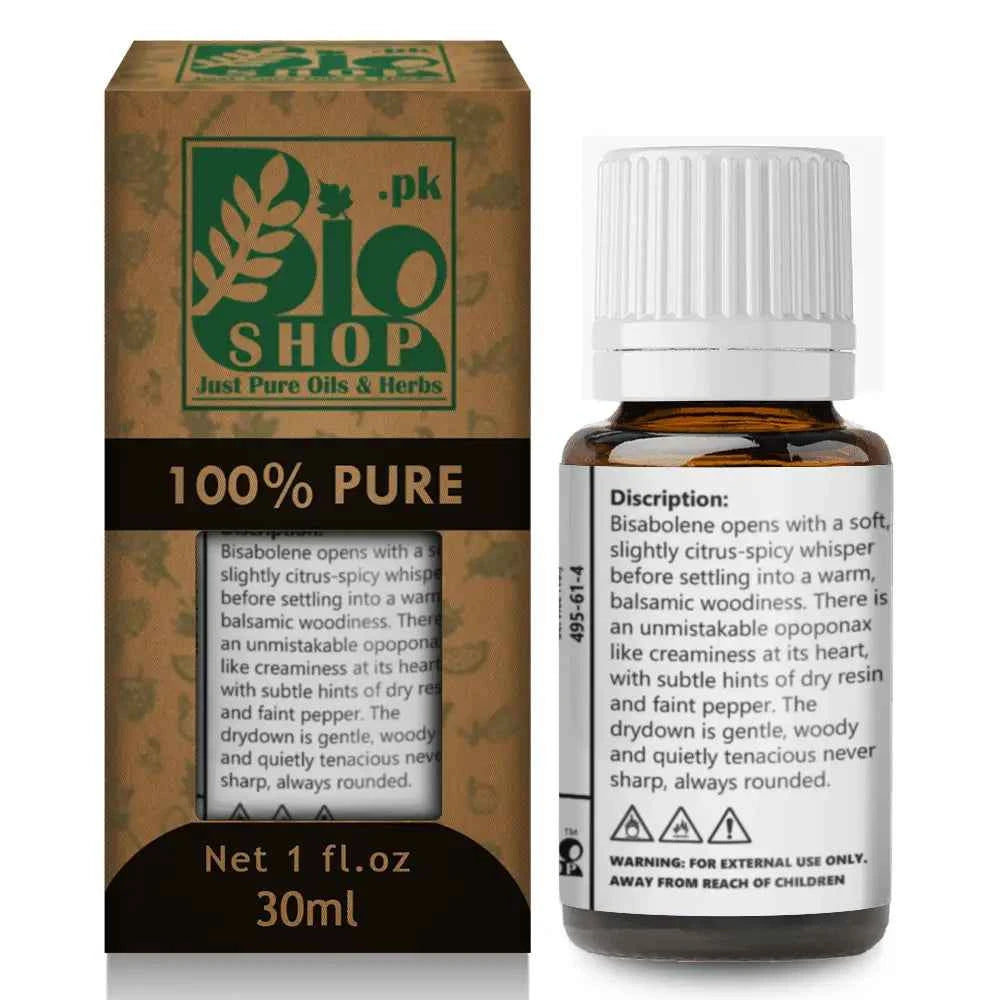
SCENT DESCRIPTION : Bisabolene opens with a soft, slightly citrus-spicy whisper before settling into a warm, balsamic woodiness. There is an unmistakable opoponax-like creaminess at its heart, with subtle hints of dry resin and faint pepper. The drydown is gentle, woody and quietly tenacious — never sharp, always rounded. It feels like sun-warmed wood resting on amber-soaked skin.
NOTE POSITION : Mid-Base
FRAGRANCE FAMILY : Woody · Balsamic · Oriental
FACETS : Woody · Balsamic · Opoponax · Resinous · Slightly Citrus
TENACITY : Medium to High (6 to 10 hours on skin)
SILLAGE : Low to Medium — soft, intimate, skin-close radiance
Technical Specifications
Chemical Name : Bisabolene (mixture of isomers, predominantly beta-bisabolene)
CAS Number : 495-61-4 (beta-bisabolene) — verify isomer with supplier CoA
Synonyms : β-Bisabolene; 1-Methyl-4-(6-methylhept-5-en-2-yl)cyclohexa-1,3-diene
Purity % : 90% minimum (verify with supplier CoA)
Appearance : Clear, colorless to pale yellow mobile liquid
Odor Threshold : Low — detectable in trace concentrations
Solubility : Soluble in alcohol, oils and most organic solvents; insoluble in water
Specific Gravity : 0.870 to 0.885 at 20°C (verify with supplier)
Flash Point : Approximately 100°C (verify with supplier SDS)
Type : Natural / Naturally-derived sesquiterpene
Applications & Usage Guidelines
Fine Fragrance : ★★★★★
Bisabolene is a refined material in modern fine fragrance, lending warmth and naturalistic depth to woody, oriental and ambery compositions. It softens harsh synthetic woods and rounds out citrus colognes beautifully.
Attar & Oriental Blending : ★★★★★
A natural ally in mukhallat work — its opoponax facet pairs effortlessly with oudh, amber, labdanum and rose. It adds the sun-warmed balsamic quality prized in Gulf-style perfumery.
Functional Fragrance : ★★★★
Performs well in room sprays, incense compositions and reed diffusers. Stable in alcohol-based and oil-based functional bases.
Cosmetics : ★★★
Acceptable in leave-on and rinse-off cosmetics within IFRA limits. Patch testing recommended due to terpene content.
Home Fragrance : ★★★★
Excellent in incense, bakhoor blends, candles and diffusers. Adds a naturalistic resinous warmth that pairs well with woods and resins.
IFRA & Usage Rate
EDP (Eau de Parfum) : 0.5% to 5% of fragrance concentrate
EDT (Eau de Toilette) : 0.3% to 3% of fragrance concentrate
Body Lotion : 0.05% to 0.3% in finished product
Shampoo / Body Wash : 0.05% to 0.2% in finished product
Candle (paraffin/soy) : 1% to 6% of fragrance load
Reed Diffuser : 1% to 8% of fragrance load
Soap (cold process) : 0.2% to 1% in finished product
⚠️ As a sesquiterpene hydrocarbon, bisabolene is prone to oxidation. Always store under nitrogen or with antioxidants where possible.
⚠️ Verify current IFRA 51st Amendment category limits at ifrafragrance.org before commercial use, as terpene materials are subject to category-specific restrictions.
⚠️ Patch test in leave-on cosmetics — oxidized terpenes may pose sensitization risk.
Blending Guide
METHOD 1 — Naturalistic Woody Base
Combine bisabolene with cedarwood, sandalwood and a touch of labdanum to build a warm, sun-bleached woody base. Use 2% to 5% of the base accord.
METHOD 2 — Citrus Cologne Rounding
Add 0.5% to 2% bisabolene to bergamot-lemon-neroli colognes to extend longevity and soften the volatility of top notes.
METHOD 3 — Mukhallat Bridge Note
Use bisabolene as a connecting layer between rose-oudh hearts and amber-labdanum bases at 1% to 3% of total formula.
BEST PAIRINGS
Opoponax Resinoid → Amplifies natural balsamic warmth
Cedarwood Atlas → Creates sun-warmed dry woody character
Bergamot Oil → Smooths the citrus opening into the heart
Labdanum → Builds rich oriental amber depth
Sandalwood → Adds creamy roundness to the drydown
Oudh / Agarwood → Softens harsh oudh facets, adds naturalistic glow
Myrrh → Reinforces resinous-balsamic character
Pink Pepper → Lifts the slight spicy facet of bisabolene
AVOID
Avoid heavy oxidative exposure during blending — work quickly and minimize air contact. Avoid pairing in high doses with strong aldehydes which can mask its delicate character.
Perfumer's Note
Bisabolene is one of those quiet workhorses I return to whenever a composition feels two-dimensional. It does not announce itself — instead it fills the gaps between accords with a soft, sun-warmed naturalism that synthetic woods can rarely replicate. I think of it as the breath in a fragrance, the pause between the citrus and the resin where everything settles.
ADVANCED TIP
Build a "naturalistic warmth module" using 30% bisabolene + 25% opoponax resinoid + 20% cedarwood Virginia + 15% labdanum absolute + 10% benzoin Siam. Use this pre-made module at 3% to 8% in oriental and mukhallat formulas — it adds an instantly aged, sun-soaked balsamic quality that takes years to achieve through individual layering.
Safety & Storage
Physical State : Clear mobile liquid, colorless to pale yellow
Skin Safety : Generally safe within IFRA limits; oxidized material may sensitize
Eye Contact : Avoid contact; flush with water if exposed
Ingestion : Not for internal use; seek medical advice if swallowed
Ventilation : Use in well-ventilated area; avoid prolonged vapor inhalation
Storage : Cool, dark place; tightly sealed; protect from light, heat and air
Shelf Life : 12 to 18 months from receipt; refrigeration extends life
Container : Amber glass with PTFE-lined cap; nitrogen blanket recommended
Flammability : Combustible liquid; keep away from open flame and ignition sources
FAQ
Q: Is bisabolene the same as bisabolol?
A: No. Bisabolene is a sesquiterpene hydrocarbon used in perfumery, while bisabolol is a sesquiterpene alcohol used in cosmetics for skin-soothing properties.
Q: Why does bisabolene smell like opoponax?
A: Bisabolene is one of the major constituents of natural opoponax resin and shares its warm, balsamic-woody character. This is why perfumers often use it to extend or echo opoponax notes.
Q: Can I use bisabolene in attars?
A: Yes, it blends beautifully in oil-based attars and mukhallat compositions, especially with rose, oudh, amber and labdanum at 1% to 3% of the formula.
Q: How should I store bisabolene to prevent oxidation?
A: Store in amber glass under nitrogen blanket, refrigerated, with minimal air exposure. Add 0.05% BHT or tocopherol as an antioxidant for longer shelf life.
Q: How does bisabolene compare to opoponax essential oil?
A: Bisabolene is a single sesquiterpene molecule offering a clean, focused warm-woody facet, whereas opoponax oil is a complex resin with smoky, sweet and spicy nuances. Bisabolene is more transparent and easier to dose precisely.
Where Can You Safely Use Bisabolene?
Discover how Bisabolene performs across different applications—rated for safety, stability, and effectiveness.