


Bio Shop
Calone
Calone
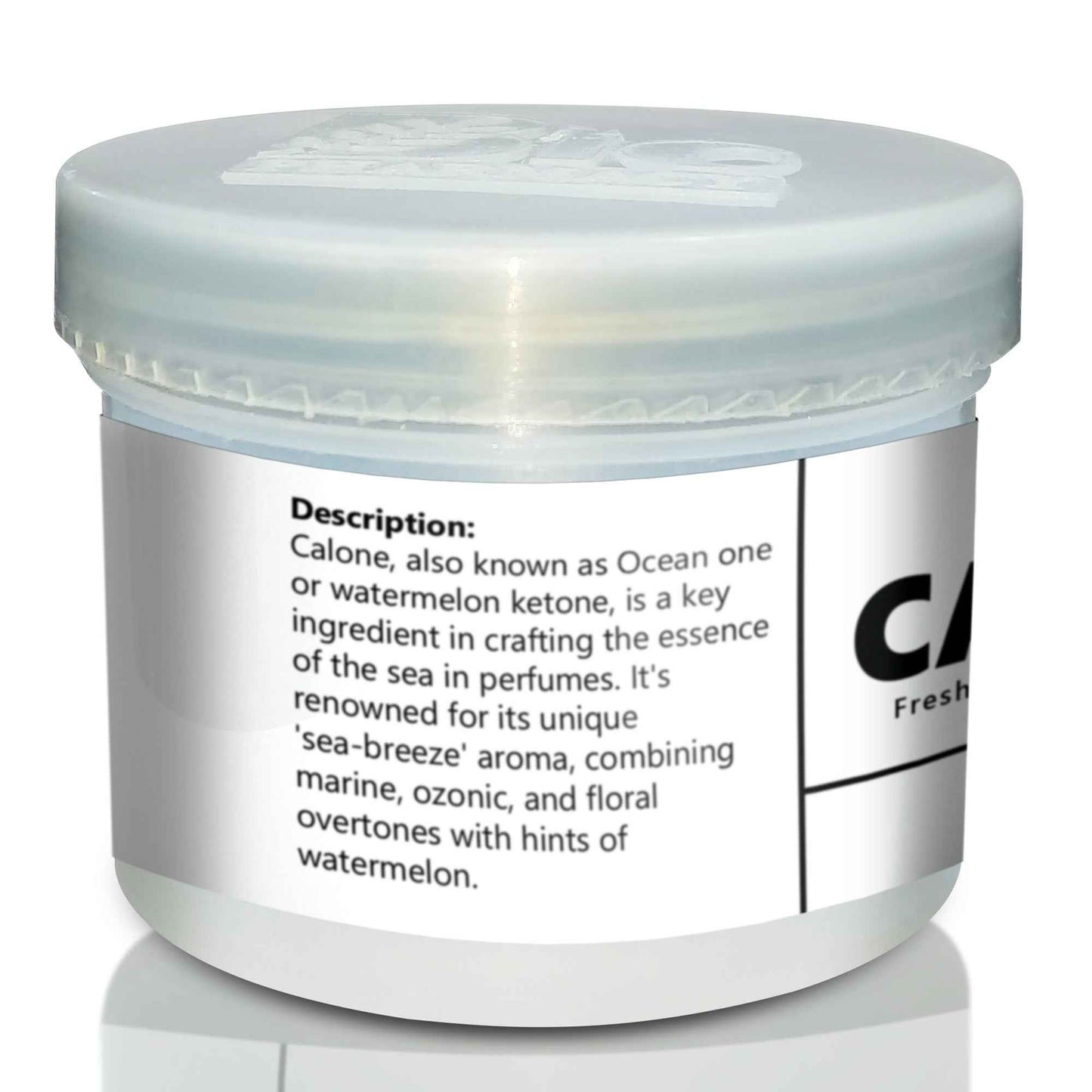
Olfactory Notes: The classic "Sea Breeze" or watery melon aquatic note.
Couldn't load pickup availability


Explore
Information About Calone
Key Features
✦ Synthetic marine aroma chemical delivering an intense oceanic, ozonic, and watery-melon impression — the defining molecule of the aquatic fragrance family
✦ Exceptionally potent — effective at concentrations as low as 0.05% in a finished formula; precise dosing is critical for beginner and professional formulators alike
✦ Featured in some of the most iconic fragrances of the modern era including L'Eau d'Issey by Issey Miyake, CK One by Calvin Klein, and Acqua di Gio by Giorgio Armani
✦ Versatile across fine fragrance, deodorants, body washes, hair care, reed diffusers, and room sprays wherever a fresh aquatic character is required
✦ Blends seamlessly with dihydromyrcenol, hedione, ambroxan, violet leaf, musks, and citrus materials to construct full marine and ozonic accords
✦ 100% synthetic — vegan, cruelty-free, free from animal-derived materials, and consistent in quality across every batch
✦ Supplied at 98%+ purity in cosmetic and fragrance grade, suitable for professional formulation and reliable sensory performance
About Calone
Calone, commercially known as Calone 1951, is a synthetic benzofuranone derivative originally developed and patented by Pfizer in the mid-20th century. It carried the distinctive character of ocean spray, watermelon rind, and open coastal air — a scent profile that had no natural equivalent in the perfumer's palette. When it was introduced into mainstream fine fragrance in the early 1990s, it fundamentally changed perfumery. The marine or aquatic accord it made possible was an entirely new fragrance vocabulary: the smell of water itself, not of flowers that grow near water, but of the sea as a sensation.
What makes Calone extraordinary is its combination of extreme radiance and very low odor threshold. It is among the most diffusive synthetic molecules in modern perfumery, capable of projecting a fresh oceanic signature at concentrations well below 1% in a compound. This potency is both its greatest asset and its greatest danger in the hands of beginners. At the correct dose it is translucent, airy, and expansive; overdosed even slightly, it becomes an overwhelming synthetic wave that drowns everything around it. Mastering Calone is one of the clearest demonstrations of the principle that in perfumery, less is almost always more.
Bio Shop Pakistan supplies cosmetic-grade Calone suitable for DIY perfumers, independent fragrance creators, beauty formulators, and home crafters working with professional-quality synthetic aroma chemicals
Olfactory Profile
SCENT DESCRIPTION : Calone opens with a startling blast of ocean spray and melon rind, instantly transporting the senses to a breezy coastal waterfront on a clear summer afternoon. It carries an almost synesthetic quality — simultaneously wet, cool, and faintly sweet — like biting into a chilled slice of watermelon at the edge of the sea. Beneath the marine burst lies a subtle green-ozonic tension that keeps the impression expansive and clean rather than overtly fruity or synthetic. At trace concentrations it reads as a soft aquatic shimmer; at higher doses it becomes an overwhelming marine wave.
NOTE POSITION : Top to Mid
FRAGRANCE FAMILY : Marine / Aquatic, Ozonic, Fresh Fruity
FACETS : Marine · Ozonic · Watermelon · Sea Breeze · Fresh
TENACITY : Medium — 4 to 6 hours on skin within an alcohol-based formula
SILLAGE : Very High — radiant and diffusive even at trace levels; projects noticeably beyond the skin surface
Technical Specifications
Chemical Name : 7-Methyl-2(3H)-benzofuranone
CAS Number : 28940-11-6
Synonyms : Calone 1951, 7-Methylbenzofuranone, 2(3H)-Benzofuranone 7-methyl
Purity : 98% minimum
Appearance : White to off-white crystalline powder or solid
Odor Threshold : Approximately 0.0001 to 0.0003 ppm (extremely low — handle with precision)
Solubility : Soluble in ethanol, DPG, IPM, and most fragrance solvents; practically insoluble in water
Specific Gravity : Approximately 1.10 g/cm³ (verify with current SDS from supplier)
Flash Point : ≥ 100°C (verify with current SDS from supplier)
Type : Synthetic
Applications & Usage Guidelines
Fine Fragrance : ★★★★★
Calone is the foundational ingredient for marine and aquatic accords in fine fragrance. It is indispensable in EDPs and EDTs targeting fresh, oceanic, or coastal summer themes. Pair with hedione, ambroxan, and clean musks to build a complete and balanced modern aquatic signature.
Attar & Oriental Blending : ★★
Calone is not a natural fit in traditional attar or oriental compositions, as its strong synthetic marine character conflicts with the warmth and richness of oud, amber, and heavy florals. Adventurous formulators may use micro-doses under 0.05% in a compound to add an unexpected cool shimmer or contrast to an otherwise dense oriental, but this requires careful control.
Functional Fragrance : ★★★★
Calone performs strongly in deodorants, body washes, shower gels, and laundry-adjacent personal care formats where fresh and clean marine notes are commercially desirable. It reinforces the impression of cleanliness and blends well with green citrus and light musk bases standard in functional fragrance systems.
Cosmetics : ★★★
In skin creams, light lotions, and hair care products Calone adds an aquatic freshness to product scenting at very low dosage. Use conservatively, as excess creates an overpowering synthetic impression. It works best in unisex or masculine-positioned cosmetic lines where a clean, cool character is part of the product identity.
Home Fragrance : ★★★★
Reed diffusers and room sprays benefit greatly from Calone's exceptional diffusivity. It creates an immediate oceanic ambiance in enclosed spaces with minimal dosage. Performance in candles is acceptable but its high volatility means some of the effect is lost in hot wax; prioritize reed and cold-diffusion formats for best results.
IFRA & Usage Rate
Recommended Usage Rates — Calone as Raw Material in Finished Product
EDP (20% fragrance load) : 0.002 to 0.05%
EDT (10% fragrance load) : 0.001 to 0.03%
Body Lotion : 0.001 to 0.02%
Shampoo / Body Wash : 0.001 to 0.02%
Candle : 0.01 to 0.1% of fragrance compound weight
Reed Diffuser : 0.05 to 0.3% of diffuser compound weight
Soap (Tablet) : 0.01 to 0.05% (stability testing recommended)
Note: When using Calone inside a fragrance compound (the perfume oil blend before dilution), typical usage is 0.1 to 1.0% of total compound weight. The finished product rates above are based on Calone as a direct raw material addition.
IFRA 51st Amendment Status
Calone (CAS 28940-11-6) does not appear on the IFRA restricted or prohibited ingredients list under the 51st Amendment at normal recommended usage levels.
⚠️ Always verify against the current IFRA guidelines at ifrafragrance.org before any commercial formulation.
⚠️ Due to extreme potency, always begin at the lowest recommended rate and assess on a smelling strip at 24 hours before scaling.
⚠️ Do not apply undiluted Calone directly to skin. Always handle in dilution of 10% or less for safe working.
Blending Guide
Usage Method 1 — Pre-dilution in DPG or Ethanol
Calone in raw crystalline form is too concentrated for direct blend addition in small batches. Prepare a 10% working solution by dissolving Calone in dipropylene glycol or ethanol. This makes dosing precise and controllable, particularly important for small formulations under 100g where even 1 extra drop can result in severe overdosing.
Usage Method 2 — Classic Marine Accord Construction
Use Calone as the nucleus of a complete marine accord at 0.2 to 0.5% within your fragrance compound. Pair with dihydromyrcenol (5 to 8%) and hedione or methyl dihydrojasmonate (3 to 5%) to build the classic 1990s-era aquatic chord. This three-material structure forms the skeleton of countless successful fresh marine fragrances and remains highly relevant for commercial work.
Usage Method 3 — Invisible Transparency Modifier
In contemporary perfumery, Calone at micro-dose (0.03 to 0.1% in compound) functions as an invisible freshener rather than a dominant marine note. Add it to floral, citrus, or woody structures to introduce unexplained coolness and aerial transparency. The composition does not read as marine at this level but gains a dimensionality and lift that is difficult to achieve by other means.
BEST PAIRINGS
Dihydromyrcenol → Amplifies the marine accord and adds laundry-fresh brightness to the ozonic chord
Hedione (MHJ) → Contributes watery jasmine softness that bridges the gap between marine and floral
Ambroxan → Anchors the cool marine opening with skin-warm depth and lasting radiance
Iso E Super → Adds woody diffusion and transparent radiance that complements oceanic shimmer
Violet Leaf Absolute → Deepens the green-watery facet, creating a convincing underwater or riverside accord
Bergamot EO → Citrus brightness that naturalizes the synthetic marine character and lifts the opening
Galaxolide / Habanolide → Clean musks that anchor and extend the Calone-based accord into the dry-down
AVOID
Avoid pairing Calone with heavy phenolic materials such as eugenol-dominant spices or animalic bases — the opposition between clean marine freshness and warm barnyard notes rarely produces coherent results. Also avoid camphoraceous materials including eucalyptus and camphor, which push the accord into a harsh medicinal-aquatic register that is difficult to correct.
Perfumer's Note
Working with Calone is one of the most immediately instructive experiences a young perfumer can have, because it teaches restraint faster than almost any other ingredient. The first time I used it I overdosed within seconds — what should have been an elegant marine shimmer became a wall of synthetic ocean that buried every other material in the formula completely. That lesson never leaves you. Once you develop the habit of working from a pre-diluted solution and treating Calone the way you would treat a concentrated aromatic — with respect and a very light hand — it becomes one of the most beautiful tools available. It does not just smell like the sea; it creates the sensation of open space within a fragrance, a quality of airy expansion that is nearly impossible to achieve any other way. That spatial quality is why the aquatic genre it gave birth to resonated so deeply with the public in the 1990s and why it still has genuine relevance in modern functional and fine fragrance today.
ADVANCED TIP : Use Calone at 0.03 to 0.05% within an oriental or musk-floral base that would otherwise feel dense and conventional. At this level the molecule does not register as marine to anyone smelling the finished composition — there is no obvious aquatic note. What happens instead is that the entire fragrance appears to open up and breathe, as though someone cracked a window in a warm room. This technique transforms heavy, introverted bases into something more contemporary and wearable without altering their essential character. It is one of the most effective invisible interventions available to the modern perfumer.
Safety & Storage
Physical State : Crystalline solid, white to off-white powder at room temperature
Skin Safety : Use only in appropriate dilution; avoid prolonged or repeated skin contact at high concentrations; may cause sensitization in susceptible individuals
Eye Contact : Avoid contact; if exposure occurs, flush immediately with clean water for at least 15 minutes and seek medical attention
Ingestion : Not for consumption under any circumstances; keep out of reach of children and pets at all times
Ventilation : Work in a well-ventilated area; the extremely low odor threshold means trace airborne quantities create significant olfactory exposure even without direct contact
Storage : Store in a cool, dry location away from direct sunlight, heat, and humidity; keep container tightly sealed at all times
Shelf Life : 2 to 3 years under correct storage conditions; assess odor quality before use in older stock
Container : Store in original airtight container; glass or HDPE preferred; avoid reactive metals and open containers
Flammability : Flash point ≥ 100°C; not classified as highly flammable under standard handling conditions; keep away from open flames as standard practice
FAQ
Q: What does Calone actually smell like if you have never experienced it?
A: It smells intensely of the open ocean — fresh, cool, watery, and faintly melon-like. Most people describe it as sea spray, or the interior of a watermelon at the beach. It is unlike any natural ingredient.
Q: Calone arrived as a solid crystal. How do I use it in a liquid perfume blend?
A: Dissolve it in DPG or ethanol to make a 10% working solution before adding it to any formula. Adding raw crystal directly to a blend makes accurate dosing nearly impossible given its extreme potency.
Q: Is Calone safe to use in skin-contact products like body lotion or EDP?
A: Yes, at the recommended finished product concentrations it is considered safe for skin contact. Stay within suggested usage rates, never apply undiluted material to skin, and always verify against current IFRA guidelines for your specific product category.
Q: Why do some experienced perfumers say Calone is dated or overused?
A: Because it dominated commercial perfumery so heavily throughout the 1990s that the entire aquatic genre became oversaturated in the market. Today it is used at micro-doses as a modifier rather than a keynote, giving compositions freshness and transparency without the recognizable 1990s marine signature.
Q: How is Calone different from Dihydromyrcenol, which is also described as a fresh marine material?
A: They are complementary but meaningfully different. Dihydromyrcenol is cleaner, more laundry-fresh, and slightly citrus-floral in character, while Calone is specifically oceanic and ozonic with a distinct watery-melon facet. Calone is also far more potent. In most marine accords both are used together — Calone provides the sea-spray burst and Dihydromyrcenol provides the fresh-clean body of the composition.
Where Can You Safely Use Calone?
Discover how Calone performs across different applications—rated for safety, stability, and effectiveness.
Perfect


