Bio Shop
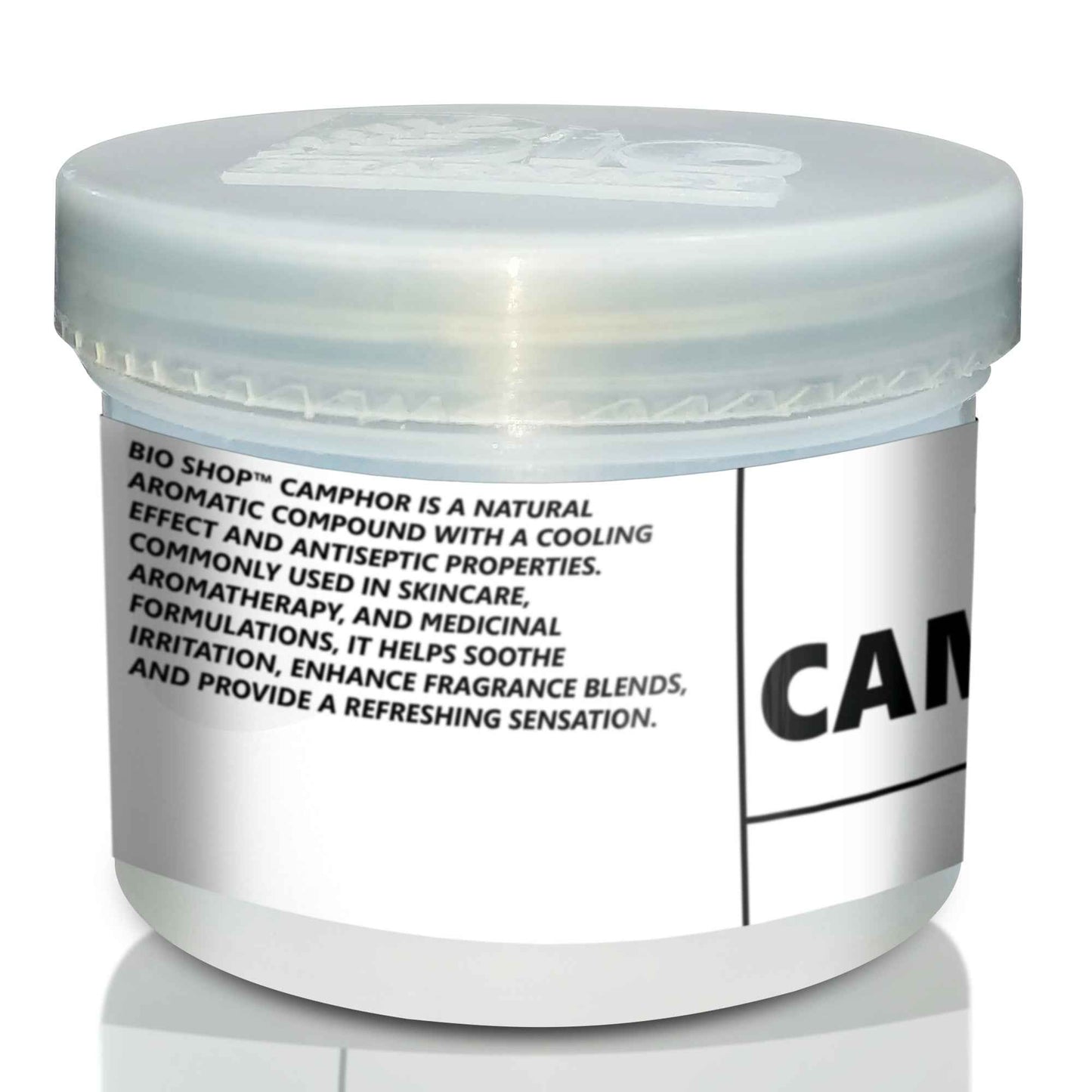
Camphor
Camphor
Key Functions: Cooling, antiseptic, counterirritant, and scalp-stimulating.
Couldn't load pickup availability


Explore
Information About Camphor
✅ Key Features
✦ Activates TRPM8 cold receptors in the skin to deliver immediate and sustained cooling and counterirritant sensation.
✦ Broad-spectrum mild antiseptic and antimicrobial active used in scalp treatments, anti-acne preparations, and foot care.
✦ Functions as a counterirritant and mild analgesic in muscle balms, joint rubs, and therapeutic body care products.
✦ EU Annex III restricted ingredient — maximum 3% in face leave-on products, 5% in body and hair leave-on products.
✦ Versatile application across muscle balms, scalp oils, anti-dandruff shampoos, deodorants, and anti-itch formulations.
✦ Dissolves readily in ethanol, fixed oils, and waxes, enabling flexible incorporation into both anhydrous and emulsion systems.
✦ Available in cosmetic-grade crystalline form; pairs synergistically with menthol and eucalyptus for enhanced cooling effect.
🔬 Description
Camphor is a bicyclic monoterpene ketone with molecular formula C10H16O, naturally obtained by steam distillation of wood from Cinnamomum camphora, the camphor laurel tree native to East and Southeast Asia. Synthetic camphor, produced from turpentine oil via a series of well-established reactions, is equally acceptable for cosmetic use and meets the same INCI classification. Historically used for millennia in Ayurvedic, Traditional Chinese, and European topical medicine, camphor was applied in everything from wound dressings and liniments to cooling ointments and scalp tonics, establishing a deep tradition of safe topical use at appropriate concentrations.
What sets camphor apart in modern cosmetic formulation is its neurological mechanism of action. By selectively activating TRPM8 thermoreceptors in peripheral nerve endings, camphor produces a cooling and counterirritant sensation without actually lowering skin surface temperature — a property exploited in both therapeutic and sensory-experience-driven formulations. Beyond its sensory effect, camphor exhibits documented mild antimicrobial, anti-inflammatory, and antifungal activity, making it a genuinely functional active rather than a purely sensory additive.
Bio Shop Pakistan supplies cosmetic-grade camphor suitable for professional cosmetic formulators, independent skincare and body care brands, soap makers, and advanced DIY beauty creators.
📊 Technical Data
INCI Name : Camphor
Chemical Name : 1,7,7-Trimethylbicyclo[2.2.1]heptan-2-one
CAS Number : 76-22-2
Molecular Formula : C10H16O
Appearance : White to colorless crystalline solid; waxy flakes or compressed powder
Odor : Strong, sharp, characteristic camphoraceous odor
pH (1% solution) : Not applicable — sparingly soluble in water; neutral in ethanolic solution
Solubility : Sparingly soluble in water (~1.2 g/L at 20°C); freely soluble in ethanol, ether, acetone, and fixed oils
Specific Gravity : 0.990 g/cm³ at 25°C
Flash Point : 66°C (closed cup)
HLB Value : Not applicable
Recommended Use Level : 0.1–3% face leave-on products; 0.1–5% body and hair leave-on products; up to 11% rinse-off products (EU limits)
Type : Bicyclic monoterpene ketone; counterirritant and cooling active
Shelf Life : 2–3 years when stored in a tightly sealed container in a cool, dry place
🧪 Recommended Usage
Skincare (Creams, Serums, Lotions) ★★★☆☆
Camphor finds its strongest skincare role in anti-itch creams, cooling gels, and acne spot treatments at 0.5–2%, where its antiseptic and counterirritant properties are most beneficial. Keep well below the 3% EU face product limit and always patch test before releasing leave-on facial formulations.
Haircare (Shampoo, Conditioner, Masks) ★★★★☆
A traditional scalp stimulant, camphor at 0.5–2% improves scalp circulation, controls dandruff-associated microbial growth, and delivers a refreshing cooling sensation during cleansing. Pair with menthol and zinc pyrithione in anti-dandruff shampoos for a clinically inspired scalp care formula.
Soap Making (Cold Process, Melt and Pour) ★★★☆☆
Camphor at 0.5–1% adds antiseptic character and a mild cooling sensation to soap, though cold process saponification at high pH may reduce sensory performance over time. Melt and pour soap base is the more reliable format for preserving camphor's characteristic cooling note.
Body Care (Scrubs, Butters, Balms) ★★★★★
Camphor reaches peak performance in muscle relief balms, cooling foot creams, and therapeutic body rubs at 1–3%, where its counterirritant, analgesic, and cooling properties combine to deliver real functional benefit. Blend with menthol, eucalyptus oil, and a dense wax-butter base for a professional-grade result.
Functional Cosmetics (Deodorants, Sunscreen, Baby Care) ★★☆☆☆
Camphor's antimicrobial and deodorizing properties are of moderate use in adult deodorant sticks and sprays at 0.5–1%, but it must be entirely excluded from any product intended for children under three years or used near the face of infants. Sunscreen formulations offer no benefit from camphor addition.
💡 Pro Tip
When I formulate with camphor, my primary challenge is sensory calibration — the sharp, medicinal intensity of camphor can dominate a formula if not deliberately counterbalanced with the right co-actives and base materials. I prefer combining camphor with menthol at a 2:1 ratio by weight, which rounds out the harsh topnote of camphor into a more balanced, sustained cooling profile that reads as sophisticated rather than clinical. Before adding camphor to any bulk batch, I always pre-dissolve it in a small portion of warm liquid oil or cetyl alcohol at 50–60°C to ensure perfectly homogeneous distribution and eliminate the risk of crystalline hotspots forming in the finished product.
ADVANCED TIP: For a high-performance cooling muscle balm, dissolve camphor (2%) and menthol (1%) together in isopropyl myristate (10%) at 55°C. Add this active-oil premix into a molten base of beeswax (8%), shea butter (20%), and coconut oil (10%) at 65°C. Pour at approximately 55°C with minimal agitation to produce a dense, slow-melting balm with prolonged skin contact time and sustained active delivery. This method prevents camphor from partitioning unevenly during cooling.
👩🔬 Skin Type Suitability
Normal Skin : ★★★★☆ — Well-tolerated at recommended concentrations; suitable for therapeutic, cooling, and antiseptic formulations without significant risk.
Dry Skin : ★★★☆☆ — Camphor's mild drying tendency requires pairing with rich emollients; appropriate in balm formats but less suitable in rinse-off products.
Oily Skin : ★★★★☆ — Antiseptic and mild astringent properties make camphor genuinely useful in products targeting congested, oily, or acne-affected skin.
Combination : ★★★☆☆ — Effective in spot-targeted formulations but requires careful concentration control to avoid over-drying the dry zones of combination skin.
Sensitive Skin : ★★☆☆☆ — A known potential sensitizer and irritant at elevated concentrations; patch testing is essential and use should be limited to the lowest effective level.
Mature Skin : ★★★☆☆ — Suitable in therapeutic body care balm applications, though its mildly drying character makes it a poor choice for facial anti-aging formulations.
Acne-Prone : ★★★★☆ — Antiseptic, anti-inflammatory, and mild astringent properties make camphor a legitimately effective active in acne spot creams and clarifying preparations.
🧴 Formulation Ideas
CONCEPT 1: Deep-Cooling Muscle Relief Balm
Usage Level : 2.5%
Key Ingredients: Menthol (1%), Beeswax (10%), Shea Butter (20%), Eucalyptus Essential Oil (1%)
Result : A firm, slow-melting balm delivering sustained cooling and counterirritant action for post-exercise muscle fatigue and joint discomfort.
CONCEPT 2: Anti-Dandruff Scalp Stimulating Oil
Usage Level : 1%
Key Ingredients: Tea Tree Essential Oil (1%), Rosemary Essential Oil (0.5%), Castor Oil (20%), Jojoba Oil (to 100%)
Result : A lightweight scalp oil combining antimicrobial, cooling, and circulation-stimulating activity to address dandruff, scalp congestion, and sluggish hair growth.
CONCEPT 3: Cooling Anti-Itch Foot Cream
Usage Level : 1.5%
Key Ingredients: Menthol (0.5%), Urea (5%), Allantoin (0.5%), Simple O/W Cream Base (to 100%)
Result : A fast-absorbing foot cream with combined cooling, keratolytic, and soothing action for tired, itchy, cracked, and overheated feet.
💧 Safety and Regulatory:
INCI Declared : Yes — required on finished product label at all use levels in EU-regulated markets
EU Cosmetics Reg : Restricted — Annex III, Entry 53; maximum 3% in face leave-on products; 5% in body and hair leave-on products; 11% in rinse-off products
Rinse-Off Limit : 11% (EU maximum for rinse-off cosmetic products)
Leave-On Limit : 3% face products; 5% body and hair products (EU Annex III)
Allergen Alert : Yes — potential skin sensitizer and irritant at concentrations above recommended levels; risk increases on sensitive and damaged skin
Skin Safety : Safe at recommended levels in healthy adult skin; patch test strongly advised for leave-on facial and sensitive area applications
Eye Area Use : Avoid — camphor is a direct ocular irritant; keep away from eye contour and orbital area
Ingestion : Not for internal use — toxic if swallowed; causes nausea, seizures, and hepatotoxicity at systemic doses
Pregnancy Use : Consult physician — transdermal absorption of camphor from high-concentration topical products is a documented concern during pregnancy
Child Safety : Avoid in products intended for children under 3 years; must never be applied near the nose, mouth, or face of infants — risk of serious respiratory distress and neurotoxicity
Ventilation : Recommended — camphor sublimes at room temperature and accumulating vapors may cause respiratory irritation in poorly ventilated workspaces
Storage : Tightly sealed container; cool, dry place; away from heat sources and direct sunlight
Container : HDPE or glass — avoid reactive metals; keep sealed to prevent sublimation loss and to contain vapors
⚠️ WARNING: Camphor is an EU Annex III restricted ingredient. Do not exceed defined concentration limits for each product type. Strictly prohibited in products for children under 3 years. Never apply near the nose or face of infants. Toxic if ingested. Handle with adequate ventilation. Avoid eye contact. Consult physician before use during pregnancy.
Stability and Compatibility
Working pH Range : 4.0–8.0 (stable across standard cosmetic pH range)
Heat Stability : Stable up to approximately 150°C; melts at 175–177°C; sublimes gradually at room temperature — always work with tightly sealed containers
Freeze-Thaw Stable : Yes
Emulsion Type : Both (O/W and W/O)
Emulsification Phase: Hot or cold — pre-dissolve in oil phase or warm liquid carrier before incorporation into emulsion
Compatible With : Menthol, eucalyptus essential oil, beeswax, fixed oils, cetyl alcohol, isopropyl myristate, silicone fluids
Incompatible With : Strong oxidizing agents; chlorinated compounds; prolonged contact with certain soft plastics (PVC, soft PET) may cause swelling or migration
Oxidation Risk : Low — camphor does not oxidize readily under normal storage conditions; no antioxidant required
Discoloration Risk : None under normal formulation and storage conditions; possible faint yellowing if exposed to temperatures above 150°C
Formulation Notes : Always pre-dissolve camphor in a portion of the oil or wax phase at 50–60°C before adding to the full batch for uniform distribution. Package in tightly sealed containers to prevent sublimation loss during storage.
❓ FAQs
Q: What is the maximum concentration of camphor allowed in a face cream sold in the EU?
A: EU Cosmetics Regulation Annex III limits camphor to a maximum of 3% in leave-on face products. For body and hair leave-on products, the limit increases to 5%, and rinse-off products are permitted up to 11%. Always verify current Annex III entries as regulations may be updated.
Q: How do I correctly incorporate camphor crystals into my formula?
A: Camphor is sparingly soluble in water but dissolves readily in warm ethanol, fixed oils, and waxes at 50–60°C. Pre-dissolve camphor in a small measured portion of your oil phase or cetyl alcohol before adding to the main batch to ensure complete and uniform distribution.
Q: Can camphor be used in a massage product for young children?
A: No. Camphor must not be included in any cosmetic product intended for children under three years of age. It must never be applied near the face, nose, or mouth of infants and young children due to the documented risk of severe respiratory distress and potential neurotoxicity even from topical exposure.
Q: Will camphor cause irritation or sensitization on normal skin?
A: At concentrations within regulatory limits, camphor is generally well-tolerated by healthy adult skin, but it is a recognized potential sensitizer and irritant, particularly on sensitive, damaged, or compromised skin. A patch test is strongly advised before finalizing any leave-on formulation containing camphor.
Q: How does camphor compare to menthol as a cooling agent in formulations?
A: Both camphor and menthol activate TRPM8 cold receptors to produce a cooling sensation without reducing actual skin temperature, but menthol delivers a more intense and faster-onset cooling effect while camphor's action is milder, more sustained, and accompanied by stronger antiseptic and counterirritant properties. The two ingredients are highly complementary and are most effective when blended together in muscle balms and therapeutic body care products.
Where Can You Safely Use Camphor
Discover how Camphor performs across different products — rated for safety, stability, and effectiveness.