


Bio Shop
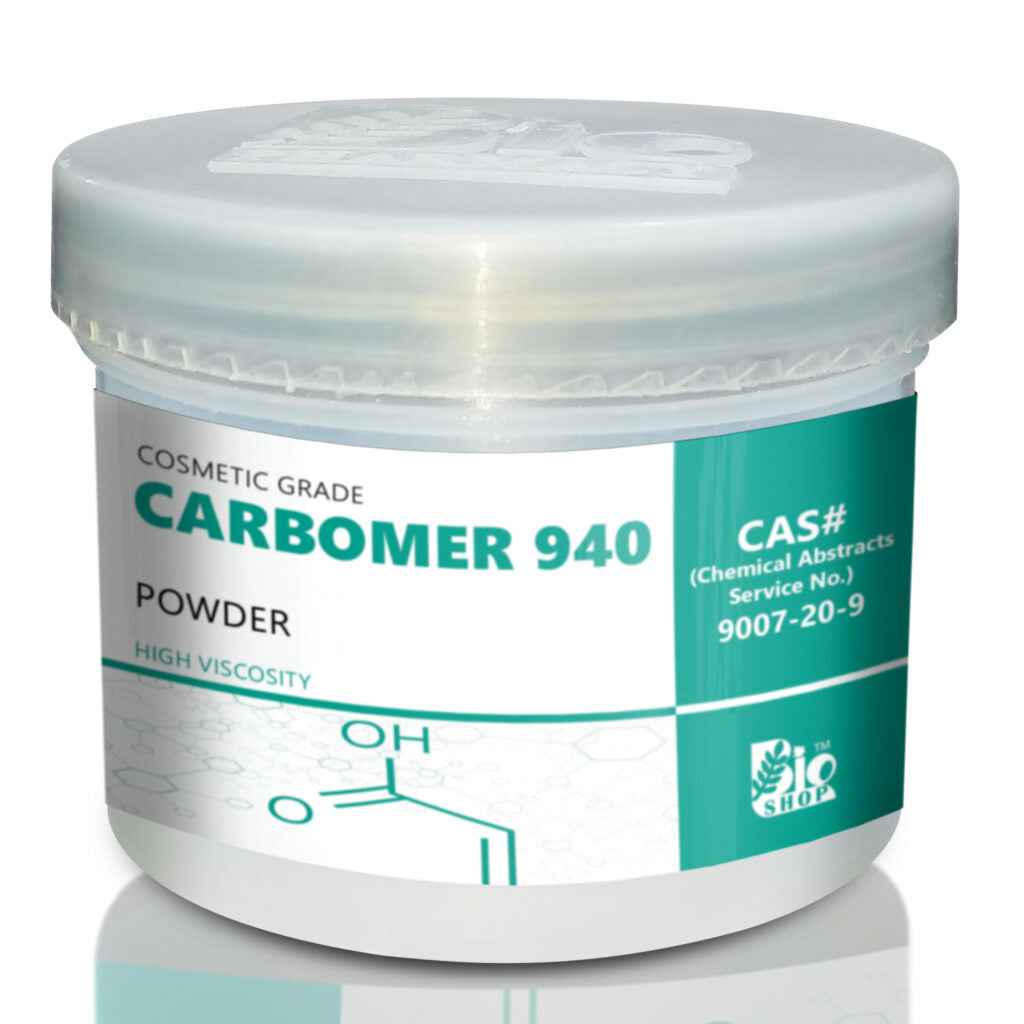
Carbomer 940 Powder
Carbomer 940 Powder
Key Functions: Thickens gels, stabilizes emulsions, suspends actives, and controls viscosity.
Couldn't load pickup availability
Explore
Information About Carbomer 940 Powder
✅ Key Features
✦ Forms crystal-clear, high-viscosity gels at use levels as low as 0.1%, making it the industry standard for transparent serums and face gels.
✦ Neutralization-activated system — requires sodium hydroxide, triethanolamine, or AMP-95 to build full gel structure and reach working viscosity.
✦ Exceptional suspension ability for insoluble actives, pigments, zinc oxide, and particulates in aqueous cosmetic bases.
✦ Effective rheology modifier and emulsion stabilizer for both rinse-off and leave-on oil-in-water formulations.
✦ Compatible with a wide range of humectants, water-soluble actives, and non-ionic emulsifiers in water-based systems.
✦ Synthetic, vegan, and free from animal-derived ingredients.
✦ Cosmetic-grade powder with consistent crosslink density and molecular weight for reliable, batch-to-batch repeatable results.
🔬 Description
Carbomer 940 is a synthetic, high-molecular-weight crosslinked polyacrylic acid polymer first commercialized by B.F. Goodrich, now Lubrizol, under the Carbopol trade name. It has been a cornerstone of cosmetic and pharmaceutical formulation for over six decades, prized for its ability to transform water into structured, stable, and aesthetically elegant gels. The ingredient is produced from acrylic acid monomer crosslinked with allyl sucrose or allyl pentaerythritol, giving it its characteristic swelling and gel-forming behavior upon neutralization.
What sets Carbomer 940 apart from other rheology modifiers is its ability to produce water-white, optically clear gels with exceptional texture at extremely low concentrations. When the powder is dispersed in water and neutralized with an alkali, the polymer chains uncoil and swell dramatically, building viscosity rapidly and consistently. This mechanism delivers a clean, non-tacky gel skin feel that carries actives effectively into the skin without occlusion or heaviness.
Bio Shop Pakistan supplies cosmetic-grade Carbomer 940 Powder suitable for DIY formulators, professional cosmetic chemists, skincare brand developers, and home beauty crafters.
📊 Technical Data
INCI Name : Carbomer
Chemical Name : Polyacrylic acid, crosslinked
CAS Number : 9003-01-4
Molecular Formula : (C3H4O2)n (crosslinked polymer; no fixed molecular formula)
Appearance : White, fluffy, hygroscopic fine powder
Odor : Slight characteristic odor; essentially odorless in use
pH (1% solution) : 2.5–3.5 (unneutralized dispersion); 6.0–7.5 when fully neutralized
Solubility : Dispersible in water; insoluble in most organic solvents
Specific Gravity : ~1.41 (bulk density approx. 208 g/L)
Flash Point : Not applicable (solid powder)
HLB Value : Not Applicable
Recommended Use Level : 0.1% to 1.5%
Type : Synthetic crosslinked polymer / Rheology modifier / Gelling agent
Shelf Life : 2 years from date of manufacture when stored correctly
🧪 Recommended Usage
Skincare (Creams, Serums, Lotions) ★★★★★
Carbomer 940 is the industry benchmark for transparent face serums, hydrating gels, and lightweight gel-cream emulsions. Use at 0.2–0.8% for stand-alone gels and 0.1–0.4% in lotions for added viscosity and emulsion stability.
Haircare (Shampoo, Conditioner, Masks) ★★★☆☆
Carbomer can provide body in low-surfactant conditioning systems but is highly sensitive to ionic surfactants and electrolytes found in most shampoo bases. Test thoroughly for gel collapse before committing to any haircare formulation.
Soap Making (Cold Process, Melt and Pour) ★☆☆☆☆
Carbomer 940 is entirely unsuitable for cold process or melt and pour soap environments due to the extreme alkaline pH of saponification. It will not function and is not recommended for any soap-making application.
Body Care (Scrubs, Butters, Balms) ★★★☆☆
Well-suited for aloe-based body gels, lightweight body lotions, and gel-format body butters where a clean, non-greasy texture is desired. Avoid use in anhydrous balms or oil-based formulations as carbomer requires a water phase to activate.
Functional Cosmetics (Deodorants, Sunscreen, Baby Care) ★★★★☆
Widely used in gel-based sunscreens for zinc oxide suspension and in roll-on deodorant gels for its thickening reliability. In baby care applications, ensure complete neutralization and confirm final product pH is within 5.5–7.0 before use.
💡 Pro Tip
In my formulation practice, Carbomer 940 is my first choice whenever a client needs a crystal-clear serum base or a structured gel with a refined skin feel. The most critical skill when working with this ingredient is the dispersion step. I never add the powder to water all at once or into hot liquid. Instead, I sift it slowly onto the surface of cold or room-temperature water while stirring at low speed, then walk away and let it hydrate undisturbed for at least twenty to thirty minutes. This patience alone separates professional-grade gels from the lumpy, aerated failures that beginners often encounter. Neutralization always comes last, added as a diluted solution, never concentrated — and never in a rush.
ADVANCED TIP: For zero-lump, maximum-clarity gels, pre-disperse Carbomer 940 powder into glycerin first at a ratio of 1 part carbomer to 5 parts glycerin, mixing thoroughly to wet every particle before any water contact. Add this slurry to water slowly with gentle stirring. Neutralize using a 10–20% sodium hydroxide solution added dropwise, targeting a final pH of 6.5–7.0. This glycerin pre-dispersion method prevents agglomeration completely and produces cleaner, more transparent gels without high-shear mixing equipment.
👩🔬 Skin Type Suitability
Normal Skin : ★★★★★ — Performs excellently as a lightweight, clean gel base with no residue or heaviness on balanced skin.
Dry Skin : ★★★★☆ — Effective for dry skin when paired with humectants like glycerin or sodium hyaluronate to deliver moisture alongside gel texture.
Oily Skin : ★★★★★ — Ideal for oil-free, mattifying gel formulations that hydrate without adding shine or blocking pores.
Combination : ★★★★☆ — Gel textures manage the oily T-zone effectively while lightweight hydration serves drier facial areas simultaneously.
Sensitive Skin : ★★★☆☆ — Generally well-tolerated but requires complete neutralization; residual acrylic acid monomer in improperly neutralized gels can cause irritation.
Mature Skin : ★★★☆☆ — Provides excellent texture and active delivery but lacks the emollient richness mature skin needs; best combined with peptides or nourishing esters.
Acne-Prone : ★★★★★ — Non-comedogenic, feather-light, and highly compatible with acne-targeting actives such as niacinamide, salicylic acid, and azelaic acid.
🧴 Formulation Ideas
CONCEPT 1: Hyaluronic Acid Hydra-Gel Serum
Usage Level : 0.5%
Key Ingredients: Sodium Hyaluronate (1%), Niacinamide (5%), Panthenol (2%), AMP-95 (neutralizer to pH 6.8)
Result : A water-clear, lightweight gel serum that delivers layered hydration and skin-brightening actives with a fast-absorbing, non-sticky finish.
CONCEPT 2: Aloe Vera Soothing Face Gel
Usage Level : 0.8%
Key Ingredients: Aloe Vera Juice (80%), Allantoin (0.5%), Cucumber Extract (2%), Sodium Hydroxide Solution (neutralizer to pH 6.5)
Result : A cooling, translucent gel that calms irritated, sunburned, or acne-prone skin with a refreshing skin feel and zero greasiness.
CONCEPT 3: Gel-Based Invisible Sunscreen Base
Usage Level : 0.4%
Key Ingredients: Micronized Zinc Oxide (10%), Glycerin (3%), Dimethicone (1%), Triethanolamine (neutralizer to pH 7.0)
Result : A suspended zinc oxide gel sunscreen that applies sheer, sets matte, and provides broad-spectrum UV protection without white cast or tackiness.
💧 Safety and Regulatory:
INCI Declared : Yes — mandatory declaration on all finished cosmetic products
EU Cosmetics Reg : Permitted — no Annex restriction; used freely at normal cosmetic concentrations
Rinse-Off Limit : No established regulatory limit; typical use 0.1–1.5%
Leave-On Limit : No established regulatory limit; typical use 0.1–1.0%
Allergen Alert : No — not a listed cosmetic allergen; rare irritation possible from improperly neutralized product
Skin Safety : Safe at recommended levels when correctly neutralized to pH 5.5–7.5
Eye Area Use : Use with caution — avoid high concentrations in the immediate eye contour zone
Ingestion : Not for internal use
Pregnancy Use : Generally considered safe for topical use; consult physician for specific formulations
Child Safety : Safe for topical use in children above 3 years when correctly formulated and neutralized
Ventilation : Recommended — fine powder inhalation must be avoided during all handling and weighing
Storage : Cool, dry place away from moisture and humidity; seal container tightly after each use
Container : HDPE or glass — avoid prolonged exposure to moisture; do not store in open or unsealed packaging
⚠️ Warning: Carbomer 940 is a fine particle dust — always wear a dust mask or N95 respirator when weighing or handling the raw powder to prevent inhalation. Un-neutralized carbomer dispersions are highly acidic at pH 2.5–3.5 and will cause skin irritation if used without full neutralization. Never introduce high-salt electrolytes, cationic polymers, or strong acids directly into a carbomer gel — these cause irreversible gel collapse that cannot be corrected by further neutralization.
Stability and Compatibility
Working pH Range : 5.0–9.0 (optimal gel performance and maximum viscosity at pH 6.0–8.0)
Heat Stability : Stable up to 80°C; avoid prolonged processing above 80°C as sustained heat degrades gel network integrity
Freeze-Thaw Stable : No — freeze-thaw cycling disrupts the polymer gel structure; not suitable for products stored below 0°C
Emulsion Type : O/W — functions as thickener, rheology modifier, and stabilizer in oil-in-water emulsions
Emulsification Phase: Cold or warm aqueous phase — disperse and hydrate before heating; always neutralize last
Compatible With : Glycerin, sodium hyaluronate, panthenol, non-ionic emulsifiers, water-soluble silicones, allantoin, and most water-soluble actives
Incompatible With : High electrolyte concentrations (NaCl, KCl, MgSO4), cationic polymers (polyquaterniums, chitosan), strong oxidizers, ethanol above 20%, and prolonged low-pH environments
Oxidation Risk : Low — carbomer is a chemically stable polymer with no significant oxidation concern under normal storage
Discoloration Risk : Possible — mild yellowing can occur with prolonged UV exposure or in formulations containing certain amines; use opaque, UV-protected packaging for finished products
Formulation Notes : Always sift carbomer powder slowly onto the water surface with gentle, low-shear mixing to prevent aeration and lump formation. Add neutralizer only after full hydration is confirmed; localized over-neutralization creates irreversible gel irregularities.
❓ FAQs
Q: How do I activate Carbomer 940 and turn it into a gel?
A: Disperse the powder slowly into cold or room-temperature water with gentle stirring and allow it to hydrate undisturbed for 20–30 minutes. Once fully hydrated, neutralize by adding a diluted 10–20% sodium hydroxide solution or triethanolamine dropwise with slow stirring until the gel forms and reaches a final pH of 6.5–7.5.
Q: What is the difference between Carbomer 940 and Carbomer 980?
A: Carbomer 940 produces very high-clarity, medium-to-high viscosity gels and is the standard choice for transparent gel formulations. Carbomer 980 is manufactured via a co-solvent-free process making it preferable in clean-label or solvent-sensitive applications, though both grades deliver similar aesthetic performance in finished products.
Q: Can Carbomer 940 be used in alcohol-based hand sanitizer gels?
A: Yes, but the gel network weakens significantly when ethanol exceeds 20%. Build the carbomer gel in water first, reach full viscosity, then incorporate the alcohol phase slowly with gentle stirring to preserve gel structure — this sequence produces a far more stable and aesthetically acceptable hand gel than adding carbomer directly to alcohol.
Q: Why did my carbomer gel suddenly turn thin and watery after I added an ingredient?
A: Gel collapse is almost always caused by electrolytes, cationic compounds, or a sharp pH drop. Even trace amounts of sodium chloride, a cationic polymer such as Polyquaternium-7, or an acidic ingredient like vitamin C powder can irreversibly destroy the carbomer network. Screen every new ingredient for ionic character and pH impact before adding it to a carbomer base.
Q: How does Carbomer 940 compare to natural alternatives like Xanthan Gum or Hydroxyethylcellulose?
A: Carbomer 940 builds far clearer and more structured gels at lower use levels than xanthan gum, which tends to produce slightly cloudy, stringy textures, and requires less material than hydroxyethylcellulose to achieve equivalent viscosity. Natural alternatives offer better salt tolerance and clean-label positioning but cannot match carbomer's optical clarity or gel elegance, making carbomer 940 the benchmark for high-performance transparent cosmetic gels.
Where Can You Safely Use Carbomer 940 Powder
Discover how Carbomer 940 Powder performs across different products — rated for safety, stability, and effectiveness.
Good quality product working very well in my DIY projects


