Bio Shop
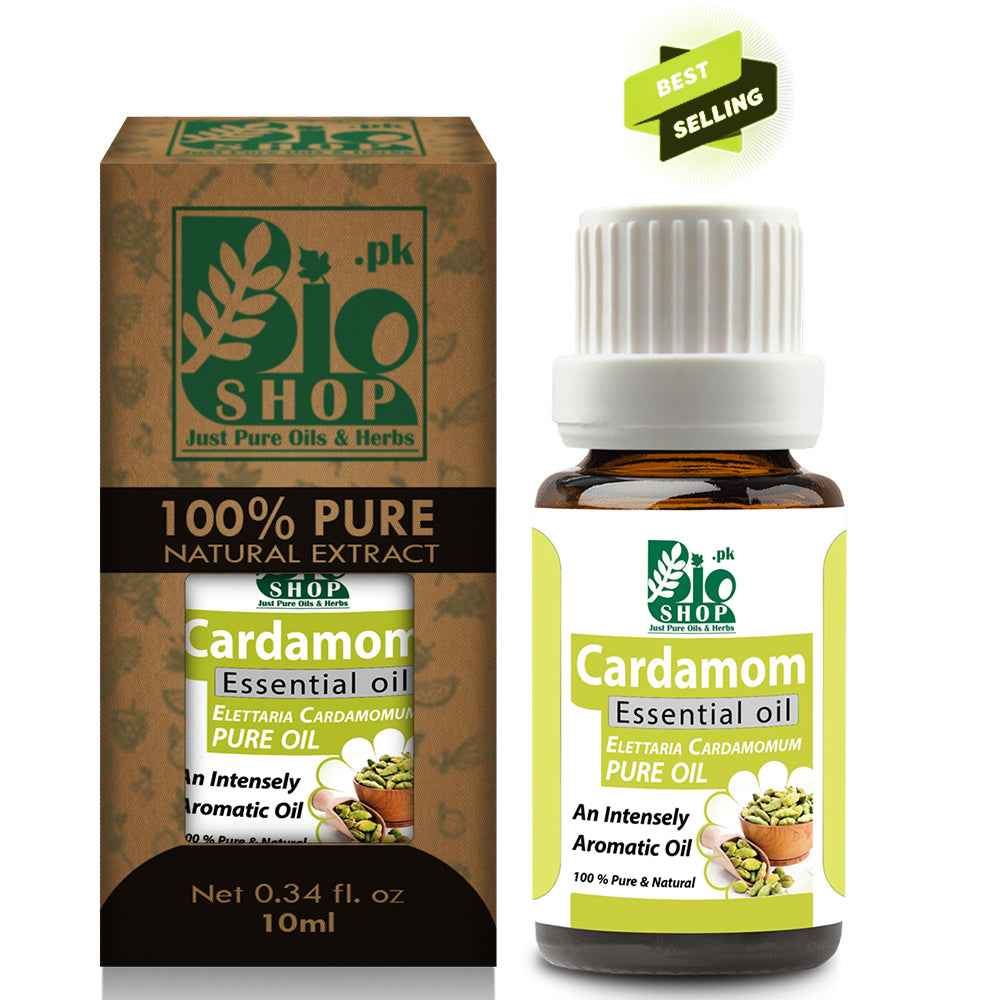
Cardamom Essential Oil
Cardamom Essential Oil
Olfactory Notes: Cool, spicy, and slightly balsamic; a very elegant perfume spice.
Couldn't load pickup availability
Explore
Information About Cardamom Essential Oil
Key Features
✦ Steam-distilled from the dried seeds of Elettaria cardamomum — one of the world's oldest and most prized spice botanicals
✦ Warm, spicy, sweet, and slightly camphoraceous scent profile with fresh green top facets and soft balsamic depth
✦ Rich in alpha-terpinyl acetate (up to 40%) and 1,8-cineole — responsible for its characteristic spicy-fresh complexity
✦ Essential building block for oriental, gourmand, and attar compositions — used in countless signature fragrances globally
✦ Blends seamlessly with rose, oud, sandalwood, citrus, and amber bases — extremely versatile in natural perfumery
✦ Suitable for fine fragrance, candles, incense, personal care, and home fragrance applications at appropriate usage rates
✦ 100% natural, vegan, and cruelty-free — no synthetic additives, no animal-derived ingredients
About Cardamom Essential Oil
Cardamom Essential Oil is derived from the seed pods of Elettaria cardamomum, a member of the ginger family (Zingiberaceae) cultivated across South Asia, Central America, and parts of Africa. Known as the Queen of Spices, cardamom has been prized for over 4,000 years — used in Ayurvedic medicine, ancient trade routes, and culinary traditions stretching from the Indian subcontinent to the Middle East and Scandinavia. The essential oil is obtained through steam distillation of the dried, crushed seeds, preserving the full aromatic complexity that makes it so highly regarded in both food and fragrance industries.
What sets cardamom oil apart from other spice oils is its remarkable balance of contrasts. It is simultaneously warm and fresh, spicy and sweet, dense and airy. This duality arises from its complex chemical composition — alpha-terpinyl acetate delivers a fresh, slightly floral spice character, while 1,8-cineole adds a cool, camphoraceous lift. Together they create an oil that functions both as a bold character note and a sophisticated supporting material, capable of lifting heavy resinous bases while grounding citrus-forward compositions. It is one of the few naturals that performs convincingly in every fragrance family from fougère to oud.
Bio Shop Pakistan supplies cosmetic-grade Cardamom Essential Oil suitable for DIY perfumers, attar blenders, candle makers, soap formulators, and independent beauty brands seeking authentic, high-quality spice-derived aromatic ingredients.
Olfactory Profile
SCENT DESCRIPTION : Cardamom Essential Oil opens with a bright, peppery-green freshness that quickly reveals its characteristic warm spice heart — sweet, camphoraceous, and slightly eucalyptus-like. There is a soft floral undertone threading through the middle, reminiscent of distant roses and fresh herbs, before the oil dries down to a warm, slightly balsamic, woody-spicy base. The overall impression is one of elegant complexity — familiar yet exotic, grounded yet uplifting.
NOTE POSITION : Top-Mid
FRAGRANCE FAMILY : Oriental Spicy / Aromatic Spicy / Gourmand
FACETS : Warm Spice · Sweet Green · Camphoraceous · Balsamic · Floral Spice
TENACITY : Medium — 4 to 6 hours on skin, longer on fabric and diffuser substrate
SILLAGE : Medium — projects cleanly in the top and middle stages, intimate in the dry-down
Technical Specifications
Chemical Name : Elettaria cardamomum seed oil
CAS Number : 8000-66-6
Synonyms : Cardamom Seed Oil · Cardamon Oil · Green Cardamom Oil · Elaichi Oil
Purity : 100% pure, undiluted (verify GC/MS certificate with supplier)
Appearance : Clear to pale yellow mobile liquid
Odor Threshold : Approximately 10–50 ppb (highly detectable at low concentrations)
Solubility : Soluble in alcohol and fixed oils; insoluble in water
Specific Gravity : 0.917–0.947 at 20°C (verify with supplier CoA)
Flash Point : Approximately 54–60°C — verify with supplier CoA
Type : Natural (steam-distilled from botanical seed material)
Applications & Usage Guidelines
FINE FRAGRANCE : ★★★★★
Cardamom essential oil is a prized ingredient in fine fragrance — from mainstream orientals to niche spice compositions. It functions as both a featured top-mid note and a supporting modifier for heavier bases. Its ability to add freshness and warmth simultaneously makes it invaluable across EDPs, EDTs, and solid perfumes.
ATTAR & ORIENTAL BLENDING : ★★★★★
Cardamom is deeply embedded in the tradition of attar and oriental perfumery, where it pairs naturally with oud, rose, sandalwood, and musks. It gives traditional compositions a bright, lifted quality that prevents heaviness. It is an essential material for any serious attar blender working with South Asian or Middle Eastern fragrance traditions.
FUNCTIONAL FRAGRANCE : ★★★★☆
Suitable for scenting body washes, shampoos, lotions, and personal care products at appropriate dilution. Its aromatic freshness works well in men's grooming products and spa-inspired formulations. Ensure dilution is within IFRA guidelines for rinse-off and leave-on categories.
CANDLE & HOME FRAGRANCE : ★★★★★
Cardamom performs excellently in candles, reed diffusers, and room sprays. It diffuses cleanly, filling a space with a warm, inviting spice aroma without being overwhelming. Combines beautifully with vanilla, cedar, and citrus for sophisticated home fragrance blends.
INCENSE & BAKHOOR : ★★★★★
One of the classic incense materials used across Middle Eastern, South Asian, and East Asian traditions. Cardamom oil enriches bakhoor, dhoop, and loose incense blends with its warm, sacred, and aromatic character — deeply familiar in Pakistani and regional incense culture.
IFRA & Usage Rate
RECOMMENDED USAGE RATES
Application : Suggested Usage Rate
EDP (Eau de Parfum) : 1.0% – 3.0%
EDT (Eau de Toilette) : 0.5% – 2.0%
Body Lotion/Cream : 0.5% – 1.5%
Shampoo/Body Wash : 0.5% – 1.0%
Candle : 3.0% – 8.0%
Reed Diffuser : 5.0% – 15.0%
Soap (tablet) : 1.0% – 2.5%
IFRA 51ST AMENDMENT GUIDANCE
Cardamom Essential Oil (Elettaria cardamomum, seed) is not subject to a specific IFRA prohibition. However, as a natural complex substance, individual components — including limonene — are subject to oxidation-related sensitization concerns. IFRA recommends adherence to general QRA (Quantitative Risk Assessment) principles for leave-on applications.
⚠️ Cardamom oil contains limonene and linalool — both listed EU cosmetic allergens. At concentrations above 0.01% (leave-on) and 0.10% (rinse-off) in the finished product, these components require declaration on EU-sold cosmetic labels.
⚠️ Always confirm current IFRA status at ifrafragrance.org before commercial formulation.
⚠️ Use fresh, properly stored oil — oxidized cardamom oil has higher sensitization potential. Include antioxidants (e.g., tocopherol) in leave-on products.
Blending Guide
USAGE METHOD 1 — DIRECT ADDITION TO ALCOHOL BASE
Add cardamom essential oil directly to perfumers alcohol at the desired concentration. Allow the blend to macerate for a minimum of 48 hours before evaluation. Cardamom evolves considerably during maturation — the green harshness of fresh addition softens to a rounder, warmer character over 1 to 2 weeks.
USAGE METHOD 2 — PRE-BLEND WITH CARRIER OIL FOR ATTAR USE
For traditional attar work, dissolve cardamom essential oil into sandalwood, jojoba, or fractionated coconut oil at a 5–15% concentration before blending into the full attar formula. This softens its initial sharpness and improves fixation on skin.
USAGE METHOD 3 — CANDLE AND DIFFUSER BLENDING
Combine with a vanilla-amber or cedarwood base in your fragrance oil premix before adding to wax or diffuser base. Start at 5% and evaluate hot and cold throw before scaling up. Cardamom diffuses strongly — use conservatively in enclosed spaces.
BEST PAIRINGS
Rose Absolute/Otto → Elevates to a classic Eastern floral-spice accord
Oud (Natural/Synthetic) → Deepens into rich bakhoor and oriental territory
Bergamot/Lemon → Creates a bright, aromatic citrus-spice accord
Sandalwood → Produces a smooth, creamy spiced woody base
Vetiver → Adds earthy depth to warm spice compositions
Vanilla/Benzoin → Drives into warm gourmand oriental territory
Frankincense/Olibanum → Builds a sacred, resinous incense accord
Black Pepper EO → Sharpens into an invigorating dry spice profile
Lavender → Balances into an aromatic fougère-spice character
AVOID
✦ Avoid blending with very fresh green or aquatic materials as a primary accord — the warm spice character can clash with watery ozonic notes
✦ Avoid overuse in leave-on formulations — above 2–3% it can become medicinal and overpowering on skin
Perfumer's Note
ardamom is one of those rare naturals I reach for when a composition needs both warmth and lift at the same time. Most spice oils give you one or the other — black pepper punches up without warmth, clove warms without freshness — but cardamom does both simultaneously. The 1,8-cineole lifts the opening and gives it that distinctive cool brightness, while the terpinyl acetate provides the rounded, sweet spice depth underneath. In attar work, I find it indispensable for bringing traditional heavy bases — particularly heavy oud and musk combinations — back to life without destroying their Oriental character.
ADVANCED TIP : When building a cardamom-forward oriental, try blending cardamom EO with a small amount of ethyl maltol (0.1–0.2% of total formula) before adding your heavier base notes. The ethyl maltol acts as a sweetness amplifier and softens the camphoraceous edge of the cineole, making the cardamom read as warmer and richer. This trick works especially well in bakhoor-inspired perfume oils and candle blends where you want a glowing, food-warm impression without adding vanilla's heaviness directly.
Safety & Storage
Physical State : Clear to pale yellow mobile liquid at room temperature
Skin Safety : Dilute properly before skin contact. Do not apply undiluted (neat) to skin. Perform patch test before use in leave-on cosmetics.
Eye Contact : Avoid contact with eyes. If contact occurs, flush with clean water for 15 minutes and seek medical attention.
Ingestion : Not for internal consumption. Keep out of reach of children.
Ventilation : Use in well-ventilated areas. Avoid prolonged inhalation of undiluted vapour.
Storage : Store in a sealed, airtight container away from direct sunlight, heat, and moisture. Ideal storage temperature: 10°C–25°C.
Shelf Life : 12–24 months from date of manufacture if stored correctly. Oxidation reduces shelf life — add 0.1% tocopherol (Vitamin E) to extend stability.
Container : Store in dark glass (amber or cobalt) or HDPE containers. Avoid prolonged storage in clear plastic.
Flammability : Combustible liquid. Flash point approximately 54–60°C. Keep away from open flame and ignition sources.
FAQ
Q: Can I use Cardamom Essential Oil directly on my skin?
A: No — never apply undiluted essential oil directly to skin. Always dilute to 0.5–2% in a carrier oil or lotion base before skin application. Undiluted use can cause irritation or sensitization.
Q: How does Cardamom Essential Oil smell in a finished perfume versus on its own?
A: On its own it smells sharp, camphorous, and strongly spicy. In a finished blend it softens considerably and reads as warm, sweet, and sophisticated. Always evaluate it blended — never judge cardamom oil from the neat bottle.
Q: Is this oil suitable for candle making?
A: Yes, cardamom performs very well in candles. Use between 3–8% in your fragrance load. It diffuses cleanly on both hot and cold throw and pairs beautifully with vanilla, cedar, and amber bases.
Q: Does Cardamom Essential Oil need to be declared as an allergen in cosmetic products?
A: It contains limonene and linalool, which are EU-listed allergens. If either component exceeds 0.01% (leave-on) or 0.10% (rinse-off) in the finished product, declaration is required for EU market compliance. Check your GC/MS report for individual component percentages.
Q: How does natural Cardamom Essential Oil compare to synthetic cardamom aroma chemicals?
A: Natural cardamom EO offers full-spectrum complexity with dozens of naturally occurring aroma compounds — it has depth, variation, and authenticity that a single synthetic cannot fully replicate. Synthetics like terpinyl acetate or 1,8-cineole can capture one facet of cardamom but not the whole. For attar and fine fragrance, the natural oil is generally preferred. For functional fragrance and home fragrance where cost and consistency matter more, synthetic cardamom materials are often used.
Where Can You Safely Use Cardamom Essential Oil?
Discover how Cardamom Essential Oil performs across different applications—rated for safety, stability, and effectiveness.
Magnificent cardamom eo, probably from Guatemala. Very real and addictive.