Bio Shop
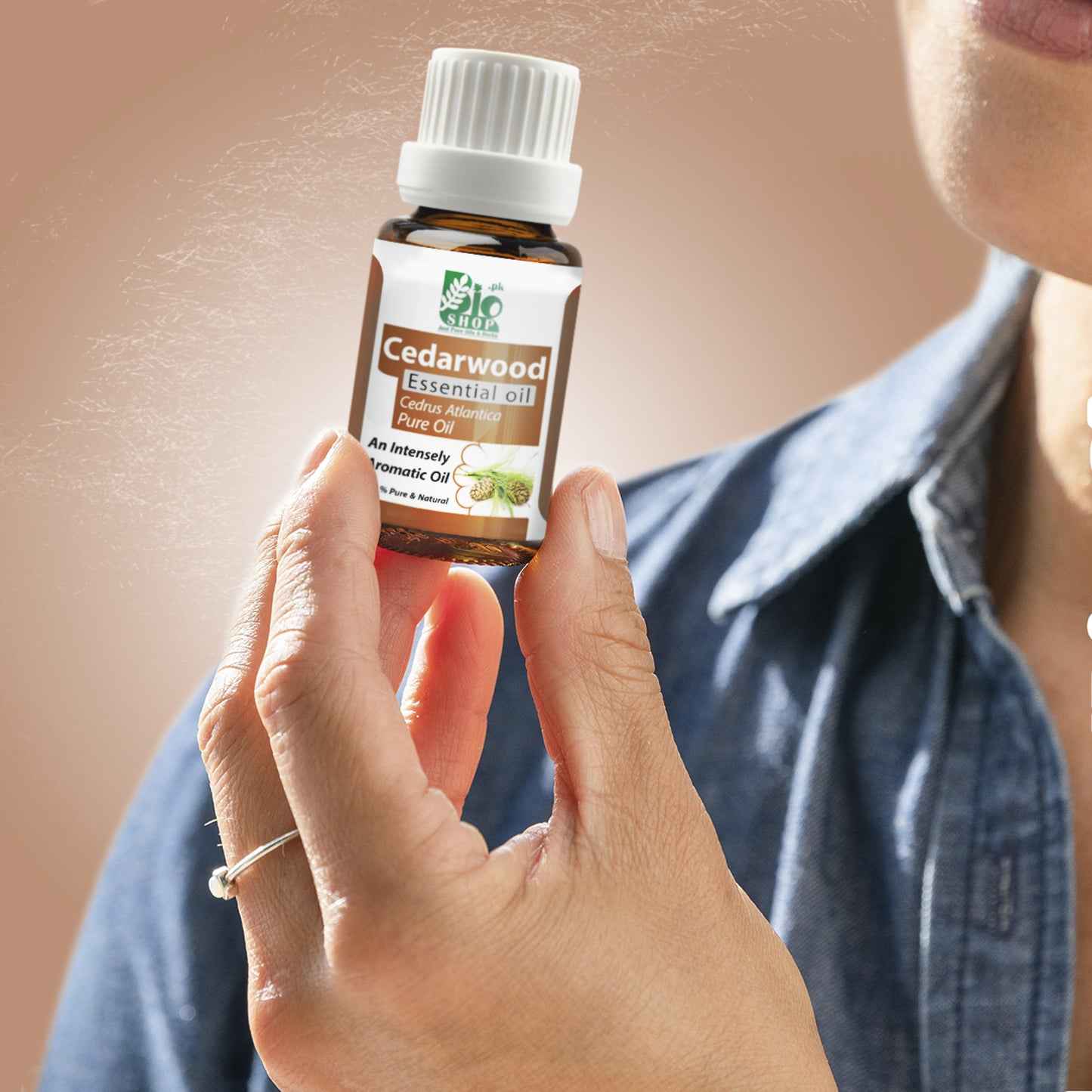
Cedarwood Essential Oil
Cedarwood Essential Oil
Olfactory Notes: Dry, pencil-shavings wood scent; fundamental for woody bases.
Couldn't load pickup availability


Explore
Information About Cedarwood Essential Oil
Key Features
✦ 100% pure Atlas Cedarwood Essential Oil (Cedrus atlantica) — no fillers, no carriers
✦ Warm, dry, balsamic woody base note with exceptional fixative and tenacity properties
✦ Rich in alpha-cedrene, beta-cedrene, and cedrol — the natural woody fixative alcohol
✦ Essential in oud attars, oriental mukhallats, fougeres, and masculine colognes
✦ Widely used in shampoos, scalp treatments, and hair care for purifying properties
✦ Outstanding performance in candles, reed diffusers, and incense — strong hot and cold throw
✦ Vegan, cruelty-free — steam-distilled from sustainably harvested Atlas Cedar heartwood
About Cedarwood Essential Oil
Cedarwood Essential Oil carries one of the longest histories of any aromatic material. The ancient Egyptians used it in embalming rituals, sacred incense, and cosmetic preparations thousands of years ago. The Atlas Cedar (Cedrus atlantica), native to the Atlas Mountains of Morocco and Algeria, produces one of the most highly regarded cedarwood oils in modern perfumery. Steam distillation of the heartwood and sawdust yields a pale yellow to amber viscous oil with a rich, dry, woody-balsamic character that has anchored fragrance compositions across cultures and centuries.
What sets Atlas Cedarwood apart from other cedarwood varieties is its sesquiterpene-rich composition — particularly its concentration of cedrol, a key fixative alcohol responsible for its exceptional longevity and diffusive woody warmth. Unlike Virginian Cedarwood (Juniperus virginiana), which leans sharper and more pencil-shaving in character, Atlas Cedarwood is smoother, rounder, and more balsamic — making it the preferred choice for fine fragrance and attar applications. Its natural fixative action means it does not merely contribute its own woody note but extends and deepens every other material built around it.
Bio Shop Pakistan supplies cosmetic-grade Atlas Cedarwood Essential Oil suitable for DIY perfumers, attar blenders, soap makers, candle crafters, and home fragrance formulators across Pakistan.
Olfactory Profile
SCENT DESCRIPTION : Atlas Cedarwood opens with a dry, resinous woody freshness before settling into a warm, balsamic heart with soft amber undertones. The drydown is smooth and slightly powdery-woody, anchored by the deep, quietly camphoraceous character of natural cedrol that lingers long on skin and fabric. It carries the unmistakable quality of ancient cedar forests — earthy, serene, and quietly majestic — with a clean, non-cloying quality that integrates seamlessly into almost any composition. There is a timelessness to this material that synthetic cedar accords can approximate but never fully replicate.
NOTE POSITION : Base (Mid-Base at elevated concentrations)
FRAGRANCE FAMILY : Woody · Oriental · Aromatic
FACETS : Dry Wood · Balsamic · Earthy · Amber-Tinged · Slightly Camphoraceous
TENACITY : Very High — detectable on skin 24–48 hours; on fabric and paper several days
SILLAGE : Medium — projects softly without overwhelming; functions as a structural foundation rather than a statement note
Technical Specifications
CHEMICAL NAME : Atlas Cedarwood Essential Oil (Cedrus atlantica wood oil)
CAS NUMBER : 92201-55-3
SYNONYMS : Atlas Cedar Oil · Moroccan Cedarwood Oil · Cedrus atlantica Wood Oil · Cedar Atlas Oil
PURITY : 100% pure essential oil (verify with supplier CoA)
APPEARANCE : Pale yellow to amber viscous liquid
ODOR THRESHOLD : Very low — perceptible at trace concentrations
SOLUBILITY : Soluble in alcohol and fixed oils; insoluble in water
SPECIFIC GRAVITY : 0.940 – 0.960 at 20°C (verify with supplier CoA)
FLASH POINT : Approximately 62°C – 68°C (verify with supplier CoA)
TYPE : Natural Essential Oil — steam-distilled from heartwood
Applications & Usage Guidelines
Fine Fragrance : ★★★★★
Atlas Cedarwood is a foundational base note in fine perfumery, providing structure, depth, and natural fixation to complex compositions. It anchors oriental, fougere, woody, and masculine blends and pairs effortlessly with musks, ambers, vetiver, and oud. Its presence in the base extends the life and depth of every note built above it.
Attar & Oriental Blending : ★★★★★
Cedarwood sits at the heart of South Asian attar tradition, forming the backbone of oud attars, sandalwood blends, and mukhallat compositions across Pakistan and the wider region. Its balsamic warmth bridges oud, rose, amber, and resinous materials into cohesive, long-lasting oriental structures. No serious attar blender's palette is complete without it.
Hair & Scalp Care : ★★★★☆
Atlas Cedarwood is widely incorporated into shampoos, scalp serums, and conditioners for its mild purifying, astringent, and circulation-stimulating properties. It contributes to sebum regulation and adds a clean, woody freshness to hair care products. Observe IFRA limits carefully for leave-on versus rinse-off formats.
Home Fragrance : ★★★★★
In candles, reed diffusers, and incense, Atlas Cedarwood delivers an exceptional woody-balsamic character with outstanding longevity and scent throw. It burns cleanly in soy, coconut, and paraffin wax systems and diffuses beautifully through reeds. One of the most dependable home fragrance base materials available.
Functional Fragrance & Soap : ★★★★☆
Cedarwood performs reliably in tablet soaps, body washes, and functional fragrances where its woody, clean character adds masculine or unisex appeal. Rinse-off applications offer more formulation flexibility; leave-on applications must be formulated within current IFRA limits for Cedrus atlantica.
IFRA & Usage Rate
RECOMMENDED USAGE RATES
APPLICATION : SUGGESTED RATE
EDP (Eau de Parfum) : 3.0 – 8.0%
EDT (Eau de Toilette) : 2.0 – 5.0%
Body Lotion / Cream : Up to 0.5% (IFRA restricted — verify current limit)
Shampoo / Body Wash : 0.5 – 1.0%
Tablet Soap : 0.5 – 1.0%
Candle : 6.0 – 10.0%
Reed Diffuser : 15.0 – 25.0%
IFRA 51ST AMENDMENT — CEDRUS ATLANTICA WOOD OIL
⚠️ Cedrus atlantica oil is a restricted ingredient under IFRA guidelines due to sensitization potential in leave-on applications. Limits are category-specific and must be verified at ifrafragrance.org before formulating.
IFRA CATEGORY : APPROXIMATE LIMIT
Leave-on skin (body lotion, cream) : Approx. 0.5% (verify)
Rinse-off body / hair (shampoo, gel) : Approx. 0.5% (verify)
Fine Fragrance (EDP / EDT) : Approx. 1.5 – 3.0% (verify current amendment)
Lip products : Very low limit — verify; generally not recommended
Children's products : Verify current IFRA limits before use
⚠️ Always confirm current limits directly at ifrafragrance.org — IFRA 51st Amendment limits for Cedrus atlantica are category-specific and supersede general estimates.
Blending Guide
USAGE METHOD 1 — DIRECT BASE ADDITION
Add Atlas Cedarwood directly to your fragrance blend during the base note stage. As a heavy, viscous base material with natural fixative action, it should be incorporated early in the blending sequence. Measure by weight for accuracy and allow the finished blend to macerate for 48–72 hours to fully integrate all notes.
USAGE METHOD 2 — PREDILUTION IN DPG OR IPM
For attar, roll-on, and functional fragrance work, predilute Cedarwood EO in dipropylene glycol (DPG) or isopropyl myristate (IPM) at 10–30% concentration for easier handling and more controlled dosing. This is particularly useful in body oil, roll-on attar, or lotion formulations where precise low-level dosing is required.
USAGE METHOD 3 — WAX BLENDING FOR CANDLES
Add Cedarwood EO to fully melted wax once the temperature has dropped to 65–70°C. Blend thoroughly before pouring into containers. Use fragrance load of 6–10% depending on wax type. Atlas Cedarwood performs well in soy, coconut, and paraffin wax systems and pairs naturally with other woody, oriental, or earthy candle fragrances.
BEST PAIRINGS
Sandalwood (EO or Sandalore) → Deepens creamy-woody character; the most natural pairing for Cedarwood
Oud / Agarwood → Builds a dark, resinous, smoky woody foundation
Vetiver → Adds earthy, smoky depth with exceptional base tenacity
Frankincense / Olibanum → Introduces resinous, incense-like spiritual depth
Rose Otto / Rose Absolute → Balances dry woodiness with soft floral femininity
Patchouli → Creates a rich, dark, complex earthy-woody base accord
ISO E Super → Amplifies and extends the diffusive, transparent cedar facet
Ambrette / Skin Musks → Lifts the woody note with skin-like warmth and diffusion
Bergamot / Lemon → Adds bright citrus contrast to open a cedar-forward composition
Labdanum / Amber Accord → Reinforces balsamic warmth and deepens oriental character
AVOID
Do not combine at high concentrations with other IFRA-restricted naturals (Peru Balsam, Oakmoss, Cinnamon Bark) in leave-on products — combined sensitization limits across multiple restricted materials can be exceeded even when each ingredient is within its individual limit.
Perfumer's Note
I have worked with Atlas Cedarwood for years and it remains one of those rare materials I reach for instinctively in nearly every oriental, fougere, or woody masculine build. What I find most compelling about it is not just its own character — that dry, warm, balsamic woodiness — but its ability to work invisibly within a composition. It supports, fixes, and extends the materials around it without demanding attention for itself. When you encounter a fragrance with remarkable depth and staying power that you cannot quite identify, there is a strong chance that cedarwood is somewhere in the base doing exactly that quiet, essential work.
ADVANCED TIP : Build a pre-made woody base accord by blending Atlas Cedarwood Essential Oil with ISO E Super in a 3:1 ratio (cedarwood to ISO E Super) before formulating. The ISO E Super dramatically amplifies the diffusive, transparent, airy cedar quality while the cedarwood grounds it with natural balsamic warmth and body. Use this accord at 8–12% of your total fragrance weight as the structural base, then build your heart and top notes above it. This two-ingredient woody foundation performs equally well in alcoholic perfume, reed diffuser, and candle formats — and it will give your compositions a depth that is difficult to achieve any other way.
Safety & Storage
PHYSICAL STATE : Viscous pale yellow to amber liquid
SKIN SAFETY : Potential skin sensitizer — always dilute; observe IFRA limits by category; patch test strongly advised
EYE CONTACT : Avoid direct contact; flush thoroughly with clean water if contact occurs; seek medical advice for persistent irritation
INGESTION : Not for internal use; keep out of reach of children
VENTILATION : Use in well-ventilated workspace; avoid prolonged inhalation of concentrated vapor
STORAGE : Sealed amber glass or aluminium container; away from heat, light, and moisture
SHELF LIFE : 2–3 years from production date when stored correctly; oxidation may alter profile over time
CONTAINER : Amber glass or aluminium preferred; avoid plastic for long-term storage
FLAMMABILITY : Combustible — flash point approximately 62–68°C; keep away from open flames and ignition sources during use
FAQ
Q: Can I use Atlas Cedarwood Essential Oil directly on skin?
A: No — never apply undiluted. Atlas Cedarwood is a potential sensitizer and must always be diluted before skin contact. Use only within IFRA-recommended limits for your specific application type and always perform a patch test before wider use.
Q: What is the difference between Atlas Cedarwood and Virginian Cedarwood?
A: Atlas Cedarwood (Cedrus atlantica) is warmer, more balsamic, and rounder — preferred in fine fragrance and attar work. Virginian Cedarwood (Juniperus virginiana) is sharper, drier, and more pencil-shaving in character. They come from different botanical families and have distinct scent profiles, though both serve as woody base notes.
Q: Can I use Atlas Cedarwood Essential Oil in candles?
A: Yes — it performs excellently in candles. Use at 6–10% fragrance load depending on your wax system. It provides strong hot and cold throw and pairs naturally with other woody, oriental, and earthy fragrance blends across soy, coconut, and paraffin wax formats.
Q: Is cedarwood essential oil safe for shampoos and hair care products?
A: Yes, at correctly formulated levels. Cedarwood is widely used in shampoos and scalp treatments. Use within IFRA guidelines for rinse-off hair products (approximately 0.5% of the finished formula) and verify current limits at ifrafragrance.org before production.
Q: How does Atlas Cedarwood Essential Oil compare to synthetic cedar materials like ISO E Super or Cedramber?
A: Atlas Cedarwood is a full-spectrum natural oil with dozens of constituents contributing warmth, earthiness, and balsamic complexity that no single synthetic can replicate. ISO E Super isolates and amplifies the transparent, diffusive cedar-woody quality. Cedramber adds a sweet amber-cedar facet. Blending the natural oil with these synthetics gives the richest result — natural roundness combined with synthetic lift and diffusion.
Where Can You Safely Use Cedarwood Essential Oil?
Discover how Cedarwood Essential Oil performs across different applications—rated for safety, stability, and effectiveness.
Best seller. Thanks bioshop.
Recommended
Eid se pehle family ke liye DIY attar set banaya. Cedarwood sandalwood aur rose blend kiya. Sab ne bohot tarif ki. Sab oils Bio Shop se li - quality pe koi complaint nahi. Agli Eid pe bhi yahi plan hai.
Sardiyon mein scalp bohot dry ho jaati thi. Cedarwood coconut oil mein dilute karke weekly lagana shuru kiya. Dryness aur flakiness both reduce hui. Oil quality acha hai. Fast delivery to Islamabad. Happy customer.
Smell rich aur warm hai. Dobara lunga.