


Bio Shop
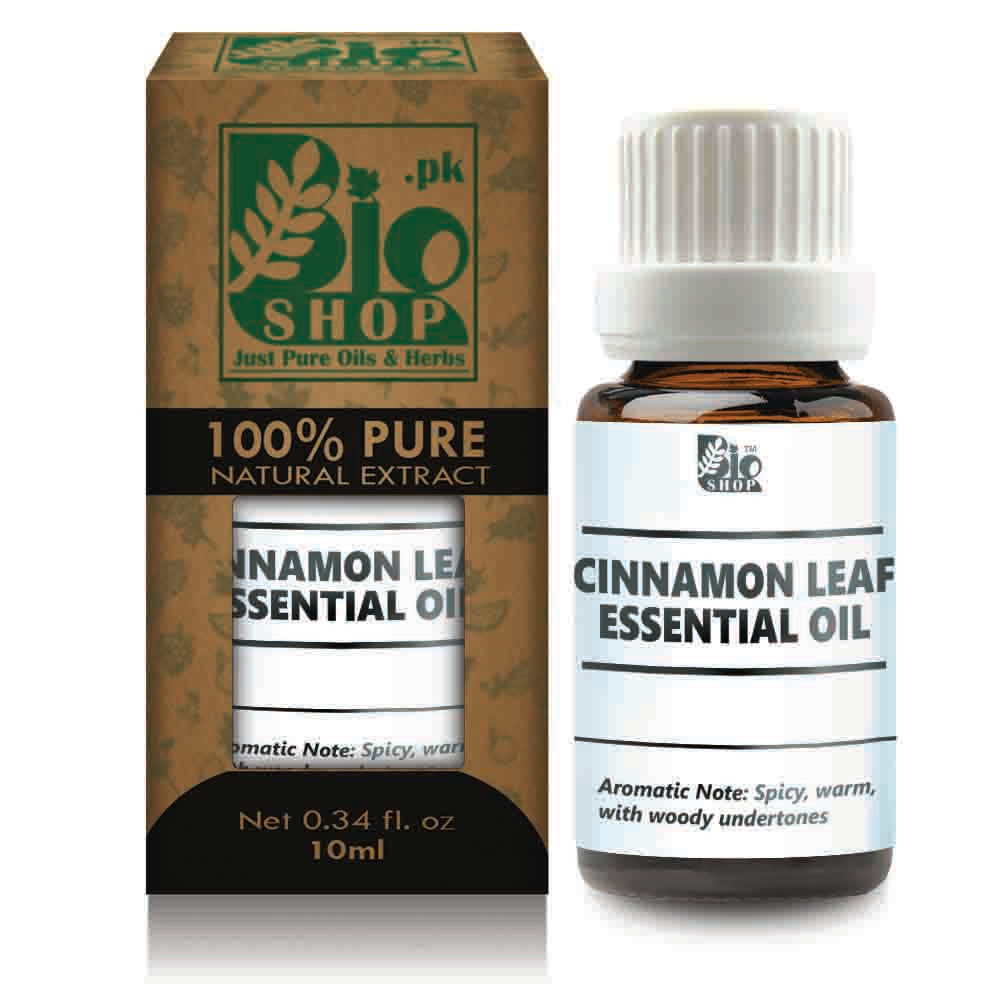
Cinnamon Leaf Essential Oil
Cinnamon Leaf Essential Oil
Olfactory Notes: Spicy and warm; smells more like Clove/Eugenol than the bark.
Couldn't load pickup availability
Explore
Information About Cinnamon Leaf Essential Oil
Key Features
✦ 100% natural steam-distilled essential oil from Cinnamomum verum leaves — not bark
✦ High eugenol content (70–90%) delivers a bold, warm, clove-spice character distinct from bark oil
✦ Core material in oriental, spice, and attar-style perfume construction
✦ Excellent performance in candles, reed diffusers, and incense with no IFRA usage ceiling
✦ EU-listed allergen (eugenol, cinnamal) — requires labeling compliance in leave-on cosmetics
✦ Vegan, cruelty-free, and palm-free — entirely plant-derived
✦ Versatile across non-skin-contact applications with strong, long-lasting olfactory impact
About Cinnamon Leaf Essential Oil
Cinnamon Leaf Essential Oil is derived through steam distillation of the leaves of Cinnamomum verum, the true Ceylon cinnamon tree native to Sri Lanka. Unlike cinnamon bark oil — which is prized for its sweet, aldehydic cinnamaldehyde character — the leaf oil is dominated by eugenol, giving it a clove-forward, spicy-medicinal warmth with a darker, drier tonality. Historically, cinnamon leaf oil has served as the more affordable and accessible counterpart to bark oil, used extensively across South Asian traditional medicine, Ayurvedic practice, and perfumery for centuries.
What sets cinnamon leaf oil apart is its dual identity as both a functional aromatic and a powerful spice note in perfumery. Its eugenol-dominant composition makes it highly tenacious on diffusion materials such as reeds, wax, and resins, where it unfolds slowly as a rich, warming heart note. It is a natural complement to oud, amber, clove, and patchouli in South Asian ittar traditions, and it contributes an authentic spice note to western oriental perfumery that no synthetic alone can fully replicate.
Bio Shop Pakistan supplies cosmetic-grade Cinnamon Leaf Essential Oil suitable for DIY perfumers, attar blenders, candle and incense makers, soap formulators, and functional fragrance developers seeking a reliable, high-eugenol spice material for their professional or hobby-scale compositions.
Olfactory Profile
SCENT DESCRIPTION : Cinnamon Leaf Essential Oil opens with a fierce, clove-like spice that is sharper and more medicinal than cinnamon bark. The mid-profile settles into a warm, woody-aromatic heart with subtle phenolic depth. Unlike the sweet, candied cinnamon note of the bark, the leaf oil carries a dry, slightly astringent quality that reads as raw spice rather than confection. On dry-down, it blends seamlessly into oriental bases, leaving behind a tenacious, resinous warmth that supports oud, amber, and musks with authority.
NOTE POSITION : Mid to Base
FRAGRANCE FAMILY : Oriental Spicy · Woody Aromatic · Herbal
FACETS : Spicy · Clove-Like · Warm · Phenolic · Woody
TENACITY : High — 6 to 10 hours on strip; longer on diffusion materials and wax
SILLAGE : Medium to High — radiates warm spice in a defined range; projects powerfully in diffusion applications
Technical Specifications
CHEMICAL NAME : Essential oil of Cinnamomum verum leaf (eugenol-rich fraction)
CAS NUMBER : 8015-91-6
SYNONYMS : Ceylon Cinnamon Leaf Oil · Cinnamomum zeylanicum Leaf Oil · Cinnamon Oil (Leaf Type)
PURITY : 100% pure essential oil — no carriers or diluents
APPEARANCE : Yellow to brownish-yellow mobile liquid
ODOR THRESHOLD : Extremely low — detectable at trace concentrations due to eugenol
SOLUBILITY : Soluble in alcohol and fixed oils; insoluble in water
SPECIFIC GRAVITY : 1.030 – 1.060 at 20°C (verify with supplier CoA)
FLASH POINT : Approximately 68°C (154°F) — verify with supplier CoA
TYPE : Natural — 100% steam-distilled plant-derived essential oil
Applications & Usage Guidelines
Fine Fragrance : ★★★☆☆
Cinnamon Leaf Oil is usable in fine fragrance but requires careful handling due to strict IFRA limits in leave-on categories. It contributes an authentic spice note in oriental, chypre-spice, and woody-amber accords. Dilute thoroughly before use and restrict total inclusion to IFRA-compliant percentages. Best deployed as a supporting spice note rather than a dominant accord.
Attar & Oriental Blending : ★★★★★
This is where Cinnamon Leaf Oil excels without restriction. In alcohol-free attar and mukhallat compositions applied directly to clothing, skin contact limitations are bypassed, allowing higher dosage and full olfactory expression. It is a traditional cornerstone of South Asian spice accords alongside clove, cardamom, and oud.
Functional Fragrance : ★★★★☆
Cinnamon Leaf Oil performs reliably in home care products such as floor cleaners, surface sprays, dish detergents, and laundry fragrances. Its spicy warmth is familiar and desirable in household scents, and its natural antimicrobial associations add perceived value to cleaning products.
Cosmetics : ★★☆☆☆
Skin application requires extreme caution. Eugenol and trace cinnamal are both potent sensitizers and EU-regulated allergens. Usage in leave-on cosmetics must stay well below 0.1% total formula concentration. Not recommended for face products, lip products, or children's formulations.
Home Fragrance : ★★★★★
Candles, reed diffusers, room sprays, and incense represent the ideal applications for Cinnamon Leaf Oil. With no IFRA ceiling in non-skin-contact categories, it can be used at full effect, delivering the warm, cozy spice aroma consumers associate with festive and oriental home scenting.
IFRA & Usage Rate
RECOMMENDED USAGE RATES
EDP / Eau de Parfum : 0.5 – 0.8% (IFRA limited — stay within permitted level)
EDT / Eau de Toilette : 0.3 – 0.5%
Body Lotion (Leave-On) : 0.05 – 0.07% maximum
Shampoo / Body Wash : 0.2 – 0.4% (rinse-off — higher tolerance)
Tablet Soap : 0.5 – 1.0% (rinse-off category)
Candle (Wax) : 3 – 8% (no IFRA ceiling — adjust for wax type)
Reed Diffuser : 8 – 20% in carrier (strong throw achievable)
IFRA 51ST AMENDMENT LIMITS (Cinnamomum zeylanicum Leaf Oil)
Category 4 (Fine Fragrance — EDP/EDT) : ~1.5% — verify at ifrafragrance.org
Category 5b (Body Lotion, Leave-On) : ~0.07% — verify at ifrafragrance.org
Category 7a (Rinse-Off Hair Products) : ~0.3% — verify at ifrafragrance.org
Category 9 (Rinse-Off Body Products) : ~0.3% — verify at ifrafragrance.org
Category 10a (Household/Cleaning) : ~1.5% — verify at ifrafragrance.org
Category 11a (Non-Skin-Contact) : No limit specified
Candles / Incense / Diffusers : No IFRA limit
⚠️ Cinnamon Leaf Oil is a Category B skin sensitizer under IFRA standards. Exceeding recommended levels significantly increases the risk of allergic contact dermatitis.
⚠️ Eugenol and cinnamal are both listed EU cosmetic allergens. Products containing these compounds above 0.001% (leave-on) and 0.01% (rinse-off) must declare them on the ingredient label in the EU market.
⚠️ Not recommended for lip products, eye-area formulations, or children's skincare.
⚠️ Always verify current IFRA limits at ifrafragrance.org before finalizing any formulation.
Blending Guide
METHOD 1 — PRE-DILUTION BEFORE BLENDING
Due to cinnamon leaf oil's intensity and sensitization risk, always pre-dilute to 10% in a carrier alcohol or DPG before adding to any formulation. This gives you better volumetric control and prevents accidental overdosing in small batches. A 10% dilution allows 10x more precise measurement without specialized scales.
METHOD 2 — BUILDING A SPICE ACCORD
Cinnamon Leaf Oil rarely works alone as a single spice note. Build a spice accord by combining it with clove bud (eugenol harmony), black pepper (adds lift and contrast), and cardamom (softens and adds green freshness). Use cinnamon leaf as the warmest and darkest of the three, anchoring the accord with body and resonance.
METHOD 3 — ATTAR BASE FIXATION
In non-alcoholic attar construction, use cinnamon leaf oil as a mid-base anchoring material. Macerate it into sandalwood or base jojoba oil for 48 hours before building the accord on top. This pre-infusion integrates the eugenol into the base material naturally and softens any sharp edges.
BEST PAIRINGS
Clove Bud EO or Eugenol → Deepens the eugenol accord; creates seamless clove-cinnamon fusion
Cardamom EO → Lightens and adds green-spicy lift to prevent the accord from being too heavy
Oud or Agarwood Base → Classic South Asian harmony; cinnamon leaf bridges the spice and resinous registers
Patchouli → Adds earthy depth and extends tenacity significantly
Orange Sweet EO → Provides contrast; citrus-spice combinations are accessible and crowd-pleasing
Frankincense / Olibanum → Resinous-spicy pairing with an incense character; excellent in home fragrance
Benzoin Resinoid → Adds sweetness and balsamic softness; rounds off phenolic sharpness
Vetiver → Smoky-earthy foundation that grounds the spice and adds elegant complexity
AVOID
✦ Avoid combining at high concentrations with other strong sensitizers such as clove bud EO at full strength — cumulative sensitization load becomes difficult to control
✦ Avoid directly in lip formulations or eye-area products
✦ Avoid in children's products and sensitive skin leave-on cosmetics without extreme dilution
Perfumer's Note
I consider Cinnamon Leaf Oil one of the most misunderstood naturals in the South Asian perfumer's toolkit. Most beginners reach for it expecting sweetness — the cinnamon of tea and baked goods — and are surprised by how dry, dark, and clove-dominant it actually smells neat. That initial shock is exactly where the magic lives. Once you understand that cinnamon leaf is essentially a natural eugenol source with woody context, not a confectionery material, you start placing it correctly: deep in the mid-base of oriental constructions, not at the surface. It is a structural spice, not a dessert note.
ADVANCED TIP : If your oriental or amber accord feels flat and unconvincing, cinnamon leaf oil at 0.1–0.3% in an EDP can provide what I call the spice hinge — the connective warmth that bridges your citrus-aromatic top and your resinous base without either dominating. Add it to your base blend before evaluating the full pyramid. The effect is subtle at first, but when you remove it from the formula, you will immediately notice a coldness and flatness in the heart that nothing else quite replaces. This is cinnamon leaf operating as a background harmonizer rather than a foreground spice, and it is one of the most valuable ways to deploy it in professional-grade compositions.
Safety & Storage
PHYSICAL STATE : Yellow to brownish-yellow mobile liquid with strong spicy odor
SKIN SAFETY : Skin sensitizer — dilute before any application; do not use undiluted on skin; IFRA limits apply
EYE CONTACT : Irritant — avoid eye contact; flush with water immediately if contact occurs
INGESTION : Not for internal consumption; keep away from children
VENTILATION : Use in a ventilated workspace; vapor may cause mild respiratory irritation at high concentrations
STORAGE : Store in a sealed amber glass or dark container away from heat and light; keep at 10–25°C
SHELF LIFE : 2–3 years if stored correctly; oxidation may increase sensitization risk over time
CONTAINER : Amber glass preferred; avoid plastic containers for long-term storage
FLAMMABILITY : Combustible — flash point approximately 68°C; keep away from open flame during candle making
FAQ
Q: What is the difference between Cinnamon Leaf Oil and Cinnamon Bark Oil?
A: Cinnamon Leaf Oil is dominated by eugenol (clove-like, phenolic, dry) while Bark Oil is dominated by cinnamaldehyde (sweeter, more classic cinnamon candy scent). Leaf oil is significantly more affordable and safer to use in fragrance applications than bark oil, which has even stricter IFRA limits.
Q: Can I use Cinnamon Leaf Oil directly on my skin?
A: No. It must be diluted to very low concentrations before skin contact. In leave-on products such as body lotion, IFRA limits it to approximately 0.07%. Using it undiluted on skin can cause chemical burns, irritation, and long-term sensitization.
Q: Is Cinnamon Leaf Oil safe to use in soy or paraffin candles?
A: Yes — candles and incense are among the best applications. There is no IFRA ceiling for non-skin-contact applications, and cinnamon leaf oil performs beautifully in wax at 3–8%, delivering strong, warm throw both cold and hot.
Q: Will Cinnamon Leaf Oil discolor my soap or lotion?
A: Yes, it can cause light yellow to brownish discoloration in finished products due to its eugenol content. In cold-process soap, acceleration of trace is also possible. Test in small batches first and adjust if color stability is a priority.
Q: How does Cinnamon Leaf Oil compare to synthetic eugenol?
A: Synthetic eugenol is a single isolated compound — clean, consistent, and easier to dose precisely. Cinnamon Leaf Oil is a full natural complex that includes eugenol alongside minor terpenes, cinnamaldehyde traces, and other co-constituents that give it a rounder, more naturalistic character. Synthetic eugenol is preferable when precision and regulatory control are priorities; cinnamon leaf oil is preferable when authenticity and natural complexity are the objective.
Where Can You Safely Use Cinnamon Leaf Essential Oil?
Discover how Cinnamon Leaf Essential Oil performs across different applications—rated for safety, stability, and effectiveness.


