


Bio Shop
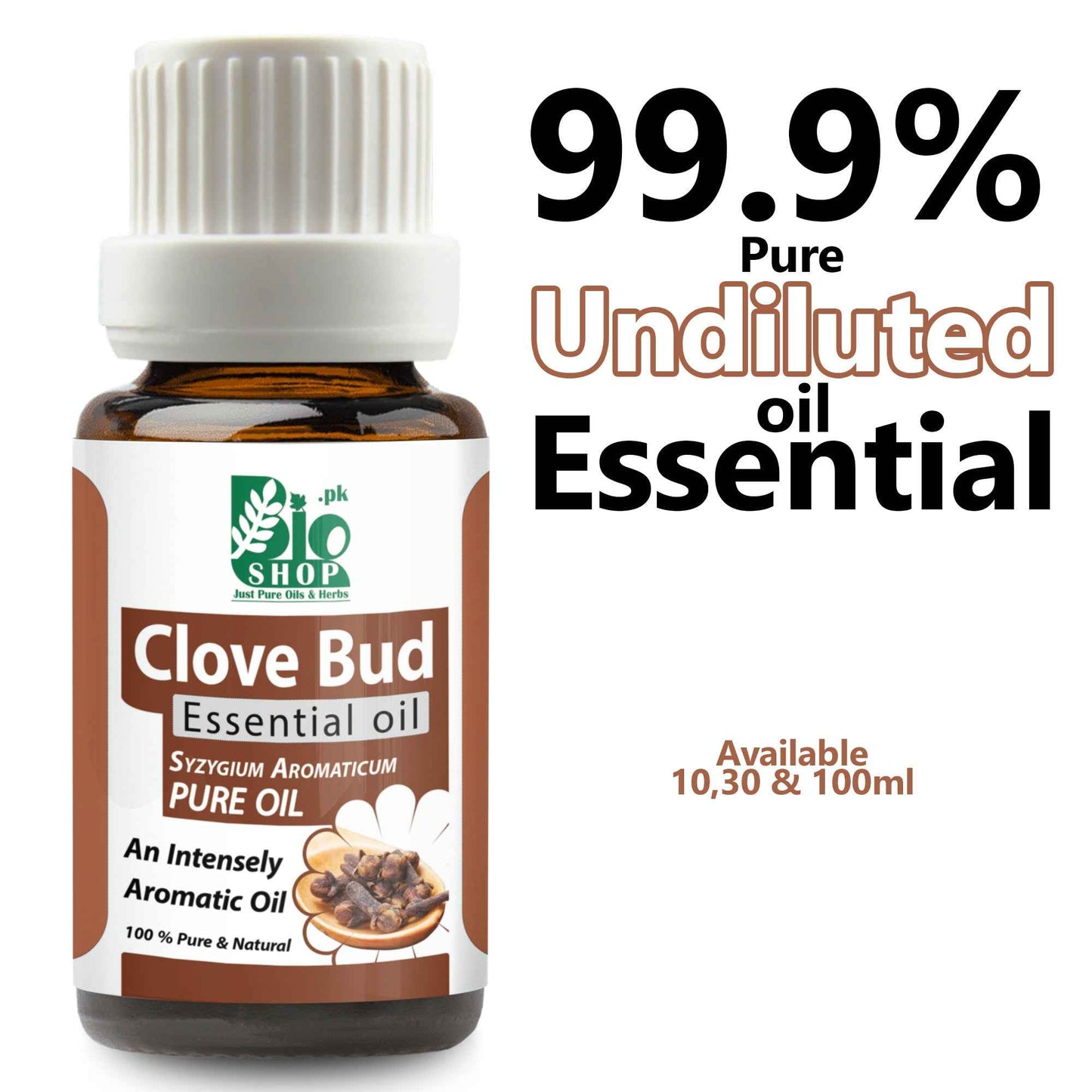
Clove Bud Essential Oil
Clove Bud Essential Oil
Olfactory Notes: Intense, spicy, and sweet; very high in Eugenol.
Couldn't load pickup availability


Explore
Information About Clove Bud Essential Oil
Key Features
✦ 100 percent pure steam-distilled essential oil from Syzygium aromaticum flower buds
✦ Rich in eugenol (85–90%), delivering a powerful spicy, warm, and slightly medicinal character
✦ Classic ingredient in oriental, amber, gourmand, and spice-forward fragrance compositions
✦ Widely used in soap making, candles, reed diffusers, and home fragrance for intensity and longevity
✦ Traditional use in South Asian and Middle Eastern attar and agarbatti blending
✦ Antimicrobial and antiseptic properties make it functional in personal care and household products
✦ Natural, vegan, non-synthetic — suitable for natural and organic product formulations
About Clove Bud Essential Oil
Clove Bud Essential Oil has one of the longest documented histories of any aromatic ingredient. The clove tree, Syzygium aromaticum, is native to the Maluku Islands of Indonesia and was among the most prized spices of the ancient spice trade, valued by Arab, Chinese, and Indian merchants for over two thousand years. The essential oil is obtained by steam distillation of the dried, unripe flower buds and is distinct from clove leaf and clove stem oils in both composition and quality. Clove bud oil is considered the finest grade, with a rounder, more complex aroma compared to the harsher leaf and stem variants.
What makes clove bud essential oil exceptional in formulation is its extraordinary potency and versatility. Its dominant compound, eugenol, delivers a sharp, dry, spicy warmth that integrates beautifully into oriental and amber accords, oud and resinous bases, as well as tobacco, leather, and gourmand themes. Even at trace usage levels, it adds unmistakable depth and a distinctly exotic character. In functional applications, its well-documented antimicrobial activity makes it a practical choice in soaps and home care, while in incense and candle work it performs with exceptional throw and projection.
Bio Shop Pakistan supplies cosmetic-grade Clove Bud Essential Oil suitable for DIY perfumers, attar blenders, soap and candle makers, and home fragrance formulators across Pakistan seeking authentic spice-note raw materials.
Olfactory Profile
SCENT DESCRIPTION : Clove Bud Essential Oil opens with a sharp, penetrating spice blast — dry, medicinal, and fiery. As it settles, a warm, woody sweetness emerges alongside a faintly floral clove carnation note. The drydown reveals a deep, resinous, and slightly smoky character with balsamic undertones that lend extraordinary richness and depth to any blend. Even in trace amounts, it commands the composition and leaves a lasting impression of warmth and exotic intensity.
NOTE POSITION : Mid to Base
FRAGRANCE FAMILY : Spicy / Oriental / Woody
FACETS : Spicy · Warm · Dry · Medicinal · Balsamic
TENACITY : Very High — 12 to 20+ hours on skin and fabric
SILLAGE : High — projects boldly in both cold and warm throw; diffuses strongly at low concentrations
Technical Specifications
Chemical Name : Syzygium aromaticum (Clove) Bud Oil
CAS Number : 8000-34-8
Synonyms : Eugenia caryophyllata bud oil, Clove oil, Oil of cloves
Purity : 100% pure essential oil (no carrier, no diluent)
Main Constituents : Eugenol 75–90%, Eugenyl Acetate 5–15%, Beta-Caryophyllene 2–7%
Appearance : Pale yellow to amber-brown clear liquid
Odor Threshold : Extremely low — perceptible at trace concentrations
Solubility : Soluble in alcohol and fixed oils; practically insoluble in water
Specific Gravity : 1.038 – 1.060 at 20°C (verify with supplier CoA)
Flash Point : Approximately 103°C (verify with supplier CoA)
Type : Natural — steam distilled essential oil
Applications & Usage Guidelines
Fine Fragrance : ★★★★☆
Clove bud oil is a classic spice modifier in oriental, amber, and chypre compositions. Used at 0.1 to 0.5% in EDP/EDT, it contributes warmth, depth, and exotic spice character. It blends seamlessly with oud, resins, and musks but requires careful dosing to avoid dominance.
Attar & Oriental Blending : ★★★★★
This is where clove bud essential oil truly excels. It is a foundational spice note in South Asian attar formulation and Middle Eastern mukhallat blending. Paired with sandalwood, oud, rose, and amber, it creates the quintessential oriental warmth prized in traditional attars.
Soap & Home Care : ★★★★☆
Clove bud oil is a long-standing ingredient in artisan cold-process and melt-and-pour soaps, valued for its scent strength and antimicrobial properties. Usage should be kept within IFRA and safety limits to prevent skin sensitization. It also performs well in surface cleaners and household products.
Home Fragrance : ★★★★★
In candles, reed diffusers, wax melts, and room sprays, clove bud oil delivers exceptional cold and warm throw. Its naturally high boiling point compounds diffuse steadily over time, making it ideal for festive, spiced, and oriental home fragrance products.
Aromatherapy & Functional : ★★★☆☆
Traditionally used in diluted massage oils for warming and stimulating properties. Must be significantly diluted in a carrier oil — never applied neat on skin. Eugenol content requires careful handling; patch testing is strongly advised before topical use.
IFRA & Usage Rate
RECOMMENDED USAGE RATES
EDP (Eau de Parfum) : 0.1 – 0.5%
EDT (Eau de Toilette) : 0.1 – 0.4%
Body Lotion (leave-on) : 0.05 – 0.2%
Shampoo / Body Wash : 0.1 – 0.5%
Candle (fragrance load) : 2.0 – 6.0%
Reed Diffuser : 5.0 – 15.0%
Soap (cold process) : 0.3 – 1.0%
IFRA 51ST AMENDMENT LIMITS
(Based on eugenol content — Clove Bud Oil is subject to IFRA restrictions as a eugenol-containing material. Limits below are indicative. Always verify against current IFRA standard at ifrafragrance.org)
IFRA Category 1 (Lip products) : Not recommended — very low permitted level
IFRA Category 3 (Fine fragrance) : Approx. 0.5% in finished product
IFRA Category 5 (Face/body leave-on) : Approx. 0.2 – 0.3% in finished product
IFRA Category 9 (Rinse-off body/hair) : Approx. 0.5 – 1.0% in finished product
IFRA Category 10 (Household, non-skin) : Higher limits — verify with IFRA standard
IFRA Category 11 (Candles, incense) : Generally unrestricted — no skin contact
⚠️ Clove Bud Essential Oil contains eugenol at up to 90%, which is a known skin sensitizer and allergen. It is subject to EU Cosmetics Regulation allergen labeling requirements above 0.001% (leave-on) and 0.01% (rinse-off) thresholds.
⚠️ Never apply undiluted to skin. Avoid use on broken, damaged, or sensitive skin.
⚠️ Always perform a patch test before inclusion in topical products.
⚠️ Not recommended for use in lip care products at meaningful levels.
⚠️ Verify all IFRA limits against the current 51st Amendment at ifrafragrance.org before product launch.
Blending Guide
METHOD 1 — SPICE MODIFIER IN ORIENTAL AND AMBER ACCORDS
Introduce clove bud oil at 0.1 to 0.3% of the total fragrance weight as a spice modifier to add warmth and depth. Combine with benzyl benzoate, labdanum, or amber bases to anchor the spice. Blend with oud, sandalwood, or vetiver to ground and extend the character. This technique is especially effective in EDP and attar concentrations.
METHOD 2 — TOP NOTE BURST IN FUNCTIONAL FRAGRANCE
In soaps, household cleaners, and body washes, use clove bud oil at 0.3 to 0.8% alongside citrus top notes such as orange, lemon, or bergamot. The citrus-spice combination is a classic pairing for fresh yet warming functional fragrance profiles. The eugenol in clove bud also contributes antimicrobial functionality in these applications.
METHOD 3 — HOME FRAGRANCE ANCHOR
In candles and reed diffusers, combine clove bud oil at 3 to 8% with cinnamon bark, star anise, benzoin, and vanilla to build a complete spiced-oriental room fragrance. This combination produces strong cold and warm throw and creates a rich, festive, cozy atmosphere. Clove bud acts as the sharp spice anchor that prevents the composition from becoming too sweet or flat.
BEST PAIRINGS
Oud / Agarwood → Deepens oriental character; creates classic Middle Eastern mukhallat base
Rose Absolute → Carnation-like spicy floral bridge — classic in taif and oriental rose attars
Sandalwood → Creamy, warm, meditative accord with excellent tenacity
Benzoin / Vanilla → Sweet balsamic warmth; classic festive and gourmand spice profile
Cinnamon Bark → Intensifies the spice note; use with caution — both are sensitizers
Labdanum → Animalic, resinous depth — anchors the spice in amber compositions
Orange Sweet EO → Fresh, bright citrus contrast that lifts the heavy spice note
Vetiver → Earthy, smoky grounding; excellent in men's oriental bases
Frankincense → Sacred, dry, meditative quality — suits incense and spiritual blends
Black Pepper EO → Adds dry, sharp peppery edge — enhances the spice complexity
AVOID
Using clove bud oil at high percentages alongside other eugenol-rich materials such as cinnamon bark, clove leaf, or bay laurel — the combined eugenol load will breach IFRA and safety limits rapidly.
Avoid in lip care, baby care, and sensitive skin formulations.
Perfumer's Note
Working with clove bud essential oil demands both respect and restraint. In my formulation practice, it is one of the very few ingredients where 0.05% can be the difference between a beautifully warm spice accord and an overpowering medicinal blast. The eugenol in clove bud is not just a scent molecule — it is a fixative, a modifier, and an intensity multiplier. When used correctly, it elevates every ingredient around it. It makes musks warmer, ambers richer, and rose more carnation-like. It is the heartbeat of a great mukhallat and the backbone of an authentic Pakistani attar. I have found that the finest use of clove bud is not as the star, but as the invisible force that makes the star shine.
ADVANCED TIP
Try macerating clove buds directly in your carrier oil or perfumer's alcohol for 48 to 72 hours and then filtering before blending. This cold infusion technique produces a softer, rounder clove note with the sharp edge slightly subdued, yielding a more faceted and integrated spice character than raw essential oil alone. Alternatively, combine clove bud oil with eugenyl acetate (if available) at a 70:30 ratio to extend the floral-sweet facets and reduce the harsh medicinal opening — a technique borrowed from classic French oriental perfumery.
Safety & Storage
Physical State : Clear pale yellow to amber liquid
Skin Safety : Dermal sensitizer — must be diluted; never apply neat; patch test required
Eye Contact : Irritant — avoid all contact; flush with water immediately if exposure occurs
Ingestion : Not for internal use; keep away from children
Ventilation : Use in well-ventilated area; vapors may cause irritation at high concentrations
Allergen Labeling : Required in EU/GCC cosmetics above 0.001% leave-on / 0.01% rinse-off (eugenol)
Storage : Store in a cool, dark place away from heat and direct sunlight
Temperature : Ideal storage 10–20°C; avoid freezing
Shelf Life : 2 to 3 years from manufacture date when stored correctly; check for clouding or thickening
Container : Dark amber glass bottle preferred; avoid prolonged storage in plastic
Flammability : Combustible liquid — flash point approx. 103°C; keep away from open flame at scale
Pregnancy / Children : Avoid use in products for pregnant women, infants, or young children without professional guidance
FAQ
Q: What is the difference between clove bud, clove leaf, and clove stem essential oil?
A: Clove bud oil is steam distilled from the flower buds and is the highest quality grade with a more rounded, sweet-spicy aroma. Clove leaf and stem oils have a harsher, more phenolic character and higher eugenol content. For perfumery and cosmetics, bud oil is always preferred.
Q: Can I use clove bud essential oil directly on my skin?
A: No. Clove bud essential oil must always be diluted before any skin contact. Undiluted application causes serious irritation and sensitization. Use at a maximum of 0.2 to 0.5% in leave-on products and patch test before use.
Q: Is clove bud essential oil safe to use in candles?
A: Yes, candles and incense are among the best applications for clove bud oil because there is no direct skin contact. Use at 2 to 6% fragrance load. It provides excellent hot and cold throw with a warm, festive character.
Q: How much clove bud oil should I add to a perfume blend?
A: Start at 0.05 to 0.1% of the finished formula and evaluate carefully before increasing. Clove bud is extremely potent and can overpower a composition quickly. Most professional oriental blends use it at 0.1 to 0.3% maximum.
Q: How does clove bud essential oil compare to eugenol isolate in perfumery?
A: Eugenol isolate is a single molecule isolated from clove oil and gives a cleaner, more linear spicy-floral note. Clove bud essential oil is a full-spectrum material with eugenol acetate, beta-caryophyllene, and other minor compounds that give it greater complexity, warmth, and naturalness. For authentic attars and naturals-based perfumery, clove bud EO is the preferred choice; eugenol isolate is better when you want precise control over concentration and character.
Where Can You Safely Use Clove Bud Essential Oil?
Discover how Clove Bud Essential Oil performs across different applications—rated for safety, stability, and effectiveness.
Original and pure essential oil not compromise quality


