Bio Shop
Ethyl Maltol
Ethyl Maltol
Olfactory Notes: The smell of "Cotton Candy" or burnt sugar; very powerful.
Couldn't load pickup availability


Explore
Information About Ethyl Maltol
Key Features
✦ Synthetic aroma chemical delivering an intense cotton candy, caramel, and soft fruity sweetness in fragrance and cosmetic applications
✦ Four to six times more potent than Maltol — a small dosage creates a powerful, long-lasting sweet effect
✦ Functions as a sweetening modifier, rounding harsh chemical edges and blending transitions between fragrance notes
✦ Key ingredient in gourmand, oriental, and aquatic perfumes — found in iconic commercial fragrances worldwide
✦ Soluble in alcohol, propylene glycol, and warm water — easy to incorporate into most formulation bases
✦ Vegan, cruelty-free, and not derived from animal sources
✦ Available in cosmetic and perfumery grade — suitable for skin-safe formulations at recommended usage rates
About Ethyl Maltol
Ethyl Maltol is a synthetic organic compound belonging to the pyranone family, first developed and commercialized during the mid-twentieth century as an evolution of maltol, a naturally occurring compound found in larch bark, pine needles, and roasted malt. While maltol itself has a pleasant sweet and caramellic character, chemists discovered that adding an ethyl group to the molecular structure dramatically amplified its olfactory potency and shifted the scent profile toward a cleaner, more pronounced cotton candy quality. Since its commercial introduction, ethyl maltol has become one of the most widely used synthetic sweeteners in both the global flavor industry and in fine fragrance creation.
What makes ethyl maltol uniquely valuable to perfumers is its dual role as both an independent fragrance note and a functional blending tool. At higher concentrations it contributes a clearly identifiable sweet, spun-sugar character that anchors gourmand compositions. At lower concentrations — often below half a percent — it acts as an invisible enhancer, softening sharp aroma chemicals, extending the sweetness of musks, and adding a smooth, cohesive quality to the overall blend. This versatility has made it a standard component in many celebrated commercial fragrances from major perfume houses, particularly in oriental, amber, and fruity floral structures.
Bio Shop Pakistan supplies cosmetic-grade Ethyl Maltol suitable for DIY perfumers, independent fragrance blenders, cosmetic formulators, and home crafters working in the Pakistani market who require a reliable, professionally sourced sweetening aroma chemical.
Olfactory Profile
SCENT DESCRIPTION : Ethyl Maltol opens with a bright, immediately recognizable cotton candy sweetness that feels airy and almost caramelized. As it develops it reveals soft fruity undertones reminiscent of cooked stone fruit and warm toffee, without the sharp edge sometimes associated with synthetic sweeteners. On dry-down it settles into a smooth, mellow sugary warmth that blends seamlessly into base musks and ambers. The overall impression is clean, enveloping, and universally pleasing — one of the most crowd-appealing scent profiles in a perfumer's toolkit.
NOTE POSITION : Mid to Base
FRAGRANCE FAMILY : Gourmand · Oriental · Fruity
FACETS : Cotton Candy · Caramel · Toffee · Spun Sugar · Soft Fruity
TENACITY : High — 8 to 12 hours in alcoholic perfume at standard usage rates
SILLAGE : Medium — projects softly and warmly without overwhelming the surrounding accord; blends into skin rather than radiating outward aggressively
Technical Specifications
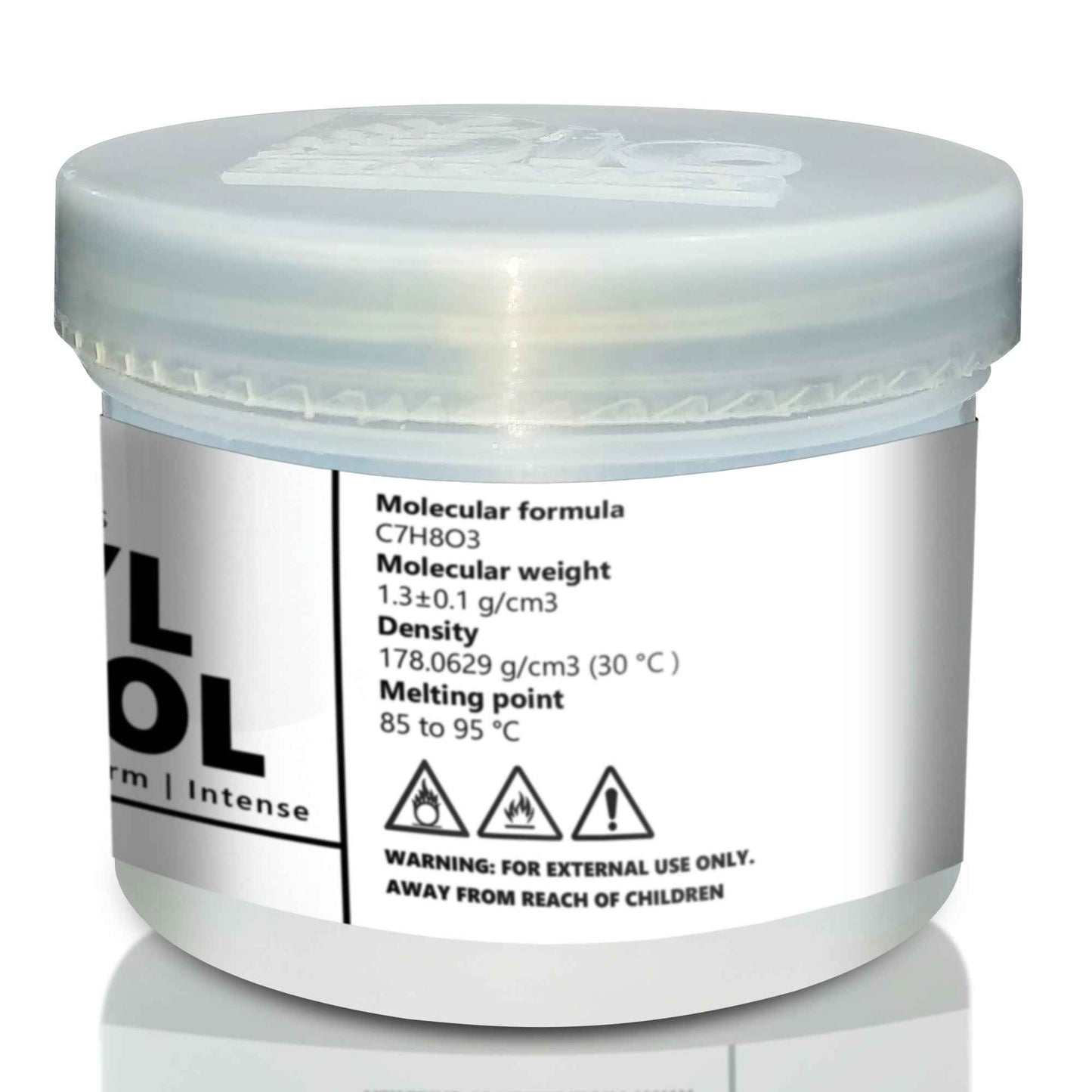
Chemical Name : 2-Ethyl-3-hydroxy-4H-pyran-4-one
CAS Number : 4940-11-8
Synonyms : Ethyl Maltol · 3-Hydroxy-2-ethyl-4-pyrone · 2-Ethylpyromeconic Acid · Veltol-Plus
Purity : 99% minimum (perfumery and cosmetic grade)
Appearance : White to off-white crystalline powder or granules
Odor Threshold : Approximately 0.01 to 0.05 ppm in air — extremely low detection threshold
Solubility : Soluble in ethanol, propylene glycol, and warm water (above 50°C); limited solubility in cold water; slightly soluble in fixed oils
Specific Gravity : Not applicable as solid — bulk density approximately 500 to 700 g/L
Melting Point : 89 to 92°C
Flash Point : Above 100°C (closed cup)
Type : Synthetic
Applications & Usage Guidelines
Fine Fragrance ★★★★★
Ethyl Maltol is a cornerstone of modern gourmand and oriental fine fragrance. It sweetens, rounds, and softens the entire accord, making it indispensable in EDP and EDT construction. Use at 0.1 to 1% to add cotton candy sweetness or at trace levels to smooth transitions between notes without contributing an obvious sweet character.
Attar and Oriental Blending ★★★★★
In traditional attar and Arabic-style oriental blending, ethyl maltol enhances the sweetness of oud, amber, and musk bases dramatically. It pairs naturally with rose, sandalwood, and vanilla-based ouds to create that characteristically rich, edible sweetness associated with Gulf-style perfumery. Even small additions at 0.1 to 0.3% transform the perceived quality of an oriental blend.
Functional Fragrance ★★★★
Ethyl Maltol performs well in rinse-off and leave-on personal care products. It contributes a pleasant, consumer-friendly sweet background to body washes, shampoos, and conditioners. Stability in surfactant systems is generally good at low concentrations, though pH and temperature should be monitored during formulation.
Cosmetics ★★★★
In creams, lotions, and body butters, ethyl maltol adds a subtle sweet fragrance note while complementing other cosmetic ingredients. Some studies suggest mild preservative-boosting properties in specific pH ranges, though it should not replace a primary preservation system. Effective at 0.05 to 0.2% in leave-on formulations.
Home Fragrance ★★★★
Ethyl Maltol contributes well to candles, reed diffusers, and room sprays, particularly in gourmand and bakery-themed home fragrance concepts. Stability in wax is acceptable, and the sweet throw reads as warm and comforting. Higher usage rates of 1 to 3% are typically needed in cold-throw applications to achieve perceptible intensity.
IFRA & Usage Rate
RECOMMENDED USAGE RATES
Application : Suggested Rate
EDP : 0.1 – 1.0%
EDT : 0.1 – 0.5%
Body Lotion : 0.05 – 0.3%
Shampoo/Body Wash : 0.05 – 0.2%
Candle : 0.5 – 2.0%
Reed Diffuser : 1.0 – 3.0%
Soap (Cold Process) : 0.1 – 0.5%
IFRA 51st AMENDMENT STATUS
Ethyl Maltol does not appear on the IFRA 51st Amendment restricted or prohibited ingredient list and is not currently subject to category-specific concentration limits under IFRA guidelines. It is considered safe for use in cosmetic and fragrance applications at the above usage rates.
⚠️ Always perform a patch test before use in leave-on skin formulations.
⚠️ Use within recommended rates — excessive sweetness can create cloying or unbalanced compositions.
⚠️ Dissolve in warm ethanol or propylene glycol before adding to formulas. Do not add as dry powder directly into cold bases.
⚠️ Verify current IFRA and local regulatory status before commercial product launch.
Blending Guide
METHOD 1 — Pre-dissolving in Ethanol
Dissolve Ethyl Maltol in perfumers alcohol or IPM at a 10% dilution before adding to your blend. This ensures complete dissolution and prevents crystallization in the final formula. Always prepare a dilution first — never add dry powder directly into a finished accord.
METHOD 2 — Sweetness Bridging in Accords
Add Ethyl Maltol at 0.05 to 0.2% to soften the transition between a sharp citrus top note and a heavy oriental base. It acts as an invisible bridge, creating the impression of smoothness and coherence without being identifiable as cotton candy at these low rates. This is the most professional and nuanced way to use it.
METHOD 3 — Gourmand Anchor
At 0.5 to 1% in the base of a perfume, Ethyl Maltol becomes a clearly identifiable gourmand anchor. Layer it under vanilla, benzyl benzoate, and coumarin to build a rich dessert-like base. Combine with musks that have a clean, powdery character for the best effect.
BEST PAIRINGS
Vanilla Absolute → Amplifies creaminess and creates a rich custard-like warmth
Iso E Super → Softens woody sharpness and adds a smooth sweet cedar quality
Hedione → Enhances jasmine facets with a clean, sweet floral uplift
Rose Oxide → Balances the metallic edge of rose oxide with soft sweetness
Ambroxan → Rounds ambery dryness into a sweeter, more skin-like impression
Benzyl Benzoate → Deepens oriental bases with balsamic sweetness
Coumarin → Creates a hay-tonka-candy combination ideal for fougeres and orientals
Oud Oil → Tames smoky and medicinal oud facets into a sweeter, richer profile
AVOID
Avoid combining at high concentrations with other powerful sweeteners such as Maltol, Ethyl Vanillin, and Furaneol simultaneously — the compound sweetness can become overwhelming and one-dimensional. Use only one primary sweetener per accord and keep Ethyl Maltol as a supporting modifier when other sweet materials are present.
Perfumer's Note
Working with Ethyl Maltol over the years has taught me that its greatest value is not in what you smell but in what you cannot quite identify. When used at sub-threshold levels — around 0.05 to 0.15% of the total formula — it never reads as cotton candy. Instead, it quietly dissolves harsh chemical edges, makes synthetics smell more natural, and gives a blend that polished, expensive quality that customers associate with premium commercial fragrances. Every time I have a blend that feels technically correct but somehow cold or clinical, a drop of Ethyl Maltol is almost always the solution.
ADVANCED TIP
Try preparing a 1% pre-blend of Ethyl Maltol in Iso E Super in a 1:9 ratio — one part Ethyl Maltol dissolved into nine parts Iso E Super. Add this modifier at 5 to 10% of your formula in woody and oud-based accords. The Iso E Super carries the Ethyl Maltol deep into the structure of the blend, and the resulting effect is a warm, smooth, almost velvety sweetness that reads as natural quality rather than synthetic sugar. This technique works particularly well in Pakistani-style heavy oriental attars where oud and rose are the dominant notes.
Safety & Storage
Physical State : White crystalline solid — dissolve before use
Skin Safety : Safe at recommended usage rates — avoid use above 2% in leave-on products without stability and patch testing
Eye Contact : Avoid direct eye contact — rinse thoroughly with water if contact occurs
Ingestion : Not for internal use in cosmetic applications — contact a physician if accidentally ingested in quantity
Ventilation : Standard ventilation adequate — not considered a significant inhalation hazard at normal handling quantities
Storage : Store in a cool, dry place away from direct sunlight and moisture at 15 to 25°C
Shelf Life : 24 to 36 months when stored correctly in sealed original container
Container : Store in tightly sealed glass or HDPE container — avoid prolonged exposure to air to prevent moisture absorption and caking
Flammability : Flash point above 100°C — not classified as flammable at ambient temperatures under standard handling conditions
FAQ
Q: How do I dissolve Ethyl Maltol since it comes as a powder?
A: Dissolve it in warm perfumers alcohol, IPM, or propylene glycol before adding to your blend. A 10% dilution works well. Never add dry powder directly into a finished formula.
Q: How much Ethyl Maltol should I use in an EDP?
A: Start between 0.1% and 0.3% for a subtle sweetening effect. If you want a clearly identifiable gourmand note, go up to 0.8 to 1%. Anything above 1.5% risks becoming one-dimensional.
Q: Can I use Ethyl Maltol in cold process soap?
A: Yes, at 0.1 to 0.5% it performs reasonably well in cold process soap. Be aware that heavy sweeteners can slightly accelerate trace in some formulations, so test a small batch first.
Q: Does Ethyl Maltol have any IFRA restrictions I need to know about?
A: As of the IFRA 51st Amendment, Ethyl Maltol is not a restricted ingredient. However, always verify current regulatory status before launching a commercial product and follow local cosmetic regulations.
Q: What is the difference between Ethyl Maltol and Maltol?
A: Ethyl Maltol has an additional ethyl group on the molecular structure that makes it approximately four to six times more potent than Maltol. Maltol has a slightly more natural malt and caramel quality, while Ethyl Maltol leans cleaner toward cotton candy and spun sugar. In most perfumery applications Ethyl Maltol is preferred due to its greater efficiency at lower usage rates.
Where Can You Safely Use Ethyl Maltol?
Discover how Ethyl Maltol performs across different applications—rated for safety, stability, and effectiveness.