


Bio Shop
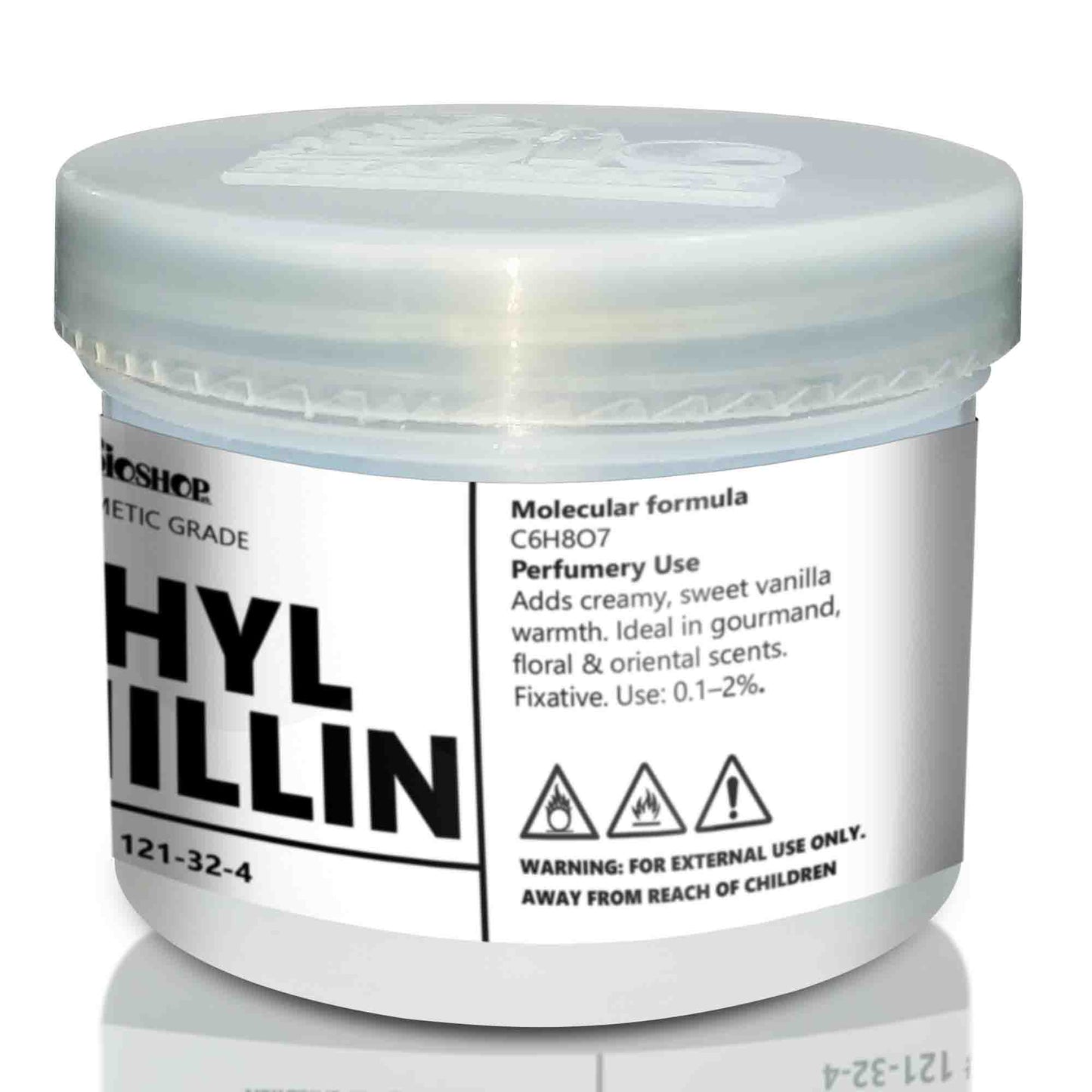
Ethyl Vanillin
Ethyl Vanillin
Olfactory Notes: Intense, creamy vanilla; much stronger than Vanillin.
Couldn't load pickup availability


Explore
Information About Ethyl Vanillin
Key Features
✦ Approximately 2 to 3 times more potent than standard vanillin — a little goes a very long way in formulation
✦ Iconic rich, creamy, sweet vanilla scent with a slightly phenolic and balsamic warmth ideal for oriental and gourmand accords
✦ Outstanding fixative — extends the longevity of entire compositions, particularly floral, woody, and spice bases
✦ Suitable for fine fragrance, attars, candles, reed diffusers, incense, body care, and hair care applications
✦ GRAS (Generally Recognised As Safe) status by FEMA for flavour use; no IFRA 51st Amendment restriction at normal perfumery levels
✦ White to off-white crystalline solid — easy to weigh, dissolves readily in warm alcohol and DPG
✦ Vegan, palm-free, and animal-derived-free synthetic ingredient
About Ethyl Vanillin
Ethyl Vanillin was first synthesised in the late nineteenth century as chemists explored the structural relatives of natural vanillin, the primary aromatic compound of the vanilla bean. While vanillin is derived from the guaiacol or lignin pathway, ethyl vanillin replaces the methoxy group with an ethoxy group at the 3-position of the benzaldehyde ring, producing a molecule with a noticeably stronger and slightly richer character. It entered commercial fragrance and flavour production in the early twentieth century and quickly became a staple of the industry, appearing in some of the most iconic oriental and gourmand perfumes ever created.
What sets ethyl vanillin apart is its exceptional odour intensity combined with a cleaner, less smoky vanilla quality compared to natural vanilla absolute or even standard vanillin. It blends seamlessly with heliotropin, coumarin, tonka-derived materials, ambers, musks, and woody bases, acting both as a featured note and as an invisible fixative that rounds off and extends surrounding materials. Its low use threshold means even trace quantities register clearly on the skin, giving formulators precise control over sweetness in a composition.
Bio Shop Pakistan supplies cosmetic-grade Ethyl Vanillin suitable for DIY perfumers, professional attar blenders, candle makers, cosmetic formulators, and fragrance hobbyists who require a consistent, high-purity vanilla material for creative and commercial formulation.
Olfactory Profile
SCENT DESCRIPTION : Ethyl Vanillin opens with an immediate wave of warm, intensely sweet vanilla that feels creamier and fuller than standard vanillin. There is a subtle phenolic and balsamic undertone that adds depth without the smoky edge of natural vanilla absolute. In dilution, a soft powdery facet emerges that blends gracefully with musks and florals. On the dry-down it retains a clean, enveloping sweetness that clings to fabric and skin for many hours.
NOTE POSITION : Base / Mid-Base
FRAGRANCE FAMILY : Oriental · Gourmand · Balsamic
FACETS : Creamy · Sweet · Vanilla · Powdery · Balsamic
TENACITY : Very High — perceptible on skin 12 to 24 hours post-application at normal usage rates
SILLAGE : Medium to High — projects noticeably in warm conditions, becomes intimate and skin-close in cooler environments
Technical Specifications
Chemical Name : 3-Ethoxy-4-hydroxybenzaldehyde
CAS Number : 121-32-4
Synonyms : Ethavan · Bourbonal · Vanillin Ethyl Ether · 3-Ethoxy-4-hydroxybenzaldehyde
Purity : 99%+ (pharmaceutical and cosmetic grade)
Appearance : White to off-white crystalline solid
Odor Threshold : Approximately 0.04 to 0.4 ppb (air) — significantly lower than vanillin
Solubility : Slightly soluble in cold water; freely soluble in warm ethanol, DPG, IPM, and most fragrance carriers; dissolve gently at 40 to 50°C
Specific Gravity : 1.18 to 1.19 g/cm³ (solid bulk density; verify with supplier for lot-specific data)
Flash Point : Approximately 128°C (262°F)
Type : Synthetic aroma chemical
Applications & Usage Guidelines
Fine Fragrance : ★★★★★
Ethyl Vanillin is an industry-standard base note and fixative in fine fragrance. It underpins gourmand, oriental, and floral oriental compositions and is found in some of the world's best-selling perfumes. Use at 0.2 to 2% in EDP and EDT to add lasting vanilla warmth without overpowering the accord.
Attar and Oriental Blending : ★★★★★
It is one of the most compatible materials for traditional attar and Arabic-style fragrance work, pairing naturally with oud, rose, sandalwood, amber, and spice bases. Even at 0.1 to 0.5% in an attar blend it contributes a rich, sweet depth that elevates the entire composition and improves fixation on skin.
Candles and Home Fragrance : ★★★★★
Ethyl Vanillin performs excellently in soy, paraffin, and blended wax candles due to its high tenacity and heat-stable vanilla throw. In reed diffusers it provides a warm, long-lasting background note. Recommended at 0.5 to 3% in candle fragrance blends and 1 to 5% in reed diffuser concentrates.
Functional Fragrance and Body Care : ★★★★☆
It adds a comforting, skin-safe vanilla note to body lotions, hair conditioners, and shower gels at low use levels (0.05 to 0.5%). Formulators should be aware of a mild yellowing tendency in leave-on products over time and should conduct stability testing before finalising formulations.
Soap : ★★☆☆☆
Ethyl Vanillin is known to cause moderate to significant discoloration (browning or darkening) in cold-process and hot-process soap due to the presence of a free aldehyde group reacting with the alkaline environment. Use is possible at low levels with vanilla stabilisers but discoloration management is necessary.
IFRA & Usage Rate
RECOMMENDED USAGE RATES
EDP (Eau de Parfum) : 0.3 to 2.0%
EDT (Eau de Toilette) : 0.2 to 1.5%
Body Lotion / Cream : 0.05 to 0.5%
Shampoo / Body Wash : 0.05 to 0.3%
Candle (fragrance load) : 0.5 to 3.0%
Reed Diffuser : 1.0 to 5.0%
Cold-Process Soap : 0.1 to 0.5% (discoloration expected — use stabiliser)
Attar / Concentrated Oil : 0.1 to 1.0%
IFRA 51ST AMENDMENT STATUS
Ethyl Vanillin is not listed as a restricted or prohibited ingredient in the IFRA 51st Amendment at standard perfumery use levels. It is not a recognised skin sensitiser at normal concentrations and carries no mandatory QRA limit under current IFRA guidance. Formulators should follow general good manufacturing practice and conduct standard skin sensitisation risk assessment for final products as required by EU Cosmetics Regulation and local standards.
FEMA GRAS Status : Yes (FEMA 2464) — approved for food flavour use
EU Cosmetics Regulation : No mandatory labelling threshold as a named allergen under current Annex III listings
⚠️ Note: Always verify the most current IFRA standards against your specific formulation and intended market before final production.
Blending Guide
METHOD 1 — DILUTION IN DPG OR ALCOHOL
Ethyl Vanillin is a solid at room temperature. Warm your DPG or perfumers alcohol gently to 40 to 50°C, add your weighed ethyl vanillin at 10 to 20% in carrier to make a working solution, and allow it to dissolve fully before blending into your formula. This prevents dosing errors and ensures even distribution throughout the batch.
METHOD 2 — BASE NOTE ANCHOR IN ORIENTAL AND GOURMAND ACCORDS
Use ethyl vanillin at 0.3 to 1% as the backbone of oriental, amber, or gourmand bases. Pair it first with a musk such as Habanolide or Galaxolide to set the dry-down, then layer in resins, coumarin, or heliotropin before adding the top and mid notes. This builds the base-first framework that gives oriental fragrances their characteristic depth and longevity.
METHOD 3 — MICRO-DOSING FOR FLORAL ENHANCEMENT
At 0.05 to 0.15% ethyl vanillin works as an invisible sweetener and softener in floral compositions — particularly rose, jasmine, and tuberose — without registering as a distinct vanilla note. This technique is borrowed from classic French perfumery and adds an almost imperceptible warmth that makes florals feel more luxurious and wearable on skin.
BEST PAIRINGS
Coumarin → Creates a classic fougère-gourmand base with a warm, hay-like sweetness
Heliotropin → Adds a powdery almond-cherry facet ideal for oriental and floral-oriental blends
Iso E Super → Builds a modern woody-amber structure that is cedarwood-smooth and long-lasting
Ambroxan → Amplifies skin-warmth and adds an animalic, musky vanilla depth
Sandalwood / Sandalore → Produces a creamy, skin-close oriental drydown with excellent tenacity
Cinnamon / Eugenol → Creates spiced chai and oriental gourmand accords with excellent warmth
Tonalide / Galaxolide → Extends the sweet base into clean, laundry-style musk formulations
Rose Oxide / Geraniol → Softens the sweetness and adds a rosy-spice dimension
AVOID
Avoid combining at high concentrations with chlorine-based compounds or strongly alkaline systems such as un-superfatted soap without stabilisation — discoloration and performance degradation can occur. Do not blend with materials that are themselves prone to darkening without assessing the combined discoloration risk.
Perfumer's Note
Working with ethyl vanillin has taught me to respect the principle that concentration and effect are not always proportional. This material carries more odour-per-gram than almost anything else on the palette — I have watched a quarter of a percent turn an entire kilogram of oriental base into something unmistakably dessert-like. The skill is not in adding it; it is in restraint. When I dose it correctly, no one in the room knows it is there — they simply feel the warmth and find the fragrance addictive. That invisible sweetness, the kind that makes people lean in and say they cannot quite place what they are smelling, is the real artistry of ethyl vanillin in a skilled hand.
ADVANCED TIP
Try building a two-part vanilla system by combining ethyl vanillin at 0.3% with standard vanillin at 0.5% and a small dose of vanilla CO2 extract or vanilla absolute at 0.05% in your base. The ethyl vanillin provides the high-intensity headspace hit, the vanillin adds a slightly smoky, more natural roundness, and the absolute bridges the two with botanical credibility. This layered vanilla accord reads as far more complex and natural than any single vanilla material can produce on its own, and it costs significantly less per kilogram than relying on absolute alone.
Safety & Storage
Physical State : White to off-white crystalline solid at room temperature; melts at approximately 76 to 78°C
Skin Safety : Generally considered safe at recommended usage rates; patch test recommended for leave-on products; avoid undiluted skin contact
Eye Contact : Avoid contact with eyes; rinse thoroughly with water for 15 minutes if contact occurs; seek medical advice if irritation persists
Ingestion : Not for internal use in cosmetic/fragrance applications; GRAS only applies to approved food flavour use levels — keep out of reach of children
Ventilation : Use in a well-ventilated workspace; fine dust from solid material should not be inhaled during weighing — use a dust mask if handling large quantities
Storage : Store in a cool, dry location away from direct light and heat; keep tightly sealed to prevent moisture absorption and discoloration
Shelf Life : 2 to 3 years from date of manufacture when stored correctly; inspect for discoloration or clumping before use in final products
Container : Airtight amber glass or HDPE container preferred; avoid prolonged storage in clear glass or open containers
Flammability : Flash point approximately 128°C — not flammable under normal ambient conditions; keep away from open flame in heated candle and diffuser production environments
FAQ
Q: Is Ethyl Vanillin the same as Vanillin?
A: No. Both are vanilla-scented aroma chemicals but ethyl vanillin is 2 to 3 times more potent due to the ethoxy group replacing the methoxy group in its molecular structure. Ethyl vanillin also has a slightly creamier and less smoky character than standard vanillin.
Q: Can I use Ethyl Vanillin in cold-process soap?
A: Yes, but expect significant discoloration — it will turn your soap brown or tan. Use it at under 0.5% with a vanilla colour stabiliser if colour matters. At higher levels discoloration is nearly impossible to prevent.
Q: How do I dissolve Ethyl Vanillin since it is a solid?
A: Gently warm your carrier (DPG, IPM, or perfumers alcohol) to 40 to 50°C, add the crystals, and stir until fully dissolved. Pre-diluting to a 10 to 20% solution in DPG makes it far easier to dose accurately in small batches.
Q: Is Ethyl Vanillin restricted by IFRA?
A: Ethyl Vanillin has no restriction listed in the IFRA 51st Amendment at standard perfumery concentrations. It is not classified as a restricted sensitiser under current guidance, though best practice always includes conducting a standard safety assessment for your final formulation.
Q: How does Ethyl Vanillin compare to Vanilla Absolute?
A: Ethyl vanillin is purely synthetic, consistent batch-to-batch, far less expensive, and dramatically more potent by weight. Vanilla absolute is a natural extract with complex nuance, trace tobacco-like and fruity facets, and botanical authenticity — but it is costly, dark-coloured, and variable. Many professional perfumers use both: ethyl vanillin for intensity and economy, vanilla absolute for a small natural anchor that adds depth and character the synthetic cannot replicate alone.
Where Can You Safely Use Ethyl Vanillin?
Discover how Ethyl Vanillin performs across different applications—rated for safety, stability, and effectiveness.
Great Product from a Great Supplier


