Skip to product information
1 of 3

Bio Shop

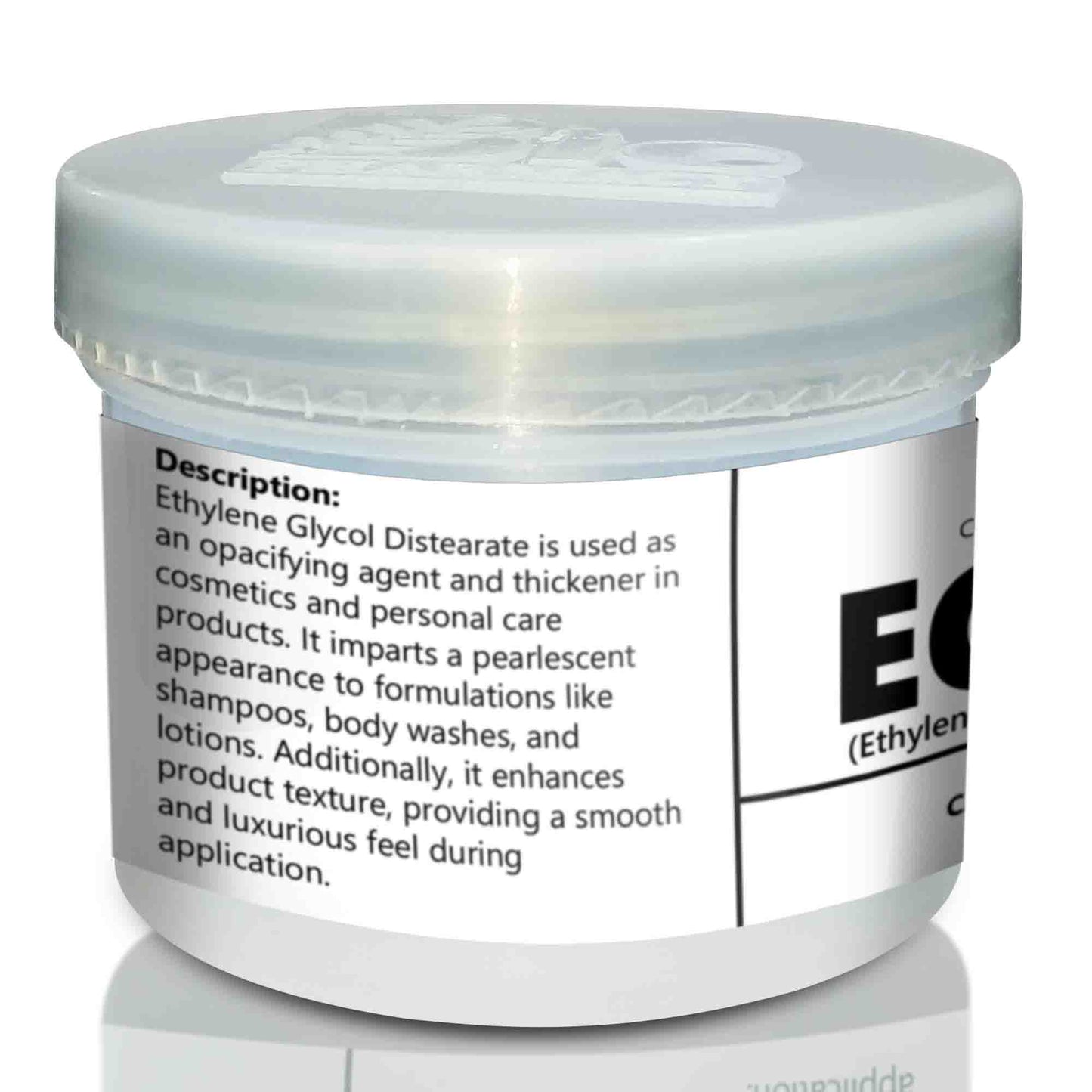
EGDS (Ethylene Glycol Distearate)

EGDS (Ethylene Glycol Distearate)

Regular price Rs.300.00
Regular price Sale price Rs.300.00
Sale Sold out
Shipping calculated at checkout.

Key Functions: Creates pearl effect, opacifies, smooths texture, and enhances appearance.

Weight
Quantity
🚚 Estimated delivery time:
Learn More About This Ingredient View full details

Explore

Information About EGDS (Ethylene Glycol Distearate)

✅ Key Features

✦ Gold-standard pearlizing and opacifying agent for rinse-off hair and body care formulations
✦ Produces a professional nacreous or milky lustre through controlled crystalline recrystallization
✦ Compatible with anionic, amphoteric, and nonionic surfactant systems used in most shampoo bases
✦ Contributes a soft, creamy, silky texture to shampoos, conditioners, and body wash formulations
✦ Stable across a wide pH range of 4.0 to 9.0 — no pH adjustment required for standard rinse-off bases
✦ Vegan-suitable when sourced from vegetable-derived stearic acid — confirm origin with supplier
✦ Simple processing — melt above 70°C, blend into hot phase, and cool slowly for instant pearl development

🔬 Description

Ethylene Glycol Distearate (EGDS) is a diester formed from the esterification of ethylene glycol with stearic acid, carrying the INCI name Glycol Distearate. It is a well-established cosmetic raw material that has been used in the personal care industry for several decades. Available as white waxy flakes or pellets with a faint, fatty odor, EGDS is most widely recognized as the primary ingredient responsible for the pearl or nacreous visual effect seen in commercial shampoos, shower gels, and conditioning washes.

What makes EGDS technically distinctive is its crystalline behavior within a surfactant matrix. When the ingredient is fully melted above 65°C and incorporated into a hot aqueous surfactant base, it disperses evenly throughout the system. As the formulation cools, EGDS recrystallizes into fine, flat, reflective platelets that align within the liquid structure and scatter incident light to produce a characteristic pearlescent sheen. The quality, depth, and uniformity of this effect depend entirely on the rate of cooling and the level of agitation during solidification. In addition to its visual function, EGDS acts as a mild opacifier, a subtle texture enhancer, and contributes marginally to the sensory feel of rinse-off systems.

Bio Shop Pakistan supplies cosmetic-grade EGDS suitable for DIY soap makers, hair care formulators, cosmetic chemists, and personal care product developers.

📊 Technical Data

INCI Name : Glycol Distearate
Chemical Name : Ethylene glycol distearate
CAS Number : 627-83-8
Molecular Formula : C38H74O4
Appearance : White waxy pellets or flakes
Odor : Faint waxy; odorless to mild fatty note
pH (1% solution) : Not Applicable (insoluble in water)
Solubility : Insoluble in water; soluble in hot oils and warm ethanol
Specific Gravity : ~0.87 at 70°C (molten state)
Flash Point : >200°C
HLB Value : ~1.0 (strongly lipophilic)
Recommended Use Level : 1.0% to 3.0%
Type : Diester (ethylene glycol and stearic acid)
Shelf Life : 2 years under recommended storage conditions

🧪 Recommended Usage

Skincare (Creams, Serums, Lotions) : ★★☆☆☆
EGDS provides negligible benefit in leave-on skincare and does not function as a pearlizing agent outside of a surfactant matrix. If used at all, restrict to trace levels in heavy, occlusive balm systems where texture is the sole goal.

Haircare (Shampoo, Conditioner, Masks) : ★★★★★
EGDS is the industry benchmark for pearlizing rinse-off hair care products and delivers consistent, professional nacreous results. Add at 1.5% to 3.0% in the hot surfactant phase above 70°C and allow the batch to cool slowly without agitation for the finest pearl development.

Soap Making (Cold Process, Melt and Pour) : ★★★☆☆
EGDS is not compatible with cold process soap, as high-pH saponification conditions hydrolyze its ester bonds and destroy pearlizing performance. It can be incorporated at 2% to 3% in melt-and-pour bases where temperature and pH remain controlled.

Body Care (Scrubs, Butters, Balms) : ★★☆☆☆
EGDS does not produce a pearl effect in anhydrous systems such as body butters or scrubs and contributes minimal emollient value in these formats. It is more appropriately used in surfactant-based body wash or shower gel formulations within this category.

Functional Cosmetics (Deodorants, Sunscreen, Baby Care) : ★★☆☆☆
EGDS offers no functional benefit in deodorants, sunscreens, or baby care formulations and is not recommended for these applications. Its use should remain confined to rinse-off surfactant systems where its crystallization behavior can be properly controlled.

💡 Pro Tip

As a formulator, I treat EGDS as a system-dependent ingredient — its performance is inseparable from the surfactant base surrounding it. The ionic character of your surfactant blend, the ratio of anionic to amphoteric components, the cooling rate, and the degree of mechanical agitation during cooling all directly determine whether you achieve a fine, dense pearl or a coarse, uneven opacity. I always perform small-scale cooling trials before scaling up a new formula, testing static cool versus slow-stirred cool to identify the best crystallization protocol for that specific base.

ADVANCED TIP: For maximum pearl density and definition in a shampoo system, combine EGDS at 2.0% with glycol stearate (the monoester) at 0.5% as a co-crystallizing agent. Melt both waxes together above 75°C before blending into your hot sodium laureth sulfate and cocamidopropyl betaine base. Once fully incorporated, transfer the batch to a static vessel and cool in a 38°C water bath over 45 to 60 minutes without stirring. This slow, undisturbed crystallization produces dense, silver-white, uniform pearl platelets characteristic of salon-grade professional shampoos.

👩‍🔬 Skin Type Suitability

Normal Skin : ★★★☆☆ — Neutral in rinse-off use; no leave-on benefit or concern for normal skin types.
Dry Skin : ★★☆☆☆ — Provides no meaningful moisturization as it is rinsed away before any emollient effect can occur.
Oily Skin : ★★★☆☆ — Completely inert in rinse-off systems and does not contribute to sebum production or pore congestion.
Combination : ★★★☆☆ — Neither beneficial nor problematic for combination skin in its standard rinse-off application context.
Sensitive Skin : ★★★★☆ — Non-irritating and well-tolerated at recommended levels; no known sensitization risk in rinse-off products.
Mature Skin : ★★★☆☆ — Offers no direct anti-aging or firming activity; functions purely as an aesthetic and textural ingredient.
Acne-Prone : ★★★★☆ — Non-comedogenic in rinse-off formulations as it is completely washed from the skin surface before absorption.

🧴 Formulation Ideas

CONCEPT 1: Pearl Shine Moisturizing Shampoo
Usage Level : 2.5%
Key Ingredients: Sodium Laureth Sulfate, Cocamidopropyl Betaine, Panthenol, Citric Acid
Result : A salon-quality shampoo with a rich nacreous appearance, dense creamy lather, and a smooth, conditioned feel after rinsing.

CONCEPT 2: Pearlescent Body Wash
Usage Level : 2.0%
Key Ingredients: Sodium Laureth Sulfate, Cocamide DEA, Glycerin, Fragrance Oil
Result : A visually luxurious body wash with a white pearl shimmer, silky in-use feel, and a clean, soft skin finish after rinsing.

CONCEPT 3: Pearlized Clarifying Scalp Shampoo
Usage Level : 1.5%
Key Ingredients: Sodium Lauryl Sulfate, Cocamidopropyl Betaine, Salicylic Acid, Tea Tree Essential Oil
Result : A clarifying shampoo with a refined pearlescent finish, deep cleansing action, and a cooling scalp sensation suited to oily hair types.

💧 Safety and Regulatory:

INCI Declared : Yes — mandatory declaration on all finished cosmetic products in EU and UK
EU Cosmetics Reg : Permitted — not listed in Annexes II, III, IV, V, or VI; general safety provisions of Regulation EC 1223/2009 apply
Rinse-Off Limit : No established regulatory upper limit; industry standard is 1% to 3%
Leave-On Limit : No established limit; leave-on use is not recommended for this ingredient
Allergen Alert : No — not a listed cosmetic allergen under EU Cosmetics Regulation
Skin Safety : Safe at recommended levels in rinse-off product formats
Eye Area Use : Use with caution — avoid formulating for direct eye-area leave-on contact
Ingestion : Not for internal use
Pregnancy Use : Consult physician
Child Safety : Safe above 3 years of age in rinse-off formats; use at lower end of recommended range
Ventilation : Not required under normal ambient handling and melting conditions
Storage : Store in a cool, dry location below 25°C away from direct heat and moisture
Container : HDPE or glass preferred; avoid reactive metals

⚠️ EGDS is derived from stearic acid, which may be of animal tallow origin unless explicitly stated as vegetable-derived. Confirm raw material sourcing with your supplier if vegan certification or halal compliance is required for your finished product. No significant skin sensitization risk has been reported at industry-standard use levels.

Stability and Compatibility

Working pH Range : 4.0 to 9.0
Heat Stability : Melt point approximately 60–65°C; process above 70°C for full dispersion; avoid prolonged exposure above 80°C
Freeze-Thaw Stable : No — repeated freeze-thaw cycles disrupt crystalline structure and degrade pearl effect
Emulsion Type : O/W compatible; Not applicable for W/O systems
Emulsification Phase: Hot phase only — must be fully melted before incorporation
Compatible With : Anionic surfactants, amphoteric surfactants, nonionic surfactants, fatty alcohols, conditioning polymers, panthenol
Incompatible With : Strong oxidizing agents; very high concentrations of cationic surfactants may alter crystal habit and pearl quality
Oxidation Risk : Low — no antioxidant required under standard storage and formulation conditions
Discoloration Risk : Possible — may develop slight yellowing on prolonged exposure to temperatures above 80°C
Formulation Notes : Always melt EGDS completely before adding to the surfactant phase and control the cooling rate carefully; rapid cooling or vigorous mechanical agitation during crystallization produces a diffuse milky opacity rather than a well-defined nacreous pearl effect.

❓ FAQs

Q: What exactly does EGDS do in a shampoo formulation?
A: EGDS acts as a pearlizing and opacifying agent, producing a nacreous, silvery-white shimmer in shampoos and body washes. It achieves this through controlled crystalline recrystallization within the surfactant matrix as the formulation cools.

Q: How do I process EGDS correctly to get the best pearl effect?
A: Melt EGDS fully above 70°C and blend it into your hot surfactant phase before the batch begins to cool. Allow the formulation to cool slowly and without aggressive stirring from around 70°C down to 38°C — this controlled crystallization produces the finest, most uniform pearl.

Q: Can I use EGDS in cold process soap?
A: EGDS is not suitable for cold process soap because the strongly alkaline, high-pH saponification environment hydrolyzes the ester bonds and eliminates all pearlizing function. Use it only in melt-and-pour bases or liquid surfactant systems where pH and temperature are controlled.

Q: Will EGDS affect the lather or foam quality of my shampoo?
A: At the recommended use level of 1% to 3%, EGDS has minimal impact on foam volume or quality. Many formulators observe a slightly creamier, more stable lather quality, which is generally perceived as a premium sensory attribute in finished products.

Q: How does EGDS compare to mica as a pearlizing agent in rinse-off products?
A: Mica produces a sparkling, particulate shimmer from suspended mineral platelets and remains visible as a separate phase in the formulation. EGDS creates a soft, integrated nacreous effect through in-situ crystallization within the surfactant system, producing a more classic, creamy pearl appearance without visible particles. For most shampoo applications, EGDS delivers a more professional and stable pearlescent result than mica alone.

Where Can You Safely Use EGDS (Ethylene Glycol Distearate)

Discover how EGDS (Ethylene Glycol Distearate) performs across different products — rated for safety, stability, and effectiveness.

Skincare
Serums
2
Stability Issues
Creams & Lotions
3
Discoloration
Eye Creams
2
Stability Issues
Face Masks
3
Discoloration
Cleansers
7
Reasonable
Toners
1
Major Problems
Lip Balms
3
Discoloration
Ointments
3
Discoloration
Body & Hair Care
Body Butters
2
Stability Issues
Shampoos
9
Very Good
Conditioners
7
Reasonable
Hair Masks
6
Fair
Soap & Specialty
Soaps
5
Mediocre
Deodorants
2
Stability Issues