Bio Shop
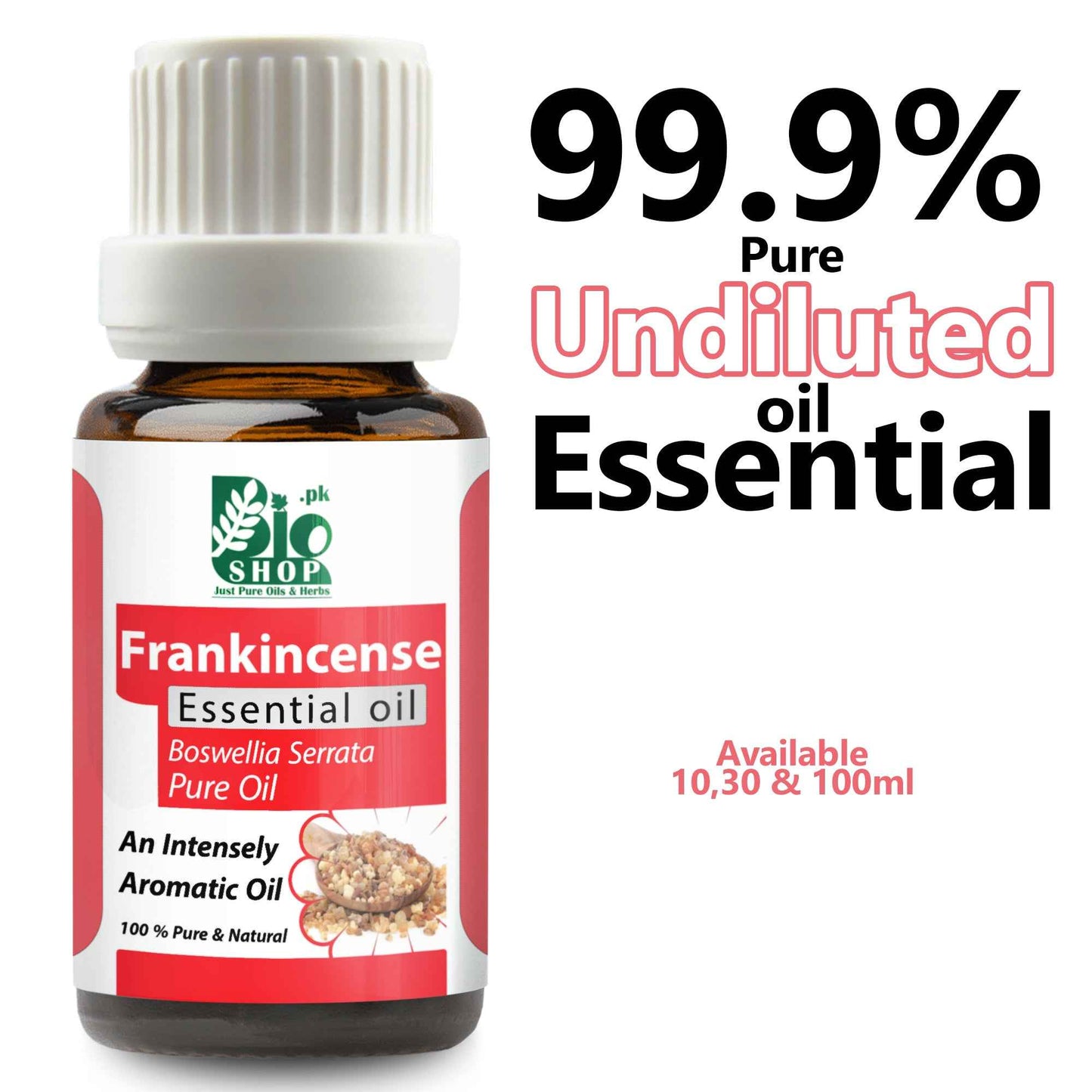
Frankincense Essential Oil
Frankincense Essential Oil
Olfactory Notes: Terpenic, resinous, Relaxing scent - A meditative base note.
Couldn't load pickup availability


Explore
Information About Frankincense Essential Oil
Key Features
✦ Pure essential oil steam distilled or CO2 extracted from Boswellia resin — one of the oldest and most prized aromatic materials in the world
✦ Delivers a deep, woody, balsamic, and resinous scent with a faint citrus opening — complex and meditative
✦ A cornerstone base note in oriental, woody, and spiritual fragrance compositions including attars, oud blends, and incense
✦ Rich in alpha-pinene, limonene, and incensole acetate — valued both for fragrance depth and reported skin-calming properties
✦ Featured in iconic fragrance families including Church incense accords, Middle Eastern musks, and modern niche woody florals
✦ Widely used in luxury skincare — anti-aging creams, serums, facial oils, and massage blends
✦ 100% natural, vegan, and cruelty-free — no synthetic carriers or adulterants in cosmetic-grade supply
About Frankincense Essential Oil
Frankincense essential oil is obtained from the aromatic resin of Boswellia trees, a genus of flowering plants native to the Arabian Peninsula, East Africa, and the Indian subcontinent. The resin — historically called olibanum — has been harvested by hand for over five thousand years, traded along ancient incense routes, and used in religious ceremonies, Ayurvedic medicine, and royal perfumery across civilizations from Egypt and Rome to Persia and South Asia. Steam distillation of the dried resin yields an essential oil whose complexity mirrors the rich cultural history of the raw material itself.
What sets frankincense essential oil apart from most natural aromatics is its remarkable compositional balance. The volatile top notes carry a brief citrus and slightly green freshness, quickly giving way to a warm, resinous heart that deepens into a dry, woody, and balsamic dry-down. This multi-layered character allows frankincense to function simultaneously as a modifier, fixative, and anchor in fragrance compositions. Its key constituent incensole acetate is also studied for its psychoactive and anti-anxiety properties, which may explain the oil's long association with meditation and spiritual ritual.
Bio Shop Pakistan supplies cosmetic-grade frankincense essential oil suitable for fine fragrance development, attar blending, incense crafting, soap making, skincare formulation, and home fragrance applications.
Olfactory Profile
SCENT DESCRIPTION : Frankincense opens with a fleeting brightness — faintly citrusy and slightly green — that settles within minutes into a warm, resinous, and deeply woody heart. The core scent is balsamic, dry, and sacred, carrying an almost smoky camphor-like undertone that grounds any composition. As it dries down on skin or in a blend, it becomes softer and more ambery, revealing a quiet sweetness that lingers without becoming heavy.
NOTE POSITION : Mid-Base
FRAGRANCE FAMILY : Woody · Resinous · Oriental
FACETS : Woody · Balsamic · Resinous · Smoky · Slightly Citrus
TENACITY : High — lasts 8 to 14 hours in alcohol-based perfumery; excellent fixative in oil and wax bases
SILLAGE : Medium — intimate and enveloping rather than projecting; the scent stays close to the skin with a warm, meditative trail
Technical Specifications
CHEMICAL NAME : Olibanum Oil — mixture of monoterpenes, sesquiterpenes, and diterpene alcohols from Boswellia spp. resin
CAS NUMBER : 8016-36-2 (Boswellia carterii); 89957-98-2 (Boswellia sacra) — verify species with supplier CoA
SYNONYMS : Olibanum Essential Oil · Boswellia Oil · Sacred Frankincense Oil · Luban Oil
PURITY : 100% pure essential oil — verify exact species and extraction method on supplier CoA
APPEARANCE : Pale yellow to amber-yellow mobile liquid; color may deepen with age
ODOR THRESHOLD : Approximately 0.3 to 1 ppb — high olfactory impact at low concentrations
SOLUBILITY : Soluble in ethanol and fixed oils; insoluble in water
SPECIFIC GRAVITY : 0.870 to 0.910 at 20°C — verify with supplier CoA
FLASH POINT : Approximately 46°C to 62°C depending on species and distillation batch — verify with supplier CoA
TYPE : Natural — 100% pure essential oil from plant resin
Applications & Usage Guidelines
FINE FRAGRANCE : ★★★★★
Frankincense is a foundational ingredient in fine perfumery, valued as a mid-base note and fixative. It adds depth, spirituality, and longevity to oriental, woody, and chypre compositions. Works at 2% to 15% in EDPs and is used in countless iconic resinous accords.
ATTAR & ORIENTAL BLENDING : ★★★★★
This is where frankincense is most at home. In traditional attar making and Arabic-style perfumery, it pairs with oud, ambergris, musk, rose, and saffron to create warm, meditative, and deeply resinous compositions. Considered a must-have for any serious attar formulator.
INCENSE & HOME FRAGRANCE : ★★★★★
Frankincense is one of the primary materials in incense sticks, cones, and resin blends worldwide. In reed diffusers and room sprays it creates a sacred, calming atmosphere. Highly effective in wax melts and scented candles for meditation and spiritual home settings.
SKINCARE & COSMETICS : ★★★★☆
Widely used in facial oils, serums, anti-aging creams, and massage blends. Frankincense is associated with skin-toning, regenerative, and anti-inflammatory properties. Use at skin-safe dilutions (0.5% to 2% in leave-on products) and follow IFRA sensitization guidelines.
FUNCTIONAL FRAGRANCE : ★★★★☆
Effective in luxury soap bars, shower gels, and hair care products to impart a warm, resinous, and slightly exotic character. Performs well in rinse-off formulations and provides a premium feel to personal care product lines.
IFRA & Usage Rate
RECOMMENDED USAGE RATES
EDP (Eau de Parfum) : 3.0% – 15.0%
EDT (Eau de Toilette) : 2.0% – 8.0%
Body Lotion / Cream : 0.5% – 2.0%
Facial Serum / Oil : 0.3% – 1.0%
Shampoo / Body Wash : 0.5% – 1.5%
Soap (Cold Process) : 1.0% – 3.0%
Candle (Wax Melt/Pillar) : 6.0% – 10.0%
Reed Diffuser : 15.0% – 25.0%
Incense Base : 5.0% – 30.0% depending on format
Massage Oil : 1.0% – 3.0%
IFRA 51ST AMENDMENT LIMITS (Boswellia carterii / sacra Oil)
Category 1 (Lip products) : 0.02% — verify at ifrafragrance.org
Category 2 (Deodorant / Axilla) : 0.13%
Category 3 (Fine fragrance applied to skin) : verify with current IFRA 51st Amendment
Category 4 (Fine fragrance — not applied to skin) : no quantified limit established for most Boswellia species; verify with supplier
Category 5a (Body lotion, leave-on) : verify with current IFRA 51st Amendment
Category 9 (Rinse-off — soap, shampoo) : no quantified limit — use at industry-standard rates
Category 11a (Candles) : no quantified limit
⚠️ IFRA limits vary by Boswellia species. Always confirm the exact species on your supplier CoA before finalizing usage rates for leave-on skin products.
⚠️ As a natural essential oil, frankincense may contain skin sensitizers including limonene and alpha-pinene. Conduct patch testing for leave-on cosmetic applications.
⚠️ Avoid undiluted application to skin. Always dilute in a carrier oil or formulation base.
Blending Guide
METHOD 1 — ORIENTAL & ATTAR BASE
Use frankincense as the anchor of a resinous base accord alongside myrrh, oud, and labdanum. Start with a combined base of 30 to 40% — frankincense can carry 10 to 15% of that weight. Add rose or saffron as a heart to lift the composition. This produces a deep, spiritual, and traditionally Middle Eastern fragrance profile.
METHOD 2 — WOODY FLORAL MODIFIER
In contemporary niche perfumery, frankincense works beautifully as a dry-down modifier in woody florals. Combine with sandalwood or cedarwood at the base, add iris or violet at the heart, and let frankincense provide the resinous balsamic bridge between wood and flower. Use at 3 to 8% in an EDP formula.
METHOD 3 — SKINCARE & AROMATHERAPY DILUTION
Dilute in a carrier oil such as jojoba or rosehip at 1 to 2%. Blend with lavender, cedarwood, and a touch of rose to create a calming facial oil or massage blend. Frankincense acts as both a scent anchor and a reported skin-conditioning agent in this context.
BEST PAIRINGS
Oud → Adds smokiness and depth; creates a classic Arabic attar character
Myrrh → Intensifies the resinous and balsamic quality; sacred and ceremonial
Sandalwood → Softens the dryness; adds creamy warmth to the woody-resinous accord
Rose Otto / Rose Abs. → Lifts the heavy base; adds a floral luminosity to the sacred note
Labdanum → Deepens ambery warmth; creates an animalic-resinous base
Cedarwood (Atlas/Vir.) → Grounds and extends; adds forest dryness to the smoky resin
Vetiver → Earthy counterpoint; pushes the blend toward a smoky, rooty complexity
Bergamot → Brightens the opening; counterbalances the heaviness with citrus freshness
Spikenard → Creates a meditative, ancient incense accord; deep spiritual resonance
Clove Bud → Adds spice and warmth; excellent in oriental and chai-style accords
AVOID
Frankincense is highly compatible and rarely clashes. Avoid pairing with very sharp synthetic aldehydes at high concentrations as these can flatten its natural complexity. Use with caution alongside heavy musks if targeting a light, clean application — frankincense will push the blend into heavier oriental territory.
Perfumer's Note
Among all the natural materials I work with, frankincense holds a unique position — it is one of the very few ingredients that carries both spiritual weight and technical utility. It is not merely a note; it is a mood. When I introduce frankincense into a formula, I am not just adding a scent — I am shifting the emotional register of the entire composition toward something contemplative, ancient, and deeply felt. What I find most fascinating is how the drydown evolves: that brief citrusy opening so many perfumers overlook is actually an opportunity to build contrast — place a bergamot or neroli above it in the top, and watch how frankincense catches and deepens those top notes as they fade, creating a seamless transition rather than a jarring shift.
ADVANCED TIP : For attar formulation, try macerating frankincense resin pieces directly in warm sandalwood oil at 40°C for 48 to 72 hours before adding the distilled frankincense essential oil on top. This dual-extraction technique extracts the heavier resin-soluble diterpene compounds that steam distillation misses, resulting in a richer, more rounded olibanum character that cannot be achieved with essential oil alone. The combined infusion-plus-distillate approach is how traditional Omani and Somali frankincense attars achieve their unmistakable complexity.
Safety & Storage
PHYSICAL STATE : Clear to pale amber mobile liquid at room temperature
SKIN SAFETY : Dilute before use — maximum 2% in leave-on products; may cause sensitization in undiluted form; always patch test
EYE CONTACT : Avoid direct contact; rinse with clean water for 15 minutes if contact occurs; seek medical advice if irritation persists
INGESTION : Not for internal use; keep out of reach of children; seek medical attention if swallowed
VENTILATION : Use in well-ventilated areas; avoid prolonged inhalation of undiluted oil vapors
STORAGE : Store in a cool, dark place below 25°C in a tightly sealed amber glass bottle; keep away from heat and direct sunlight
SHELF LIFE : 2 to 3 years when stored correctly; alpha-pinene rich oils are prone to oxidation — refrigeration extends shelf life
CONTAINER : Amber glass preferred; HDPE plastic acceptable for short-term storage; avoid PET
FLAMMABILITY : Flammable liquid — keep away from open flame; flash point approximately 46°C to 62°C
FAQ
Q: What type of frankincense does Bio Shop Pakistan carry?
A: We supply cosmetic-grade frankincense essential oil from Boswellia species commonly used in perfumery and skincare. Verify the exact species and extraction method on the product CoA at time of purchase.
Q: Can I use frankincense essential oil directly on my skin?
A: No — always dilute in a carrier oil or formulation base before skin contact. For leave-on products such as serums and lotions, use at 0.3% to 2% maximum. Undiluted application risks sensitization.
Q: How do I use frankincense in soap making?
A: Add frankincense essential oil at trace in cold process soap at 1% to 3% of total oil weight. It performs well in soap and imparts a warm, resinous character. Note that its lighter citrusy top notes may fade in the saponification process — the base remains.
Q: Does frankincense essential oil work in soy or paraffin candles?
A: Yes. Use at 6% to 10% fragrance load. Frankincense performs better in softer waxes and in combination with other resinous or woody fragrance materials. Test for hot throw as performance can vary by wax type and wick size.
Q: How does frankincense essential oil compare to frankincense resin CO2 extract?
A: CO2 extraction captures a broader spectrum of the resin's chemistry — including heavier diterpene fractions like incensol and incensole acetate — resulting in a richer, more complete, and more resinous scent. Steam-distilled frankincense is lighter, brighter, and more citrusy in character. For perfumery depth and attar work, CO2 is preferred; for diffusion and lighter applications, steam-distilled is excellent.
Where Can You Safely Use Frankincense Essential Oil?
Discover how Frankincense Essential Oil performs across different applications—rated for safety, stability, and effectiveness.
reminded of loban aroma particularly in winter, wonderful base note
Pretty good
Good product
Good enough 👍.. I'm satisfied
Thandi raaton mein frankincense diffuse kiya warm blanket ke neeche. Ghar mein ek cozy spiritual warmth ayi. Bilkul asli luban jaisi smell. Koi synthetic note nahi. Bio Shop quality pe hamesha trust karta hoon.