Bio Shop
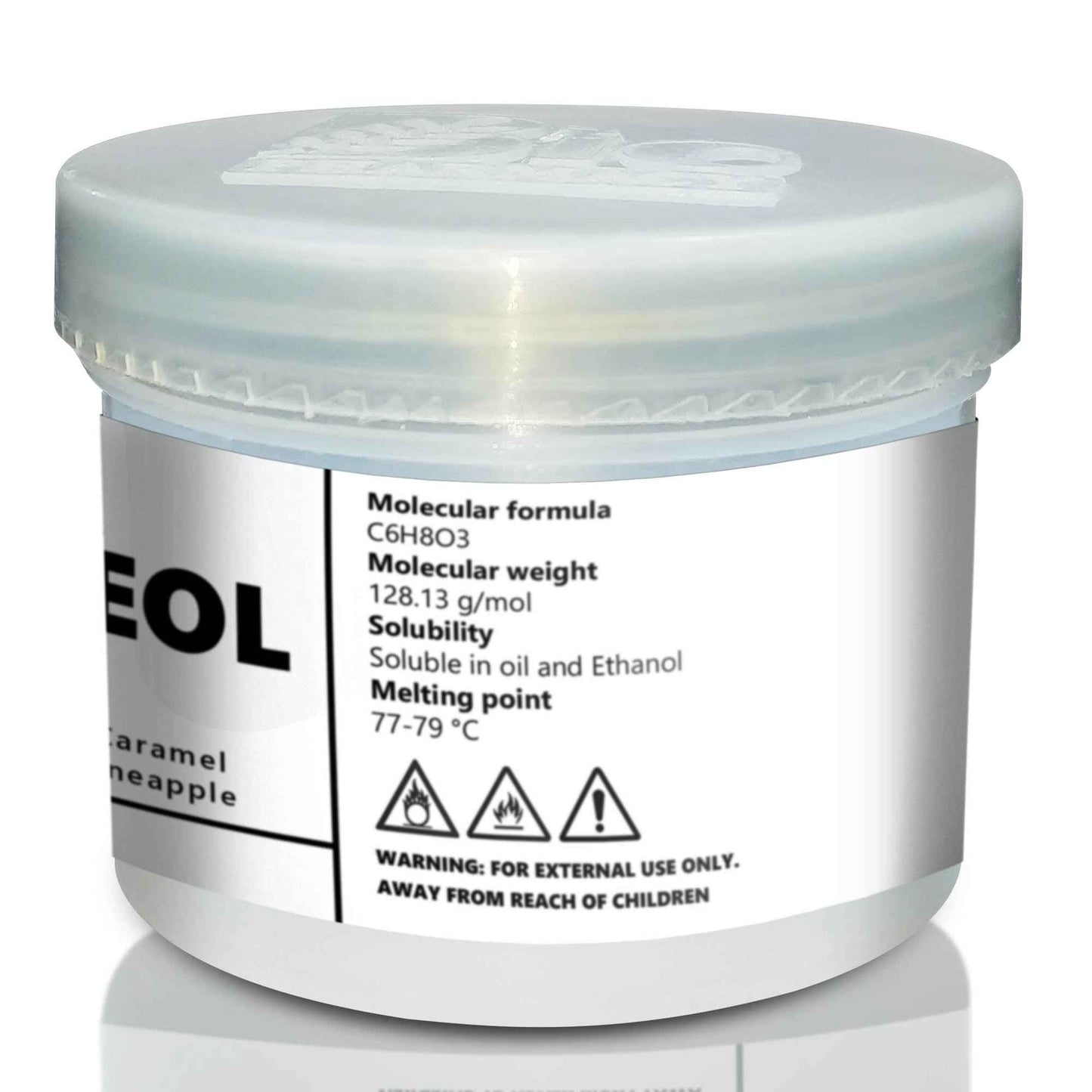
Furaneol
Furaneol
Olfactory Notes: Intensely sweet, caramelized strawberry and cotton-candy-like character.
Couldn't load pickup availability


Explore
Information About Furaneol
Key Features
✦ Delivers an intensely sweet, caramellic, and strawberry-like aroma with cotton candy and bready undertones — a defining gourmand ingredient
✦ Naturally occurring in strawberries, pineapples, and roasted foods — the synthetic version replicates this with exceptional fidelity
✦ Extremely low odor threshold (0.03–0.05 ppb in water) means very small amounts create significant olfactory impact
✦ Essential in modern gourmand, fruity, and oriental perfumery — used in candy accords, dessert fragrances, and sweet oriental bases
✦ Used in fine fragrance, body care, hair care, candles, and incense applications
✦ Semi-synthetic origin — can also be extracted from natural sources; the commercial form is bio-identical
✦ Vegan and cruelty-free in its synthetic form; widely accepted in natural-inspired and clean beauty formulations
About Furaneol
Furaneol, formally named 2,5-Dimethyl-4-hydroxy-3(2H)-furanone, was first identified as the primary impact compound responsible for the characteristic aroma of ripe strawberries. It was discovered in the 1960s during early gas chromatography studies of strawberry volatiles and quickly gained attention in both the food flavoring and fragrance industries. It naturally occurs in strawberries, pineapples, tomatoes, mangoes, roasted coffee, beef broth, and baked goods, making it one of the most universally familiar aroma compounds in human experience.
What makes furaneol exceptional is its extraordinary potency combined with a remarkably natural sweetness that does not smell synthetic or artificial. Unlike simple sweeteners such as vanillin or ethyl maltol, furaneol carries a dimensional character — simultaneously fruity, caramellic, bready, and floral in trace amounts. It acts as both a standalone note and a powerful harmonizer, smoothing harsh transitions in a formula while adding warmth and depth. Its behavior changes meaningfully with concentration: at very low doses it reads as fresh strawberry; at moderate doses it becomes caramellic candy; at higher doses it develops a deep, almost jam-like or roasted quality.
Bio Shop Pakistan supplies cosmetic-grade furaneol suitable for DIY perfumers, independent fragrance house formulators, home crafters, and cosmetic product developers working in Pakistan.
Olfactory Profile
SCENT DESCRIPTION : Furaneol opens with a burst of ripe, jammy strawberry that quickly settles into a rich caramel and cotton candy warmth. There is a soft bready, almost pastry-like undercurrent that gives the note depth and naturalness. At low concentrations it reads as fresh fruit; at higher use rates it becomes intensely sweet and dessert-like with a slight roasted nuance. The overall impression is comforting, familiar, and indulgent — like warm strawberry jam on freshly baked bread.
NOTE POSITION : Mid-Base
FRAGRANCE FAMILY : Gourmand · Fruity · Oriental
FACETS : Caramellic · Strawberry · Cotton Candy · Bready · Jammy
TENACITY : Medium — 4 to 7 hours on skin; longer on fabric and in wax
SILLAGE : Medium — intimate to moderate projection; radiates warmth at close range rather than projecting strongly into a room
Technical Specifications
Chemical Name : 2,5-Dimethyl-4-hydroxy-3(2H)-furanone
CAS Number : 3658-77-3
Synonyms : DMHF, Strawberry Furanone, Caramel Furanone, Pineapple Ketone, 4-Hydroxy-2,5-dimethyl-3(2H)-furanone
Purity : 98% minimum (fragrance and cosmetic grade)
Appearance : White to off-white crystalline powder or granules
Odor Threshold : 0.03–0.05 ppb in water (extremely potent)
Solubility : Freely soluble in ethanol and propylene glycol; slightly soluble in water; insoluble in most carrier oils cold — dissolve with gentle heat
Specific Gravity : Approximately 1.09 g/cm³ at 20°C (dissolved solution)
Flash Point : Greater than 100°C (solid form; not classified as flammable)
Type : Semi-synthetic (bio-identical to natural furaneol found in strawberries and pineapples)
Applications & Usage Guidelines
Fine Fragrance ★★★★★
Furaneol is a premier gourmand ingredient for EDPs and EDTs. It contributes caramellic sweetness and strawberry depth to the heart and base of candy, fruity, and oriental compositions. Recommended at 0.1–1.5% in the final fragrance blend for perceptible impact without overpowering other notes.
Attar and Oriental Blending ★★★★★
In attar and oriental perfumery, furaneol blends seamlessly with oud, amber, musk, and vanilla to create warm, edible depth. It enhances the sweetness of rose and jasmine bases without introducing a synthetic edge. Use at 0.05–0.5% in concentrated attar bases for a layered gourmand warmth.
Functional Fragrance ★★★☆☆
Furaneol performs reasonably well in body washes, shampoos, and light functional products where a sweet, fruity character is desired. Stability should be tested in high-pH formulations, as furaneol can degrade under strongly alkaline conditions. Keep usage rates conservative — typically 0.05–0.3%.
Cosmetics ★★★★☆
In creams, scrubs, and hair care products, furaneol adds a delicate sweet-caramel scent note that enhances perceived luxury. It is stable in most emulsion pH ranges (4.5–7.0). Patch testing is advised for leave-on skin care at higher concentrations due to sensitization potential.
Home Fragrance ★★★★☆
Furaneol performs well in candles, reed diffusers, and incense sticks, where it contributes a warm, sweet, dessert-like ambiance. In soy and coconut wax candles, use at 0.5–2% of the fragrance load. In incense, it burns with a sweet caramellic smoke that blends well with sandalwood and vanilla bases.
IFRA & Usage Rate
Recommended Usage Rates by Application
EDP (Eau de Parfum) : 0.2 – 1.5%
EDT (Eau de Toilette) : 0.1 – 1.0%
Body Lotion / Cream : 0.05 – 0.3%
Shampoo / Body Wash : 0.05 – 0.2%
Candle (in fragrance load) : 0.5 – 2.0%
Reed Diffuser : 0.5 – 2.5%
Soap (melt and pour / CP) : 0.1 – 0.5%
IFRA 51st Amendment Guidance
Furaneol appears in the IFRA standards as a material requiring category-specific limits due to sensitization data. The limits below are approximate — always verify against the current IFRA 51st Amendment standard document before commercial production.
Category 1 (Lip products) : 0.01% maximum — verify with IFRA
Category 4 (Body lotion, hand cream) : 0.06% maximum — verify with IFRA
Category 5A (Face moisturizer) : 0.06% maximum — verify with IFRA
Category 5B (Hand sanitizer) : 0.06% maximum — verify with IFRA
Category 9 (Rinse-off body) : 0.4% maximum — verify with IFRA
Category 11A (Fine fragrance, EDP/EDT) : No restriction cited in current amendment — verify with IFRA
⚠️ IFRA limits are subject to revision. Always consult the official IFRA 51st Amendment standards document at ifrafragrance.org before finalizing any commercial formula.
⚠️ Furaneol has documented skin sensitization potential in some studies. Perform a dermal sensitization risk assessment for leave-on products, especially at concentrations above 0.1% in rinse-off and 0.05% in leave-on applications.
⚠️ Dissolve furaneol in warm ethanol or propylene glycol before incorporating into your formula. Do not add the raw powder directly to cold oil or water phases.
Blending Guide
Method 1 — Dissolution in Ethanol
Furaneol is a solid at room temperature and must be pre-dissolved before use. Add the measured amount to warm (40–50°C) perfumers alcohol or propylene glycol and stir until fully dissolved. A 10% dilution in ethanol is a practical working stock for precise dosing in fragrance formulas. Never add raw crystalline furaneol directly to a cold formula.
Method 2 — Gourmand Accord Building
Furaneol is the backbone of any serious gourmand accord. Layer it with ethyl maltol for added cotton candy sweetness, vanillin for creamy vanilla depth, and gamma-decalactone for a peach-cream fruity dimension. Start with furaneol at 0.3%, ethyl maltol at 0.5%, and vanillin at 1.0% as a base accord, then build around it.
Method 3 — Oriental and Attar Enhancement
In oud-based or amber-heavy orientals, furaneol works as a sweetening bridge that softens the resinous and animalic elements. Add it to the base accord at 0.05–0.15% to impart a subtle jammy warmth without pushing the composition into full gourmand territory. It harmonizes especially well with rose absolute and Taif rose oil in Pakistani-style attars.
BEST PAIRINGS
Vanillin → Deepens sweetness and adds creamy vanilla dimension to the caramel note
Ethyl Maltol → Creates a cotton candy and spun sugar effect; classic sweet accord combination
Gamma-Decalactone → Adds ripe peach and cream facets; builds a fuller fruity-gourmand structure
Coumarin → Softens furaneol and introduces a warm, powdery almond-hay nuance
Rose Oxide → Adds green-floral lift that contrasts beautifully with the caramellic sweetness
Benzyl Benzoate → Acts as fixative and diffusion enhancer; improves tenacity on skin
Oud / Agarwood Base → Creates a deep, sweet-smoky oriental; very effective in attar construction
Sandalwood → Provides creamy woody support that elevates the sweetness without masking it
Ambroxan → Adds skin-close musk depth; makes furaneol-based accords feel luxurious and modern
AVOID
Furaneol can clash with intensely green, aquatic, or ozonic ingredients such as cis-3-hexenol, Calone, or Dihydromyrcenol. The contrast between its warm sweetness and fresh-cold notes reads as dissonant rather than interesting. Also avoid combining furaneol with ingredients having strong phenolic or medicinal characters, such as eugenol or isoeugenol at high doses, as the combination can produce an unpleasant medicinal-candy effect.
Perfumer's Note
I consider furaneol one of the most deceptively simple yet technically demanding ingredients in a gourmand perfumer's palette. Its challenge is not in its character — that warm, universally loved strawberry-caramel sweetness is immediately recognizable — but in its concentration sensitivity. Drop below the perception threshold and it disappears entirely. Push slightly over and it collapses the composition into a single-note candy. The sweet spot, typically between 0.1% and 0.5% in a finished fragrance, is where furaneol becomes a texture rather than a note — adding a dimensional warmth that makes a composition feel full and satisfying without reading as edible in an obvious way.
ADVANCED TIP : Try a technique I call caramel underlighting. Dissolve furaneol at 0.2% in your base alongside benzyl benzoate at 3% and a trace of ethyl maltol at 0.3%. Do not use furaneol in the heart at all. This positions its caramellic warmth entirely in the dry-down, where it emerges 30 minutes after application as a gentle, unexpected sweetness beneath your main accord. This approach works brilliantly in floral orientals and woody musks where direct gourmand character would feel heavy, but a hint of sweetness in the base creates lasting emotional appeal.
Safety & Storage
Physical State : White crystalline solid at room temperature; dissolves in ethanol and PG
Skin Safety : Potential skin sensitizer — keep leave-on concentrations conservative; perform IFRA risk assessment before commercial use; patch test recommended
Eye Contact : Avoid direct contact; rinse immediately with water for 15 minutes if contact occurs; seek medical attention if irritation persists
Ingestion : Not intended for ingestion in fragrance grade form; keep away from food and beverages; if ingested call poison control
Ventilation : Work in a ventilated area when weighing or dissolving; avoid prolonged inhalation of dust from raw powder
Storage : Store in a cool, dry place away from direct light and heat; ideal temperature 10–25°C; keep container tightly sealed to prevent moisture absorption
Shelf Life : 24 months from date of manufacture when stored correctly in sealed original container
Container : Store in glass or HDPE containers; avoid prolonged contact with reactive metals
Flammability : Flash point greater than 100°C; not classified as flammable under standard conditions; keep away from open flame as general precaution
FAQ
Q: What does furaneol smell like on its own?
A: Furaneol smells intensely sweet, caramellic, and strawberry-like with a cotton candy and slightly bready character. The raw powder has a powerful, almost jam-like aroma that becomes more nuanced when diluted in a formula.
Q: How do I dissolve furaneol since it comes as a solid powder?
A: Dissolve furaneol in warm ethanol, propylene glycol, or DPG at 40–50°C before adding it to your formula. Making a 10% pre-dilution in perfumers alcohol is the most practical approach for accurate dosing.
Q: Can I use furaneol in cold process soap?
A: Yes, but use it conservatively at 0.1–0.5% of the fragrance load. High-pH soap environments can degrade furaneol over time, so perform a cure and sniff test over 4–6 weeks to assess scent retention in your specific formula.
Q: Is furaneol the same as ethyl maltol or vanillin?
A: No, they are distinct ingredients. Ethyl maltol reads as cotton candy and caramel, vanillin as creamy vanilla, and furaneol as strawberry-caramel with a bready nuance. They are highly complementary and often combined to build complete gourmand accords, but each contributes a unique facet.
Q: How does synthetic furaneol compare to the natural furaneol found in real strawberries?
A: Commercial furaneol (CAS 3658-77-3) is bio-identical — the same molecule found in natural strawberries, pineapples, and roasted foods. The synthetic route produces a chemically identical compound at a fraction of the cost and with greater purity consistency than any natural extract could provide. For all practical perfumery and cosmetic purposes, synthetic and natural furaneol are indistinguishable.
Where Can You Safely Use Furaneol?
Discover how Furaneol performs across different applications—rated for safety, stability, and effectiveness.