Bio Shop
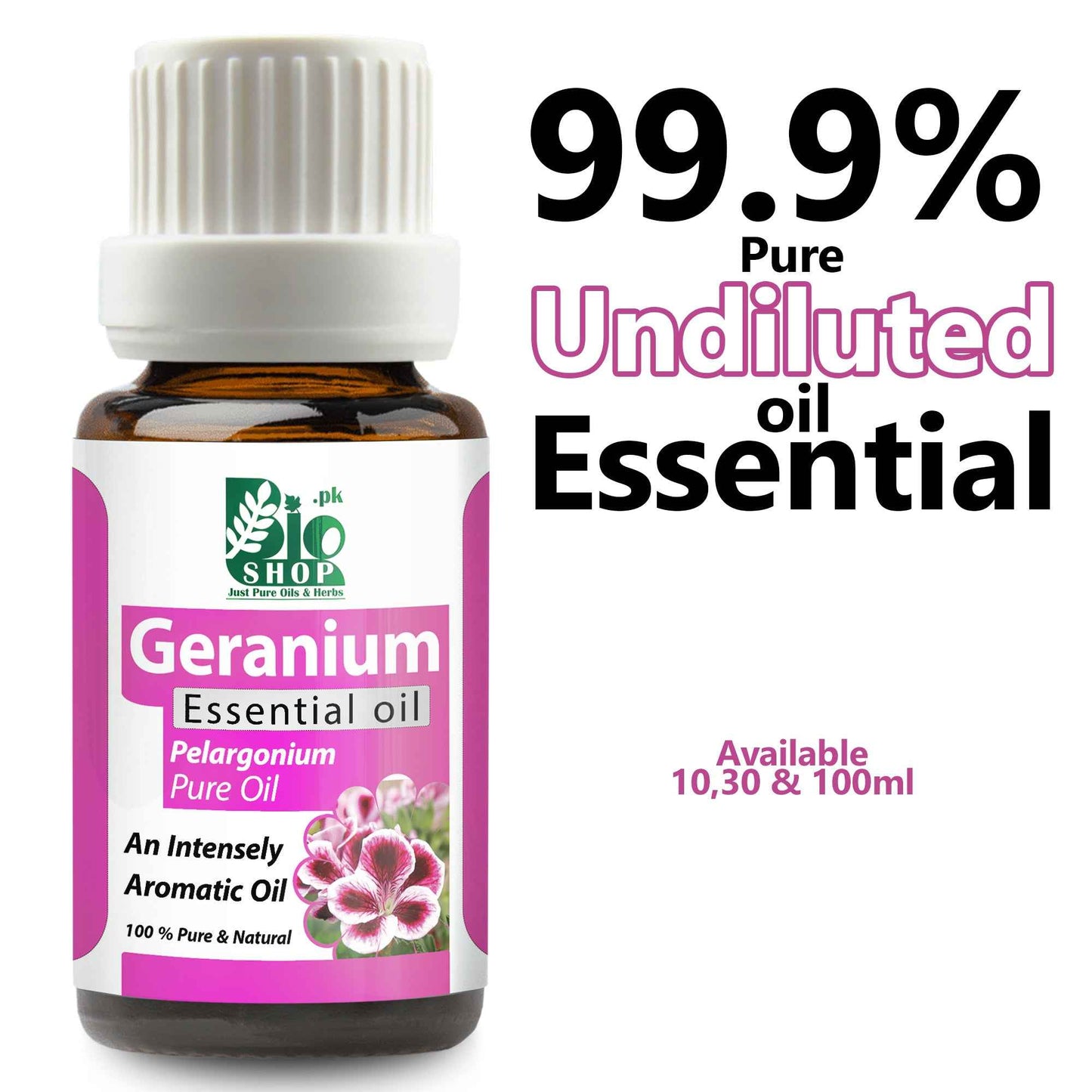
Geranium Essential Oil
Geranium Essential Oil
Olfactory Notes: Green, leafy rose profile; essential for fougère and floral scents.
Couldn't load pickup availability


Explore
Information About Geranium Essential Oil
Key Features
✦ 100% pure steam-distilled Geranium Essential Oil from Pelargonium graveolens — no dilution, no adulteration
✦ Fresh rosy-green floral scent with soft herbaceous and minty undertones — a natural rose extender and modifier
✦ Rich in citronellol and geraniol — key components prized in both perfumery and cosmetic skin-benefit applications
✦ Exceptional blender: bridges floral, green, and earthy fragrance families for versatile top-to-mid note construction
✦ Widely used in fine fragrance, attars, serums, creams, shampoos, and functional personal care products
✦ Vegan and cruelty-free — steam distilled from aerial plant parts with no animal-derived processing
✦ Cosmetic-grade quality suitable for leave-on and rinse-off formulations within IFRA and regulatory guidelines
About Geranium Essential Oil
Geranium Essential Oil has been prized since the 17th century when Pelargonium species were first brought to Europe from South Africa. By the 19th century, commercial cultivation had taken root in Grasse, France — the perfumery capital of the world — and today the finest grades come from Egypt, Morocco, China, and the Reunion Islands, the latter producing the legendary Bourbon Geranium. Steam distillation of the fresh leaves, stems, and flowers yields a vivid, complex oil that has remained a cornerstone of classical and contemporary perfumery for over two centuries.
What sets Geranium Essential Oil apart is its extraordinary chemical profile. Citronellol and geraniol — two of nature's most elegant aroma compounds — combine with linalool, isomenthone, and citronellyl formate to produce a scent that reads simultaneously as rosy, clean, green, and softly herbaceous. This complexity makes it one of the most useful naturals available: it reinforces rose without the cost of rose absolute, adds green character without the sharpness of violet leaf, and grounds citrus blends without pulling them toward wood or resin. In skin care, the same constituents contribute to its well-documented astringent and sebum-balancing properties.
Bio Shop Pakistan supplies cosmetic-grade Geranium Essential Oil suitable for DIY perfumers creating floral, oriental, and green fragrances, skincare formulators developing serums and creams, attar blenders crafting traditional Pakistani and Gulf-style compositions, and home crafters producing candles, soap, and personal care products.
Olfactory Profile
SCENT DESCRIPTION : Geranium Essential Oil opens with a vivid burst of fresh green-rosy brightness — simultaneously herbaceous and floral, clean yet complex. The heart reveals its signature rosy character, softened by a subtle minty-cool facet that distinguishes it from heavier rose materials. At drydown it leaves a warm, slightly waxy-green trail with gentle earthy undertones, lending compositions a natural, garden-fresh quality that synthetic rose accords rarely replicate.
NOTE POSITION : Top to Mid
FRAGRANCE FAMILY : Floral · Green · Herbal-Aromatic
FACETS : Rosy · Fresh-Green · Herbaceous · Minty-Cool · Waxy-Floral
TENACITY : Medium — active in blend for 4 to 6 hours on skin; longer on fabric and diffuser materials
SILLAGE : Medium — radiates a soft, natural aura around the wearer without projecting aggressively; ideal for intimate and personal-wear fragrances
Technical Specifications
Chemical Name : Pelargonium graveolens herb oil (steam distillate)
CAS Number : 90082-51-2
Synonyms : Rose Geranium Oil · Geranium Rose Oil · Pelargonium Oil · Geranium Bourbon (Reunion Island origin)
Purity : 100% pure essential oil (no carrier, no diluent)
Appearance : Clear to pale yellow-green mobile liquid
Odor Threshold : Very low — detectable at trace concentrations in complex blends
Solubility : Insoluble in water; fully soluble in ethanol, fixed oils, and cosmetic esters
Specific Gravity : 0.879 – 0.903 at 20°C (verify against supplier CoA)
Flash Point : Approximately 73°C – 78°C (verify against supplier CoA)
Type : Natural — 100% plant-derived via steam distillation
Key Constituents : Citronellol (20–35%) · Geraniol (10–20%) · Linalool (5–12%) · Citronellyl Formate (5–10%) · Isomenthone (3–8%)
Applications & Usage Guidelines
Fine Fragrance : ★★★★★
Geranium Essential Oil is a classical fine fragrance material, used in thousands of commercial launches across floral, chypre, fougère, rose soliflore, and green compositions. It functions as a top-to-mid note modifier, adding natural vibrancy and rosy freshness that bridges expensive rose materials and lighter green accords. Usage rates of 1% to 8% in finished EdP/EdT are typical depending on the desired effect.
Attar & Oriental Blending : ★★★★★
In Pakistani and Gulf attar tradition, Geranium Essential Oil serves as a key modifier in rose attars, floral mukhallats, and green-oriental compositions. It extends expensive rose otto or rose absolute at a fraction of the cost while contributing its own green, dewy character. Combine with sandalwood, oud, musk, and rose at 2% to 10% in the attar concentrate for authentic multi-layered depth.
Skincare & Cosmetics : ★★★★☆
Geranium's well-documented astringent and skin-balancing properties make it a valued active in serums, creams, toners, and facial oils — particularly for oily or combination skin types. At 0.5% to 1% in leave-on products, it contributes both scent and functional benefit. Its geraniol and citronellol content requires adherence to IFRA limits for sensitization safety in rinse-off and leave-on categories.
Hair Care : ★★★★☆
Widely used in shampoos, conditioners, and scalp treatments, Geranium Essential Oil provides scalp-balancing, fragrance, and a clean floral-herbal scent character popular in prestige hair care. It performs well in both rinse-off and leave-on hair formats. Recommended usage in shampoo is 0.5% to 2% in the finished formulation.
Home Fragrance & Functional Fragrance : ★★★★☆
Geranium performs well in reed diffusers, wax melts, room sprays, and potpourri, delivering a natural fresh-floral note without the synthetic flatness of many aroma chemicals. In candles, moderate usage of 3% to 6% in wax is typical as flash point and hot-throw behavior should be tested per wax type. Also effective in fabric softeners, functional personal care, and aromatherapy applications.
IFRA & Usage Rate
RECOMMENDED USAGE RATES IN FINISHED PRODUCT
Eau de Parfum (EdP) : 1.0% – 8.0%
Eau de Toilette (EdT) : 1.0% – 6.0%
Body Lotion / Cream : 0.3% – 1.5%
Shampoo / Body Wash : 0.5% – 2.0%
Soy / Paraffin Candle : 3.0% – 6.0%
Reed Diffuser : 5.0% – 15.0%
Cold Process Soap : 1.0% – 3.0%
Facial Serum : 0.3% – 0.8%
Attar Concentrate : 2.0% – 12.0%
IFRA 51ST AMENDMENT LIMITS — PELARGONIUM GRAVEOLENS OIL
(Limits shown as maximum % in finished product — verify current standards at ifrafragrance.org)
IFRA Category 1 (Lip products) : 0.2%
IFRA Category 2 (Deodorant sprays/body sprays) : 1.3%
IFRA Category 3 (Eye-area and facial cosmetics) : 0.5%
IFRA Category 4 (Fine fragrance, EdP, EdT) : 6.8%
IFRA Category 5a (Body lotion, leave-on cream) : 1.3%
IFRA Category 5b (Face cream, leave-on facial) : 0.8%
IFRA Category 6 (Mouthwash / oral products) : Not recommended
IFRA Category 7a (Rinse-off hair products) : 3.4%
IFRA Category 8 (Shampoo, body wash) : 3.4%
IFRA Category 9 (Bar soap, liquid soap) : 3.4%
IFRA Category 11a (Candles) : No restriction listed
⚠️ Geranium Essential Oil contains citronellol and geraniol — both EU-listed fragrance allergens requiring declaration on cosmetic labels in the EU at concentrations above 0.001% in leave-on and 0.01% in rinse-off products.
⚠️ Always formulate within IFRA limits for the intended product category. Lip product usage requires strict adherence to the 0.2% limit.
⚠️ Verify final IFRA limits against the current 51st Amendment standard and your supplier Certificate of Analysis before production.
Blending Guide
METHOD 1 — DIRECT ADDITION TO ALCOHOL BASE
Add Geranium Essential Oil directly to perfumers alcohol at the desired concentration. Allow the blend to macerate for a minimum of 48 to 72 hours before evaluation, as geranium's green-rosy facets integrate and soften considerably with time. This is the standard approach for fine fragrance and attar-in-alcohol applications.
METHOD 2 — DILUTION IN CARRIER OIL FOR COSMETIC USE
For skincare, massage, or hair oil applications, dilute Geranium Essential Oil at 0.5% to 2% in a suitable carrier oil such as jojoba, sweet almond, or fractionated coconut. Pre-blend the essential oil with a small amount of carrier first before incorporating into the full batch to ensure even distribution.
METHOD 3 — INCORPORATION INTO SOAP AND WASH PRODUCTS
Add Geranium Essential Oil to cooled soap batter (cold process) at trace stage, or add to the aqueous phase of liquid formulations at temperatures below 40°C to preserve volatile top notes. In cold process soap, combine with a fixative such as patchouli, cedarwood, or benzoin to reduce top note loss during cure.
BEST PAIRINGS
Rose Otto / Rose Absolute → Amplifies and extends the rosy core; reduces cost without compromising character
Lavender Essential Oil → Classic fougère-floral pairing; clean, balanced, and broadly appealing
Bergamot Essential Oil → Adds sparkling citrus brightness on top of the green-rosy base
Patchouli Essential Oil → Grounds the blend with earthy depth; a cornerstone of chypre and oriental profiles
Sandalwood (Mysore / Synthetic) → Smooth woody drydown that lifts geranium's warmth on the skin
Cedarwood / Atlas Cedar → Adds dry, clean woody structure; excellent in fougères and masculine florals
Vetiver → Adds smoky-earthy contrast to the fresh green facets
Ylang Ylang → Creates rich, heady floral depth; use sparingly as ylang can overwhelm
Clary Sage Essential Oil → Reinforces the herbaceous-green character with slightly musky depth
Lemon / Sweet Orange EO → Bright citrus opening that harmonises beautifully with geranium's freshness
AVOID
✦ Avoid combining at high concentrations with other citronellol-rich materials (e.g., rose oxide, citronellal) in leave-on products — cumulative allergen levels can breach IFRA limits
✦ Avoid prolonged exposure to heat, light, and moisture in the blending environment as geraniol and citronellol are prone to oxidation, which can affect scent quality and skin safety
Perfumer's Note
Working with Geranium Essential Oil is one of the genuine pleasures of natural perfumery — it is that rare material that behaves generously in almost every composition type. I use it not just as a floral note in its own right, but as a living bridge: it connects the radiant brightness of citrus top notes to the warmth of woody or resinous bases without the jarring discontinuity you often get when those two worlds meet. What I find most useful is its ability to modulate rose compositions — a small addition of geranium at 1% to 2% makes a rose absolute or rose otto smell less precious and more wearable, more like a living flower than a museum piece. In Pakistani and Gulf attar-style work, this property is invaluable when building affordable, high-quality rose mukhallats.
ADVANCED TIP : To create a surprisingly beautiful rose-forward accord on a budget, combine Geranium Essential Oil at 15 to 20 parts with Phenyl Ethyl Alcohol at 50 parts, Rose Oxide at 1 to 2 parts, and Citronellol at 15 parts. This accord, when used at 5% to 10% in your finished fragrance, delivers a convincing dewy rose character at a small fraction of rose absolute cost. Geranium provides the green-rosy lift and naturalness that purely synthetic rose accords often lack — it is what makes the accord breathe.
Safety & Storage
Physical State : Clear to pale yellow-green mobile liquid at room temperature
Skin Safety : Safe within IFRA limits; may cause sensitization in individuals with known citronellol or geraniol sensitivity — patch test recommended for leave-on products
Eye Contact : Avoid direct eye contact; flush thoroughly with water if contact occurs and seek medical advice if irritation persists
Ingestion : Not for internal use; keep out of reach of children
Ventilation : Use in a well-ventilated workspace; avoid prolonged inhalation of concentrated vapors
Storage : Store in a tightly sealed amber glass or aluminium container, away from direct sunlight, heat sources, and humidity
Shelf Life : 2 to 3 years from production date when stored correctly; citronellol and geraniol are prone to oxidation — refrigeration extends life
Container : Amber glass, aluminium, or HDPE — do not store in clear PET or polystyrene containers
Flammability : Flammable liquid — flash point approximately 73°C to 78°C; keep away from open flames and ignition sources during use and storage
FAQ
Q: Can I apply Geranium Essential Oil directly to my skin?
A: No. Geranium Essential Oil must always be diluted in a carrier oil, lotion, or formulation before skin application. Direct application risks irritation and sensitization. Safe dilution for leave-on use is typically 0.5% to 1.5%.
Q: What is Bourbon Geranium and is it different from regular geranium oil?
A: Bourbon Geranium refers to Geranium Essential Oil produced on the Reunion Islands (formerly Île Bourbon) and is considered the finest quality due to its exceptionally balanced citronellol and geraniol ratio. It tends to be richer, smoother, and more rosy than Egyptian or Chinese grades, which are sharper and more herbaceous.
Q: Can I use Geranium Essential Oil in cold process soap?
A: Yes, but expect some top note loss during the cure period as volatile components evaporate. Anchor it by blending with patchouli, cedarwood, or benzoin before adding to the soap batter. A usage rate of 1% to 3% in the finished bar is typical.
Q: Does Geranium Essential Oil have a IFRA restriction I should know about?
A: Yes. Geranium oil is IFRA-regulated primarily due to its citronellol and geraniol content. The most restrictive limits apply to lip products (0.2%) and eye-area cosmetics (0.5%). Fine fragrance allows up to 6.8% in the finished product. Always verify the current 51st Amendment limits at ifrafragrance.org before formulating.
Q: How does Geranium Essential Oil compare to Rose Absolute or Rose Otto?
A: Rose Absolute and Rose Otto are richer, deeper, and more complex with a heavier honeyed quality. Geranium shares the rosy-citronellol character but is significantly fresher, greener, and more affordable — often 20 to 50 times less expensive than true rose materials. Many perfumers use geranium as a rose extender or modifier rather than a replacement, as the two materials complement each other beautifully in a blend.
Where Can You Safely Use Geranium Essential Oil?
Discover how Geranium Essential Oil performs across different applications—rated for safety, stability, and effectiveness.
Good quality oils
Excellent quality