Bio Shop
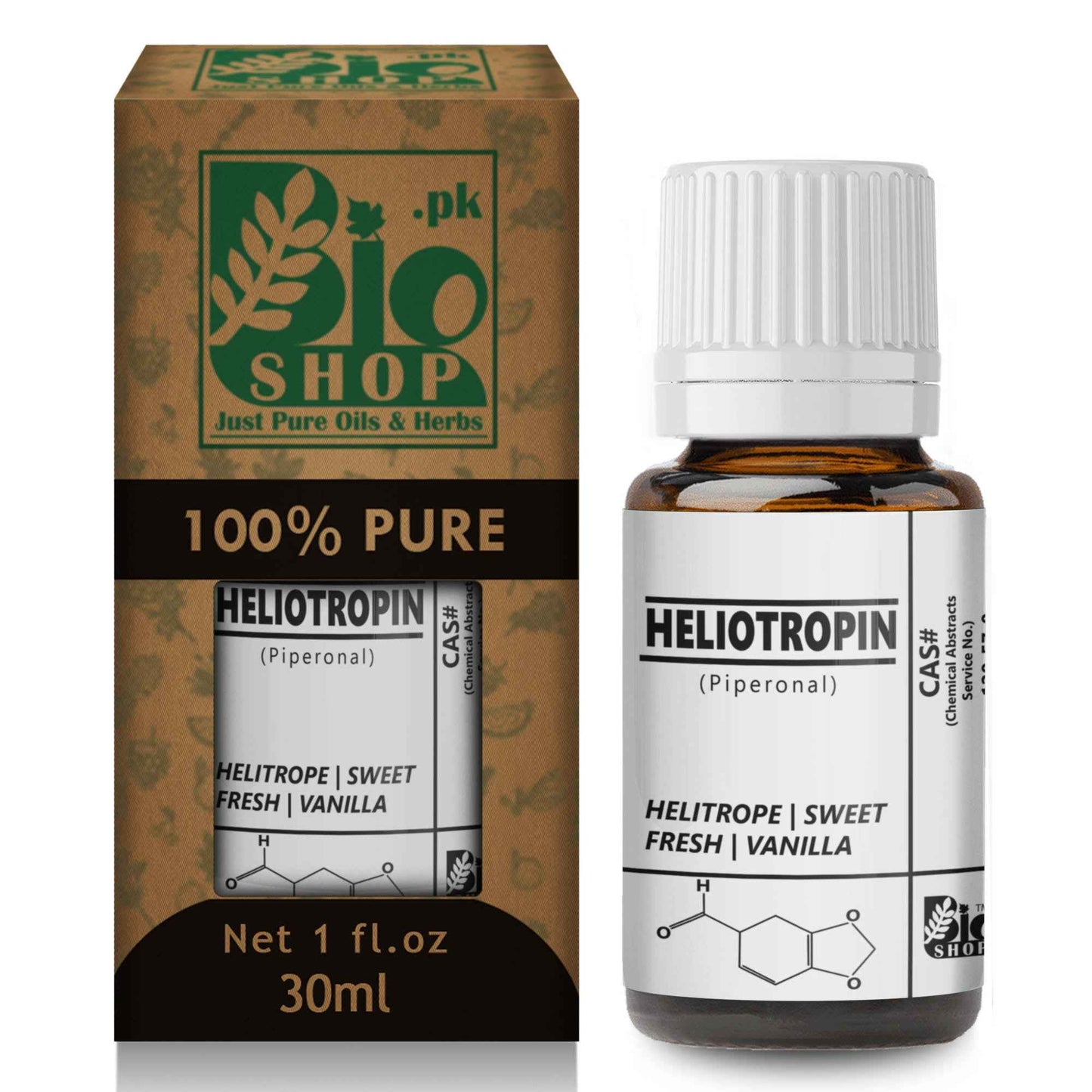
Heliotropin
Heliotropin
Olfactory Notes: Powdery, sweet "Cherry Pie" or marzipan-floral note.
Couldn't load pickup availability
Explore
Information About Heliotropin
Key Features
✦ Heliotropin (Piperonal) delivers a signature sweet, powdery, floral-almond scent that instantly adds softness and warmth to any fragrance blend.
✦ One of the most versatile aroma chemicals in perfumery — used in floral, oriental, gourmand, powdery, and aldehydic accords.
✦ Appears as a white to off-white crystalline solid that melts easily into warm alcohol or carrier oil.
✦ Core ingredient in iconic fragrance families including baby powder accords, heliotrope soliflores, and classic oriental bases.
✦ Suitable for fine fragrance, soaps, candles, body care, and home fragrance at varied usage levels.
✦ IFRA-regulated sensitizer — usage rates must stay within recommended limits for each application category.
✦ Vegan and not animal-derived — synthetically produced from safrole or piperonal precursors.
About Heliotropin
Heliotropin, known scientifically as piperonal, was first isolated in the mid-19th century from heliotrope flowers and oil of sassafras. It quickly became one of the earliest commercially synthesized aroma chemicals, entering perfumery in the late 1800s when the industry was just beginning to embrace synthetic ingredients. Its distinctive powdery-sweet, floral-almond character made it an immediate staple, and it remains in active use over 150 years later — a testament to its enduring appeal and versatility across fragrance styles.
What sets heliotropin apart from other floral aroma chemicals is its unique ability to soften and unify a composition. It rounds sharp edges, adds a quiet sweetness without becoming overtly sugary, and lends a nostalgic, skin-like warmth that many perfumers describe as comforting or intimate. Its dry powdery facets make it ideal for creating vintage-style floral aldehydics, modern musk-forward blends, and the beloved baby-powder accords that remain popular in functional fragrance and personal care. It interacts beautifully with coumarin, musks, and vanillin, multiplying their diffusion and softness.
Bio Shop Pakistan supplies cosmetic-grade heliotropin suitable for DIY perfumers, independent fragrance houses, soap makers, and beauty formulators across Pakistan who require a dependable, high-purity aroma chemical for professional and home use applications.
Olfactory Profile
SCENT DESCRIPTION : Heliotropin opens with a delicate, powdery sweetness that evokes the soft petals of heliotrope flowers mingled with warm almond and a faint suggestion of cherry. As it dries down, it takes on a creamy, skin-like depth — almost talcum-soft — with subtle floral and slightly spicy undertones. It is never harsh or strident; instead, it wraps a composition in a quiet, rounded warmth. On skin, it blends seamlessly with natural body chemistry, creating an intimate, signature softness.
NOTE POSITION : Mid to Base
FRAGRANCE FAMILY : Floral · Powdery · Oriental
FACETS : Sweet · Powdery · Almond · Floral · Warm
TENACITY : Medium — 6 to 10 hours on skin, longer on fabric
SILLAGE : Low to Medium — a close, intimate projection that stays near the skin rather than projecting boldly; ideal for skin scents and intimate wear
Technical Specifications
Chemical Name : Piperonal (3,4-Methylenedioxybenzaldehyde)
CAS Number : 120-57-0
Synonyms : Piperonal · Piperonyl Aldehyde · 3,4-Methylenedioxybenzaldehyde · Heliotrope Aldehyde
Purity : 99% minimum
Appearance : White to off-white crystalline solid; melts to clear liquid above 37°C
Odor Threshold : Approximately 1–4 ppb in air (extremely low — very detectable at trace levels)
Solubility : Slightly soluble in water; freely soluble in ethanol, diethyl ether, and most fragrance carriers; soluble in DPG and IPM when warmed
Specific Gravity : Approximately 1.337 at 25°C (verify with supplier lot certificate)
Flash Point : Approximately 116°C (241°F)
Type : Synthetic (also occurs naturally in heliotrope flowers and sassafras oil at trace levels)
Applications & Usage Guidelines
Fine Fragrance : ★★★★★
Heliotropin is a classic fine fragrance material used in florals, orientals, chypres, and powdery compositions. It is found in the bases of some of the most celebrated perfumes of the 20th and 21st century. Even at 0.5%, it can transform a linear floral into something rounded and memorable.
Attar and Oriental Blending : ★★★★★
Heliotropin blends seamlessly into traditional attar-style compositions. Its powdery warmth enhances oud, rose, sandalwood, and amber bases, adding a soft Western-style sweetness that bridges classical Eastern perfumery with modern sensibilities. It pairs particularly well with dark musk and resinous bases.
Functional Fragrance : ★★★★☆
In soaps, shampoos, body washes, and lotions, heliotropin contributes a clean, powdery note that consumers associate with freshness and quality. Usage rates must respect IFRA category limits for rinse-off and leave-on products due to sensitization potential.
Cosmetics : ★★★★☆
Used as a scenting agent in creams, body butters, and talcum powders. Heliotropin is stable in most cosmetic matrices. Its natural association with baby powder accords makes it appealing for gentle skin care lines. Monitor concentration to stay within IFRA leave-on limits.
Home Fragrance : ★★★★★
Heliotropin performs excellently in candles, reed diffusers, and incense. Its low volatility and high tenacity allow it to project evenly over time. In candle wax, it provides a warm, sweet-powdery room note that is universally appealing and gender-neutral.
IFRA & Usage Rate
Recommended Usage Rates
EDP : 0.5 – 2.5% in finished fragrance concentrate
EDT : 0.3 – 1.5%
Body Lotion : 0.05 – 0.2% in finished product (leave-on limit applies)
Shampoo/Body Wash : 0.1 – 0.5% in finished product (rinse-off)
Candle : 2 – 6% in finished candle
Reed Diffuser : 2 – 8% in diffuser blend
Soap (Bar) : 0.3 – 1.0% in finished soap
IFRA 51st Amendment Limits (Piperonal / CAS 120-57-0)
Category 1 (Lip products) : 0.01% in finished product
Category 4 (Fine fragrance) : Approximately 1.4% in finished product
Category 5A (Body lotion, leave-on) : Approximately 0.2% in finished product
Category 9 (Rinse-off body/hair) : Approximately 0.5% in finished product
Category 11A (Candle) : Not restricted under IFRA (verify current amendment)
⚠️ Heliotropin is a known skin sensitizer. Always calculate final product concentration — not just the fragrance oil concentration — against the applicable IFRA category limit.
⚠️ IFRA limits apply to the finished product, not the fragrance compound. Adjust usage rates in your formulation accordingly.
⚠️ Always verify the most current IFRA limits at ifrafragrance.org before production.
Blending Guide
Method 1 — Dissolving for Alcohol Perfume
Heliotropin is a crystalline solid. Gently warm your carrier alcohol or DPG to 40–50°C, add heliotropin crystals, and stir until fully dissolved before adding other materials. Do not introduce it cold into finished blends — undissolved crystals will cloud your perfume.
Method 2 — Pre-blending in DPG
For soap and cosmetic applications, pre-dissolve heliotropin in dipropylene glycol (DPG) at a 1:4 ratio (warmed). This creates a pourable stock solution that disperses evenly into water-based and oil-based formulas without clumping or recrystallization.
Method 3 — Layered Base Building
Use heliotropin as a mid-to-base note anchor. Build it as part of a powdery base alongside coumarin and a musk, then layer floral and top notes over this foundation. This technique produces a well-rounded, cohesive composition with excellent longevity.
BEST PAIRINGS
Vanillin → Deepens sweetness and creates a classic gourmand-oriental base
Coumarin → Produces a timeless powdery-sweet accord, perfect for oriental florals
Benzyl Acetate → Adds a fresh jasmine-fruity lift that brightens the powdery character
Iso E Super → Adds woody depth and amplifies diffusion and skin-blending
Ethyl Linalool → Creates a soft floral-powdery accord with added freshness
Ambrette Seed → Builds a skin musk-powdery combination with excellent tenacity
Rose Oxide → Contrast — sharpens the accord and adds rose-metallic edge
Sandalwood EO → Anchors the base and adds creamy wood depth to the sweet accord
Musk Ketone/Exaltone → Classic powdery musk accord — vintage perfumery staple
AVOID
Do not combine heliotropin at high concentrations with strong aldehydes (C-11, C-12) in the same base without careful testing — the combination can turn soapy and sharp. Also avoid introducing into very alkaline soap batter above pH 10 without testing, as higher pH may cause slight discoloration or stability issues over time.
Perfumer's Note
I have worked with heliotropin across hundreds of compositions, and it never ceases to surprise me with how much it gives for how little it takes. It is the kind of ingredient that you notice more by its absence than its presence — when it is in a blend, everything feels warmer, rounder, and more complete. It excels in the space between floral and oriental, acting as a bridge that makes both families feel more polished. I use it in almost every powdery base I construct, and often sneak it into florals just to give them a softer skin-like quality that reads as sophisticated without being obvious.
ADVANCED TIP
Try building a classic heliotrope soliflore accord using heliotropin at 3%, coumarin at 1.5%, vanillin at 0.5%, and a light synthetic musk at 2% — all dissolved in ethanol. Test this base at 10–15% total in a 90% ethanol perfume. The result is a vintage-style floral with remarkable elegance and longevity. From this base, add small amounts of violet leaf absolute or orris concrete to push it toward a true heliotrope character, or add rose oxide and geraniol to pull it into a powdery floral rose direction. This foundation is extraordinarily versatile and forms the backbone of some of the most beloved powdery feminine fragrances in history.
Safety & Storage
Physical State : White crystalline solid at room temperature; melts above 37°C
Skin Safety : Known sensitizer — follow IFRA limits strictly; patch test on sensitive individuals; avoid undiluted skin contact
Eye Contact : Avoid direct contact; rinse thoroughly with water for 15 minutes if contact occurs; seek medical advice if irritation persists
Ingestion : Not for consumption; if ingested, seek immediate medical attention
Ventilation : Use in a well-ventilated workspace; avoid prolonged inhalation of melted material or vapors
Storage : Store in a cool, dry place away from light and heat; ideal storage below 25°C in a sealed container
Shelf Life : 2 to 3 years when stored correctly in original sealed packaging; check for yellowing or odor change before use
Container : Store in glass, HDPE, or aluminum; avoid PVC or reactive metals
Flammability : Flash point approximately 116°C — not considered flammable under normal handling conditions; keep away from open flames when melted
FAQ
Q: What does heliotropin smell like?
A: Heliotropin smells sweet, powdery, and floral — similar to heliotrope flowers with a warm almond and light cherry character. It is soft and skin-like rather than sharp or fruity.
Q: Heliotropin is a solid — how do I use it in a liquid perfume?
A: Warm your alcohol or DPG to around 40–50°C, then stir the crystals in until fully dissolved before blending with other ingredients. Never add it cold to a finished formula as it will not dissolve evenly.
Q: Is heliotropin safe to use in skin care products?
A: Yes, but it is an IFRA-regulated sensitizer. Stay within the IFRA 51st Amendment leave-on limits — approximately 0.2% in body lotions — and always calculate concentration in the final product, not just the fragrance phase.
Q: What is the recommended starting usage rate for a perfume?
A: A good starting point is 0.5 to 1.5% of the finished EDP or EDT. Heliotropin is potent — even small amounts contribute meaningfully. Build up gradually and evaluate on blotter and skin.
Q: How does heliotropin differ from natural heliotrope absolute?
A: Natural heliotrope absolute is extremely rare, expensive, and difficult to source at commercial scale. Heliotropin captures the core powdery-sweet-floral facet of the flower but lacks the full complexity of the natural absolute, which includes additional green, spicy, and waxy nuances. For most practical perfumery and cosmetic applications, synthetic heliotropin provides consistent quality, predictable performance, and accessibility at a fraction of the cost.
Where Can You Safely Use Heliotropin?
Discover how Heliotropin performs across different applications—rated for safety, stability, and effectiveness.