Bio Shop
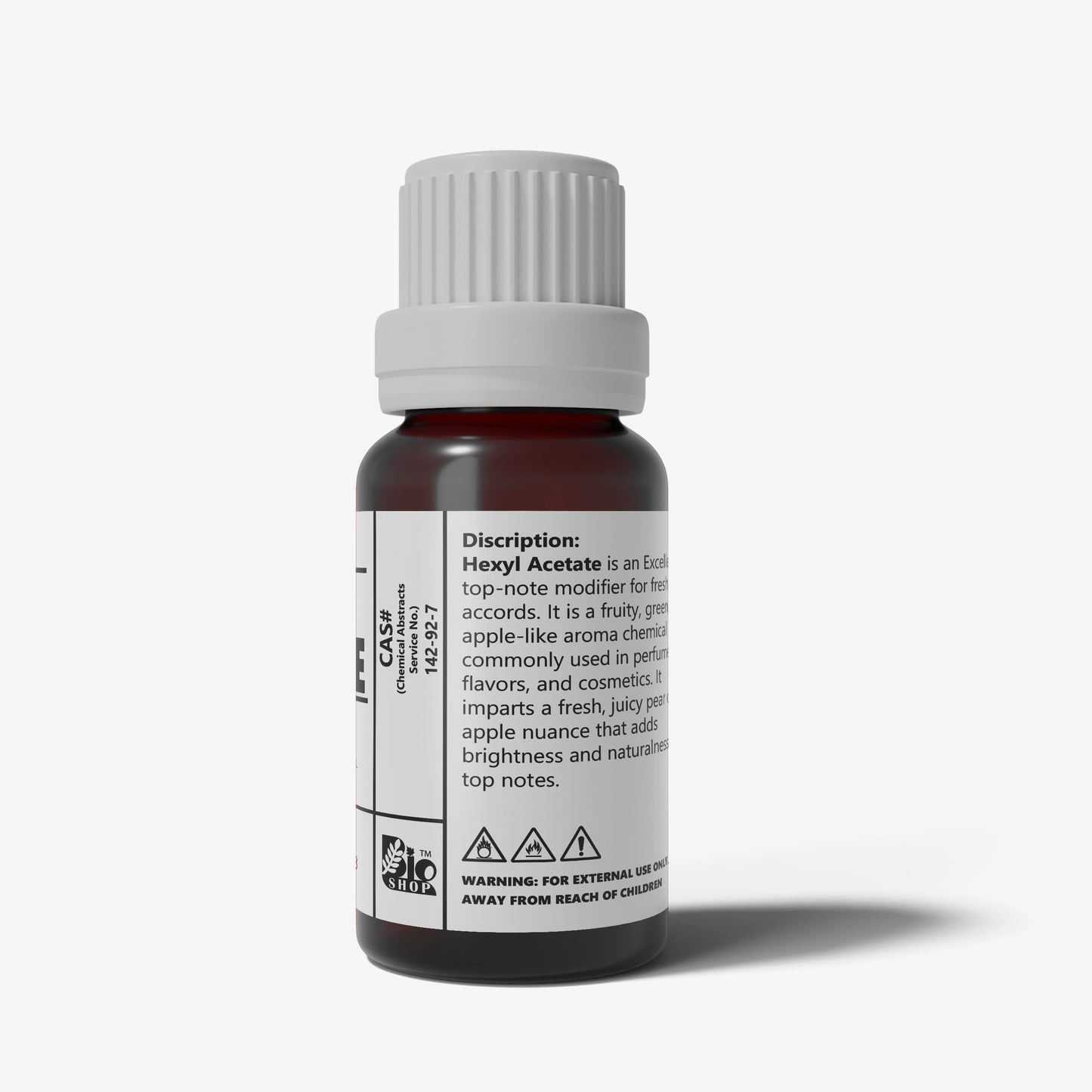
Hexyl Acetate
Hexyl Acetate
Olfactory Notes: Sharp, fruity, and pear-like; provides a "shampoo-fresh" top note.
Couldn't load pickup availability

Explore
Information About Hexyl Acetate
Key Features
✦ Fresh green-fruity aroma chemical — apple, pear, and berry character
✦ Classic top note material — high volatility with immediate olfactory impact
✦ Occurs naturally in apples, pears, strawberries, peaches, and roses
✦ Excellent diffusion — instantly lifts and brightens any fragrance blend
✦ Versatile — used in fine fragrance, cosmetics, home fragrance & cleaning
✦ No IFRA restriction — safe across all standard fragrance applications
✦ Vegan, biodegradable & readily biodegradable — eco-friendly choice
About Hexyl Acetate
Hexyl Acetate is a short-chain aliphatic ester formed by the esterification of hexanol and acetic acid. It occurs naturally in numerous fruits including apples, pears, strawberries, and bananas, where it contributes to their characteristic fresh, ripe aroma. Synthetically produced for commercial use, Hexyl Acetate has been a staple of the fragrance and flavor industries for decades, appearing in everything from mass-market shampoos to designer eau de parfums. Its simple molecular structure belies a remarkably convincing and pleasant odor profile that perfumers have relied on to add naturalness and lift to complex compositions.
What sets Hexyl Acetate apart from other fruity aroma chemicals is its balance between fruitiness and freshness. Unlike heavier fruity esters that can turn sickly or synthetic at high doses, Hexyl Acetate retains a clean, airy quality that integrates naturally into accords. Its high volatility means it acts as a true top note diffuser, opening a fragrance with immediate brightness before giving way to heart and base materials. This makes it invaluable in fresh, aquatic, green, and fruity floral constructions as well as functional fragrance applications where the initial burst of freshness is commercially essential.
Bio Shop Pakistan supplies cosmetic-grade Hexyl Acetate suitable for DIY perfumers, candle and soap makers, shampoo and body wash formulators, and home fragrance developers across Pakistan.
Olfactory Profile
SCENT DESCRIPTION:
Crisp, fresh, and brightly fruity — like biting into a perfectly ripe
green apple on a cool morning, with subtle undertones of pear, fresh
berry, and a whisper of jasmine-like softness. It is lighter and less
sharp than Amyl Acetate with a more natural, slightly floral quality
that adds elegance to fruit compositions.
NOTE POSITION: Top
FRAGRANCE FAMILY: Fruity / Green / Floral
FACETS: Apple · Pear · Fresh Berry · Green · Softly Floral
TENACITY: Low — 1 to 3 hours on skin (by design as top note)
SILLAGE: High initially — strong opening impact, fades quickly
Technical Specifications
Chemical Name : n-Hexyl Acetate (Acetic Acid, Hexyl Ester)
CAS Number : 142-92-7
Synonyms : Hexyl Ethanoate · 1-Hexanol Acetate · Acetic Acid n-Hexyl Ester · n-Hexyl Ethanoate
Purity : ≥98% (GC)
Appearance : Colorless to very pale yellow clear liquid
Odor Threshold : Approximately 0.002–0.005 ppm (very low — highly impactful at trace levels)
Solubility : Freely soluble in ethanol, IPM, DPG, and most fragrance carriers · Practically insoluble in water
Specific Gravity : 0.868 – 0.876 at 20°C
Flash Point : Approximately 45°C (113°F)
Type : Synthetic
Applications & Usage Guidelines
Fine Fragrance ★★★★★
Hexyl Acetate is a classic top note material in fine fragrance. It excels in fruity florals, fresh fougères, green chypres, and aquatic compositions. Use it at 0.5–5% to add a natural, sparkling fruitiness to openings without overwhelming heart materials.
Attar and Oriental Blending ★★★☆☆
While not a traditional attar material, Hexyl Acetate can serve a useful role in contemporary oriental and fruity oriental accords by providing a fresh contrast to heavy resins, musks, and ouds. Keep usage rates low (0.2–1%) so it lifts rather than clashes with warmer base materials.
Functional Fragrance ★★★★★
Hexyl Acetate is extensively used in shampoos, body washes, fabric softeners, and household cleaners where fresh fruity top notes are commercially expected. Its good stability in mild formulations and strong first-impression diffusion make it ideal for rinse-off and wipe-off products.
Cosmetics and Body Care ★★★★☆
Suitable for body lotions, creams, lip balms, and bath products at low concentrations. Its low odor threshold means even small additions at 0.1–0.5% deliver noticeable freshness. Ensure formulation pH stays in the mildly acidic to neutral range to minimize ester hydrolysis.
Home Fragrance ★★★★☆
Performs well in reed diffusers and wax melts where its high volatility translates into strong initial throw. In candles, performance is good but the relatively low flash point requires attention to safety protocols during manufacturing. Blend with longer-lasting base notes to support the overall arc.
IFRA & Usage Rate
Recommended Usage Rates by Application
EDP (Eau de Parfum) : 1.0 – 5.0%
EDT (Eau de Toilette) : 1.0 – 8.0%
Body Lotion / Cream : 0.2 – 1.0%
Shampoo / Body Wash : 0.3 – 1.5%
Bar Soap : 0.3 – 1.0%
Candle : 3.0 – 8.0%
Reed Diffuser : 5.0 – 20.0%
Fabric Softener : 0.2 – 1.0%
Household Cleaner : 0.1 – 0.5%
IFRA 51st Amendment Status
Hexyl Acetate is not listed as a restricted or prohibited ingredient under the IFRA 51st Amendment. No IFRA quantitative limits apply at the time of publication. Formulators should nonetheless adhere to general good manufacturing practice and dermatological safety standards. Always conduct a QRA (Quantitative Risk Assessment) for leave-on cosmetic applications.
⚠️ Flash point of approximately 45°C means Hexyl Acetate is classified as a flammable liquid. Store away from heat and open flame. Observe candle manufacturing safety protocols regarding pour temperature and fragrance addition point.
⚠️ In high-pH formulations (pH above 8–9) such as cold process soap, esters can undergo hydrolysis over time, potentially reducing scent intensity. Test retention in your specific base before committing to production batches.
Blending Guide
Method 1 — Direct Dilution in Alcohol
Dilute Hexyl Acetate to 10–20% in perfumer's alcohol or ethanol before adding to fine fragrance blends. This improves dosing accuracy given its very low odor threshold and prevents accidental overdosing, which can push the blend toward an artificial, solvent-like fruitiness.
Method 2 — Carrier Dilution for Cosmetics
For body care and cosmetic applications, pre-dilute in a neutral carrier such as DPG (Dipropylene Glycol) or IPM (Isopropyl Myristate) at 10–20% concentration. This improves dispersion in water-based and emulsion formulations and reduces the risk of localized high concentration causing irritation on sensitive skin.
Method 3 — Blending into Functional Fragrance Compounds
Hexyl Acetate is best incorporated into a pre-built functional fragrance compound that includes fixatives and base materials before addition to shampoo or detergent bases. Its volatility means it benefits from anchoring by heavier materials in the compound rather than being added in isolation.
BEST PAIRINGS
Linalool → Softens fruitiness into a fresh floral-fruity accord
Citronellol → Adds rosy roundness to the apple note
Hexenyl Acetate → Deepens green freshness, creates a natural leafy-fruit facet
Dihydromyrcenol → Amplifies fresh, clean, laundry-fruity character for functional use
Hedione → Lifts and diffuses the fruit into an elegant floral-fresh signature
Habanolide / Exaltolide → Anchors the volatile top note; improves longevity significantly
Benzyl Acetate → Bridges fruity and jasmine floral facets for fruity floral accords
Ethyl Maltol → Adds a candy-cotton sweetness beneath the apple character
Galbanum → Creates a sharp, green-fruit accord with a natural garden quality
Ambroxan → Grounds the entire accord, adding depth and skin-meld quality
AVOID
Avoid combining at high concentrations with strong phenolic materials such as Eugenol or Isoeugenol without testing — the contrast between sharp phenolic heat and light ester fruitiness can read as discordant. In alkaline soap bases, test carefully for scent retention before scaling up.
Perfumer's Note
I reach for Hexyl Acetate whenever a fragrance needs that first breath of fresh air — the moment a composition speaks before the heart has even arrived. What I find endlessly useful about this ester is not just that it reads as apple or pear, but that it reads as alive. There is a waxy, slightly green quality underneath the fruitiness that behaves the way real fruit smells on a warm afternoon rather than in a laboratory. It integrates rather than sits on top of a blend, which is why I use it as much in floral constructions as in outright fruit accords — a trace at 0.3–0.5% can make a rose or jasmine soliflore feel like it was just cut from the garden.
ADVANCED TIP: Try layering Hexyl Acetate (0.5–1.0%) with CIS-3-Hexenol (0.05–0.1%) and a trace of Galbanum resinoid (0.1–0.2%) to build a full-spectrum green-fruit top note that has both the ripe fruit signal and the raw, snapped-stem greenness underneath it. This trio creates a naturalistic opening with genuine complexity that single-note fruity materials alone cannot achieve. Add Hedione at 2–3% beneath it and you have the bones of a compelling modern fruity floral that will carry through to the heart without collapsing the moment the top evaporates.
Safety & Storage
Physical State : Clear colorless to pale yellow liquid at room temperature
Skin Safety : Generally considered safe at recommended usage rates. Avoid prolonged undiluted skin contact. Dilute before use in all leave-on applications.
Eye Contact : Irritant. Avoid contact with eyes. In case of contact, flush immediately with clean water for 15 minutes. Seek medical attention if irritation persists.
Ingestion : Not for internal use. Keep away from children. If swallowed, do not induce vomiting. Contact a medical professional immediately.
Ventilation : Work in a well-ventilated area or use respiratory protection when handling large quantities. Vapors can accumulate in enclosed spaces.
Storage : Store in a tightly sealed container away from heat, sparks, and open flame. Keep in a cool, dark place between 10°C and 25°C.
Shelf Life : 24–36 months when stored correctly in sealed containers away from light and heat. Ester hydrolysis may occur over time if moisture is introduced.
Container : Store in glass, HDPE, or stainless steel containers. Avoid PVC and certain soft plastics for long-term storage.
Flammability : Flammable liquid. Flash point approximately 45°C. Keep away from ignition sources. Classified as a flammable liquid under standard safety regulations.
FAQ
Q: What does Hexyl Acetate smell like?
A: It smells like fresh, ripe apple and green pear with a subtle banana-waxy undertone. It is clean, airy, and natural-smelling rather than artificial or candy-like.
Q: What is the recommended usage rate for Hexyl Acetate in perfume?
A: For EDP and EDT, 1–5% is typical. Because its odor threshold is very low, even small amounts are clearly perceptible. Start at 1% and adjust upward in small increments.
Q: Is Hexyl Acetate safe for use in skin care and cosmetics?
A: Yes, at recommended usage rates it is considered safe for cosmetic use. Always dilute before skin contact and conduct a patch test for leave-on applications. It is not restricted under IFRA 51st Amendment.
Q: Can Hexyl Acetate be used in cold process soap?
A: It can, but ester hydrolysis in high-pH soap bases may reduce scent intensity over time. Test retention in a small batch first and consider blending with more stable base note materials to support longevity.
Q: How does Hexyl Acetate compare to other fruity esters like Amyl Acetate or Ethyl Butyrate?
A: Amyl Acetate (banana) is sweeter and more one-dimensional, while Ethyl Butyrate reads as tropical pineapple-strawberry. Hexyl Acetate is the most versatile of the three — its apple-pear character has a green freshness that integrates across many fragrance families without reading as overtly fruity candy, making it the preferred choice for fine fragrance and modern cosmetic applications.
Where Can You Safely Use Hexyl Acetate?
Discover how Hexyl Acetate performs across different applications—rated for safety, stability, and effectiveness.