Bio Shop
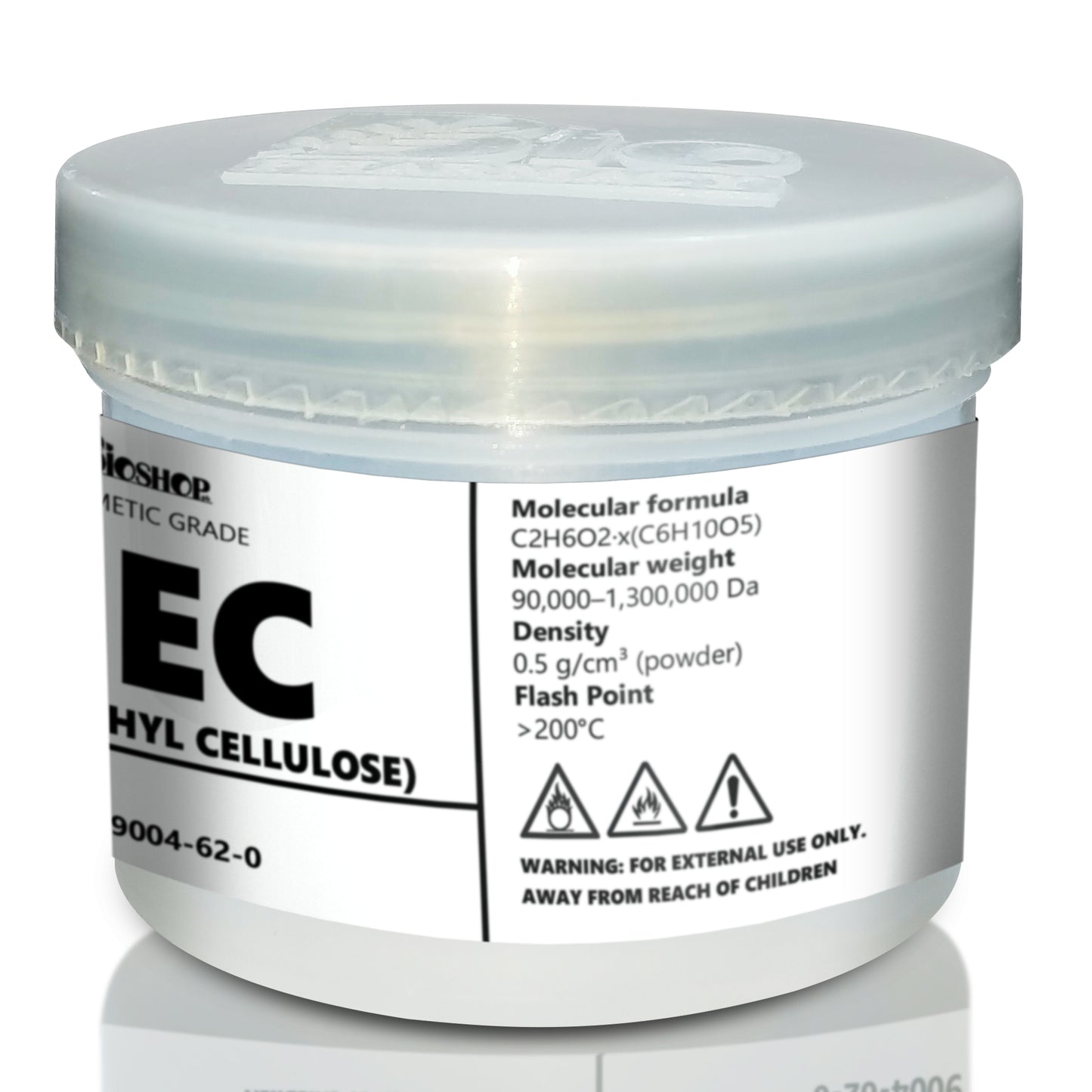
Hydroxyethyl Cellulose (HEC)
Hydroxyethyl Cellulose (HEC)
Key Functions: Thickens water-phase, forms protective films, stabilizes emulsions, and enhances skin feel.
Couldn't load pickup availability


Explore
Information About Hydroxyethyl Cellulose (HEC)
✅ Key Features
✦ Non-ionic water-soluble thickener that builds gel texture without requiring pH neutralization.
✦ Derived from natural cellulose, making it suitable for naturally positioned and clean beauty formulations.
✦ Functions as a film former on both skin and hair, improving slip, reducing frizz, and enhancing surface smoothness.
✦ Compatible with anionic, cationic, and non-ionic surfactants across a broad pH range of 2 to 12.
✦ Suitable for rinse-off and leave-on applications including serums, gels, shampoos, conditioners, and gel masks.
✦ Produces clear to slightly hazy gels depending on concentration, ideal for transparent serum formulations.
✦ Vegan and non-animal-derived with a well-established cosmetic safety profile and no known sensitization concerns.
🔬 Description
Hydroxyethyl Cellulose is a chemically modified derivative of cellulose, the most abundant natural polymer on earth. It is produced through the controlled etherification of purified cellulose pulp with ethylene oxide, introducing hydroxyethyl groups along the cellulose backbone. This modification renders the originally water-insoluble cellulose fully soluble in both hot and cold water while preserving its biopolymer character. HEC has been used in cosmetics and personal care for decades, appearing in formulations ranging from pharmaceutical topical gels to mass-market hair conditioners and premium serums.
What distinguishes HEC from many other rheology modifiers is its non-ionic character. Unlike carbomer, it does not require neutralization with a base to activate thickening. Unlike xanthan gum, it produces cleaner, less stringy gel textures that spread smoothly on skin without drag. HEC builds viscosity reliably across a wide pH window, tolerates moderate electrolyte concentrations, and contributes film-forming properties that improve sensory performance in both rinse-off and leave-on systems. Its clarity in gel systems makes it particularly valuable for transparent serums where visual elegance matters alongside functional performance.
Bio Shop Pakistan supplies cosmetic-grade Hydroxyethyl Cellulose suitable for DIY beauty formulators, independent skincare and haircare brands, soap makers formulating liquid and syndet products, and professional cosmetic chemists developing water-based personal care formulations.
📊 Technical Data
INCI Name : Hydroxyethylcellulose
Chemical Name : Cellulose, 2-hydroxyethyl ether
CAS Number : 9004-62-0
Molecular Formula : Polymeric — cellulose backbone with hydroxyethyl substituents
Appearance : White to off-white free-flowing powder or granules
Odor : Odorless
pH (1% solution) : 5.5 – 8.0 (naturally near neutral)
Solubility : Freely soluble in cold and hot water; insoluble in most organic solvents
Specific Gravity : Approximately 1.35 g/cm³ (bulk density 0.35 – 0.65 g/cm³)
Flash Point : Not applicable — non-flammable solid powder
HLB Value : Not applicable — non-ionic polymer, not a surfactant
Recommended Use Level : 0.5 – 2.0% for standard thickening; up to 3.0% for firm gels
Type : Non-ionic water-soluble polymer / rheology modifier / film former
Shelf Life : 24 months when stored sealed in a cool, dry environment
🧪 Recommended Usage
Skincare (Creams, Serums, Lotions) ★★★★★
HEC is an outstanding thickener for water-based serums, lightweight gel-creams, and micellar waters due to its neutral pH behavior and clean skin feel. Use at 0.8 to 1.5% for flowing serums and 1.5 to 2.5% for firm gel textures.
Haircare (Shampoo, Conditioner, Masks) ★★★★★
HEC performs exceptionally well in shampoos, conditioning gels, and hair masks as both a thickener and film-forming conditioning agent. Incorporate into the water phase at 0.5 to 1.5% for shampoos and up to 2% in hair masks to improve wet slip and frizz control.
Soap Making (Liquid Soap, Syndet Bars) ★★★☆☆
HEC is not compatible with traditional cold process soap due to the high alkalinity of saponification, which degrades the polymer. It is, however, useful in liquid syndet bases, shampoo bars with surfactant systems, and shower gel formulations at 0.5 to 1.0%.
Body Care (Gels, Mists, Roll-Ons) ★★★★☆
HEC is well suited for body gel formulations, after-sun gels, cooling body mists thickened with light gel bases, and roll-on deodorant vehicles. Use at 1.0 to 2.0% for body gel applications where a non-greasy, water-washable texture is desired.
Functional Cosmetics (Deodorants, Tinted Gels, Eye Gels) ★★★★☆
Its non-irritating profile and film-forming capability make HEC a practical choice for roll-on deodorant gels, tinted facial gels, cooling eye gels, and water-based sunscreen emulsions. Confirm compatibility with the full formula system when including electrolytes above 2%.
💡 Pro Tip
When I formulate water-based serums and gel systems, Hydroxyethyl Cellulose is often my first choice for clean, non-tacky thickening precisely because it avoids the neutralization step that carbomers require. It disperses predictably, builds viscosity smoothly with heat and hydration, and leaves a skin feel that most consumers describe as silky rather than sticky. I particularly value it in haircare formulations where the film-forming action contributes real conditioning benefit beyond texture alone.
ADVANCED TIP: To achieve a lump-free, fully hydrated HEC gel, never add the powder directly to still water at room temperature. Instead, disperse HEC into a small amount of glycerin or propylene glycol first at a ratio of approximately 1 part HEC to 5 parts glycol until a uniform slurry forms, then add this premix to your bulk water phase heated to 60 to 70°C under moderate agitation. This pre-wetting step in glycol prevents clumping and reduces hydration time from over 30 minutes to under 10 minutes, producing a smoother, clearer final gel structure with no undispersed lumps.
👩🔬 Skin Type Suitability
Normal Skin : ★★★★★ — Provides elegant gel textures with no residue, suitable for all water-based formulation types.
Dry Skin : ★★★★☆ — Works well when combined with humectants and emollients, as HEC alone does not provide occlusion or lipid replenishment.
Oily Skin : ★★★★★ — Ideal for oily skin due to its completely non-greasy, matte-finish gel texture that does not contribute to sebum-like feel.
Combination : ★★★★☆ — Performs well in lightweight serums and toners targeting the T-zone while remaining comfortable on drier cheek areas.
Sensitive Skin : ★★★★☆ — Non-irritating and non-sensitizing with no known allergen concerns, making it a safe choice for sensitive formulations.
Mature Skin : ★★★☆☆ — Functional as a thickener but lacks the emollient and barrier-supportive properties that mature skin typically benefits from.
Acne-Prone : ★★★★★ — Non-comedogenic, oil-free, and compatible with acne-targeted actives such as niacinamide, salicylic acid, and azelaic acid.
🧴 Formulation Ideas
CONCEPT 1: Brightening Niacinamide Gel Serum
Usage Level : 1.2%
Key Ingredients: Niacinamide 10%, Alpha Arbutin 1%, Allantoin 0.5%, Sodium PCA
Result : A clear, lightweight gel serum that delivers pigmentation control and barrier support with a smooth, non-tacky finish.
CONCEPT 2: Moisturizing Shampoo Gel Base
Usage Level : 0.8%
Key Ingredients: Sodium Laureth Sulfate, Cocamidopropyl Betaine, Panthenol, Citric Acid
Result : A stable, well-bodied shampoo gel with improved lather consistency, enhanced wet slip, and gentle cleansing suitable for daily use.
CONCEPT 3: Soothing Aloe Vera After-Sun Gel
Usage Level : 1.5%
Key Ingredients: Aloe Vera Juice 70%, Allantoin 0.5%, Cucumber Extract, Glycerin
Result : A cooling, transparent body gel with a refreshing skin feel that soothes heat-exposed skin and evaporates cleanly without tackiness.
💧 Safety and Regulatory:
INCI Declared : Yes — required on all finished cosmetic product labels
EU Cosmetics Reg : Permitted — no Annex restriction; no concentration limit established under EU Cosmetics Regulation No. 1223/2009
Rinse-Off Limit : No limit established
Leave-On Limit : No limit established
Allergen Alert : No — no known contact allergen designation; non-sensitizing polymer
Skin Safety : Safe at recommended formulation levels
Eye Area Use : Use with caution — non-irritating polymer but avoid direct ocular instillation; suitable for eye gel formulations at low concentrations
Ingestion : Not for internal use
Pregnancy Use : Considered safe for topical cosmetic use; no contraindications established
Child Safety : Suitable for use in rinse-off baby products at standard cosmetic levels
Ventilation : Not required — non-volatile solid; standard laboratory handling precautions apply
Storage : Store sealed in a cool, dry place away from moisture and humidity; avoid exposure to dampness before dispersal
Container : HDPE or multilayer foil-lined bags; avoid storage in open containers in humid environments
⚠️ Note: HEC powder may cause mild respiratory irritation if inhaled in large quantities during weighing. Use a dust mask when handling large volumes in open environments. Once fully hydrated in formulation, no inhalation risk applies.
Stability and Compatibility
Working pH Range : 2.0 – 12.0 (optimal thickening performance at pH 5.0 – 8.0)
Heat Stability : Stable up to 120°C; prolonged high-heat exposure above 150°C may cause chain degradation
Freeze-Thaw Stable : Yes — HEC gels generally recover viscosity after freeze-thaw cycling
Emulsion Type : O/W and water-continuous systems; not suitable for anhydrous or W/O emulsions
Emulsification Phase: Add to water phase; cold dispersion preferred via glycol premix followed by heat hydration
Compatible With : Non-ionic surfactants, anionic surfactants, most cosmetic actives, humectants, preservatives, chelating agents, low-molecular-weight polymers
Incompatible With : High concentrations of cationic surfactants above 1% may reduce viscosity; strong oxidizing agents; very high electrolyte concentrations may cause salting-out at certain grades
Oxidation Risk : Low — cellulose polymer backbone is not subject to lipid oxidation
Discoloration Risk : Possible — slight yellowing may occur under prolonged UV exposure or in formulas with high iron ion content; use chelating agents such as EDTA to mitigate
Formulation Notes : Always pre-wet HEC in a polyol such as glycerin before adding to the water phase to ensure even hydration and avoid lump formation. Hydration is accelerated by heat above 60°C and continuous gentle agitation.
❓ FAQs
Q: Does Hydroxyethyl Cellulose need to be neutralized to thicken like carbomer does?
A: No. Unlike carbomer, HEC builds viscosity through hydration alone and does not require neutralization with a base such as sodium hydroxide or triethanolamine. This makes it simpler to use and more forgiving in formulas that already have a set pH target.
Q: Can I use HEC in a formulation that also contains salicylic acid or niacinamide?
A: Yes. HEC is non-ionic and chemically inert toward most cosmetic actives including salicylic acid, niacinamide, vitamin C derivatives, and alpha arbutin. It is one of the preferred thickeners in active-heavy serum formulations precisely because it does not interact with or destabilize these ingredients.
Q: How do I prevent lumps when mixing HEC into water?
A: The most reliable method is to pre-disperse HEC powder in glycerin or propylene glycol before adding to water. This coats each particle with glycol, preventing the surface hydration that causes clumping. Add the glycol-wetted slurry to water heated to 60 to 70°C with continuous stirring for best results.
Q: Is HEC suitable for clear gel formulations where transparency matters?
A: Yes, HEC produces clear to very slightly hazy gels in the 1 to 2% range, particularly when fully hydrated at elevated temperature. For maximum clarity, use demineralized or distilled water, a chelating agent, and ensure complete hydration before pH adjustment or active addition.
Q: How does Hydroxyethyl Cellulose compare to xanthan gum as a thickener?
A: Both are biopolymer-derived water-phase thickeners, but they produce distinctly different textures. Xanthan gum creates a more elastic, stringy, and pseudoplastic gel that can feel draggy on skin, while HEC produces a cleaner, smoother, less stringy gel texture with better spreadability and a lighter skin feel. HEC is generally preferred in leave-on skincare for its more elegant sensory profile, while xanthan gum is often chosen in rinse-off products and emulsions for its superior emulsion stabilization and suspension capabilities.
Where Can You Safely Use Hydroxyethyl Cellulose (HEC)
Discover how Hydroxyethyl Cellulose (HEC) performs across different products — rated for safety, stability, and effectiveness.