Bio Shop
Isobornyl Acetate
Isobornyl Acetate
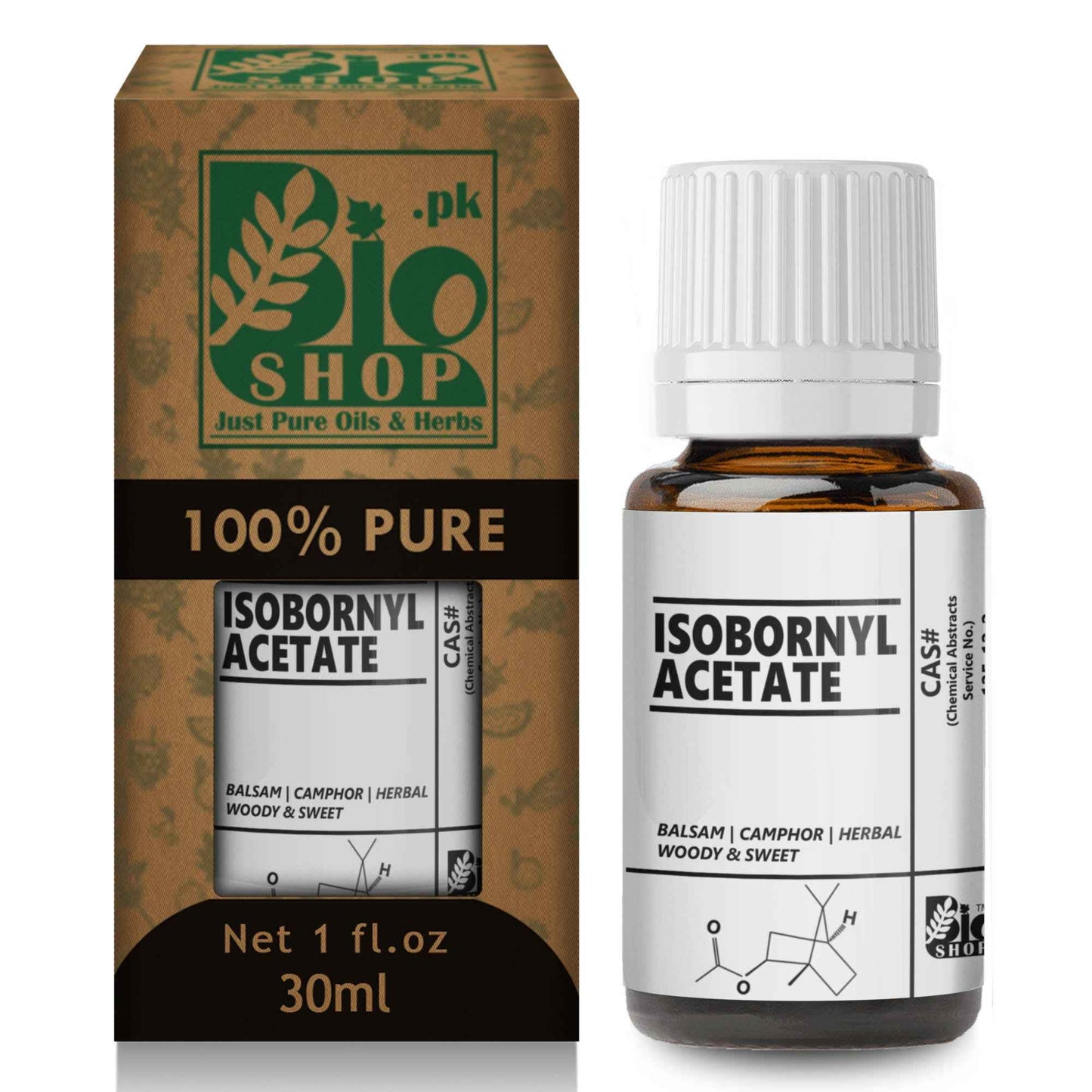
Olfactory Notes: Refreshing pine, camphor, and herbal-woody note.
Couldn't load pickup availability
Explore
Information About Isobornyl Acetate
Key Features
✦ Fresh pine-needle and green camphoraceous aroma chemical used in fougères, forest, and clean fresh fragrance families
✦ Versatile top-to-mid note that blends seamlessly with lavender, citrus, woods, and musks
✦ Extensively used in functional fragrances — household cleaners, laundry, and air fresheners
✦ Naturally occurring in pine needle oil — synthetic production ensures consistent quality and purity
✦ Performs well in rinse-off, ambient, and alcoholic fragrance applications
✦ Vegan and cruelty-free — no animal-derived raw materials involved in production
✦ Cosmetic-grade purity suitable for leave-on and rinse-off formulations within
IFRA-recommended limits
About Isobornyl Acetate
Isobornyl Acetate is a bicyclic monoterpene ester that has been a workhorse of the fragrance industry for decades. It belongs to the bornane family of aroma chemicals and is produced synthetically through the esterification of isoborneol with acetic anhydride, though it also occurs naturally in the essential oils of pine, fir, and certain conifer species. Its discovery and widespread adoption followed the fragrance industry's growing demand for affordable, stable coniferous materials that could replicate the smell of fresh pine forests without the variability of natural extracts.
What makes Isobornyl Acetate particularly valuable is its dual character — it reads simultaneously as fresh, green, and camphoraceous, yet carries a subtle sweetness that prevents it from smelling harsh or medicinal at correct usage levels. This complexity gives it remarkable blending versatility. It works as a naturalness-boosting modifier in fine fragrance, a dominant accord note in functional and cleaning fragrances, and a supporting fresh lifter in oriental and woody compositions. Its reasonable tenacity and good diffusion make it effective even in challenging rinse-off and diluted applications.
Bio Shop Pakistan supplies cosmetic-grade Isobornyl Acetate suitable for DIY perfumers, soap makers, candle crafters, home care formulators, and professional fragrance developers looking for a reliable coniferous-fresh building block.
Olfactory Profile
SCENT DESCRIPTION : Isobornyl Acetate opens with a sharp, clean rush of fresh pine needles and forest green, carrying an unmistakable camphoraceous edge that reads as crisp and airy rather than medicinal. As it develops, a subtle sweetness emerges beneath the green, lending the material a slightly balsamic warmth reminiscent of freshly cut conifer branches. The overall impression is of a cool mountain forest immediately after rainfall — clean, natural, and expansive. It diffuses readily, projecting its fresh character outward with confidence before settling into a soft woody-green trail.
NOTE POSITION : Top-Mid
FRAGRANCE FAMILY : Fresh Green · Coniferous/Forest · Woody Aromatic
FACETS : Pine · Camphoraceous · Green · Woody · Sweet-Balsamic
TENACITY : Medium — projects actively for 4 to 6 hours in alcoholic fragrance
SILLAGE : Medium — good initial projection with a clean, airy diffusion that carries well in functional and ambient applications
Technical Specifications
Chemical Name : 1,7,7-Trimethylbicyclo[2.2.1]heptan-2-yl acetate
CAS Number : 125-12-2
Synonyms : Isobornyl acetate · 2-Bornyl acetate (common trade usage) · Acetic acid isobornyl ester · 1,7,7-Trimethylbicyclo[2.2.1]hept-2-yl acetate
Purity : 95% minimum (cosmetic and fragrance grade)
Appearance : Colourless to pale yellow clear liquid
Odor Threshold : Approximately 0.1 to 0.5 ppb — highly potent, low threshold material
Solubility : Insoluble in water · Freely soluble in ethanol, IPM, and most fragrance carriers
Specific Gravity : 0.980 to 0.990 at 20°C
Flash Point : Approximately 88°C (190°F)
Type : Synthetic (also found naturally in pine needle and fir balsam essential oils)
Applications & Usage Guidelines
Fine Fragrance ★★★★★
Isobornyl Acetate is a classic material in fougère, fresh, forest, and chypre fine fragrances. It adds a convincing pine-green naturalness that supports citrus top notes, lavender hearts, and woody bases. Use it to build coniferous accords or as a modifier to boost the green freshness of a composition.
Attar and Oriental Blending ★★★☆☆
Less conventional in attar work but can serve as a fresh-green contrast element in light orientals and woody compositions. It pairs effectively with sandalwood, vetiver, and resinous materials to create a cool-warm tension. Use sparingly to avoid dominating warmer, heavier accord structures.
Functional Fragrance ★★★★★
This is where Isobornyl Acetate truly excels. It is one of the defining materials in household cleaning, laundry, toilet, and air freshener fragrances globally. Its association with cleanliness and freshness makes it instantly effective in these categories. Usage rates here are typically higher than in fine fragrance.
Cosmetics and Personal Care ★★★☆☆
Used in deodorants, shampoos, shower gels, and body washes at controlled levels. It contributes a fresh, clean character to personal care blends. Formulators must stay within IFRA limits for leave-on categories and monitor for sensitization risk at elevated concentrations.
Home Fragrance ★★★★☆
Isobornyl Acetate performs very well in reed diffusers, room sprays, and wax melts. It diffuses readily at room temperature and imparts a consistent fresh-pine character. In candles, performance is good but flash point and burn stability should be reviewed during development.
IFRA & Usage Rate
Recommended Usage Rates by Application
EDP (Eau de Parfum) : 5 to 15%
EDT (Eau de Toilette) : 5 to 20%
Body Lotion : 0.5 to 2% — observe IFRA leave-on limits
Shampoo and Body Wash : 0.5 to 3%
Candle : 3 to 8% in finished wax
Reed Diffuser : 10 to 25% in diffuser base
Bar Soap : 0.5 to 2%
IFRA 51st Amendment Guidance
⚠️ Isobornyl Acetate is a restricted material under IFRA guidelines due to demonstrated skin sensitization potential in repeated insult patch testing.
Category 4 (Body Lotion, Leave-on skin) : Verify current limit with supplier — approximately 0.8 to 1.6% — confirm against latest IFRA 51st Amendment document
Category 9 (Rinse-off, Shampoo) : Higher allowance — approximately 3 to 4% — verify with current IFRA standard
Category 3 (Hydroalcoholic — EDP/EDT) : Moderate allowance — verify with current IFRA document
⚠️ Always cross-reference the official IFRA 51st Amendment publication for exact category-by-category limits before finalising formulas intended for commercial sale or professional use.
Blending Guide
Method 1 — Direct Solvent Dilution
Dilute Isobornyl Acetate in perfumer's alcohol or IPM to a 10 to 20% working solution before adding to your formula. This improves dosing accuracy given its high potency and low odour threshold. Never use undiluted directly in leave-on products without weighing precisely.
Method 2 — Accord Building
Build a coniferous-fresh accord by combining Isobornyl Acetate with Alpha-Pinene or Pine Needle Essential Oil for authenticity, adding Linalool for softness and Citronellol for lift. This three-part accord forms a strong natural pine backbone for fougères, sport fragrances, and fresh woods compositions.
Method 3 — Functional Fragrance Blending
In household and cleaning fragrances, pair Isobornyl Acetate with Dihydromyrcenol and Limonene to build a clean fresh-pine effect. Add a small proportion of Eucalyptol or Camphor to reinforce the hygienic perception. This approach is standard in global laundry and surface cleaner fragrances.
BEST PAIRINGS
Lavender EO → Creates the classic fougère backbone — clean, masculine, timeless
Dihydromyrcenol → Amplifies clean freshness with an aquatic mineral edge
Linalool → Softens the camphoraceous edge, adds floral-fresh lift
Cedarwood Atlas → Grounds the pine note into a warm woody structure
Iso E Super → Adds smoothness and diffusive radiance to the forest accord
Galaxolide / Habanolide → Anchors the fresh note in a soft clean musk base
Bergamot EO → Bridges pine with citrus for bright fresh compositions
Vetiver → Creates a cool-green earthiness in woody oriental blending
AVOID
Heavy animalic materials — costus, civet-type bases — as these clash with the clean coniferous character and produce an unpleasant cold-sour effect. Also avoid overuse alongside other camphoraceous materials such as Camphor or high-camphor Rosemary EO, as the combined effect becomes overwhelming and medicinal.
Perfumer's Note
I keep Isobornyl Acetate in my kit not because it is glamorous but because it is irreplaceable. There is a specific kind of outdoor freshness — the smell of pine trees on a cold morning, the clean snap of a forest trail — that almost nothing else replicates with the same efficiency and at the same price point. It is the kind of material that does not announce itself in a finished formula yet is felt immediately when you remove it. In fougères especially, it works as the invisible architecture behind the lavender and coumarin, providing a green airiness that keeps the composition from feeling flat or powdery.
ADVANCED TIP : When working on forest or coniferous accords, try pre-blending Isobornyl Acetate with a small amount of Borneol (roughly 5 to 10% of the Isobornyl Acetate weight within the accord) before incorporating into your formula. Borneol reinforces the woody-camphoraceous facets and adds a subtle dryness that pushes the accord from synthetic-pine into something resembling the complex bark-and-needle smell of a real conifer tree. The combination reads far more natural than Isobornyl Acetate alone and reduces the slightly sweet edge that some perfumers find limiting in certain composition styles.
Safety & Storage
Physical State : Clear colourless to pale yellow liquid at room temperature
Skin Safety : Potential skin sensitizer — avoid high concentration leave-on use · stay within IFRA limits · conduct patch test in formulation
Eye Contact : Irritant — avoid direct contact · flush immediately with water for 15 minutes if contact occurs · seek medical attention if irritation persists
Ingestion : Not for consumption · keep out of reach of children · seek immediate medical attention if swallowed
Ventilation : Work in a well-ventilated space or under a fume hood when handling at scale · vapours are irritating at high concentration
Storage : Store in a tightly sealed container away from direct sunlight and heat sources · ideal storage temperature 10 to 25°C
Shelf Life : 24 to 36 months from manufacture date when stored correctly in sealed original container
Container : Store in glass or HDPE containers · avoid PET for long-term storage · keep away from reactive metals
Flammability : Combustible liquid · Flash point approximately 88°C · keep away from open flames and ignition sources in bulk storage
FAQ
Q: What does Isobornyl Acetate smell like?
A: It smells like fresh pine needles — clean, green, and slightly camphoraceous with a faint underlying sweetness. It is the defining scent of pine forests and is instantly associated with cleanliness and the outdoors.
Q: Is Isobornyl Acetate safe to use in skin products?
A: It can be used in skin products but it is a known sensitizer at high concentrations. Always stay within current IFRA 51st Amendment limits for each product category and avoid high usage rates in leave-on formulations.
Q: What is the recommended starting usage rate for beginners?
A: Start at 1 to 3% in your fragrance compound and assess from there. Because its odour threshold is very low, a little goes a long way — it is easy to overdo in your first blends.
Q: Can I use Isobornyl Acetate in soy or paraffin candles?
A: Yes, it performs well in candles at 3 to 8% in the finished wax. Always test flash point compatibility with your specific wax system and follow candle safety guidelines during development.
Q: How does Isobornyl Acetate compare to natural Pine Needle Essential Oil?
A: Isobornyl Acetate is more linear and consistent than Pine Needle EO but lacks the full complexity of the natural material. Pine Needle EO contains Alpha-Pinene, Beta-Pinene, Limonene, and other components that create a rounder, more authentic forest profile. For naturalness, blend both — use Isobornyl Acetate as the clean pine backbone and Pine Needle EO for depth and authenticity.
Where Can You Safely Use Isobornyl Acetate?
Discover how Isobornyl Acetate performs across different applications—rated for safety, stability, and effectiveness.