Bio Shop
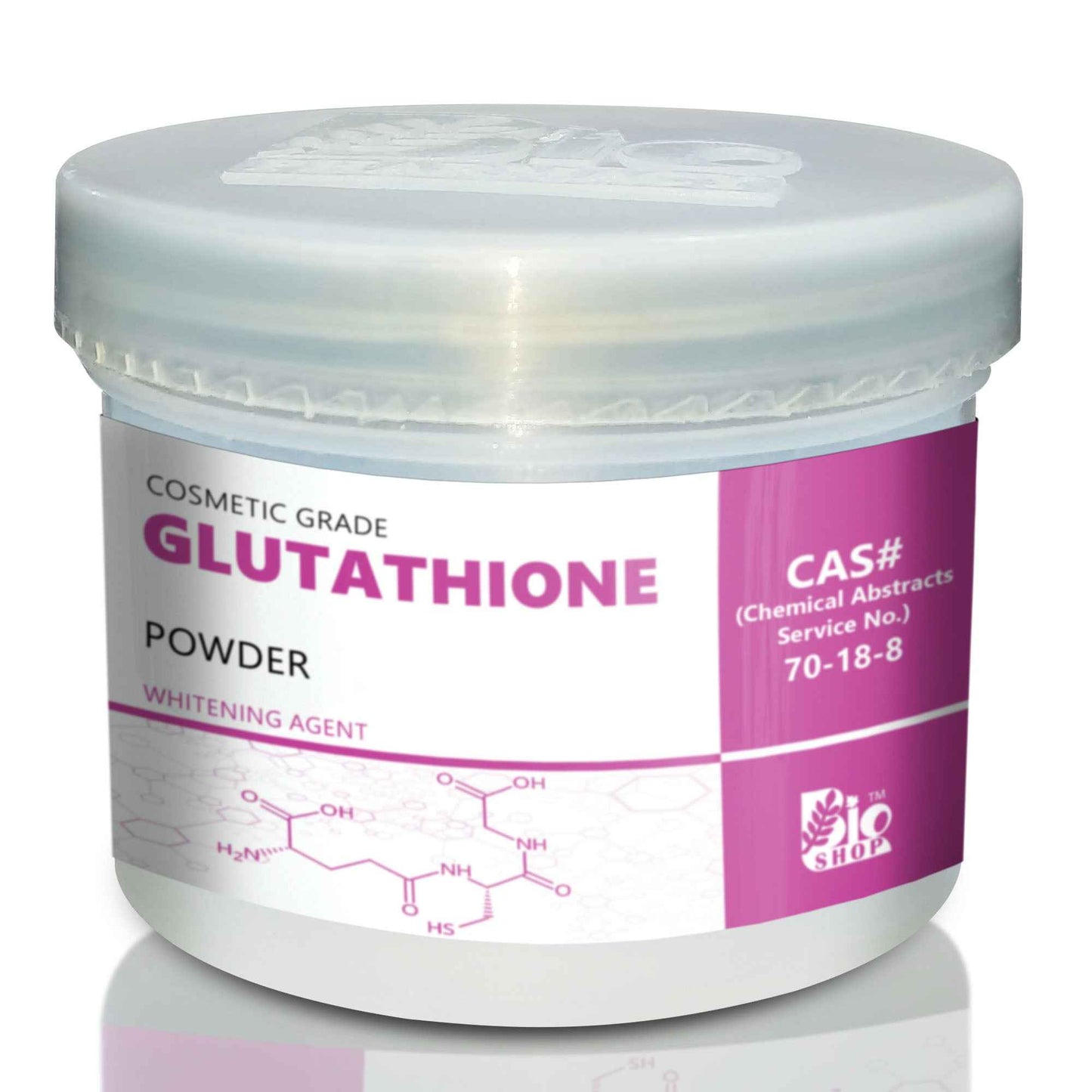
L-Glutathione Powder
L-Glutathione Powder
Key Functions: Inhibits melanin synthesis, brightens skin tone, delivers antioxidant protection, and reduces hyperpigmentation.
Couldn't load pickup availability
Explore
Information About L-Glutathione Powder
✅ Key Features
✦ Potent tyrosinase inhibitor that visibly reduces dark spots, uneven pigmentation, and dullness with consistent use.
✦ Tripeptide antioxidant that neutralizes free radicals and protects skin from oxidative stress and premature aging.
✦ Water-soluble white crystalline powder that disperses cleanly into aqueous-phase formulations without residue.
✦ Effective across brightening serums, whitening creams, face masks, ampoules, toners, and sheet mask concentrates.
✦ Synergistic with Vitamin C, Niacinamide, and Alpha Arbutin for enhanced multi-pathway brightening systems.
✦ Produced via yeast fermentation — vegan, non-animal-derived, and suitable for clean beauty formulations.
✦ Suitable for all skin types including sensitive and acne-prone skin when used within recommended concentration ranges.
🔬 Description
L-Glutathione is a tripeptide composed of three amino acids — glutamic acid, cysteine, and glycine — occurring naturally in human cells and widely distributed across the biological world. It has been a fixture of Asian skincare science for decades, first gaining prominence in Japanese and Korean pharmaceutical-grade whitening treatments before transitioning into mainstream cosmetic formulation across Southeast Asia and global markets. Its journey from clinical IV therapy to topical cosmetic active reflects growing formulator understanding of enzyme-targeted depigmentation.
What distinguishes L-Glutathione from conventional brightening agents is its dual mechanism. It directly inhibits tyrosinase activity, suppressing melanin production at its enzymatic source, while simultaneously switching melanogenesis from the eumelanin pathway to the phaeomelanin pathway — producing lighter pigment even when some melanin synthesis continues. As a master cellular antioxidant, it also scavenges reactive oxygen species that drive post-inflammatory hyperpigmentation, making it effective for both active correction and long-term prevention of uneven skin tone.
Bio Shop Pakistan supplies cosmetic-grade L-Glutathione Powder suitable for DIY beauty formulators, skincare brand developers, professional cosmetic chemists, and beauty entrepreneurs developing brightening and anti-aging product lines.
📊 Technical Data
INCI Name : Glutathione
Chemical Name : L-γ-Glutamyl-L-cysteinylglycine
CAS Number : 70-18-8
Molecular Formula : C10H17N3O6S
Appearance : White to off-white crystalline powder
Odor : Odorless to faintly sulfurous
pH (1% solution) : 3.0 – 4.5
Solubility : Freely soluble in water; slightly soluble in ethanol; insoluble in fixed oils
Specific Gravity : Not Applicable (solid powder)
Flash Point : Not Applicable (non-flammable water-soluble solid)
HLB Value : Not Applicable
Recommended Use Level : 0.5% – 5.0% (cosmetic topical use)
Type : Active Ingredient, Antioxidant, Skin Brightening Agent, Skin Conditioning Agent
Shelf Life : 24 months from manufacture date under recommended storage conditions
🧪 Recommended Usage
Skincare (Creams, Serums, Lotions) ★★★★★
L-Glutathione performs at its highest efficacy in water-based serums, brightening ampoules, and lightweight emulsions where pH can be precisely controlled. Dissolve in the water phase at room temperature and maintain system pH between 3.5 and 5.5 for optimal stability and bioactivity.
Haircare (Shampoo, Conditioner, Masks) ★★★☆☆
Glutathione has limited but valid application in scalp serums and antioxidant-focused hair masks targeting oxidative damage. Add to the cool phase at 0.5–1% and avoid alkaline shampoo bases where the ingredient rapidly degrades.
Soap Making (Cold Process, Melt and Pour) ★☆☆☆☆
L-Glutathione is not suitable for cold process soap due to high-pH degradation and heat destruction during saponification. Even melt-and-pour applications at low temperatures yield minimal active survival, making this an ineffective delivery system.
Body Care (Scrubs, Butters, Balms) ★★★☆☆
Glutathione can be incorporated into water-containing body lotions and body serums for full-body brightening applications at 1–3%. It is incompatible with anhydrous balms and oil-based scrubs as it requires an aqueous medium to dissolve and function.
Brightening Treatments (Masks, Ampoules, Toners) ★★★★★
Sheet mask concentrates, leave-on brightening ampoules, and essence toners represent the optimal delivery vehicles for L-Glutathione. High water activity and formulator-controlled pH in these formats maximize both ingredient stability and transdermal delivery.
💡 Pro Tip
When I formulate with L-Glutathione, I treat it as a pH-critical active that demands full system design discipline before a single gram goes into the batch. The ingredient is at its most stable and bioavailable between pH 3.5 and 4.8. I pre-dissolve it in a small, weighed portion of room-temperature distilled water, confirm full dissolution, then introduce it into the main batch only after the formula has cooled below 40°C and pH has been adjusted. I never add it to a hot phase. Pairing it with Vitamin C at 0.5–1% extends the active life of both molecules through antioxidant regeneration cycling — glutathione reduces oxidized ascorbate back to its active form, and ascorbate reciprocates.
ADVANCED TIP: Build a four-pathway brightening serum using 2% L-Glutathione, 3% Niacinamide, 0.5% Alpha Arbutin, and 0.5% Ascorbic Acid in a base of 1% Sodium Hyaluronate, 3% Betaine, and 0.1% Ferulic Acid. Adjust final pH to 3.8–4.2 using lactic acid after incorporating all actives in the cool phase. Package in an airless pump with UV-resistant opaque housing. This system targets tyrosinase inhibition, melanosome transfer suppression, melanogenesis pathway switching, and oxidative pigmentation simultaneously.
👩🔬 Skin Type Suitability
Normal Skin : ★★★★★ — Responds excellently to glutathione brightening with no sensitization concerns at standard use levels.
Dry Skin : ★★★★☆ — Highly effective for brightening but must be paired with hydrating actives like Sodium Hyaluronate to prevent moisture compromise.
Oily Skin : ★★★★★ — Exceptionally well tolerated in lightweight water-based serums and toners with no occlusion or comedogenic risk.
Combination : ★★★★☆ — Works uniformly across T-zone and dry areas; lightweight serum and essence formats deliver the most balanced coverage.
Sensitive Skin : ★★★☆☆ — Generally non-irritating but patch testing is advised; introduce at 0.5–1% and avoid combining with other low-pH actives until tolerance is confirmed.
Mature Skin : ★★★★★ — Dual antioxidant and brightening action simultaneously addresses both age-related pigmentation and oxidative skin aging.
Acne-Prone : ★★★★☆ — Particularly useful for reducing post-inflammatory hyperpigmentation left by active breakouts; use in non-comedogenic, oil-free formulations.
🧴 Formulation Ideas
CONCEPT 1: Advanced Brightening Booster Serum
Usage Level : 2.0%
Key Ingredients: Niacinamide 3%, Alpha Arbutin 0.5%, Sodium Hyaluronate 1%, Ferulic Acid 0.1%
Result : A lightweight, fast-absorbing multi-active brightening serum that visibly reduces dark spots, evens skin tone, and delivers antioxidant protection with consistent daily use.
CONCEPT 2: Brightening Whitening Day Emulsion
Usage Level : 1.5%
Key Ingredients: Olivem 1000, Niacinamide 2%, Panthenol 1%, Zinc Oxide 5%
Result : A light daily moisturizer that delivers ongoing tyrosinase inhibition and UV-assisted depigmentation while maintaining skin hydration throughout the day.
CONCEPT 3: Intensive Brightening Sheet Mask Concentrate
Usage Level : 3.0%
Key Ingredients: Sodium Hyaluronate 2%, Ascorbic Acid 0.5%, Allantoin 0.2%, Glycerin 5%
Result : A high-dose aqueous mask concentrate that delivers an intensive burst of glutathione and Vitamin C directly to the skin surface for immediate radiance boost and cumulative depigmentation.
💧 Safety and Regulatory:
INCI Declared : Yes — full INCI declaration required on finished cosmetic product label in all markets
EU Cosmetics Reg : Permitted — not listed in Annexes II, III, IV, V, or VI; used as antioxidant and skin conditioning agent without concentration restriction
Rinse-Off Limit : No established regulatory limit; formulate within safe and effective use range
Leave-On Limit : No established regulatory limit; typical cosmetic range 0.5%–5.0%; verify current guidance with regulatory authority
Allergen Alert : No — not a recognized cosmetic contact allergen; individual patch testing still advised
Skin Safety : Safe at recommended levels; avoid high concentrations without completed stability and safety testing
Eye Area Use : Use with caution — avoid direct ocular contact; not validated for periorbital applications at concentrations above 1%
Ingestion : Not for internal use
Pregnancy Use : Consult physician — topical use at low concentrations is generally considered low systemic risk, but controlled clinical data in pregnancy remains limited
Child Safety : Avoid use on children under 3 years; use in diluted formulations under adult supervision for older children
Ventilation : Not required — non-volatile crystalline solid with negligible vapor pressure
Storage : Store in a cool, dry place away from light, air, and moisture; refrigeration at 2–8°C is recommended for long-term powder storage
Container : HDPE or amber glass with airtight closure; avoid reactive metals and direct sunlight exposure
⚠️ L-Glutathione is highly susceptible to oxidative degradation upon exposure to air, heat, and alkaline pH. Keep containers sealed immediately after each use. Finished formulations must be packaged in airless or nitrogen-sealed containers. Any visible yellowing in the powder or finished product indicates significant loss of active potency.
Stability and Compatibility
Working pH Range : 3.0 – 5.5 (optimal stability and tyrosinase inhibition activity)
Heat Stability : Heat sensitive; add below 40°C in cool phase only; never include in hot processing
Freeze-Thaw Stable : Yes — stable in dry powder form; finished formulations should be individually tested
Emulsion Type : O/W only — water phase active; not functional in anhydrous or W/O systems
Emulsification Phase: Cold phase exclusively — must not be added during hot emulsification
Compatible With : Niacinamide, Sodium Hyaluronate, Alpha Arbutin, Ascorbic Acid, Panthenol, Ferulic Acid, Betaine
Incompatible With : Oxidizing agents, alkaline systems above pH 6.5, soap bases, heavy metal ions, prolonged air exposure
Oxidation Risk : High — include 0.1–0.2% Ferulic Acid or 0.1% Sodium Metabisulfite as stabilizer; use airless or nitrogen-blanketed packaging
Discoloration Risk : Possible — yellow to amber discoloration develops upon oxidative degradation; accelerated by light, heat, and air exposure
Formulation Notes : Pre-dissolve powder in a weighed portion of distilled water before adding to bulk batch. Adjust final pH to 3.8–4.5 after full incorporation. Airless pump dispensers with UV-opaque housing are strongly recommended for all L-Glutathione finished products.
❓ FAQs
Q: What is the correct percentage to use L-Glutathione in a brightening serum?
A: For daily-use serums, 0.5% to 2% is the standard effective range. Intensive treatment ampoules and professional concentrates may use up to 5%. Begin at 1% when developing a new formula and adjust based on stability testing and desired efficacy.
Q: Can I combine L-Glutathione with Vitamin C in the same formulation?
A: Yes, and the combination is actively encouraged. Ascorbic Acid regenerates oxidized glutathione back to its active reduced form, creating a self-reinforcing antioxidant cycle that extends the active life of both ingredients. Keep the combined system at pH 3.5–4.2 and use airless packaging to protect both actives from oxidation.
Q: Why has my glutathione powder or finished serum turned yellow?
A: Yellowing is a direct indicator of oxidative degradation. It is caused by exposure to air, light, or temperatures above 40°C. Incorporate 0.1–0.2% Ferulic Acid into your formula as a stabilizer, store your powder refrigerated in an airtight amber or HDPE container, and package finished products in airless dispensers to substantially extend active life.
Q: Is L-Glutathione safe for everyday facial use?
A: At concentrations of 0.5–2%, topical L-Glutathione is considered safe for daily use and is well tolerated by most skin types. Individuals with highly reactive or sensitized skin should perform a patch test before full-face application and introduce the ingredient gradually.
Q: How does L-Glutathione compare to Alpha Arbutin as a skin brightening ingredient?
A: Alpha Arbutin functions as a direct competitive inhibitor of tyrosinase, blocking melanin synthesis at the enzymatic level. L-Glutathione works through both tyrosinase inhibition and melanogenesis pathway switching — redirecting pigment production toward lighter phaeomelanin — while also delivering antioxidant benefits that Alpha Arbutin does not provide. Glutathione is the more comprehensive brightening active of the two, and combining both at moderate concentrations delivers superior results compared to using either ingredient in isolation.
Where Can You Safely Use L-Glutathione Powder
Discover how L-Glutathione Powder performs across different products — rated for safety, stability, and effectiveness.
Nice product