Bio Shop
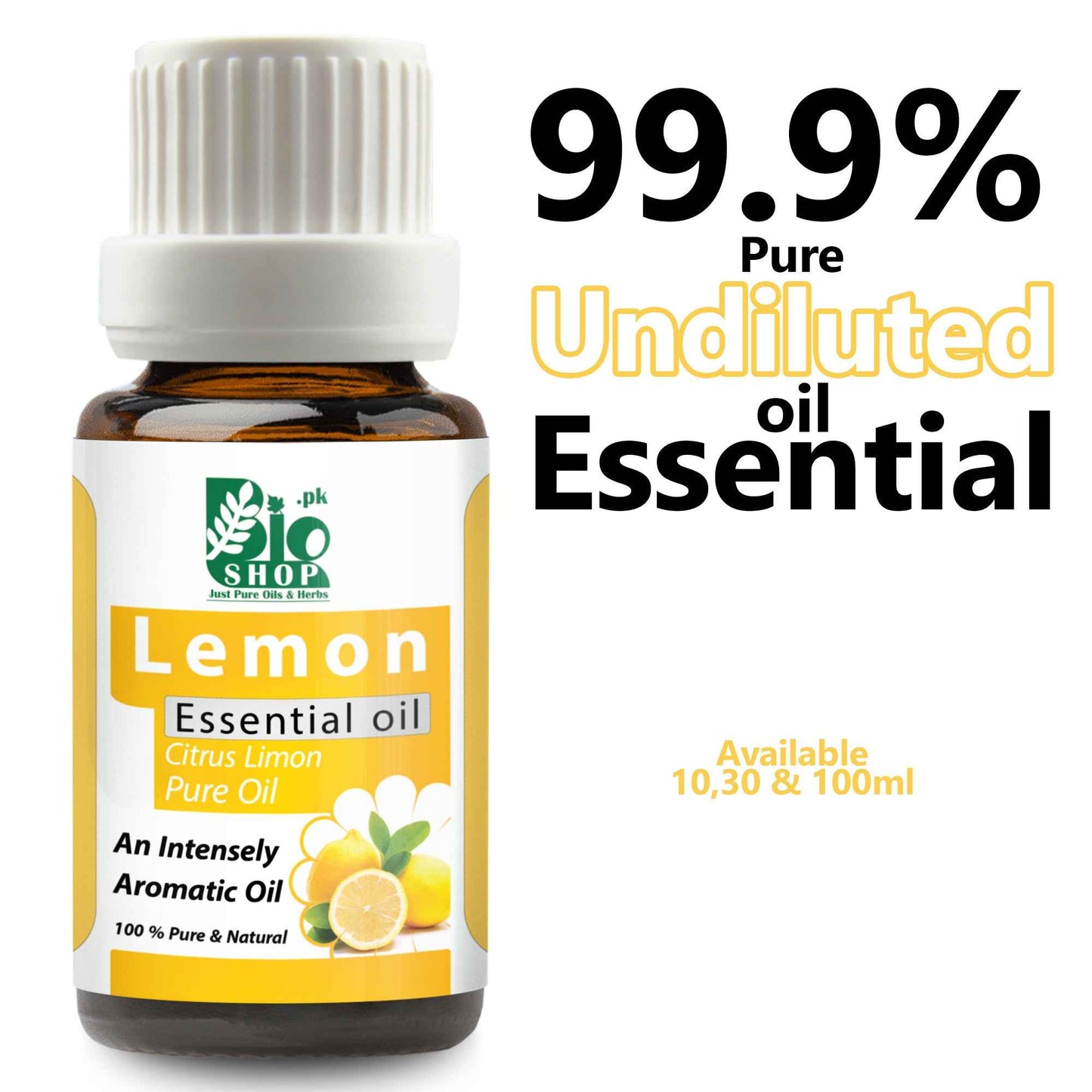
Lemon Essential Oil
Lemon Essential Oil
Olfactory Notes: Bright, zesty, fresh lemon citrus.
Couldn't load pickup availability


Explore
Information About Lemon Essential Oil
Key Features
✦ 100% natural cold-pressed essential oil extracted from fresh Citrus limon peel with no carriers or additives
✦ Delivers a sharp, intensely fresh, and zesty citrus top note — one of the most universally recognised scents in fragrance
✦ High d-Limonene content (55–75%) provides powerful brightness and uplifting character
✦ Widely used in colognes, fresh perfumes, soap, shampoo, shower gel, and household cleaning formulations
✦ Valued in aromatherapy for mood-lifting, concentration-enhancing, and stress-relieving effects
✦ Phototoxic when used cold-pressed in leave-on skin products — IFRA limits must be observed for rinse-off and leave-on applications
✦ Vegan, cruelty-free, and naturally derived — no animal-derived processing aids
About Lemon Essential Oil
Lemon essential oil has been extracted from the peel of Citrus limon for centuries, originating in the Mediterranean basin where lemon cultivation first became widespread. Unlike many essential oils that require steam distillation, lemon oil is traditionally cold-pressed — a mechanical expression process that preserves the full aromatic complexity of the fresh peel, including volatile top-note compounds that distillation would diminish or destroy. Sicily, Calabria, Spain, and Argentina remain the principal commercial production regions. The oil has been an ingredient in Eau de Cologne formulations since the 18th century and remains foundational to the classical cologne structure alongside bergamot, neroli, and rosemary.
What makes lemon essential oil distinctive is the transparency and immediacy of its scent. It opens instantly, cuts through other ingredients with authority, and communicates freshness to the nose within seconds of application. Its chemical backbone — dominated by d-Limonene — gives it both its recognisable brightness and its functional value as a natural solvent and degreasing agent in cleaning products. The presence of Citral, though minor in quantity, adds a richer lemon-verbena facet that lifts the oil above a simple terpenic blast into something with genuine aromatic character. This complexity has made lemon EO irreplaceable in both artisan and industrial formulation for well over two centuries.
Bio Shop Pakistan supplies cosmetic-grade lemon essential oil suitable for DIY perfumers, soap and candle makers, home care formulators, and beauty product developers across Pakistan who require a reliable, quality-verified natural citrus ingredient.
Olfactory Profile
SCENT DESCRIPTION : Lemon essential oil opens with an immediate, sharp, and sparkling burst of fresh-squeezed lemon peel — bright, clean, and unmistakably citrus. Beneath the initial zesty impact lies a slightly terpenic, almost piney undertone from beta-Pinene and gamma-Terpinene that gives the oil body without heaviness. A faint floral-green nuance, contributed by trace Citral and Linalool, adds a delicate softness as the top note begins to evolve. The overall impression is clean, uplifting, and airy — the olfactory equivalent of slicing into a ripe lemon on a summer morning.
NOTE POSITION : Top Note (dominant in the first 30–60 minutes; trace presence up to 2 hours in blends)
FRAGRANCE FAMILY : Citrus · Fresh · Aromatic
FACETS : Bright · Zesty · Clean · Terpenic · Sparkling
TENACITY : Low — 1 to 2 hours as top note; longevity extends slightly when anchored by a fixative base
SILLAGE : Medium — radiates well on initial application but diffuses quickly due to the high volatility of its dominant terpene constituents
Technical Specifications
Chemical Name : Citrus limon peel oil expressed
CAS Number : 8008-56-8
Synonyms : Lemon Oil, Lemon Peel Oil, Citrus limon Oil, Cold-Pressed Lemon Oil
Purity : ≥99% natural (verify exact composition with supplier CoA)
Appearance : Pale yellow to light yellow mobile liquid
Odor Threshold : Approximately 0.06 ppm (highly detectable at trace concentrations)
Solubility : Soluble in alcohol and fixed oils; insoluble in water
Specific Gravity : 0.849 – 0.855 at 20°C (verify with supplier CoA)
Flash Point : Approximately 46°C / 115°F (verify with supplier CoA)
Type : Natural (cold-pressed)
Main Components : d-Limonene (55–75%), beta-Pinene (8–15%), gamma-Terpinene (6–12%), alpha-Terpinene, Citral, Linalool (trace)
Applications & Usage Guidelines
Fine Fragrance ★★★★★
Lemon essential oil is the backbone of classical Eau de Cologne and a standard top-note opener in fresh, aromatic, fougère, and chypre fragrance families. It provides an immediate, consumer-friendly brightness that makes a fragrance feel clean, confident, and contemporary from first spray. Use at 3–8% in EDP/EDT blends for top-note impact; pair with hedione, bergamot, and musks for classical cologne structure.
Functional Fragrance & Home Care ★★★★★
Lemon EO is among the most widely used natural materials in household cleaning products, dish soap, surface sprays, and laundry formulations. Its high limonene content delivers both a perceived cleanliness signal and mild degreasing action. In fabric softeners and detergents, it imparts a fresh-washed character that customers associate with hygiene and cleanliness. Dosage typically 0.1–0.5% in functional applications.
Soap & Body Wash ★★★★☆
In rinse-off products such as bar soap, shower gel, shampoo, and liquid hand wash, lemon essential oil performs reliably with minimal phototoxicity concern at standard usage levels. Its bright scent lifts soap bases effectively and complements mint, lavender, eucalyptus, and citrus blends. Expect some top-note dissipation in hot-process soap; cold-process retains more character.
Home Fragrance & Candles ★★★★☆
Lemon EO blends well in reed diffusers, room sprays, and wax candles. Its brightness provides excellent cold throw in reed diffusers; hot throw in candles is adequate but note that the high limonene content is highly volatile and may require blending with a more tenacious citrus accord or fixative to extend diffusion. Flash point must be respected in candle formulation.
Aromatherapy & Wellness ★★★★★
Lemon essential oil is one of the three most widely used aromatherapy ingredients globally alongside lavender and peppermint. Clinical and observational studies support its use for mood elevation, mental focus, stress reduction, and mild antibacterial ambient use in diffusers. It blends easily with eucalyptus, frankincense, peppermint, and rosemary for focused or refreshing diffuser blends.
IFRA & Usage Rate
RECOMMENDED USAGE RATES
EDP / Parfum : 3 – 8%
EDT / Cologne : 5 – 10%
Body Lotion (leave-on) : 0.4% maximum (IFRA limit — phototoxicity)
Shampoo : 0.5 – 1.5%
Body Wash / Shower Gel : 0.5 – 2%
Bar Soap (rinse-off) : 1 – 2%
Candle : 5 – 10% (respect flash point in wax selection)
Reed Diffuser : 10 – 20%
Room Spray : 2 – 5%
Cleaning Products : 0.1 – 0.5%
Fabric Softener : 0.1 – 0.3%
IFRA 51st AMENDMENT LIMITS — LEMON OIL EXPRESSED (CAS 8008-56-8)
⚠️ Cold-pressed lemon oil contains furanocoumarins (including bergapten and psoralen) which cause photosensitisation and phototoxic skin reactions upon UV exposure. IFRA restricts leave-on applications strictly.
Category 1 (Lip products) : 0.01%
Category 2 (Deodorant, underarm) : 0.5%
Category 3 (Eye area cosmetics) : 0.01%
Category 4 (Body lotion, leave-on) : 0.4%
Category 5A (Fine fragrance — body) : 2.4%
Category 5B (Fine fragrance — face) : 0.4%
Category 6 (Mouthwash, oral) : Not permitted
Category 8A (Rinse-off hair) : Higher limit — verify at ifrafragrance.org
Category 9 (Rinse-off body/hand wash) : Higher limit — verify at ifrafragrance.org
Category 11 (Candles, non-skin contact) : Not restricted
⚠️ If phototoxicity is a concern for your application, consider steam-distilled or furocoumarin-free (FCF) lemon oil as an alternative — verify its availability with your supplier.
⚠️ Always verify current IFRA 51st Amendment limits directly at ifrafragrance.org before final formulation.
Blending Guide
USAGE METHODS
Method 1 — Direct Perfumery Addition
Add lemon essential oil directly to your alcohol base as part of the top-note fraction. Dissolve in perfumers alcohol (96% ethanol) at room temperature. Because of its high volatility, incorporate it last in the blending sequence to minimise evaporation loss during weighing. At 5–8% in an EDP, it delivers a brilliant, sharp citrus opening for the first 30–45 minutes.
Method 2 — Accord Anchoring with Fixatives
Lemon EO on its own dissipates quickly. To extend longevity, create a lemon accord by combining it with Hedione (jasmine-citrus bridge), a small percentage of Linalool (softening, extends the citrus into the heart), and a musks base. Alternatively, pair with Iso E Super at 1–3% to create a woody-citrus structure that holds the lemon note much longer in the drydown.
Method 3 — Functional Product Scenting
In soap, shampoo, or cleaning products, blend lemon EO with complementary aromatic materials before incorporation into the base. Pre-mixing with citronellol or geraniol helps round off the sharp terpenic edge and creates a more balanced citrus profile at lower overall usage.
BEST PAIRINGS
Bergamot EO → Softens and rounds the lemon with a floral-green dimension; classical cologne pairing
Neroli EO → Adds depth and sophistication; the classic Eau de Cologne trio with Rosemary
Lavender EO → Balances the sharp citrus brightness with herbaceous calm; popular in fresh florals
Eucalyptus EO → Amplifies the clean, medicinal freshness; excellent for cleaning and personal care
Peppermint EO → Creates a sharp, invigorating fresh accord; strong in functional products
Rosemary EO → Traditional aromatic pairing; reinforces the bright, energising character
Hedione → Modern jasmine-citrus bridge; elevates lemon into fine fragrance territory
Iso E Super → Woody-amber fixative; dramatically improves longevity of lemon note in perfumery
Linalool → Soft floral-citrus connector; smooths harsh terpenic edges at 2–5%
Cedarwood EO → Provides a subtle woody base that anchors the citrus without overpowering
AVOID
Combining with heavy animalic materials (civet, castoreum accords) at high levels — the sharp brightness of lemon tends to clash rather than harmonise with dense, dark base notes in simple two-material combinations.
Perfumer's Note
Of all the citrus materials I work with, lemon essential oil remains the most honest. It has no agenda — no complexity, no mystery — just an immediate, unwavering brightness that communicates freshness faster than any other single material in the palette. In a blind evaluation, most people identify it within a second. That recognisability is its superpower, and it is precisely why lemon has anchored commercial colognes, household products, and wellness blends for over two centuries. The challenge is never getting the lemon note — the challenge is keeping it. Because of its top-heavy volatility, the question every perfumer must answer is not whether to use lemon oil, but how to build a structure beneath it that makes the brightness feel like a gateway rather than a fleeting introduction.
ADVANCED TIP : To create a lemon note with genuine staying power in an EDP or attar-style fragrance, build a lemon accord using three materials in combination: lemon EO at 5%, Citral (the aldehyde responsible for the verbena-like richness in lemons) at 0.5%, and Lemon Nitrile or Citronellal at 0.2% to add a slightly dewy, green dimension. This three-layer approach replicates the natural peel profile more faithfully than straight lemon EO alone, and the Citral fraction extends perceived citrus character well into the heart note stage — something cold-pressed lemon EO alone simply cannot achieve.
Safety & Storage
Physical State : Mobile liquid at room temperature
Skin Safety : Phototoxic in leave-on applications — do not apply cold-pressed lemon oil to skin that will be exposed to UV/sunlight above IFRA limits. Observe category-specific limits strictly. May cause sensitisation in rare individuals at high concentrations.
Eye Contact : Irritant — avoid direct contact. Flush immediately with clean water for 15 minutes if eye exposure occurs and seek medical advice.
Ingestion : Not for internal use. Keep away from children and pets.
Ventilation : Use in a well-ventilated area. Avoid prolonged inhalation of concentrated vapour.
Storage : Store in a tightly sealed, dark-glass or aluminium container away from heat, light, and oxygen. Refrigeration extends shelf life.
Shelf Life : 12 to 18 months from production date if stored correctly. High limonene content oxidises readily on exposure to air — seal tightly after each use.
Container : Dark glass (amber or cobalt), aluminium, or stainless steel preferred. Avoid plastic long-term.
Flammability : Flammable liquid. Flash point approximately 46°C. Keep away from open flames, sparks, and heat sources.
FAQ
Q: Is lemon essential oil safe to apply directly to skin?
A: No — always dilute before any skin application. Cold-pressed lemon EO is phototoxic, meaning it can cause burns or pigmentation on skin exposed to sunlight. For leave-on products, stay within IFRA limits and avoid sun exposure after use.
Q: Why does my lemon scent disappear so quickly in perfume?
A: Lemon EO is a top note dominated by highly volatile terpenes that evaporate fast. To extend longevity, blend it with Hedione, Iso E Super, or a musk base that holds and radiates the lemon character longer into the drydown.
Q: Can I use lemon essential oil in cold-process soap?
A: Yes, but note that high limonene content can accelerate trace and may seize in some soap bases. Pre-mixing with a carrier or soap-safe fragrance component before adding to the batch helps control acceleration. Rinse-off use significantly reduces phototoxicity concern.
Q: What is the difference between cold-pressed and steam-distilled lemon oil?
A: Cold-pressed oil retains the full peel character including furanocoumarins that cause phototoxicity. Steam-distilled lemon oil has most furanocoumarins removed during the distillation process, making it safer for leave-on applications but with a slightly less rich, more terpenic scent profile.
Q: How does lemon essential oil compare to synthetic lemon aroma chemicals like Citral or d-Limonene?
A: Lemon EO offers a complete, natural peel profile with subtle complexity from multiple constituents. Citral delivers a richer, more concentrated lemon-verbena character and is stronger at lower concentrations. d-Limonene on its own reads as clean but flat. For most finished fragrance work, the natural EO provides the most convincing lemon character, though combining EO with a trace of Citral is a common professional enhancement.
Where Can You Safely Use Lemon Essential Oil?
Discover how Lemon Essential Oil performs across different applications—rated for safety, stability, and effectiveness.
Good product. Recommended.
Original products for great value
Versatile pure aur affordable. Ghar mein hamesha honi chahiye.
Fridge mein lemon oil soaked cotton ball rakhi. 2 din mein fridge ki smell bilkul fresh ho gayi. Yeh idea kisi ne diya tha - genuinely kaam kiya. Oil potent aur real hai.
Mild gala kharab tha. Warm pani mein lemon oil aur honey se gargle ki. Genuine relief mila. Food grade pure oil hai. Simple effective natural remedy. Bio Shop ka oil authentic aur potent hai.