


Bio Shop
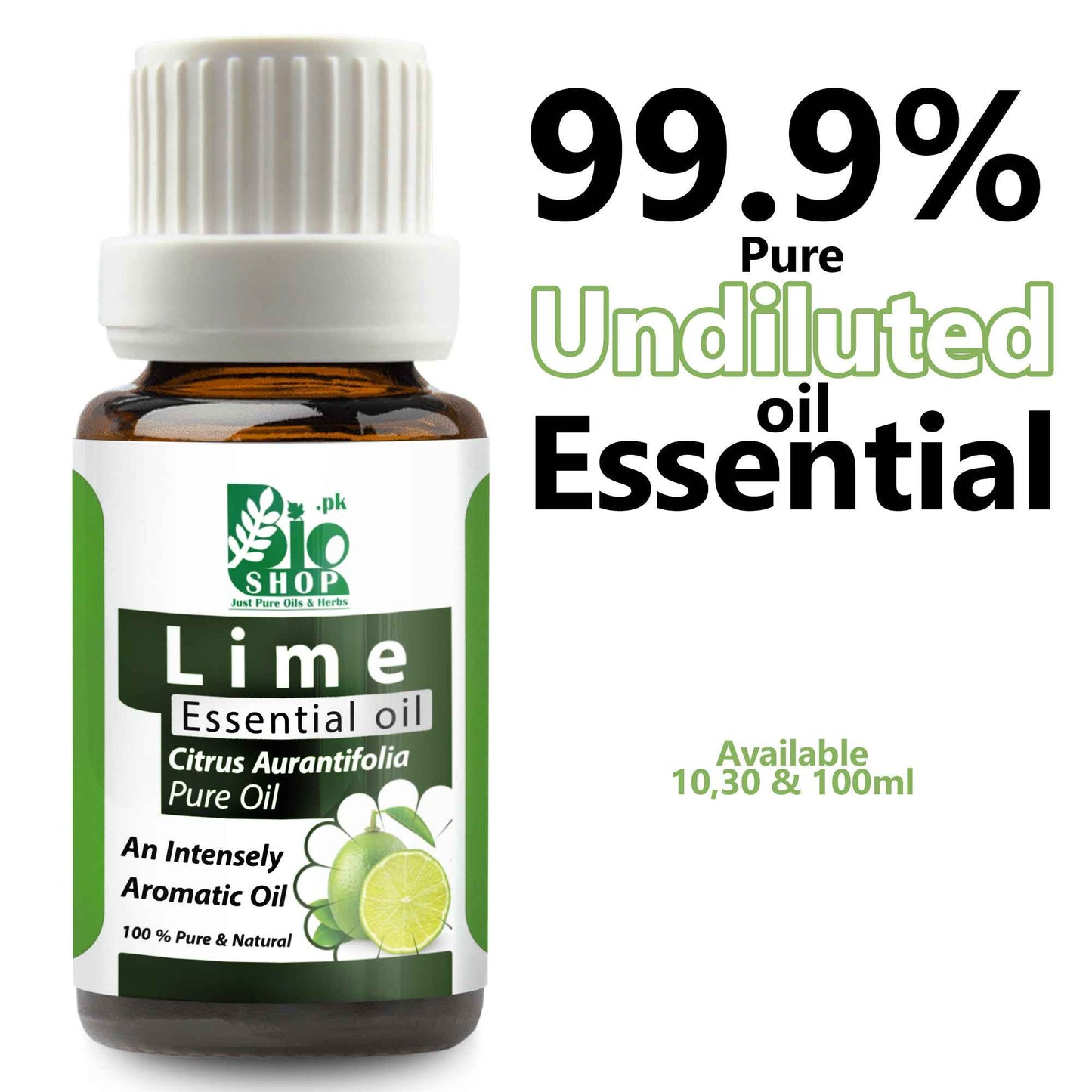
Lime Essential Oil
Lime Essential Oil
Olfactory Notes: Citrus · Fresh · Green · Tart · Sparkling · Clean
Couldn't load pickup availability


Explore
Information About Lime Essential Oil
Key Features
✦ Cold-pressed from Citrus aurantifolia peel — intense, authentic lime character with natural terpene complexity
✦ Dominant top note delivering immediate freshness and lift in any fragrance composition
✦ Rich in limonene and beta-pinene — bright, green-citrus facets with a faint tart edge
✦ Dual-use ingredient — viable in fine fragrance, soap, shampoo, candles, and cleaning formulations
✦ Cold-pressed variant requires IFRA-compliant usage rates for leave-on applications due to furanocoumarin content
✦ Steam-distilled option available — furanocoumarin-reduced profile, safer for cosmetic leave-on use
✦ Vegan, plant-derived, and free from synthetic additives
About Lime Essential Oil
Lime essential oil has been extracted from the peel of Citrus aurantifolia for centuries, originating in Southeast Asia before spreading through the Arab world and eventually becoming a commercial crop in Mexico, the Caribbean, and South Asia. The oil is produced by two distinct methods — cold expression, which presses the fresh peel mechanically to capture the full aromatic spectrum including phototoxic furanocoumarins, and steam distillation, which passes steam through the peel material and produces a cleaner, furanocoumarin-reduced oil. Both variants are commercially important, with cold-pressed lime valued for its vivid, true-to-fruit character and distilled lime preferred for its regulatory flexibility in cosmetics.
What makes lime essential oil particularly useful for formulators is its versatility across product categories. Unlike lemon or bergamot, lime carries a distinctly green, slightly bitter-tart edge that reads as clean and sharp rather than soft or sweet. This makes it an excellent choice not only for fresh citrus fragrances but also for functional products such as household cleaners, surface sprays, dishwashing liquids, and masculine body care lines where sharp freshness is desirable. Its compatibility with a wide range of fragrance families — from florals and herbs to woods and musks — makes it a practical building block across many formulation contexts.
Bio Shop Pakistan supplies cosmetic-grade lime essential oil suitable for perfumers, soap makers, candle crafters, hair care formulators, home fragrance developers, and cleaning product manufacturers seeking a reliable, high-quality citrus raw material.
Olfactory Profile
SCENT DESCRIPTION : Lime essential oil opens with an immediate burst of sharp, green citrus — tart, bright, and almost sparkling on first impression. The character is distinctly lime rather than lemon or bergamot, carrying a faint bitterness that keeps it from reading as sweet. As it develops, soft floral and faintly herbaceous undertones emerge beneath the citrus edge. It is a high-energy, transparent note that lifts compositions without adding depth or body.
NOTE POSITION : Top Note
FRAGRANCE FAMILY : Citrus · Fresh · Aromatic
FACETS : Zesty · Green · Tart · Sparkling · Clean
TENACITY : Low — 30 to 90 minutes in alcoholic formula; slightly longer in wax and carrier oil bases
SILLAGE : Medium — immediate projection on application, trails cleanly, dissipates without heavy trail
Technical Specifications
Chemical Name : Citrus aurantifolia Peel Oil (Cold-Pressed) / Citrus aurantifolia Distillate (Steam-Distilled)
CAS Number : 8008-26-2 (cold-pressed) · 90063-52-8 (steam-distilled) — verify against supplier CoA
Synonyms : Lime Peel Oil · Mexican Lime Oil · Key Lime Essential Oil · Citrus aurantifolia Oil
Purity : 100% pure — no carrier, no diluent (verify with supplier CoA)
Appearance : Pale yellow to yellow-green mobile liquid (cold-pressed) · Colorless to pale yellow (steam-distilled)
Odor Threshold : Approximately 10–20 ppb (limonene-dominant character)
Solubility : Insoluble in water · Fully soluble in ethanol, IPM, DPG, and carrier oils
Specific Gravity : 0.857–0.863 at 20°C — verify with supplier
Flash Point : Approximately 47°C / 117°F (cold-pressed) — verify with supplier
Type : Natural — cold-pressed or steam-distilled from Citrus aurantifolia peel
Applications & Usage Guidelines
Fine Fragrance ★★★★★
Lime essential oil is a core top note in colognes, fresh aquatics, aromatic fougères, and citrus-forward EDTs and EDPs. It delivers the opening freshness that registers immediately on skin before base notes emerge. Cold-pressed lime provides maximum aromatic impact but must be used within IFRA leave-on limits. Steam-distilled lime offers greater formulation flexibility for leave-on fragrance products.
Functional Fragrance ★★★★★
This is one of lime's strongest commercial applications. Household cleaners, dishwashing liquids, surface sprays, toilet blocks, and laundry care products all benefit from lime's sharp, clean, "just-washed" freshness. High usage rates are acceptable in rinse-off and non-skin-contact products. Cost-effective and impactful at moderate dosage.
Soap and Hair Care ★★★★☆
Excellent in shampoos, body washes, and bar soaps where rinse-off use reduces phototoxicity concern. Provides authentic citrus freshness that synthetic lime fragrance oils rarely replicate. Use steam-distilled lime for products with any potential leave-on or scalp contact. Performs well at 0.5–1.5% in rinse-off formulations.
Home Fragrance ★★★★☆
Lime essential oil performs well in reed diffusers, room sprays, and wax melts. In soy or paraffin candles it performs reliably at 5–8%, though citrus top notes have naturally limited throw longevity. Best combined with middle and base notes to extend perceived freshness. Excellent for blending with eucalyptus, mint, or cedar in home fragrance applications.
Cosmetics and Body Care ★★★☆☆
Cold-pressed lime requires strict usage-rate control in leave-on products such as creams, lotions, and serums due to furocoumarin-related phototoxicity. Steam-distilled lime is significantly safer for cosmetic applications. Suitable as a fresh top note in body lotions, hair conditioners, and lip-safe formulations when using the distilled grade within safe limits.
IFRA & Usage Rate
RECOMMENDED USAGE RATES
EDP (Eau de Parfum) : 2.0–5.0%
EDT (Eau de Toilette) : 3.0–7.0%
Body Lotion (leave-on) : 0.1–0.3% (cold-pressed) · Up to 1.0% (steam-distilled) — verify IFRA
Shampoo / Body Wash : 0.5–1.5%
Bar Soap : 1.0–2.5%
Soy / Paraffin Candle : 5.0–8.0%
Reed Diffuser : 10.0–20.0%
Room Spray : 3.0–6.0%
Cleaning Products : 0.5–2.0%
IFRA 51ST AMENDMENT LIMITS — CITRUS AURANTIFOLIA PEEL OIL (COLD-PRESSED)
⚠️ Cold-pressed lime oil is restricted by IFRA in leave-on skin categories due to phototoxic furanocoumarins. The following are approximate limits — always verify against the current IFRA standard at ifrafragrance.org.
IFRA Category 1 (Lip products) : 0.1%
IFRA Category 3 (Fine fragrance) : 0.7% (approximate — verify)
IFRA Category 4 (Eau de Toilette) : 1.1% (approximate — verify)
IFRA Category 5a (Body lotion, leave-on) : 0.2% (approximate — verify)
IFRA Category 9 (Rinse-off body/hair) : 4.5% (approximate — verify)
IFRA Category 11 (Non-skin contact) : Not restricted
⚠️ Steam-distilled lime oil has significantly higher IFRA limits across all categories due to reduced furanocoumarin content. If formulating for leave-on cosmetics, use the steam-distilled grade and verify current IFRA limits for that specific grade.
⚠️ Always source your IFRA amendment data directly at ifrafragrance.org before production use.
Blending Guide
USAGE METHOD 1 — TOP NOTE ANCHOR IN CITRUS FRAGRANCE
Use lime essential oil at 3–6% as the primary citrus opening in fresh colognes and EDTs. Combine with bergamot for softness, neroli for floral depth, and petitgrain for a bitter-green backbone. Anchor the composition with cedarwood or vetiver to extend the composition's longevity after the lime evaporates.
USAGE METHOD 2 — FRESHNESS BOOSTER IN FUNCTIONAL FORMULATIONS
In cleaning products, dishwashing liquids, or laundry formulations, lime oil works well at 0.5–2.0% to impart a natural, green-citrus freshness. Blend with eucalyptus, pine, or tea tree for a classic household clean scent. No phototoxicity concern applies in non-skin-contact or rinse-off applications.
USAGE METHOD 3 — HOME FRAGRANCE LAYERING
In candle or reed diffuser blends, lime works best not as a solo note but as a freshness layer over a supporting mid and base structure. Pair with basil or mint at the top, jasmine or ylang ylang in the mid, and sandalwood or musk at the base. This architecture keeps the lime prominent while giving the overall composition body and longevity.
BEST PAIRINGS
Bergamot → Softens lime's tartness, adds floral-citrus roundness
Neroli → Elevates lime into elegant, floral-fresh territory
Petitgrain → Adds green, woody depth and extends citrus tonality
Lavender → Classic fougère accord — clean, barbershop freshness
Cedarwood → Grounds the brightness, adds dry woody warmth
Vetiver → Earthy, smoky contrast that makes lime read more complex
Peppermint → Sharp, bracing fresh-clean accord for functional products
Jasmine → Surprising contrast — lifts jasmine's heaviness, adds sparkle
Eucalyptus → Clean, medicinal-fresh blend for spa and home fragrance
Rosemary → Herbal-citrus accord with good presence and clarity
AVOID
✦ High concentrations in leave-on skin products when using cold-pressed grade — phototoxicity risk
✦ Prolonged exposure to heat, light, and air — lime oxidizes quickly, reducing quality and increasing sensitisation potential
✦ Combining with heavily sweet bases — lime's tartness can clash with dense gourmand or amber-heavy compositions without a bridging mid note
Perfumer's Note
There is a particular honesty about lime essential oil that I respect. It does not disguise itself or linger beyond its welcome. The moment it opens a composition, it announces freshness with absolute clarity — that sharp, tart, green citrus burst that nothing synthetic has ever quite replicated. Cold-pressed lime carries a faint natural complexity underneath that bright surface: a softness, a faint bitterness, a suggestion of the actual fruit rather than an idea of it. It disappears quickly, but it does its job before it goes. The opening of a fine fragrance is the first handshake — and lime essential oil makes that handshake confident.
ADVANCED TIP : Lime essential oil oxidizes faster than most citrus materials, and oxidized lime does not just lose quality — it can become a sensitizer. To slow oxidation in your formulation stock, pre-dilute your lime essential oil to 10% in IPM (isopropyl myristate) or a quality fractionated coconut oil and store in a dark, cool environment with minimal headspace in the bottle. This extends usable shelf life significantly and also makes dosing easier at small scale. Refresh your dilution every 8–10 months rather than stretching oxidized stock.
Safety & Storage
Physical State : Clear mobile liquid at room temperature
Skin Safety : Cold-pressed grade — phototoxic, use within IFRA limits for leave-on. Steam-distilled grade — significantly reduced phototoxicity risk. Dilute before any skin application. Patch test recommended.
Eye Contact : Avoid direct contact. If contact occurs, flush with water for 15 minutes and seek medical advice if irritation persists.
Ingestion : Not for internal use. Keep out of reach of children.
Ventilation : Use in a well-ventilated space. Avoid prolonged inhalation of undiluted vapour.
Storage : Store in a tightly sealed, dark glass or aluminium container. Keep away from heat, light, and air. Refrigeration recommended for extended storage.
Shelf Life : 12–18 months from production date when stored correctly. Citrus oils oxidize faster than most essential oil categories.
Container : Dark glass (amber) or aluminium — avoid plastic for long-term storage
Flammability : Flammable. Flash point approximately 47°C. Keep away from open flame and heat sources.
FAQ
Q: Is this cold-pressed or steam-distilled lime oil?
A: Bio Shop Pakistan supplies lime essential oil — confirm the specific grade (cold-pressed or steam-distilled) on the product listing or by contacting us. Both grades have different regulatory profiles, particularly for leave-on cosmetic use.
Q: Can I use lime essential oil directly on my skin?
A: Never apply undiluted essential oil to skin. Cold-pressed lime is phototoxic and must be used within strict IFRA limits in leave-on products. Steam-distilled lime is safer but still requires dilution. Avoid sun exposure on skin treated with cold-pressed lime oil.
Q: How do I stop lime essential oil from fading too fast in my perfume?
A: Pre-blend lime into your composition at slightly higher percentage to account for early evaporation. Pair it with petitgrain or bergamot to extend the citrus phase. A small addition of iso E super or a woody base note helps the citrus read persist longer on skin.
Q: Is lime essential oil safe for candles and diffusers?
A: Yes. Non-skin-contact applications like reed diffusers and candles carry no phototoxicity concern. Lime performs well in soy and paraffin wax at 5–8% and in reed diffusers at 10–20%.
Q: How does lime essential oil compare to synthetic lime fragrance oil?
A: Natural lime essential oil has a true-to-fruit complexity — a green, slightly bitter edge and a layered terpene character — that most synthetic lime fragrance oils cannot fully replicate. However, lime EO has a shorter lifespan on skin and is more fragile in formulations. Synthetic lime fragrance oils offer better tenacity, lower cost, and IFRA-compliant stability, making them practical for high-volume products. Many professional formulators use both: natural lime for authenticity in fine fragrance, synthetic for functional and home products.
Where Can You Safely Use Lime Essential Oil?
Discover how Lime Essential Oil performs across different applications—rated for safety, stability, and effectiveness.
Authentic. Powerful. Zesty. But a bit too expensive.


