


Bio Shop
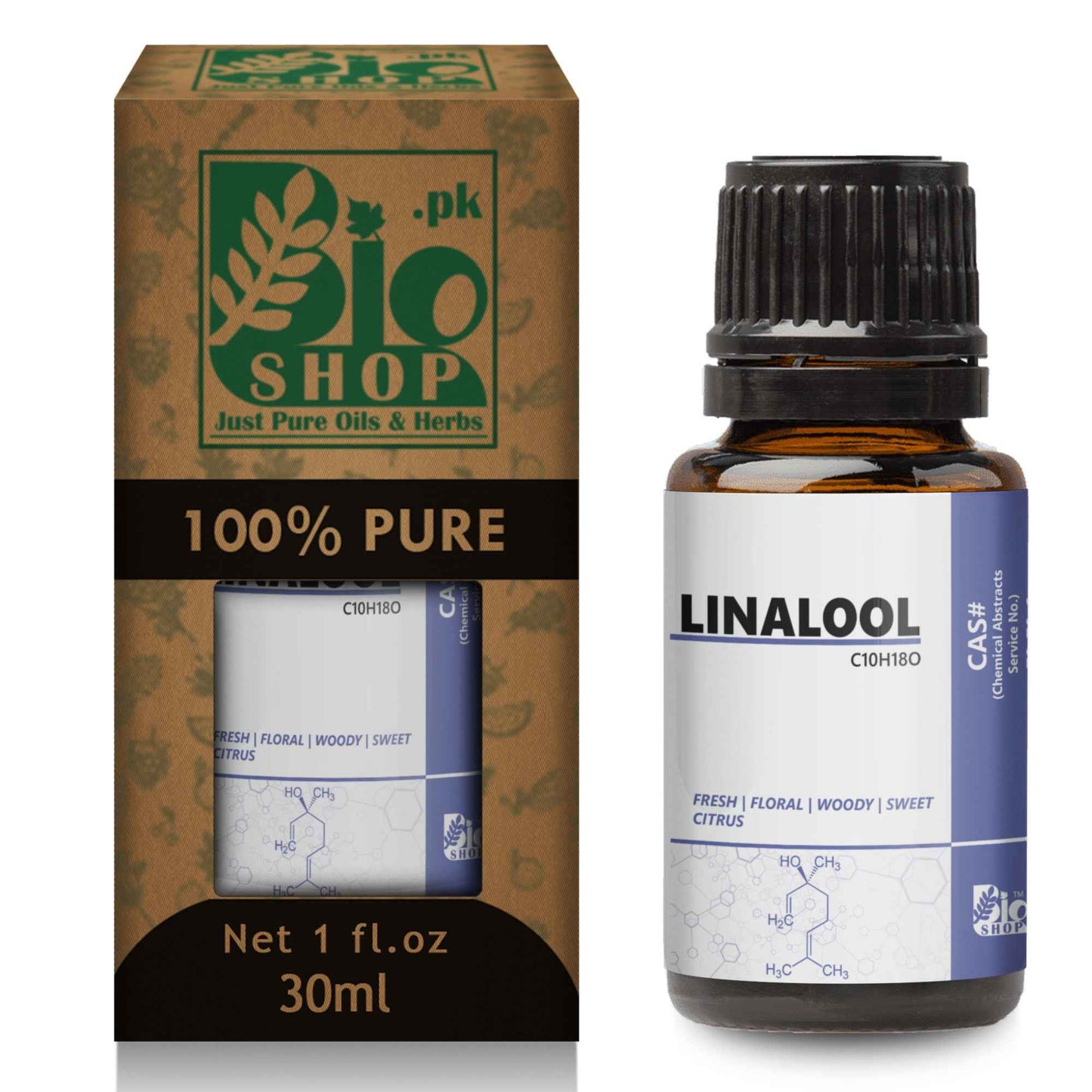
Linalool
Linalool
Olfactory Notes: Floral · Fresh · Citrus · Soft · Slightly Woody · Clean
Couldn't load pickup availability
Explore
Information About Linalool
Key Features
✦ Natural-identical terpene alcohol isolated from or inspired by lavender, coriander, and rosewood essential oils
✦ Soft floral, woody, and faintly spicy character — one of the most versatile aroma chemicals in perfumery
✦ Core building block for lavender, fougère, fresh floral, and oriental fragrance accords
✦ Used at significant levels in fine fragrance, body lotion, shampoo, soap, and candles
✦ Provides mild calming and skin-conditioning properties in cosmetic applications
✦ Vegan-suitable and compatible with most cosmetic and fragrance bases
✦ Listed IFRA-regulated ingredient — safe at recommended usage levels across all major applications
About Linalool
Linalool is a naturally occurring monoterpene alcohol found in over 200 plant species, including lavender, bergamot, coriander, basil, rose, and rosewood. It has been used in perfumery and cosmetics for well over a century and remains one of the highest-volume aroma chemicals produced globally. Both natural linalool extracted from essential oils and synthetic linalool share the same molecular structure and aromatic profile, giving formulators the flexibility to source it in either form.
What makes linalool exceptional is its near-universal compatibility with other fragrance materials. It softens harsh woody and citrus notes, lifts heavy oriental bases, and provides a clean, natural quality to floral compositions. It also acts as a fixative to some degree, contributing to the overall balance and tenacity of a blend. Its calming aromatic properties have made it a popular ingredient in aromatherapy and wellness product formulations. Linalool is also a precursor to linalyl acetate, the primary component of true lavender essential oil.
Bio Shop Pakistan supplies cosmetic-grade linalool suitable for DIY perfumers, home fragrance crafters, soap and lotion makers, and professional formulators working across fine fragrance, personal care, and wellness product categories.
Olfactory Profile
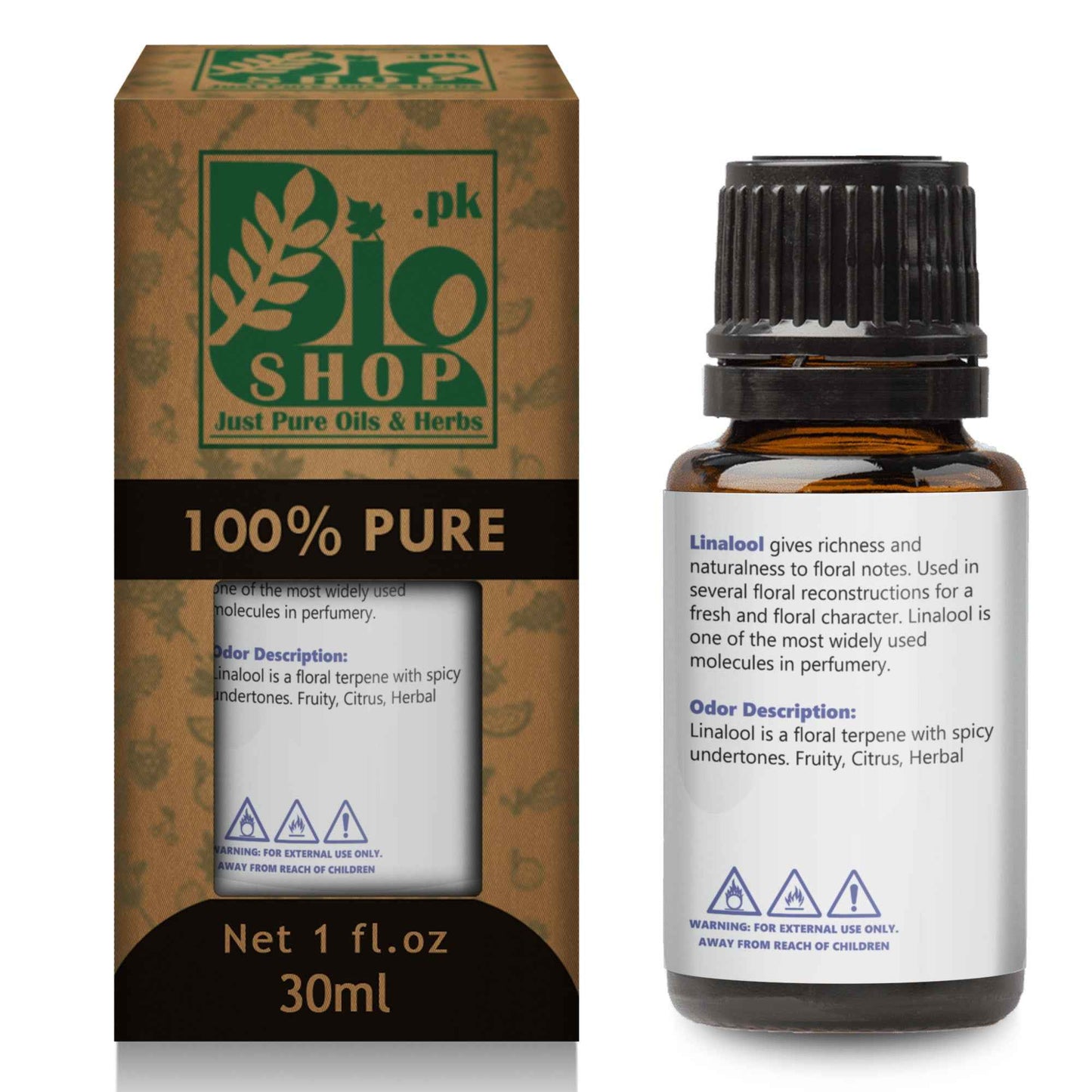
SCENT DESCRIPTION : Linalool opens with a soft, clean floral freshness reminiscent of lavender in full bloom. As it develops, a gentle woody and slightly herbaceous quality emerges, grounded by a faint spicy undertone. The overall impression is light, airy, and natural — never synthetic or harsh. It has a calming, almost powdery softness that makes it instantly recognizable in lavender, bergamot, and rosewood-style compositions.
NOTE POSITION : Mid to Base
FRAGRANCE FAMILY : Floral · Fresh · Woody
FACETS : Lavender · Woody · Herbaceous · Spicy · Clean
TENACITY : Medium — 4 to 6 hours on skin
SILLAGE : Medium — present but not projecting, blends quietly into the background and supports surrounding notes
Technical Specifications
Chemical Name : 3,7-Dimethyl-1,6-octadien-3-ol
CAS Number : 78-70-6
Synonyms : Linalol · Beta-Linalool · Licareol · Coriandrol
Purity : 95% minimum (cosmetic/fragrance grade)
Appearance : Colorless to pale yellow clear liquid
Odor Threshold : Approximately 0.8 to 1.0 ppb (very low — highly detectable)
Solubility : Slightly soluble in water · Freely soluble in ethanol and carrier oils
Specific Gravity : 0.858 to 0.868 at 20°C
Flash Point : 76°C (168°F)
Type : Natural-identical Synthetic / Also available from natural plant sources
Applications & Usage Guidelines
Fine Fragrance : ★★★★★
Linalool is a fundamental building block in fine fragrance. It is present in the majority of commercial EdP and EdT formulas as a mid note modifier and blender. It softens sharp woody and citrus elements and adds natural body to floral compositions.
Attar and Oriental Blending : ★★★★☆
Linalool integrates beautifully into attar and oriental bases, where it lifts heavy oudy or musky foundations and adds a fresh floral dimension. It pairs well with rose, oud, sandalwood, and ambergris materials to create balanced, layered compositions.
Functional Fragrance : ★★★★★
In detergents, fabric softeners, shampoos, and household cleaners, linalool delivers a recognizable clean-laundry lavender freshness. It is one of the most used functional fragrance materials globally and performs well in rinse-off and leave-on formats.
Cosmetics : ★★★★☆
In body lotions, creams, and shower gels, linalool contributes to both fragrance and mild skin-soothing properties. It is well tolerated at typical cosmetic usage levels and supports the overall sensory experience of the finished product.
Home Fragrance : ★★★★☆
Linalool performs well in reed diffusers and wax melts. In candles, it provides a clean floral woody note when cold-throw is the priority, though hot-throw performance is moderate due to its volatility profile.
IFRA & Usage Rate
RECOMMENDED USAGE RATES
Application : Suggested Usage Rate
EDP (Eau de Parfum) : 2.0% to 15.0%
EDT (Eau de Toilette) : 1.0% to 10.0%
Body Lotion : 0.5% to 2.0%
Shampoo/Body Wash : 0.5% to 1.5%
Candle : 0.5% to 1.5% in finished wax
Reed Diffuser : 3.0% to 10.0%
Soap (Cold Process) : 0.5% to 1.5%
IFRA 51ST AMENDMENT LIMITS (in finished product)
IFRA Category 1 (Lip products) : 0.8%
IFRA Category 2 (Deodorant/Axillary) : 0.8%
IFRA Category 3 (Eye area products) : 0.8%
IFRA Category 4 (Fine fragrance/EdP) : 16.4%
IFRA Category 5A (Body lotion leave-on) : 7.2%
IFRA Category 9 (Rinse-off hair/body) : 20.0%
IFRA Category 10 (Bar soap) : 14.0%
IFRA Category 11A (Candle) : 1.7%
⚠️ Linalool is listed as a known skin sensitizer and allergen under EU Cosmetics Regulation at concentrations above 0.001% in leave-on and 0.01% in rinse-off products. Labeling on finished products sold in regulated markets may be required.
⚠️ Oxidized linalool is significantly more sensitizing than fresh linalool. Always store with antioxidant and use within shelf life.
⚠️ Always verify current IFRA limits at ifrafragrance.org before finalizing formulas.
Blending Guide
USAGE METHOD 1 — Solo Modifier
Use linalool at 2% to 8% in an alcohol base to create a clean lavender-woody soliflore. It works as a standalone note when combined with a simple base of ISO E Super and musk. This is an excellent starting exercise for beginner perfumers to understand its character.
USAGE METHOD 2 — Accord Foundation
Build a classic fougère accord by combining linalool with coumarin, oakmoss or Evernyl, and lavender essential oil. Linalool acts as the thread connecting the herbal top with the mossy base. Start at 10% linalool in the accord, then adjust.
USAGE METHOD 3 — Floral Enhancer
Add linalool at 3% to 5% to any rose, jasmine, or ylang-ylang composition to add a softer, fresher dimension. It rounds off sharp indolic notes in jasmine bases and prevents the composition from reading as heavy or dated.
BEST PAIRINGS
Lavender EO → Amplifies and naturalizes the lavender profile authentically
Linalyl Acetate → Reconstructs true lavandin / lavender absolute character
ISO E Super → Adds woody depth behind the floral softness
Coumarin → Classic fougère foundation — warm, sweet, powdery
Bergamot EO → Fresh citrus-floral combination with excellent lift
Geranium EO → Rosy-green pairing with natural character
Sandalwood → Creamy woody base that anchors linalool beautifully
Ambroxan → Skin-close musky floral accord for modern EdP
AVOID
Avoid blending linalool with highly acidic raw materials without pH testing, as this can accelerate oxidation. Do not use oxidized stock — discard any linalool that has yellowed significantly or taken on a sharper, more acrid smell, as oxidized linalool is a stronger sensitizer.
Perfumer's Note
I consider linalool one of the most honest materials in my palette. It does exactly what it promises — it softens, connects, and naturalizes. When a blend feels too sharp, too synthetic, or too angular, a small addition of linalool at 2% to 4% often resolves the dissonance without leaving a detectable fingerprint. It is not a star note, but it is one of those invisible workhorses that separates a professional composition from an amateur one.
ADVANCED TIP : When building a lavender reconstruction, do not rely on lavender essential oil alone. Instead, combine linalool at 40%, linalyl acetate at 35%, lavender EO at 15%, and a touch of coumarin at 5% with camphor at 2% and fenchone at 3%. This gives you a more stable, consistent lavender that performs better in soap and shampoo than natural lavender EO alone — and at a fraction of the cost. Adjust the linalool-to-linalyl-acetate ratio to shift between a sharper lavandin profile and a softer, sweeter true lavender profile.
Safety & Storage
Physical State : Colorless to pale yellow liquid at room temperature
Skin Safety : Safe at IFRA-recommended levels. Patch test recommended for sensitive skin. Avoid use on broken or damaged skin.
Eye Contact : Irritant. Avoid contact with eyes. Rinse thoroughly with water for 15 minutes if contact occurs. Seek medical advice if irritation persists.
Ingestion : Not for internal use. Keep out of reach of children. Seek immediate medical attention if swallowed.
Ventilation : Use in a well-ventilated area. Prolonged inhalation of concentrated vapor not recommended.
Storage : Store in a tightly sealed container away from heat, light, and air. Addition of antioxidant (BHT at 0.01%) is recommended to slow oxidation.
Shelf Life : 12 to 18 months from manufacture date when stored properly with antioxidant
Container : Amber glass or HDPE plastic. Avoid PET for long-term storage.
Flammability : Combustible liquid. Flash point 76°C. Keep away from open flames and high heat sources.
FAQ
Q: What does linalool smell like on its own?
A: Linalool smells soft, floral, and slightly woody with a faint herbal quality similar to lavender. It is clean and light without being sharp or synthetic-smelling.
Q: Is linalool natural or synthetic?
A: Both exist. Natural linalool is isolated from essential oils like coriander, rosewood, or ho wood. Synthetic linalool is chemically identical and is used widely in commercial perfumery for consistency and cost efficiency.
Q: Can I use linalool directly on skin?
A: Not undiluted. Always dilute to safe usage levels in your final product formula. At recommended IFRA-compliant concentrations it is well tolerated by most skin types.
Q: Why does my linalool smell different after a few months?
A: Linalool oxidizes over time, especially when exposed to air and light. Oxidized linalool develops a harsher, more acrid smell and becomes a stronger skin sensitizer. Always store with an antioxidant and in a sealed amber or HDPE container.
Q: How does linalool compare to lavender essential oil?
A: Linalool is one of the main components of lavender essential oil, making up 25% to 45% of its composition. Pure linalool is more stable, more consistent, and easier to dose precisely. Lavender EO has a richer, more complex profile due to its full spectrum of minor components. For soap and shampoo formulation, isolated linalool often outperforms lavender EO in stability and scent retention.
Where Can You Safely Use Linalool?
Discover how Linalool performs across different applications—rated for safety, stability, and effectiveness.
Best Quality linlool


