


Bio Shop
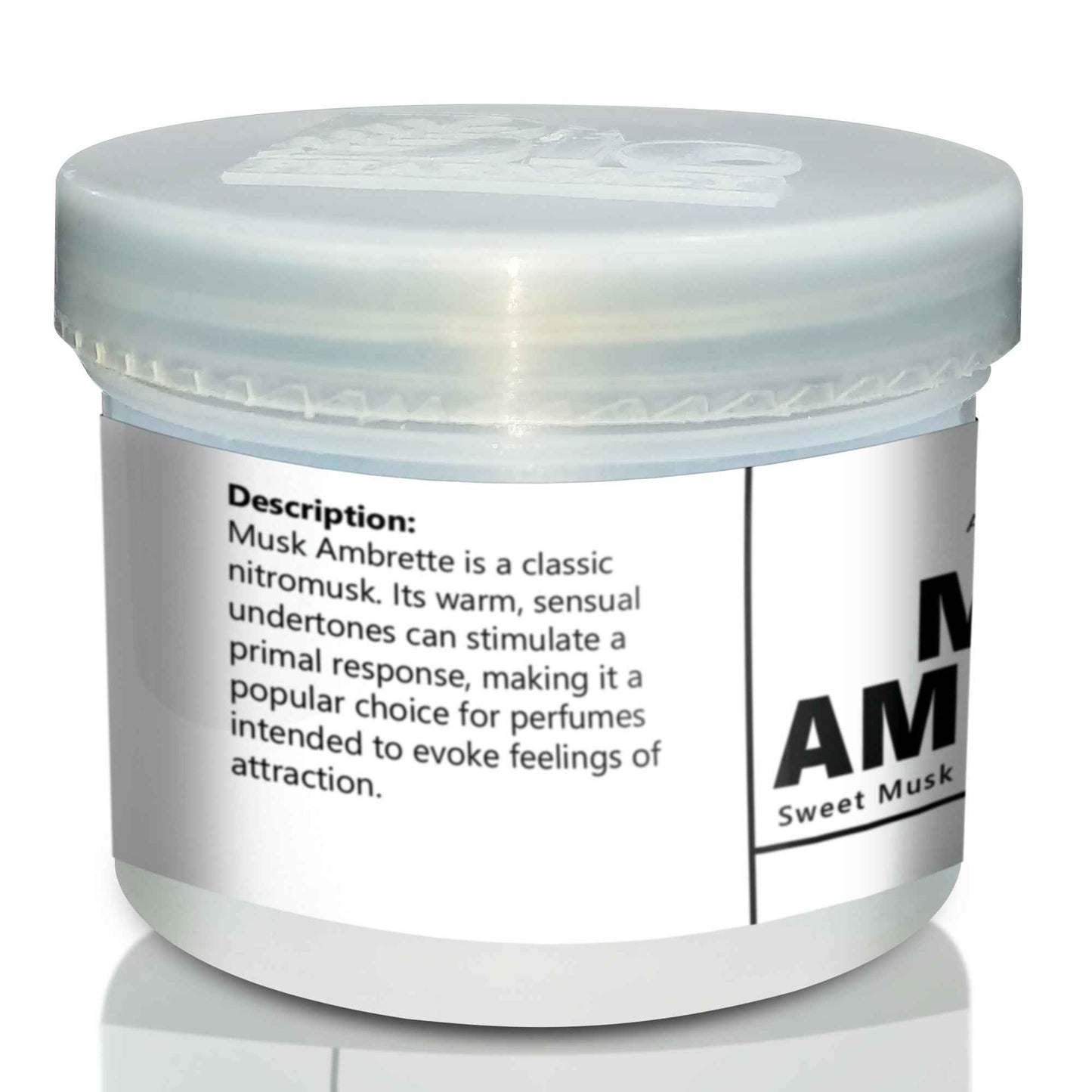
Musk Ambrette
Musk Ambrette
Olfactory Notes: Powerful, floral-musky with a distinct ambrette seed vibe.
Couldn't load pickup availability


Explore
Information About Musk Ambrette
Key Features
✦ Natural botanical musk extracted from the seeds of Abelmoschus moschatus, the Musk Mallow plant native to India and tropical Asia
✦ Delivers genuine animalic musk warmth with pear-like sweetness, soft floral nuances, and a wine-like earthy drydown
✦ Primary aromatic compounds are ambrettolide and farnesyl acetate, giving it a complex macrocyclic musk character found in no synthetic alternative
✦ Widely used in fine fragrance EDP and EDT formulations, traditional oriental attars, and luxury personal care
✦ Excellent fixative and base-to-mid connector note — blends seamlessly with rose, oud, sandalwood, iris, and amber
✦ 100% plant-derived from seeds — vegan and cruelty-free alternative to animal musks such as deer musk and civet
✦ Long-lasting tenacity with intimate, skin-close sillage highly valued in oriental and natural perfumery
About Musk Ambrette
Musk Ambrette is obtained from the seeds of Abelmoschus moschatus, a flowering plant belonging to the mallow family that grows across India, Sri Lanka, and tropical Southeast Asia. The seeds have been prized in Eastern perfumery for centuries and were historically one of the only plant-based sources of genuine musk character available to perfumers. Long before synthetic musks were introduced in the late 19th century, ambrette seed was a foundational ingredient in Indian attars, Arabic perfumes, and European fine fragrance, valued for its remarkable ability to mimic the warmth and intimacy of animal-derived musks without any cruelty.
What sets Musk Ambrette apart from every other natural or synthetic musk is its unique combination of macrocyclic musk depth from ambrettolide and the soft, pear-wine quality contributed by farnesyl acetate and related sesquiterpene esters. This dual character gives it a naturalness and complexity that polycyclic synthetics like Galaxolide or macrocyclic synthetics like Habanolide simply cannot replicate. It behaves differently at different concentrations — at trace levels it reads as a warm skin accord, while at higher percentages the full animalic, floral-musky personality emerges with striking presence and tenacity.
Bio Shop Pakistan supplies cosmetic-grade Musk Ambrette suitable for professional perfumers, attar makers, DIY beauty formulators, and home crafters across Pakistan looking for a high-quality ethically sourced natural musk ingredient.
Olfactory Profile
SCENT DESCRIPTION: Musk Ambrette opens with a warm, intimate animalic musk that feels skin-like and deeply personal rather than sharp or harsh. A characteristic pear-like sweetness develops in the heart alongside soft floral facets reminiscent of rose and violet in quiet bloom. The drydown reveals a wine-like, slightly earthy depth that roots the musk in natural complexity and gives the entire impression a living, organic quality. It is intimate and quietly persistent — the kind of musk that stays close to the skin and reveals itself slowly to those near you.
NOTE POSITION : Mid-Base
FRAGRANCE FAMILY : Oriental / Musky / Floral-Musky
FACETS : Animalic · Pear-like · Floral · Wine-like · Earthy
TENACITY : High — 6 to 10 hours on skin, noticeably longer on fabric
SILLAGE : Medium — intimate skin-close projection with a warm, trailing presence
Technical Specifications
Chemical Name : Complex natural mixture; primary compound Ambrettolide ((Z)-Oxacycloheptadec-8-en-2-one); also contains Farnesyl Acetate, Farnesol, and related sesquiterpenes
CAS Number : 8015-62-1 (Ambrette Seed Oil) / 28645-51-4 (Ambrettolide, isolated component)
Synonyms : Ambrette Musk, Ambrette Seed Oil, Abelmoschus Moschatus Seed Oil, Musk Mallow Seed Oil, Hibiscus Abelmoschus Oil
Purity % : Varies by extraction grade — verify with supplier batch certificate
Appearance : Pale yellow to golden amber viscous liquid
Odor Threshold : Approximately 1 to 5 ppb — highly potent even at trace concentrations
Solubility : Soluble in ethanol and DPG; limited solubility in water; miscible with fixed oils
Specific Gravity : 0.900 to 0.920 g/cm³ at 20°C
Flash Point : Above 100°C — verify with supplier SDS
Type : Natural (botanical seed extraction — CO2, steam distillation, or solvent extraction depending on grade)
Applications & Usage Guidelines
Fine Fragrance ★★★★★
Musk Ambrette is a premier fine fragrance ingredient, valued as a base-to-mid fixative that provides genuine animalic warmth and skin-like depth in EDP and EDT compositions. It performs exceptionally in oriental, chypre, floral oriental, and modern musky formats. Even at low usage rates of 1 to 3%, its presence is clearly felt in the drydown of a finished formula.
Attar & Oriental Blending ★★★★★
This is the natural environment of Musk Ambrette, and where it delivers its most extraordinary performance. In traditional Pakistani and Indian attar-making, it acts as both a core musk note and a fixative, creating the characteristic depth that defines high-quality oriental attars. Blending it with rose, oud, and sandalwood produces compositions of remarkable richness and longevity.
Functional Fragrance ★★★☆☆
Musk Ambrette is usable in body lotions, hair serums, and personal care products but requires conservative usage rates to avoid overpowering the product fragrance profile. Pre-dilution in DPG is recommended before incorporation. Stability and skin sensitization testing should be conducted for leave-on applications.
Cosmetics ★★★☆☆
In oil-based cosmetic formulations such as facial serums, hair oils, and body butters, Musk Ambrette contributes a soft musky warmth that elevates the sensory experience. It works well alongside floral and woody cosmetic fragrances. Patch testing is advised, and usage rates should remain within IFRA-recommended limits for skin-contact applications.
Home Fragrance ★★★★☆
In reed diffusers, room sprays, and incense, Musk Ambrette delivers a warm, animalic oriental ambiance that is highly distinctive. It blends naturally with oud, sandalwood, amber, and labdanum for rich home fragrance accords. Candle performance requires stability testing as behavior in wax can vary by formulation.
IFRA & Usage Rate
Recommended Usage Rates
EDP : 2% to 5%
EDT : 1% to 3%
Body Lotion : 0.3% to 1%
Shampoo/Body Wash : 0.2% to 0.5%
Candle : 3% to 6% (conduct stability test before production)
Reed Diffuser : 5% to 15%
Soap (Cold Process) : 0.5% to 1.5%
IFRA 51st Amendment — Abelmoschus Moschatus Seed Oil
Category 1 (Lip products, oral use) : 0.001% maximum — use with extreme caution
Category 2 (Deodorant spray, body spray) : 0.003% maximum
Category 3 (Eye area cosmetics) : 0.001% maximum — practically avoid
Category 4 (Fine fragrance — EDP, EDT) : Refer to current IFRA guidelines; verify with supplier
Category 5a (Body lotion, leave-on skin) : 0.1% maximum
Category 9 (Rinse-off body wash, shampoo) : 0.1% maximum
Category 11a (Fabric treatment) : Verify with IFRA documentation
⚠️ IFRA limits are based on skin sensitization potential — always confirm current amendment limits with your raw material supplier
⚠️ Avoid use in lip products and eye-area cosmetics at meaningful concentrations
⚠️ Always dilute before skin application — never use undiluted directly on skin
⚠️ Conduct patch testing for all leave-on cosmetic formulations
⚠️ Not recommended for children's products without a certified safety assessment
⚠️ Note: The historic Musk Ambrette (nitromusk, CAS 83-66-9) is permanently banned by IFRA — this product is the natural botanical seed oil, which is a completely different and permitted ingredient
Blending Guide
Method 1 — Dilution in Perfumers Alcohol
Dissolve Musk Ambrette directly in high-grade perfumers ethanol at 1 to 5% of your total formula weight. Allow the blend to macerate undisturbed for 48 to 72 hours before evaluating the scent. This method produces the cleanest expression of its musky character and is the standard approach for EDP and EDT creation.
Method 2 — Pre-dilution in DPG for Body Care and Functional Fragrance
For body lotion, hair care, and leave-on applications, pre-dilute Musk Ambrette in dipropylene glycol at a ratio of 10 to 20% before adding to your formula. DPG moderates the intensity, aids even distribution throughout the base, and reduces the risk of sensitization at the usage point. This is the recommended approach for any water-containing cosmetic product.
Method 3 — Direct Attar Blending in Carrier Oil
In traditional attar work, blend Musk Ambrette directly into aged sandalwood oil or fractionated coconut oil at 1 to 3% and allow to macerate for 7 to 14 days in a sealed dark glass vessel. The extended maceration transforms the musk character significantly, integrating it deeply into the carrier and producing a rounded, naturalistically complex attar-style musk base.
BEST PAIRINGS
Rose Absolute → Amplifies the floral-musky duality; creates the classic oriental rose-musk accord
Oud / Agarwood → Deepens animalic warmth; adds smoky resinous complexity to the musk
Sandalwood → Smooths and rounds the edges; creates a creamy, skin-like musk foundation
Iris / Orris Root → Brings out powdery facets; creates a sophisticated and refined floral musk character
Vetiver → Adds earthy rooty contrast; grounds the musk and prevents it from floating
Jasmine Absolute → Indolic richness meets animalic musk; produces intensely sensual oriental depth
Bergamot → Brightens and lifts; creates a fresh-musky opening before the warmth settles
Labdanum / Amber → Deepens the oriental base; locks the musk into a rich, resinous accord
Cistus → Adds animalic leather nuances; amplifies the naturalness of the musk character
AVOID
✦ Avoid pairing with very sharp aggressive green top notes at high percentages — the contrast can create a jarring, discordant effect in the blend
✦ Avoid high concentrations in formulas designed for application on white or light-colored fabrics — potential for mild staining
Perfumer's Note
I have used Musk Ambrette for many years and it remains one of the most irreplaceable ingredients in my entire palette. What makes it unlike anything else is the way its character shifts based on concentration — at 0.5% it reads as a barely perceptible warmth, almost like the memory of skin, while at 3 to 5% the full animalic pear-wine personality emerges with genuine presence and authority. It is not an easy ingredient to use well precisely because of this concentration sensitivity, and beginner perfumers sometimes dismiss it as subtle or underwhelming before they understand how to unlock it. The patience it demands is exactly the patience that separates a good perfumer from a great one.
ADVANCED TIP: Use Musk Ambrette as a structural connector between your floral heart and your woody base rather than treating it as a standalone musk note. Prepare a 10% dilution in DPG and add it at 0.5 to 1% of the total formula at the bridge point between heart and base materials. It has an extraordinary ability to smooth harsh transitions, integrate discordant notes, and give the entire composition a coherent, living, skin-like quality that no synthetic musk achieves with the same naturalism. In attar formulation, macerating it with aged East Indian sandalwood for a minimum of two weeks before evaluating produces a transformation in depth and roundness that is genuinely remarkable.
Safety & Storage
Physical State : Liquid, oily texture, pale yellow to golden amber color
Skin Safety : Do not apply undiluted; patch test all leave-on applications before use
Eye Contact : Avoid direct contact; flush thoroughly with clean water if contact occurs
Ingestion : Not for internal use under any circumstances; store away from children
Ventilation : Work in a well-ventilated space when handling or measuring larger quantities
Storage : Cool, dark location away from direct sunlight, heat sources, and humidity
Shelf Life : 12 to 24 months when sealed correctly; some perfumers note improvement with careful aging
Container : Dark amber glass or HDPE recommended; avoid standard PET plastic for long-term storage
Flammability : Flash point above 100°C — low flammability risk under standard handling conditions
FAQ
: What is Musk Ambrette and where does it come from?
A: Musk Ambrette is a natural aromatic extract from the seeds of Abelmoschus moschatus, the Musk Mallow plant native to India and tropical Asia. It has been used in Eastern perfumery for centuries as a plant-based source of warm, animalic musk character.
Q: Can a beginner use Musk Ambrette in their first perfume blends?
A: Yes, but start at 0.5% to 1% in your total blend and evaluate after 24 to 48 hours of maceration. It is potent and its personality changes noticeably at different concentrations, so build gradually and give it time to integrate before judging.
Q: Is Musk Ambrette completely vegan and cruelty-free?
A: Yes. It is entirely plant-derived from ambrette seeds and involves no animal-sourced materials, making it a fully vegan and cruelty-free alternative to traditional animal musks like deer musk, civet, and ambergris.
Q: How should Musk Ambrette be stored to maintain quality over time?
A: Keep it in a sealed dark amber glass bottle in a cool, dark location away from sunlight and heat. Properly stored, it remains stable and usable for 12 to 24 months, and experienced perfumers often note that careful aging can deepen and improve its character.
Q: How does Musk Ambrette compare to synthetic musks like Galaxolide or Habanolide?
A: The comparison reveals three very different musk personalities. Galaxolide is clean, transparent, and laundry-like — the definition of a modern synthetic musk with very little natural complexity. Habanolide is softer, more ethereal, and slightly powdery in a clean macrocyclic way. Musk Ambrette is in an entirely different category — genuinely animalic, botanically complex, with pear-wine-floral depth that no synthetic can replicate. For natural perfumery and traditional oriental attar work, Musk Ambrette is irreplaceable; for modern mass-market functional fragrance, synthetics may offer more consistency and higher usage rates.
Where Can You Safely Use Musk Ambrette?
Discover how Musk Ambrette performs across different applications—rated for safety, stability, and effectiveness.


