


Bio Shop
Pola Wax
Pola Wax
Key Functions: Emulsifies O/W systems, stabilizes creams and lotions, structures emulsions, enhances skin feel.
Couldn't load pickup availability


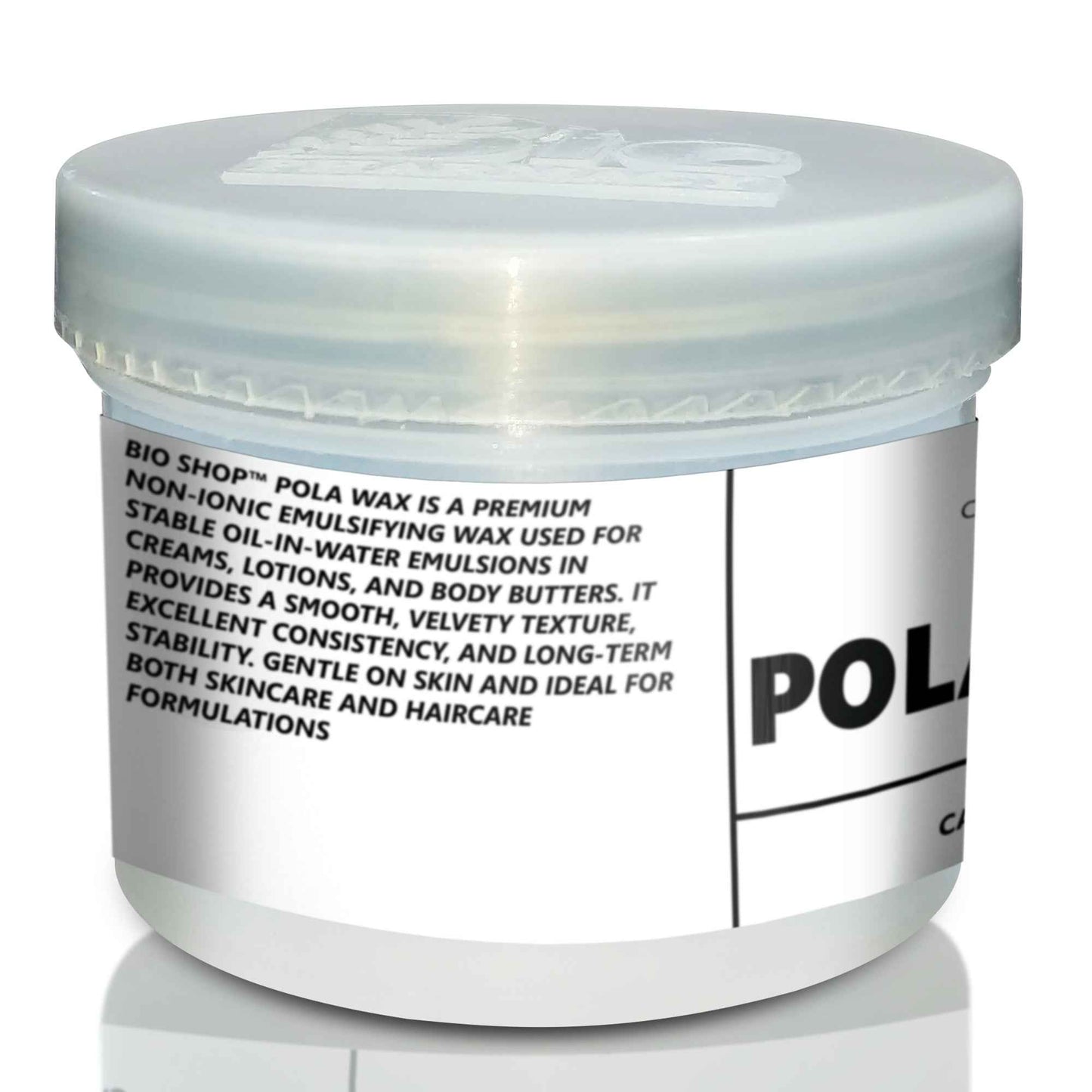
Explore
Information About Pola Wax
✅ Key Features
✦ Complete self-emulsifying system that requires no separate co-emulsifier for standard cream and lotion formulations
✦ Produces stable oil-in-water emulsions across a broad range of oil phases including vegetable oils, mineral oil, and silicones
✦ Non-ionic character provides tolerance to electrolytes, a wide pH working range of 4.0 to 8.0, and compatibility with most actives
✦ Delivers a smooth, creamy skin feel with no greasiness in finished emulsions at standard use levels
✦ Suitable for face creams, body lotions, hair conditioners, emulsified body butters, and deodorant creams
✦ Cetearyl Alcohol component adds emulsion structure and mild skin conditioning alongside its emulsifying function
✦ Easy hot-process emulsification — melted directly into the oil phase at 70 to 75 degrees Celsius for consistent, repeatable results
🔬 Description
Pola Wax, sold commercially under the trademarked name Polawax and standardized as Emulsifying Wax NF under the United States National Formulary, is a blend of Cetearyl Alcohol and Polysorbate 60 that has been a cornerstone of pharmaceutical and cosmetic emulsion manufacturing for decades. Developed to provide a reliable single-ingredient emulsification solution, it replaced the need to combine individual emulsifying alcohols and surfactants in most standard formulations. Its consistent composition and well-documented performance profile have made it one of the most referenced emulsifiers in both professional and DIY cosmetic formulation literature worldwide.
What sets Pola Wax apart from simple emulsifying alcohols or standalone surfactants is its dual-functional composition. The Cetearyl Alcohol fraction contributes structural integrity to the emulsion matrix and provides mild skin-conditioning effects, while the Polysorbate 60 fraction supplies the hydrophilic component necessary to stabilize the oil-water interface through non-ionic surfactancy. The balance between these two components produces a robust, self-sustaining emulsification system that is tolerant of variation in oil phase composition, active ingredient load, and processing conditions — making it one of the most forgiving emulsifiers available to both novice and advanced formulators.
Bio Shop Pakistan supplies cosmetic-grade Pola Wax suitable for DIY beauty formulators, independent skincare brands, soap and cosmetic product developers, and professional cosmetic chemists across Pakistan.
📊 Technical Data
INCI Name : Emulsifying Wax NF (Cetearyl Alcohol and Polysorbate 60)
Chemical Name : Cetearyl Alcohol and Polysorbate 60 blend
CAS Number : Mixture — Cetearyl Alcohol: 67762-27-0 / Polysorbate 60: 9005-67-8
Molecular Formula : Not Applicable (mixture)
Appearance : White to off-white waxy flakes or pellets
Odor : Mild, faintly characteristic; essentially odorless in formulation
pH (1% solution) : 5.5 to 7.0 (aqueous dispersion at 70 degrees Celsius)
Solubility : Dispersible in warm water; soluble in warm oils, esters, and fatty alcohols
Specific Gravity : Approximately 0.90 g/cm3 at 60 degrees Celsius
Flash Point : Greater than 200 degrees Celsius
HLB Value : Approximately 8 to 10 (optimized for O/W emulsions)
Recommended Use Level : 2 to 8% — standard creams and lotions use 4 to 6%
Type : Non-ionic self-emulsifying wax
Shelf Life : 2 years when stored sealed in cool, dry conditions
🧪 Recommended Usage
Skincare (Creams, Serums, Lotions) ★★★★★
Pola Wax is the primary emulsifier of choice for face creams, body lotions, and emulsified serums, producing stable O/W emulsions at 4 to 6 percent without the need for additional stabilizers. It pairs seamlessly with actives such as niacinamide, vitamin C esters, AHAs, and hyaluronic acid without disrupting emulsion stability.
Haircare (Shampoo, Conditioner, Masks) ★★★★☆
Highly effective in rinse-off conditioners and deep conditioning hair masks where it contributes slip, structure, and emulsion stability at 3 to 6 percent. Combine with Cetearyl Alcohol and a small amount of conditioning agent for a full-bodied conditioner base.
Soap Making (Cold Process, Melt and Pour) ★★☆☆☆
Pola Wax is an emulsifier, not a saponifiable oil or fatty wax, and will not contribute to saponification in cold process or traditional melt and pour soap. It is appropriate for syndet cleansing bars and emulsified wash-off bases where emulsification is required rather than saponification.
Body Care (Scrubs, Butters, Balms) ★★★★☆
Excellent for emulsified body butters and whipped emulsions where it converts heavy oil-butter blends into light, fast-absorbing textures at 3 to 5 percent. Not typically required in anhydrous balms or scrub oils but transforms body butter formulas when a water phase is incorporated.
Functional Cosmetics (Deodorants, Sunscreen, Baby Care) ★★★★☆
Performs well in sunscreen emulsions, deodorant creams, and mild baby care products where stable emulsification and skin compatibility are priorities. Its non-ionic nature makes it compatible with sunscreen actives and gentle enough for baby formulations.
💡 Pro Tip
When I use Pola Wax in formulations, I treat it as the most reliable baseline emulsifier in my toolkit — the one I reach for when I need a predictable, stable result without having to engineer an emulsifier blend from scratch. Its self-contained system means I can focus my attention on actives, aesthetics, and skin feel rather than troubleshooting emulsion stability. For richer creams targeting mature or dry skin, I often add 1 to 2 percent of additional Cetearyl Alcohol directly to the oil phase alongside the Pola Wax to build more body into the finished texture.
ADVANCED TIP: For high-oil-phase formulations where the oil content exceeds 30 percent of the total formula, increase Pola Wax to 7 to 8 percent and incorporate 1 to 2 percent Glyceryl Stearate as a co-emulsifier. Heat both the oil and water phases independently to 72 degrees Celsius, then add the water phase to the oil phase in a slow, steady stream under continuous high-shear mixing. Continue agitation while cooling to 40 degrees Celsius before introducing any heat-sensitive actives or fragrance. This method prevents phase separation in rich emulsions and significantly improves long-term thermostability on shelf stress testing.
👩🔬 Skin Type Suitability
Normal Skin : ★★★★★ — Produces balanced, smooth emulsions that maintain normal skin hydration without heaviness or occlusion.
Dry Skin : ★★★★★ — Enables formulation of rich, film-forming creams that deliver sustained moisture and barrier repair to dry skin.
Oily Skin : ★★★☆☆ — Suitable for oily skin when formulated with a high water phase, lightweight oils, and low overall oil content.
Combination : ★★★★☆ — Effective in zone-balanced formulations when paired with non-comedogenic lightweight oils and humectants.
Sensitive Skin : ★★★★☆ — Well tolerated at standard use levels with a low sensitization profile across both key components.
Mature Skin : ★★★★★ — Ideal for nourishing, structured creams targeting mature skin when combined with occlusive and restorative actives.
Acne-Prone : ★★★☆☆ — Cetearyl Alcohol carries a comedogenicity rating of 2; use non-comedogenic oils and keep the oil phase lean.
🧴 Formulation Ideas
CONCEPT 1: Classic Hydrating Face Cream
Usage Level : 5%
Key Ingredients: Shea Butter (5%), Jojoba Oil (10%), Niacinamide (5%), Glycerin (3%), Distilled Water (to 100%)
Result : A creamy, well-balanced O/W moisturizer with a smooth, non-greasy finish and visible brightening effect from niacinamide.
CONCEPT 2: Emulsified Whipped Body Butter
Usage Level : 4%
Key Ingredients: Mango Butter (15%), Sweet Almond Oil (10%), Glycerin (3%), Distilled Water (to 100%)
Result : A lightweight, fast-absorbing emulsified body butter that delivers deep moisture without the heavy, greasy feel of anhydrous butters.
CONCEPT 3: Conditioning Hair Mask
Usage Level : 5%
Key Ingredients: Cetearyl Alcohol (3%), Argan Oil (5%), Hydrolyzed Keratin (2%), Panthenol (1%)
Result : A thick, creamy conditioning mask that deeply moisturizes, detangles, and restores elasticity to dry or chemically treated hair.
💧 Safety and Regulatory:
INCI Declared : Yes — required on all finished cosmetic products sold in the EU and most regulated global markets
EU Cosmetics Reg : Permitted — both Cetearyl Alcohol and Polysorbate 60 are unrestricted cosmetic ingredients with no Annex concentration limits
Rinse-Off Limit : No limit established at recommended cosmetic use levels
Leave-On Limit : No limit established at recommended cosmetic use levels
Allergen Alert : No — not a classified fragrance allergen; Cetearyl Alcohol has a very low sensitization profile in the literature
Skin Safety : Safe at recommended levels (2 to 8%); well-documented safety profile in both pharmaceutical and cosmetic applications
Eye Area Use : Use with caution — avoid high concentrations in leave-on eye area products; rinse-off eye contact products can include it at standard levels
Ingestion : Not for internal use
Pregnancy Use : Considered safe at cosmetic use levels; consult a physician if uncertainty exists
Child Safety : Safe for use in baby care formulations at standard levels; reduce concentration and test for skin sensitivity in leave-on products
Ventilation : Not required under normal handling and processing conditions
Storage : Store in a cool, dry place away from direct heat sources and moisture; keep container sealed between uses
Container : HDPE or glass preferred; avoid prolonged contact with reactive metals
⚠️ The Polysorbate 60 component may cause mild irritation in hypersensitive individuals at concentrations above 8 percent. Finished product patch testing is recommended before commercial launch. Ensure full INCI declaration appears on finished product labels in compliance with applicable cosmetic regulations.
Stability and Compatibility
Working pH Range : 4.0 to 8.0 (optimal stability achieved between pH 5.0 and 7.0)
Heat Stability : Stable; melt into oil phase at 70 to 75 degrees Celsius; avoid sustained temperatures above 85 degrees Celsius
Freeze-Thaw Stable : Yes — emulsions formulated with Pola Wax demonstrate reasonable freeze-thaw stability under standard cycling conditions
Emulsion Type : O/W (oil-in-water) only; not suitable for water-in-oil emulsions
Emulsification Phase: Hot — must be melted into the oil phase and both phases brought to equal temperature before combining
Compatible With : Fatty alcohols, vegetable and plant oils, mineral oil, silicones, glycerin, water-soluble humectants, most water-soluble actives, hydrolyzed proteins
Incompatible With : High ethanol concentrations above 20 percent can disrupt emulsion structure; strongly cationic surfactants may complex with the non-ionic system and reduce emulsifying efficiency
Oxidation Risk : Low — Pola Wax itself is not prone to oxidation; protect the oil phase components independently with appropriate antioxidants such as Vitamin E or Rosemary Extract
Discoloration Risk : None under standard processing conditions; slight yellowing is possible if the blend is held at elevated temperatures for extended periods during manufacturing
Formulation Notes : Always heat both oil and water phases to the same temperature, 70 to 75 degrees Celsius, before combining to ensure full melting and consistent emulsification. Adding Pola Wax to a cool oil phase results in incomplete melting and produces unstable, grainy emulsions that cannot be recovered.
❓ FAQs
Q: What is Pola Wax and why is it used in cosmetic formulations?
A: Pola Wax is a self-emulsifying wax blend of Cetearyl Alcohol and Polysorbate 60 standardized as Emulsifying Wax NF. It functions as a complete emulsification system that combines oil and water phases into a stable, smooth emulsion. It is used as the primary emulsifier in creams, lotions, conditioners, and emulsified body products.
Q: How much Pola Wax should I add to a standard lotion formula?
A: For a standard body lotion, use 3 to 5 percent of the total formula weight. Richer face creams and body butters typically require 5 to 6 percent, while heavily loaded formulas with oil phases above 30 percent may need up to 7 to 8 percent for stable emulsification.
Q: Do I need to add a co-emulsifier when using Pola Wax?
A: No — Pola Wax is a complete self-emulsifying system and does not require a separate co-emulsifier for standard oil-in-water formulations. For very rich or high-oil-phase formulas, adding 1 to 2 percent of Glyceryl Stearate can improve long-term stability, but it is not a requirement at typical use levels.
Q: Can Pola Wax be used in cold process formulation or added at room temperature?
A: No — Pola Wax must be melted in the oil phase by heating to approximately 70 to 75 degrees Celsius. Adding it cold results in incomplete melting and produces grainy, unstable emulsions. It is a hot-process emulsifier and cannot be incorporated at room temperature.
Q: How does Pola Wax compare to BTMS-50 as an emulsifier?
A: Pola Wax is a non-ionic emulsifier designed for oil-in-water skin care emulsions and general cosmetic applications, while BTMS-50 is a cationic conditioning emulsifier engineered specifically for hair care products. BTMS-50 provides superior detangling, slip, and substantivity to hair, whereas Pola Wax offers more neutral, versatile emulsification suitable for both skin and rinse-off hair formulations across a wide range of product types.
Where Can You Safely Use Pola Wax
Discover how Pola Wax performs across different products — rated for safety, stability, and effectiveness.


