Bio Shop
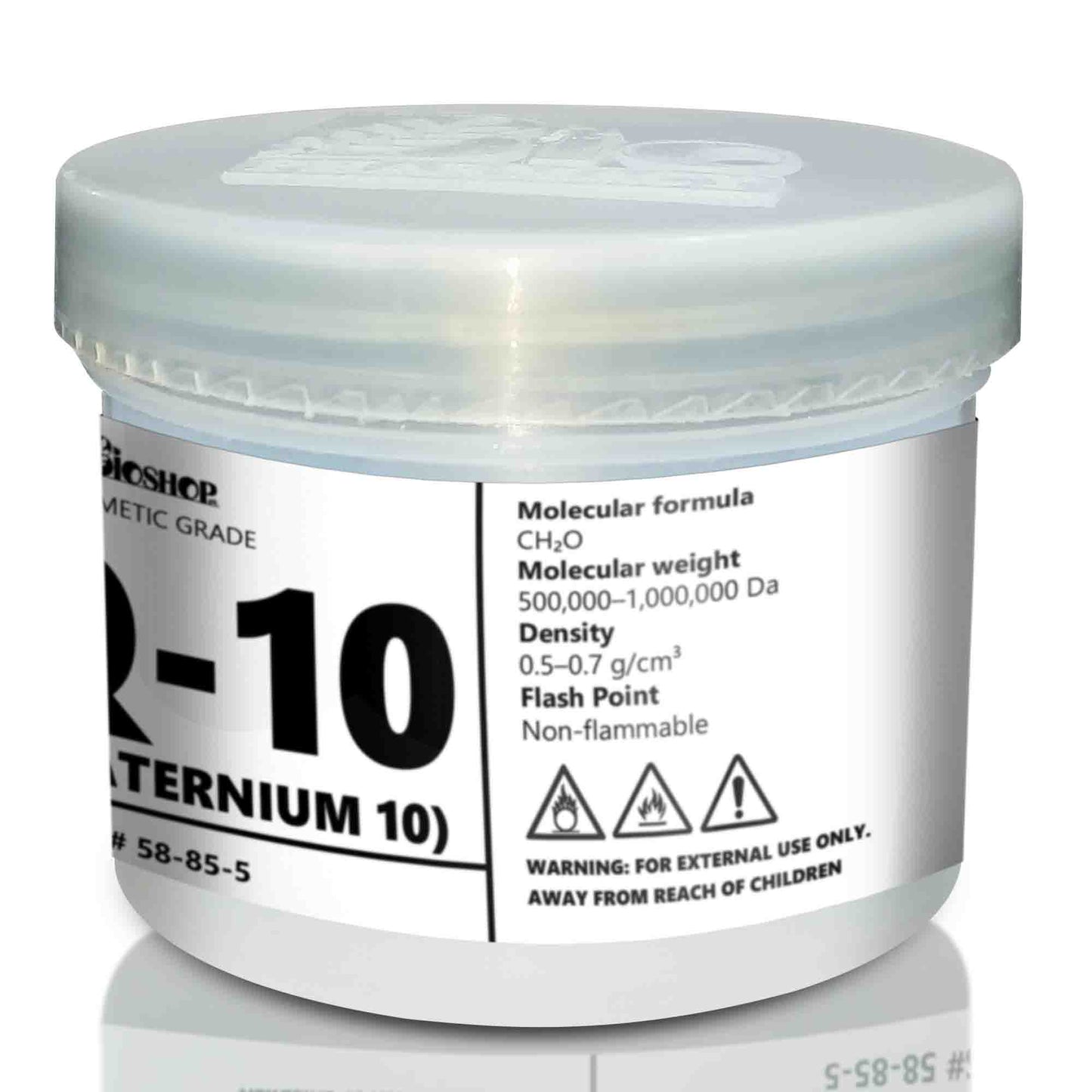
Polyquaternium 10 (PQ-10)
Polyquaternium 10 (PQ-10)
Key Functions: Conditions hair, reduces static, forms protective film, and detangles.
Couldn't load pickup availability


Explore
Information About Polyquaternium 10 (PQ-10)
✅ Key Features
✦ Cationic cellulose polymer that deposits onto hair and skin for instant conditioning and smoothness.
✦ Reduces static charge and flyaways, improving dry and wet combability in rinse-off and leave-in formats.
✦ Forms a flexible, lightweight film on hair strands that protects against environmental damage and friction.
✦ Water-soluble and easy to incorporate into aqueous formulations at cold or warm processing temperatures.
✦ Compatible with sulfate-free, silicone-free, and clean beauty formulation systems.
✦ Cellulose-derived from natural plant sources, making it suitable for naturally-positioned product lines.
✦ Effective at low usage levels of 0.1 to 2.0%, making it highly cost-efficient for professional batch production.
🔬 Description
Polyquaternium-10, designated by the INCI name Polyquaternium-10, is a quaternary ammonium salt of hydroxyethylcellulose produced by reacting hydroxyethylcellulose with a quaternizing agent such as glycidyltrimethylammonium chloride. As a cellulose derivative, it traces its origins to naturally occurring plant cell wall polysaccharides, and its development as a cosmetic conditioning agent dates to mid-twentieth-century advances in polymer modification chemistry. It has since become one of the most widely used conditioning polymers in professional hair care formulation.
What distinguishes Polyquaternium-10 is its cationic charge density, which enables it to adsorb electrostatically onto the negatively charged surface of damaged or wet hair. This electrostatic attraction causes the polymer to deposit preferentially onto the most damaged portions of the hair shaft, where it fills surface irregularities, smooths the cuticle layer, and reduces friction. In surfactant-based systems, this cationic deposition is amplified through a coacervation mechanism when the product is diluted with water during rinsing, concentrating the conditioning benefit exactly where it is needed most.
Bio Shop Pakistan supplies cosmetic-grade Polyquaternium-10 suitable for independent cosmetic formulators, professional hair care brands, and DIY beauty crafters developing conditioning shampoos, rinse-out conditioners, leave-in treatments, and skin-conditioning body care products.
📊 Technical Data
INCI Name : Polyquaternium-10
Chemical Name : Hydroxyethylcellulose 2-hydroxy-3-(trimethylammonio)propyl ether chloride
CAS Number : 54351-50-7
Molecular Formula : Complex polymeric structure; MW range 100,000 to 400,000 Da (grade-dependent)
Appearance : White to off-white free-flowing powder or granules
Odor : Odorless to faintly characteristic
pH (1% solution) : 5.0 to 8.0
Solubility : Freely soluble in cold and warm water; insoluble in most organic solvents
Specific Gravity : ~1.1 g/cm³ (aqueous solution); bulk density ~0.3 to 0.5 g/cm³
Flash Point : Not applicable — non-flammable solid
HLB Value : Not applicable — cationic polymer, not a conventional surfactant
Recommended Use Level : 0.1% to 2.0% (rinse-off); 0.1% to 1.0% (leave-on)
Type : Cationic cellulose polymer; film former, conditioner, antistatic agent
Shelf Life : 2 to 3 years when stored sealed in cool, dry conditions
🧪 Recommended Usage
Skincare (Creams, Serums, Lotions) ★★★☆☆
PQ-10 can be used in lightweight lotions and toners to deliver a soft, smooth skin feel through mild film formation. Keep usage below 0.5% in leave-on skincare to avoid any tacky residue on the skin surface.
Haircare (Shampoo, Conditioner, Masks) ★★★★★
This is the primary and most effective application category for Polyquaternium-10, where its cationic deposition delivers measurable conditioning, detangling, and antistatic performance. Use at 0.3 to 1.0% in shampoos and 0.5 to 2.0% in conditioners and masks for best results.
Leave-In Hair Treatments (Sprays, Serums, Creams) ★★★★★
PQ-10 is highly effective in leave-in formats where it forms a lasting protective film on the hair strand without buildup when used at 0.2 to 0.5%. It pairs exceptionally well with panthenol and hydrolyzed proteins in leave-in conditioning sprays.
Body Care (Scrubs, Butters, Balms) ★★★☆☆
In water-containing body lotions and shower gels, PQ-10 contributes a conditioning slip that leaves skin feeling soft after rinsing. It is not appropriate for anhydrous body butters or balms as it requires an aqueous phase to function and dissolve.
Functional Cosmetics (Deodorants, Sunscreen, Baby Care) ★★★☆☆
PQ-10 finds moderate use in gentle baby shampoos and rinse-off baby washes where its mild conditioning and low irritation profile is an asset. In adult deodorant and sunscreen applications it offers limited functional benefit and is not a primary choice.
💡 Pro Tip
When I work with Polyquaternium-10 in professional shampoo development, the most common formulation mistake I see is adding the powder directly into a surfactant premix. PQ-10 requires proper hydration in water before it encounters the surfactant system, otherwise it clumps and disperses unevenly, resulting in inconsistent texture and reduced conditioning performance across the batch. I always pre-disperse it in a portion of the deionized water at room temperature, allow it to swell completely, then integrate it into the bulk formula before introducing surfactants.
ADVANCED TIP: To deliberately engineer a coacervate conditioning system, combine PQ-10 at 0.5 to 0.8% with sodium laureth sulfate or sodium cocoyl isethionate in your shampoo base at a cationic-to-anionic charge ratio that promotes complex formation. During consumer use, water dilution shifts the charge balance and triggers coacervate deposition directly onto the hair surface. To fine-tune the coacervate intensity and silicone-free conditioning feel, combine PQ-10 with BTMS-50 at 0.2 to 0.5% in the same system — this stacks cationic deposition without requiring silicones and gives you a clean beauty claim.
👩🔬 Skin Type Suitability
Normal Skin : ★★★★☆ — PQ-10 adds a lightweight, smooth finish without disrupting balanced skin.
Dry Skin : ★★★★☆ — The film-forming action helps retain surface moisture and reduces transepidermal water loss modestly.
Oily Skin : ★★★☆☆ — The polymer film may feel slightly occlusive on oily skin at higher concentrations; keep usage at or below 0.3%.
Combination : ★★★☆☆ — Beneficial on dry zones but the film layer requires conservative dosing on oily areas of the T-zone.
Sensitive Skin : ★★★★☆ — PQ-10 has a low sensitization potential and is generally well-tolerated on reactive skin types.
Mature Skin : ★★★★☆ — The film-forming mechanism provides a subtle surface-smoothing effect that visually softens fine lines.
Acne-Prone : ★★★☆☆ — Generally considered non-comedogenic, but the conditioning film warrants caution in high-concentration leave-on formulas.
🧴 Formulation Ideas
CONCEPT 1: Coacervate Conditioning Shampoo
Usage Level : 0.5%
Key Ingredients: Sodium Laureth Sulfate, Cocamidopropyl Betaine, Panthenol, Citric Acid
Result : A lathering, sulfate-containing shampoo that deposits a conditioning coacervate on rinse-off, leaving hair detangled and soft with no silicone reliance.
CONCEPT 2: Sulfate-Free Leave-In Detangling Spray
Usage Level : 0.3%
Key Ingredients: Hydrolyzed Wheat Protein, Panthenol, Glycerin, D-Panthenol
Result : A lightweight aqueous spray that reduces friction and wet combing effort while improving elasticity, ideal for fine or color-treated hair.
CONCEPT 3: Gentle Baby Rinse-Off Wash
Usage Level : 0.2%
Key Ingredients: Sodium Cocoyl Isethionate, Coco Glucoside, Allantoin, Chamomile Extract
Result : A tear-free, ultra-mild cleansing wash that deposits a soft conditioning layer on delicate scalp and skin during rinsing.
💧 Safety and Regulatory:
INCI Declared : Yes — required on all finished product labels
EU Cosmetics Reg : Permitted — no Annex restriction; used within established safety guidelines
Rinse-Off Limit : No mandated limit; typical formulation range 0.1% to 2.0%
Leave-On Limit : No mandated limit; typical formulation range 0.1% to 1.0%
Allergen Alert : No — not a known contact allergen at cosmetic use levels
Skin Safety : Safe at recommended levels; well-established safety profile in rinse-off and leave-on products
Eye Area Use : Use with caution — may cause mild transient irritation at higher concentrations in leave-on eye-area formats
Ingestion : Not for internal use
Pregnancy Use : Generally considered safe; consult physician if uncertain
Child Safety : Safe for use in baby and children's products at recommended levels
Ventilation : Not required — non-volatile solid
Storage : Cool, dry place; seal tightly after opening to prevent moisture absorption and clumping
Container : HDPE or glass preferred; protect from humidity and direct sunlight
⚠️ PQ-10 is a cationic polymer. Avoid direct combination with high concentrations of anionic polymers such as carbomer or xanthan gum without compatibility testing, as charge neutralization may cause precipitation or viscosity collapse in the finished formula.
Stability and Compatibility
Working pH Range : 3.0 to 9.0 (optimal performance at pH 4.5 to 7.0)
Heat Stability : Stable up to 120°C briefly; can be added in hot or cold phase
Freeze-Thaw Stable : Generally yes — minor viscosity variation possible; test before scale-up
Emulsion Type : O/W preferred; also functions in aqueous non-emulsion systems
Emulsification Phase: Cold or hot — dissolve in aqueous phase before combining with other components
Compatible With : Amphoteric surfactants, nonionic surfactants, hydrolyzed proteins, panthenol, silicone emulsions, glycerin
Incompatible With : High concentrations of anionic polymers (carbomer, xanthan gum at high levels); strong oxidizing agents; highly alkaline systems above pH 9.5
Oxidation Risk : Low — no antioxidant required under normal storage conditions
Discoloration Risk : None under normal formulation and storage conditions
Formulation Notes : Always pre-disperse PQ-10 powder in cold or warm water separately before incorporating into the bulk formula to ensure complete hydration and even distribution; adding directly to surfactant concentrate causes clumping and poor polymer performance.
❓ FAQs
Q: What is Polyquaternium-10 and what role does it play in hair care products?
A: Polyquaternium-10 is a cationic cellulose polymer that deposits electrostatically onto negatively charged hair and skin surfaces. It acts as a conditioning agent, film former, and antistatic ingredient, improving combability, softness, and manageability in shampoos, conditioners, and leave-in products.
Q: How do I correctly dissolve PQ-10 powder in a formulation?
A: Sprinkle PQ-10 slowly into cold or lukewarm deionized water while stirring to prevent clumping, and allow it to hydrate fully before adding it to the rest of your formula. Never add the powder directly to a surfactant concentrate, as this causes irreversible clumping and uneven distribution.
Q: Can Polyquaternium-10 be used in sulfate-free and silicone-free formulations?
A: Yes, PQ-10 is one of the preferred conditioning polymers for sulfate-free and silicone-free product lines because it delivers tangible conditioning performance through cationic film deposition without relying on silicones or strong anionic surfactants. It pairs well with mild surfactants like coco glucoside and sodium cocoyl isethionate.
Q: What is coacervation and how does PQ-10 trigger it in shampoo formulas?
A: Coacervation occurs when the positively charged PQ-10 polymer interacts with negatively charged anionic surfactants under dilution conditions to form a concentrated deposit on hair. When a shampoo containing both PQ-10 and an anionic surfactant is rinsed with water, the shift in concentration triggers this complex to deposit directly onto the hair surface, concentrating conditioning where it is most needed.
Q: How does Polyquaternium-10 compare to Guar Hydroxypropyltrimonium Chloride as a conditioning polymer?
A: Both are cationic, naturally derived conditioning polymers, but PQ-10 is cellulose-based while Guar Hydroxypropyltrimonium Chloride is legume-derived. PQ-10 generally produces a lighter, less heavy conditioning feel and is better suited to fine or low-porosity hair, whereas Guar HPQT tends to deliver richer conditioning more appropriate for coarse or highly porous hair types.
Where Can You Safely Use Polyquaternium 10 (PQ-10)
Discover how Polyquaternium 10 (PQ-10) performs across different products — rated for safety, stability, and effectiveness.