Bio Shop
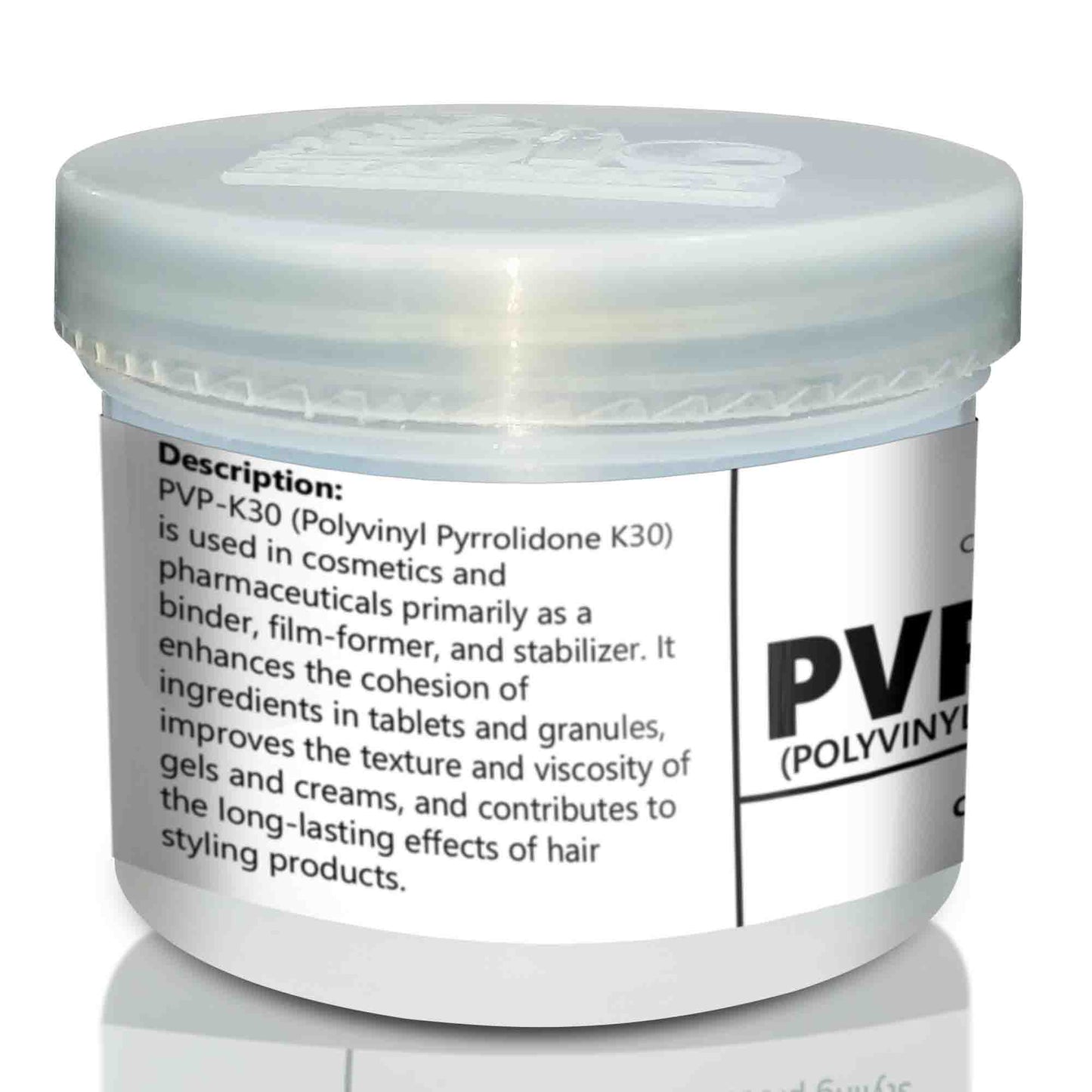
PVP-K30 (POLYVINYL PYRROLIDONE K30)
PVP-K30 (POLYVINYL PYRROLIDONE K30)
Key Functions: Forms flexible films, binds formulations, fixes hair, and stabilizes suspensions.
Couldn't load pickup availability


Explore
Information About PVP-K30 (POLYVINYL PYRROLIDONE K30)
✅ Key Features
✦ Exceptional film-forming polymer that creates a clear, flexible, and non-tacky film on skin and hair surfaces.
✦ Highly water-soluble and compatible with ethanol, making it easy to incorporate into aqueous and hydroalcoholic formulas.
✦ Functions as a binder, stabilizer, suspension agent, and fixative across a wide range of cosmetic product types.
✦ Provides clean hold in hair gels, styling sprays, and mousses without excessive stiffness or flaking.
✦ Improves pigment dispersion and adhesion in color cosmetics including foundations, eyeliners, and mascaras.
✦ Synthetic origin with well-established safety profile — compliant with global cosmetic regulations including EU Cosmetics Regulation.
✦ Available as a free-flowing white powder, offering long shelf life and straightforward handling for small-batch and industrial formulation alike.
🔬 Description
Polyvinylpyrrolidone K30 (PVP-K30) is a synthetic water-soluble polymer produced by the polymerization of N-vinylpyrrolidone. Developed originally in the 1940s as a blood plasma substitute, it rapidly found its place in pharmaceutical and cosmetic applications due to its exceptional safety profile, chemical versatility, and film-forming capacity. In cosmetics, it has been a trusted ingredient for over five decades across hair care, skincare, and decorative applications.
What distinguishes PVP-K30 from other fixatives and binders is its ability to form a transparent, flexible, and moisture-responsive film. In hair care, this film coats individual strands, providing hold without brittleness. In skincare, the same mechanism improves ingredient adhesion, enhances texture, and contributes to a smooth skin-feel finish. Its excellent solubility in both water and polar solvents like ethanol gives formulators flexibility across product architecture types. The K-value of 30 represents an optimal molecular weight balance — light enough to stay non-occlusive, yet large enough to deliver effective binding and fixative performance.
Bio Shop Pakistan supplies cosmetic-grade PVP-K30 suitable for professional cosmetic formulators, hair product developers, independent beauty brands, and serious DIY crafters seeking reliable, high-performance polymer ingredients.
📊 Technical Data
INCI Name : Polyvinylpyrrolidone
Chemical Name : Poly(1-vinyl-2-pyrrolidinone)
CAS Number : 9003-39-8
Molecular Formula : (C6H9NO)n
Appearance : White to off-white free-flowing powder
Odor : Practically odorless
pH (1% solution) : 3.0 – 7.0
Solubility : Freely soluble in water, ethanol, methanol, isopropanol; insoluble in oils and non-polar solvents
Specific Gravity : 1.20 – 1.25
Flash Point : Not applicable (solid powder)
HLB Value : Not applicable
Recommended Use Level : 0.5 – 5% (skincare), 1 – 10% (hair styling), 0.5 – 3% (color cosmetics)
Type : Synthetic water-soluble polymer — film former, binder, stabilizer, fixative
Shelf Life : 3 years in sealed original packaging under recommended storage conditions
🧪 Recommended Usage
Skincare (Creams, Serums, Lotions) ★★★★☆
PVP-K30 performs well in serums and lightweight lotions as a film former and texture enhancer, improving spreadability and adhesion of active ingredients. Use at 0.5 to 2% dissolved in the water phase for a smooth, non-occlusive skin-feel finish.
Haircare (Shampoo, Conditioner, Masks) ★★★★★
This is where PVP-K30 truly excels — it is the industry-standard fixative for hair gels, sprays, and mousses. Incorporate at 2 to 8% in the water phase of styling formulations for flexible, frizz-reducing hold without flaking.
Soap Making (Cold Process, Melt and Pour) ★★☆☆☆
PVP-K30 is not recommended for cold process soap due to the high alkalinity degrading its polymer structure. Limited use is possible in melt and pour bases at very low levels for specialty novelty applications only.
Body Care (Scrubs, Butters, Balms) ★★★☆☆
PVP-K30 has limited utility in anhydrous body butters and balms due to its water solubility, but it performs reasonably in water-containing body lotions and after-sun gels. Use at 0.5 to 1.5% to improve texture and film formation on the skin.
Color Cosmetics and Decorative Applications ★★★★★
PVP-K30 is highly effective in foundations, eyeliners, mascaras, and pressed powders as a binder and dispersant that improves pigment adhesion. Use at 1 to 3% in aqueous or hydroalcoholic color cosmetic bases to enhance wear and coverage uniformity.
💡 Pro Tip
In my formulation practice, PVP-K30 is one of those polymers I reach for when I need clean, consistent film formation without compromising the aesthetics of a product. It dissolves effortlessly in water and even more rapidly in ethanol, which makes it my first choice for hydroalcoholic hair setting sprays where clarity is non-negotiable. What I appreciate most is that it does not interfere with most other functional polymers, so I can layer it with carbomer, hydroxyethylcellulose, or Polyquaternium-11 to create more sophisticated texture and hold profiles than any single polymer could deliver alone.
ADVANCED TIP: For a high-performance, humidity-resistant hair styling gel, combine PVP-K30 at 5% with PVP/VA Copolymer at 3% and Hydroxyethylcellulose at 0.5% in a water-ethanol base (70:30 ratio). The PVP-K30 provides initial hold and clarity, the copolymer reduces hygroscopic tackiness in humid conditions, and HEC builds viscosity and body. Adjust pH to 5.5 to 6.5 with citric acid or triethanolamine. This combination mimics professional salon gel performance at a fraction of the cost.
👩🔬 Skin Type Suitability
Normal Skin : ★★★★★ — Provides smooth, even film formation without disrupting the skin's natural balance, making it ideal for everyday serums and lightweight formulas.
Dry Skin : ★★★☆☆ — Offers surface film formation but does not provide emolliency or humectancy on its own, so it must be combined with moisturizing actives like hyaluronic acid or glycerin.
Oily Skin : ★★★★☆ — Its lightweight, non-greasy film makes it a good choice for oil-control formulas, mattifying gels, and sebum-regulating serums.
Combination : ★★★★☆ — Works well in lightweight gel textures designed for combination skin, helping to balance coverage across the T-zone without overloading dry areas.
Sensitive Skin : ★★★☆☆ — Generally well tolerated, but synthetic polymer residue can occasionally irritate highly reactive skin types at higher concentrations; patch testing is advised.
Mature Skin : ★★★☆☆ — Contributes to surface smoothing, but has no anti-aging mechanism on its own and should be used as a carrier or texture enhancer alongside active ingredients.
Acne-Prone : ★★★★☆ — Non-comedogenic and well-suited to lightweight gel and water-based products for acne-prone skin, particularly in spot treatment and mattifying formulas.
🧴 Formulation Ideas
CONCEPT 1: Clear Hair Styling Gel
Usage Level : 5%
Key Ingredients: Hydroxyethylcellulose (0.8%), Panthenol (1%), Glycerin (3%), Citric Acid (pH adjuster)
Result : A professional-quality, non-flaking, clear hair styling gel with flexible hold, light conditioning benefit, and a smooth finish suitable for all hair types.
CONCEPT 2: Mattifying Pore-Refining Serum
Usage Level : 2%
Key Ingredients: Niacinamide (5%), Zinc PCA (1%), Hyaluronic Acid (0.5%), Allantoin (0.2%)
Result : A lightweight water-based serum that visibly reduces shine and minimizes pore appearance with a silky skin-feel finish and functional anti-sebum actives.
CONCEPT 3: Long-Wear Liquid Eyeliner Base
Usage Level : 3%
Key Ingredients: Black Iron Oxide (5%), Hydroxyethylcellulose (0.5%), Phenoxyethanol (0.8%), Distilled Water
Result : A smooth, film-forming liquid eyeliner with strong pigment adhesion, water resistance upon drying, and clean application that sets without smudging.
💧 Safety and Regulatory:
INCI Declared : Yes — must be declared on product label as Polyvinylpyrrolidone
EU Cosmetics Reg : Permitted — not listed in restricted Annexes; general cosmetic safety assessment applies
Rinse-Off Limit : No limit established
Leave-On Limit : No limit established
Allergen Alert : No — not a known allergen under EU Cosmetics Regulation Annex III fragrance allergen list
Skin Safety : Safe at recommended levels based on established industry and regulatory use
Eye Area Use : Use with caution — avoid contact with eyes in powder form; diluted aqueous solutions used in some eye cosmetics
Ingestion : Not for internal use
Pregnancy Use : Consult physician before use in cosmetic formulations intended for pregnant consumers
Child Safety : Safe above 3 years of age when used in diluted, properly formulated products
Ventilation : Recommended when handling powder form to prevent inhalation of fine particles
Storage : Store in a cool, dry place away from moisture and direct light in a tightly sealed container
Container : HDPE or glass preferred — avoid reactive metals and prolonged exposure to high humidity
⚠️ Inhalation of fine PVP powder should be avoided during handling. Use a dust mask when weighing or transferring the dry powder in unventilated spaces. At very high concentrations in leave-on products, some individuals may experience mild skin occlusion sensitivity; always patch test new formulations.
Stability and Compatibility
Working pH Range : 3.0 – 9.0
Heat Stability : Stable up to 150°C in dry powder form; aqueous solutions stable up to 80°C for short periods
Freeze-Thaw Stable : Yes
Emulsion Type : O/W preferred — limited compatibility with W/O systems
Emulsification Phase: Cold or hot — dissolves readily in water at room temperature; can be added at any phase
Compatible With : Water, ethanol, isopropanol, glycerin, carbomer, hydroxyethylcellulose, niacinamide, most preservative systems, most cationic and nonionic actives
Incompatible With : Strong oxidizing agents, high concentrations of strong inorganic acids, anionic polymers at high ionic strength (may cause turbidity or precipitation), and tannins
Oxidation Risk : Low — no antioxidant required under standard storage and formulation conditions
Discoloration Risk : Possible — yellowing may occur on prolonged exposure to elevated temperatures above 80°C or direct UV radiation in solution
Formulation Notes : Always pre-dissolve PVP-K30 in water or ethanol before adding to the formulation to prevent undissolved particles. At concentrations above 8% in water, viscosity increases significantly and may require additional time for full dissolution with gentle stirring.
❓ FAQs
Q: What does the K30 designation mean in PVP-K30?
A: The K-value is a measure of the relative viscosity of PVP in solution, which correlates directly to molecular weight. K30 corresponds to an average molecular weight of approximately 40,000 Daltons, placing it in the medium molecular weight range — lightweight enough for cosmetic skin and hair applications without creating heavy or sticky residue.
Q: How do I dissolve PVP-K30 in my formulation?
A: Add the powder slowly to water or ethanol at room temperature while stirring continuously. It dissolves fully without heat in most cases. Avoid adding it to oil phases directly as it is not oil-soluble. Pre-dissolving in a small amount of solvent before incorporating into the bulk formula produces the most consistent results.
Q: Can PVP-K30 be used in cold process soap making?
A: It is not recommended for cold process soap. The highly alkaline environment (pH 12 to 14) of saponification will degrade the polymer structure of PVP, eliminating its functional benefits and potentially causing formulation inconsistency. It performs better in neutral to mildly alkaline rinse-off products.
Q: Is PVP-K30 safe for use around the eyes in cosmetic products?
A: Diluted aqueous solutions of PVP-K30 are used in some eye cosmetics such as eyeliners and mascaras where it contributes film formation and pigment binding. However, it should not come into direct contact with the ocular surface and must be formulated carefully with preservatives and pH control to meet ophthalmic compatibility standards. For beginners, general eye area use is not advised without advanced formulation knowledge.
Q: How does PVP-K30 compare to PVP/VA Copolymer as a hair fixative?
A: PVP-K30 provides excellent initial hold and superior clarity but is hygroscopic, meaning it absorbs moisture from the air and can cause tackiness in humid conditions. PVP/VA Copolymer (vinylpyrrolidone/vinyl acetate copolymer) offers better humidity resistance and less tackiness at the cost of some clarity. In professional hair styling, both are often combined — PVP-K30 for hold and gloss, PVP/VA Copolymer for weather and humidity performance.
Where Can You Safely Use PVP-K30 (POLYVINYL PYRROLIDONE K30)
Discover how PVP-K30 (POLYVINYL PYRROLIDONE K30) performs across different products — rated for safety, stability, and effectiveness.