Bio Shop
Rosewood Essential Oil
Rosewood Essential Oil
Olfactory Notes: A bridge note: woody, floral (rosy), and slightly spicy.
Couldn't load pickup availability

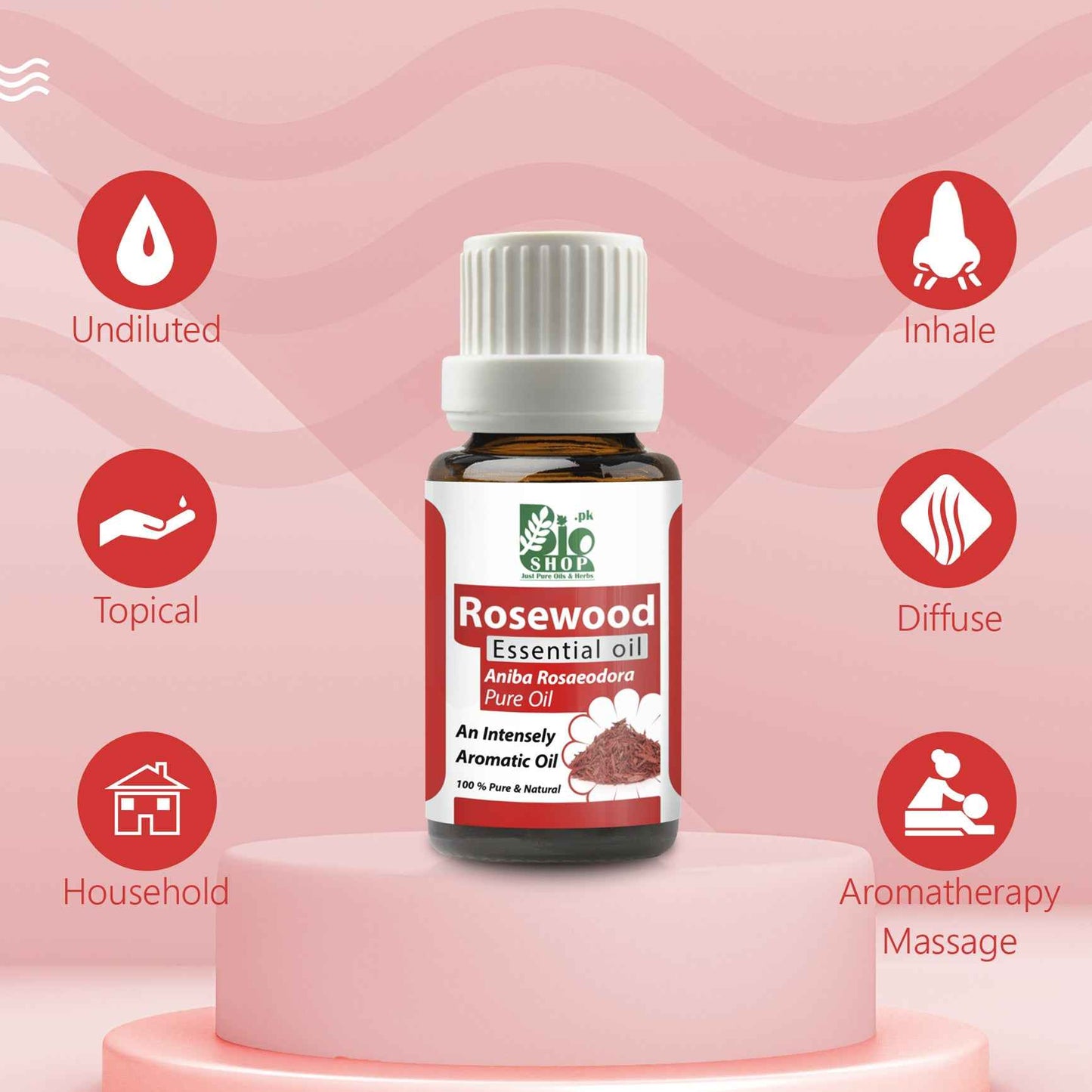
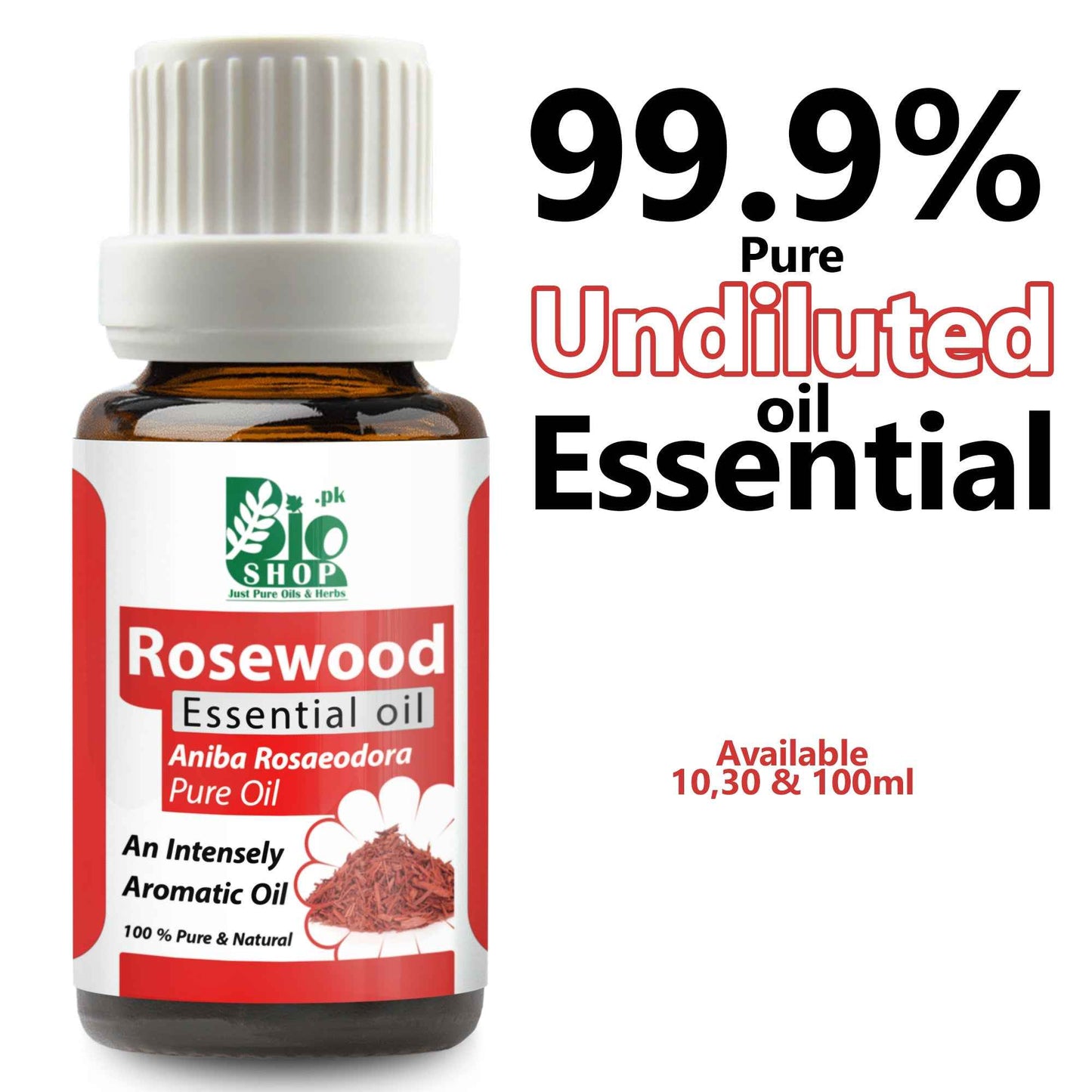
Explore
Information About Rosewood Essential Oil
Key Features
✦ Steam-distilled from the heartwood of Aniba rosaeodora, yielding 80–97% natural linalool
✦ Warm, floral-woody scent profile — a cornerstone of classic French Bois de Rose perfumery
✦ Dual-use material: valued both as a fragrance ingredient and a cosmetic skin-conditioning agent
✦ Excellent fixative and blender — smooths harsh transitions between top and base notes
✦ Used in iconic compositions including Chanel No. 5, Joy by Jean Patou, and vintage oriental attars
✦ CITES Appendix II listed species — Bio Shop Pakistan sources from sustainable, compliant supply chains
✦ 100% natural, vegan, and cruelty-free with no animal-derived components
About Rosewood Essential Oil
Rosewood Essential Oil has been extracted from the trunk and branches of Aniba rosaeodora, an Amazonian hardwood tree native to Brazil and Peru, since the early twentieth century. The oil rose to international prominence through French perfumery, where it was treasured as Bois de Rose — a natural source of linalool unmatched in softness and complexity. For decades it was one of the most heavily harvested aroma raw materials in South America, making it both historically significant and environmentally sensitive.
What distinguishes rosewood oil from synthetic linalool is the full complexity of its composition. Beyond its dominant linalool content, the oil contains minor but influential trace components — including alpha-terpineol, geraniol, and nerolidol — that give it a depth, warmth, and roundness impossible to replicate with isolated synthetic linalool alone. This makes it irreplaceable in natural perfumery constructions where authenticity and olfactory richness are the priority. Its mild, non-irritating profile also makes it one of the few natural essential oils suitable for use in leave-on cosmetic formulations at appropriate concentrations.
Bio Shop Pakistan supplies cosmetic-grade Rosewood Essential Oil suitable for fine fragrance creation, attar and oriental blending, natural skincare formulations, hair care products, aromatherapy preparations, and diffuser applications.
Olfactory Profile
SCENT DESCRIPTION : Rosewood opens with a luminous, softly floral warmth — clean and transparent, like linalool in bloom. The heart is gently woody with a creamy, almost powdery roundness, brightened by the faintest camphoraceous lift. As it dries down, a subtle spicy earthiness emerges — woody, resinous, and grounding — making it equally at home in floral bouquets, oriental bases, and clean woody accords.
NOTE POSITION : Mid to Base
FRAGRANCE FAMILY : Woody Floral · Oriental · Aromatic
FACETS : Floral · Woody · Creamy · Spicy · Soft
TENACITY : Medium — 4 to 8 hours on skin, 12+ hours on fabric and blotter
SILLAGE : Medium — intimate and close to the skin with a soft-radiant trail, not projecting
Technical Specifications
Chemical Name : Aniba rosaeodora wood oil
CAS Number : 8015-77-8
Synonyms : Bois de Rose Oil · Rosewood Wood Oil · Linaloe Rosewood Oil
Purity : 100% pure steam-distilled essential oil (no carrier added)
Linalool Content : 80–97% (GC/MS certified — verify with batch COA)
Appearance : Pale yellow to almost colourless mobile liquid
Odor Threshold : Approximately 0.8–2 ppb in air (highly detectable at trace levels)
Solubility : Soluble in alcohol, fixed oils, and most aroma chemical bases; insoluble in water
Specific Gravity : 0.875–0.895 at 20°C (verify with supplier COA)
Flash Point : Approximately 72–77°C (verify with supplier SDS)
Type : Natural — steam-distilled from hardwood
Applications & Usage Guidelines
FINE FRAGRANCE : ★★★★★
Rosewood oil is a master blender in fine fragrance. Its naturally high linalool content adds lift, floral warmth, and seamless cohesion to both soliflore and complex multi-accord compositions. It was a structural component in mid-twentieth century French classics and continues to serve as a natural substitute for synthetic linalool in high-end naturals-forward perfumery.
ATTAR & ORIENTAL BLENDING : ★★★★★
In attar and oriental fragrance construction, rosewood oil acts as a bridge material — connecting floral absolute cores with deep woody and resinous bases. It blends beautifully with oud, sandalwood, rose absolute, and amber bases, softening transitions and adding a naturalistic, luminous warmth that synthetic materials rarely achieve.
COSMETICS & SKINCARE : ★★★★☆
Rosewood oil is one of the most cosmetically accepted natural essential oils due to its gentle, non-aggressive linalool-dominant composition. It is used in facial serums, creams, and leave-on products at low concentrations for both its scent contribution and its mild skin-conditioning effect. IFRA and safety limits must be observed strictly for leave-on applications.
AROMATHERAPY & DIFFUSION : ★★★★★
In aromatherapy and diffuser applications, rosewood oil performs exceptionally well. Its calming, warm, and grounding scent character is associated with stress relief and emotional balance in traditional aromatherapy practice. Pairs excellently with bergamot, lavender, and ylang ylang in therapeutic diffuser blends.
HOME FRAGRANCE : ★★★★☆
Rosewood oil performs well in reed diffusers, room sprays, and pot pourri. In candles, performance is good but the higher flash point should be respected during manufacturing. The scent reads as warm, clean, and woody — accessible and universally appealing in home fragrance contexts.
IFRA & Usage Rate
RECOMMENDED USAGE RATES
EDP (Eau de Parfum) : 5–15%
EDT (Eau de Toilette) : 3–8%
Body Lotion / Cream : 1–3%
Shampoo / Body Wash : 0.5–2%
Candle : 3–8%
Reed Diffuser : 8–20%
Soap (Cold Process) : 1–3%
IFRA 51ST AMENDMENT LIMITS
Rosewood oil is regulated under IFRA primarily due to its high linalool content, which is a known skin sensitizer at elevated concentrations. The limits below are indicative — always verify the current standard at ifrafragrance.org using the material's CAS 8015-77-8.
IFRA Category 1 (Lip products) : ~0.5%
IFRA Category 4 (Body lotion, leave-on) : ~3.2%
IFRA Category 5 (Face products, leave-on) : ~1.9%
IFRA Category 9 (Rinse-off body/hair) : ~9%
IFRA Category 11 (Fabric conditioner) : ~14%
⚠️ Linalool is listed as a declared EU cosmetic allergen above 0.001% in leave-on and 0.01% in rinse-off formulations. At typical usage concentrations in fine fragrance or skincare, rosewood oil will trigger allergen declaration requirements on your product label.
⚠️ Rosewood is a CITES Appendix II listed species. Ensure your supplier provides documentation confirming legal and sustainable sourcing before commercial use.
Blending Guide
METHOD 1 — DIRECT DILUTION IN ALCOHOL BASE
Dissolve rosewood oil directly into perfumers alcohol at desired concentration. Allow 48 to 72 hours of maceration before evaluation. The linalool-dominant character integrates rapidly in alcohol and reveals its full floral-woody complexity within 24 hours.
METHOD 2 — PRE-BLEND WITH CARRIER OR FIXATIVE
For cosmetic and leave-on applications, dilute rosewood oil first in jojoba oil, fractionated coconut oil, or a cosmetic-grade emollient at 10–20% concentration. This pre-dilution ensures precise dosing in formulas where accurate IFRA compliance is required.
METHOD 3 — ACCORD BUILDING
Use rosewood oil as the "bridge" note in an accord — introduced after the heavier base components (oud, sandalwood, musk) have been combined and before the top notes are added. This positions its mid-base character correctly and prevents it from being overwhelmed by either end of the accord.
BEST PAIRINGS
Rose Absolute → Amplifies the floral warmth; creates a classic Bois de Rose floral heart
Oud / Agarwood → Grounds the oil; gives oriental depth and resinous complexity
Sandalwood → Extends the woody character; adds creamy, milky softness
Bergamot → Brightens the top; creates a luminous, transparent floral-woody opening
Ylang Ylang → Adds exotic floral richness; complements the spicy-floral facets
Geranium → Reinforces rosy-green facets; excellent for floral chypre structures
Frankincense / Olibanum → Adds resinous, balsamic depth; ideal for spiritual and attar blends
Patchouli → Earthy anchor; classic partner in oriental and chypre compositions
AVOID
Using rosewood oil in high-pH soap bases without prior stability testing — linalool can undergo partial hydrolysis in strongly alkaline environments, potentially causing scent drift.
Perfumer's Note
When I first encountered rosewood oil in a naturals palette, I was struck by how effortlessly it does what many synthetic linalool-dominant materials struggle to achieve — it smells like a place, not a chemical. The oil has a living quality, a slightly resinous, almost green undertone beneath all that softness that reminds you it came from a tree rather than a laboratory. For naturals perfumery, it is one of those rare materials where the complexity is already present in the raw material — your job as a perfumer is simply to give it the right frame.
ADVANCED TIP : Try blending rosewood oil with a small percentage of methyl linalool (0.5–1% of total formula) to extend its radiance and lift the floral facets without overwhelming the natural character. This hybrid approach bridges the gap between traditional naturals construction and modern high-performance perfumery — the methyl linalool adds diffusion and longevity while the rosewood oil contributes the warmth, roundness, and authenticity that purely synthetic linalool cannot deliver.
Safety & Storage
Physical State : Mobile liquid at room temperature
Skin Safety : Dilute properly before any skin contact; perform patch test before use in leave-on formulas; sensitization possible in undiluted form
Eye Contact : Avoid direct eye contact; rinse thoroughly with water for 15 minutes if exposure occurs; seek medical advice if irritation persists
Ingestion : Not for internal consumption; keep away from children; seek immediate medical attention if swallowed
Ventilation : Work in well-ventilated space; avoid prolonged inhalation of concentrated vapour
Storage : Store in a tightly sealed amber glass or dark aluminium container away from heat, light, and moisture; refrigeration extends shelf life
Shelf Life : 2–3 years from production date when stored correctly; linalool-rich oils are prone to oxidation — discard if rancid or citrus-like off-notes develop
Container : Amber glass, dark HDPE, or aluminium — avoid PVC or clear plastic containers
Flammability : Combustible liquid — flash point approximately 72–77°C; keep away from open flame during candle and soap manufacturing
FAQ
Q: Is your Rosewood Essential Oil sustainably sourced?
A: Yes. Aniba rosaeodora is listed under CITES Appendix II due to historical over-harvesting. Bio Shop Pakistan sources only from compliant, plantation-grown or certified sustainable supply chains. Documentation is available on request.
Q: Can I use Rosewood Essential Oil in cold process soap?
A: Yes, at 1–3% of total formula weight. Expect mild acceleration of trace in high-lauric oil bases. Fragrance retention in finished soap is moderate to good due to the mid-base character of rosewood oil.
Q: Is rosewood oil safe for use in leave-on face products?
A: It can be used at low concentrations within IFRA Category 5 limits (approximately 1.9% or less). At typical use levels, EU allergen labeling for linalool will also be required. Always conduct a patch test and stability assessment before production.
Q: Why does my rosewood oil smell slightly different between batches?
A: Natural variation in linalool concentration (80–97% range), geographic origin, and harvest season all influence the olfactory character of each batch. This is normal for natural essential oils. Request a GC/MS report with each new batch to confirm composition.
Q: How does Rosewood Essential Oil compare to synthetic Linalool?
A: Synthetic linalool is sharper, cleaner, and more linear in character. Rosewood oil contains linalool as its dominant note but is surrounded by minor trace components that add depth, warmth, and a naturalistic complexity. For fine fragrance and attar work, rosewood oil provides an irreplaceable naturalness. For functional fragrance and cost-sensitive formulations, synthetic linalool is the practical alternative. Both have their place depending on the application.
Where Can You Safely Use Rosewood Essential Oil?
Discover how Rosewood Essential Oil performs across different applications—rated for safety, stability, and effectiveness.
High quality product. Recommended.
Good
Already started using in liquid roll on perfume with best Rosy sweet aroma strong enough to be get noticed